

Image Source: Unsplash
A cornerstone of U.S. trade policy began with the announcement in April 2025 of “Liberation Day” when President Trump revealed a sweeping set of “ reciprocal”tariffs aimed at those nations he believed were taking an unfair advantage of the U.S. The declaration was a clear sign of an aggressive trade position and, in particular, a warning to south east Asian countries not to allow China to use their factories to tranship to the U.S.
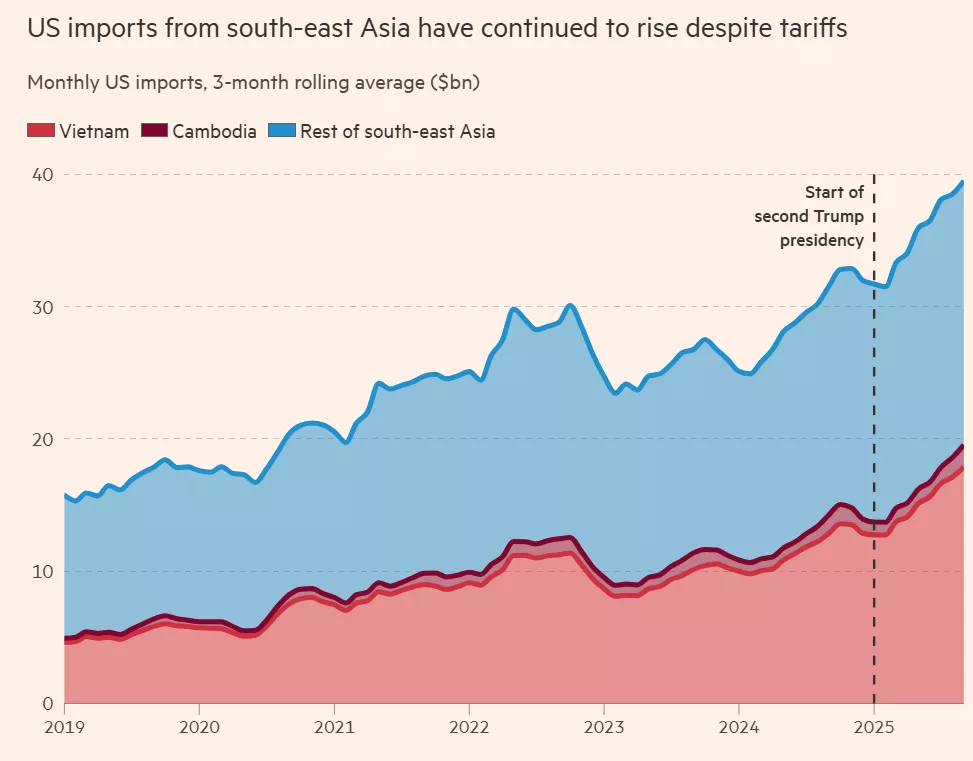
Now, some nine months later, Liberation Day tariffs have failed to improve the US trade deficit in the region. The region has more than overcome the tariffs and has in many product lines increased U.S. sales.
Recapping, Trump ordered a 49% 'reciprocal' tariff on exports from south east Asian producers, only to walk them back ,relatively quickly, to 20%. In some cases, the producing country “promised” to invest billions into US manufacturing. These countries received substantial tariff relief in exchange for some vague promise to invest billions in the U.S. manufacturing sector. This is a favorite transactional ploy used by Trump to justify why he backs down from an initial set of very high tariffs that would be very harmful to the U.S. consumer.
(Click on image to enlarge)
Source: Financial Times
In the first 11 months of 2025, major southeast Asian countries have generated large trade surpluses with the U.S. Standouts include Vietnam with a surplus of $US 122 billion and Thailand with a US $ 46 billion. Financial Times estimates that on a year -over -year basis the regional exports to the U.S. grew by 25%. A main driver has been the surge in electronics exports by 40%, largely related to chip sales . Asian producers continue to adapt to the 20% tariff and do not find any justifiable reason to jump the tariff wall and move to the U.S. To this end, the tariff policy has been a failure in reducing the imbalances as producers in Asia and consumers in the U.S. continue established trade patterns.
China has pivoted away from the U.S. market, as both U.S. exports and U.S. imports have dropped dramatically, such that the U.S. trade deficit has been cut in half, from US$ 31.8 billion to US$ 15 billion -over-year in the second quarter. Much of this decline is attributable to China diverting its trading activities outside the U.S. into very profitable markets in the EU. China successfully did an end run and registered a trade surplus in excess of $ 1 trillion, a historic high.
In sum, southeast Asia continues to generate significant trade surpluses, while China is able to shift gears readily and maintain its dominance in manufacturing. Trump may posture that he will re-introduce higher tariffs, especially in cases where southeast Asian nations re-export Chinese products. Trump has had one kick at the can on Liberation Day, and that has not succeeded in altering trade flows in favour of the U.S. China has found it can continue its export dominance without such heavy reliance on the U.S.We should not expect to revisit this tariff policy again.
More By This Author:
The Truth About U.S. Tariffs is Finally Emerging
A Year After Trump Launched His Trade War Canada Remains Largely Unscathed
The Impact Of A Dynamic Labor Market On The Israeli Economy


Comments
Log in or sign up to join the conversation.