

Image Source: Unsplash
President Trump often refers to the U.S. as the “indispensable” nation, in which every country needs to bend to its will on trade policy or suffer the consequences. Midsize nations accepted terms that greatly reduced US tariffs in exchange for some vague promises to invest billions into the US economy. Trump’s version of “ win-win”, so often touted.
However, the US three largest trading partners have not bowed to US protectionist moves, as China, Mexico and Canada continue to operate without one of President’s “deals” as just described. While Canada and Mexico are tied to the U.S. through long-standing free trade agreements ,which will not expire until late 2026, negotiations have yet to begin, China has no such arrangement and continues to challenge the U.S. as the dominant economic power.
China’s trade surplus in goods has just surpassed $1tn in the first 11 months on its way to another record breaking performance. While US imports from China have dropped as much as one-third, the rest of the world has more than taken up the slack. Chinese exports have surged in Asia, the EU and other parts of the world. Granted, there is some evidence that China is using third-party nations, especially in south-east Asia, as intermediate stops on the way to the U.S. But make no mistake, China has simply found profitable markets elsewhere. If President Trump thought China could be contained by tariffs, nothing seems further from the truth.
(Click on image to enlarge)
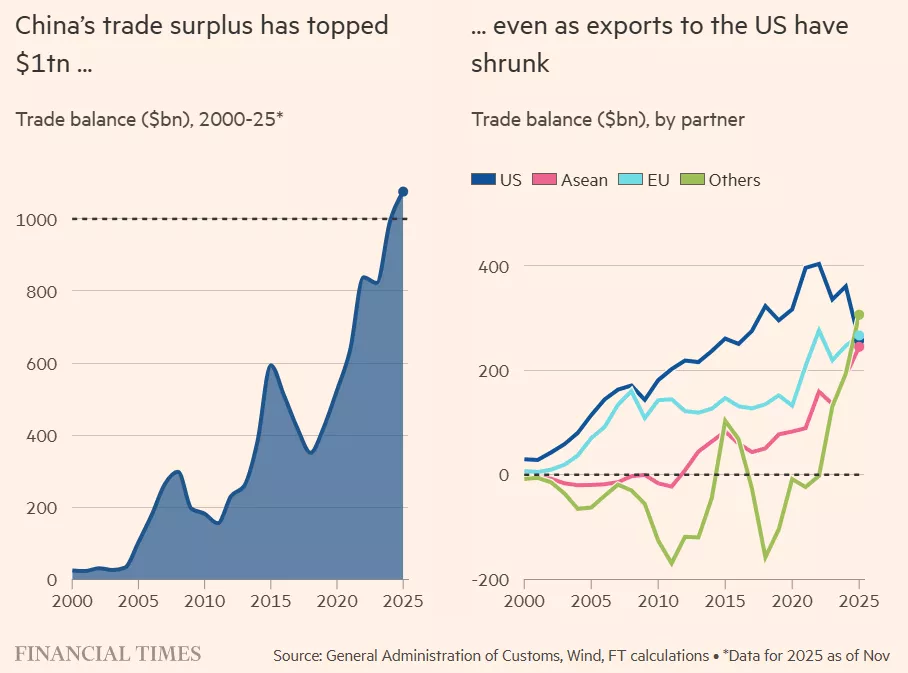
Once an exporter of low-value consumer products, China has moved heavily into much higher value manufacturing, challenging Germany, Japan and South Korea. European and Asian auto companies are losing ground to Chinese EVs, now the largest EV manufacturer worldwide. What is remarkable is how fast China was able to diversify its trading activities in favour of non-US markets. Usually, it takes several years to diversify away from historical trading arrangements.
China has long been accused of sacrificing domestic consumption in favour of expanded exports. This thinking continues to prevail as evidenced from the huge trade surplus, which by all accounts, is expected to grow yearly. Now that China is one of the leaders in several areas of the digital world and developing its own chip industry, the importation of such important inputs will likely decline. The rise of Chinese AI capability is a real challenge to the dominance of the U.S.
Chinese trading partners have long argued that the renminbi is not allowed to float freely which would make Chinese exports less competitive. Currency manipulation is hard to prove, yet is often trotted out as a reason why China has a competitive edge.
Meanwhile, the Trump trade initiatives languish for a number of reasons.Trade balances have hardly moved in favour of the US. Threats of additional tariffs are not taken seriously, since they have been offered up countless times, only to be walked back. China started out with a tariff barrier of 145%, only to be reduced to under 15%, on average.The US business community is applying pressure on administration officials to back away from tariffs. Too many industries are struggling to keep their costs from harming valued customers.There is no evidence that US protectionism has resulted in any meaningful relocation by foreign firms, as hoped . The Supreme Court is deliberating the legal basis of tariffs, as applied on the basis of “national security”. The whole edifice of US protectionism is under review. More tellingly,Canada and Mexico have stepped away from negotiations, largely in response to US domestic concerns with tariffs, and also because both countries' economies have not been hit as hard by the US tariffs, as initially thought .
More By This Author:
The Rise In Japanese Bonds Is Starting To Pressure The Global Bond MarketWhy The Silence On Canada-U.S. Tariffs Negotiations?
Post Iranian War The Israeli Economy Soars

Comments
Log in or sign up to join the conversation.