


Image Source: Pexels
Demographers frequently boast that demography can explain two-thirds of everything. In addition to economic changes, the dynamics of a labor market can go a long way to explain political and social developments. This aphorism is borne out when we dissect some of the major aspects of the Israeli population, specifically in its labor force.
At a macro level, Israel features a labor force similar to other advanced economies. Participation rate of 63%, employment rate of 61%, a very low unemployment rate of 3%, characteristics of OECD countries.
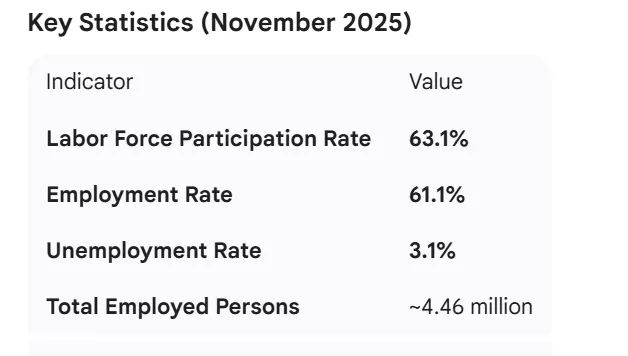
Source: Census Bureau
Drilling down, it is apparent that the labour market is far from homogenous, but features very different characteristics based upon gender,religious and Arab-Israeli divides. Politically, these divides often lead political analysts to describe the Israeli population as such: “1/3th of the population works, 1/3th serves in the military and 1/3th pay all the taxes—-and it is the same 1/3th of the population in each instance”. Not so far from realty.
One word that has been used to describe the labor market is its resilience. Over the past 24 months. The participation rates, initially, dropped due to the massive call up of reservists in late 2023 in preparation for the invasion of Gaza. Two years later, participation rates have been restored to pre-Oct 7 levels and have even moved upwards slightly as the economy started to recover rapidly, starting in 2025.
A breakdown of participation and employment rates across Israel’s diverse demographic sectors reveals striking splits that are not apparent at the macro level. The majority divides features : the secular non-Haredi population; the Ultra-Orthodox (Haredi) sector; and the Arab sector. Secular men and women have very high participation rates, exceeded 83% and essentially form the backbone of the economy. The Ultra-Orthodox, accounting for approximately 14% of the population, have their own “split” market. Only half of Ultra-Orthodox men count themselves as part of the labor market ( the balance indulges infull time religious study)thus, by necessity 80% of Ultra-Orthodox women work. Arab Israeli men have a high participation rate of 74% and Arab Israeli women rates are steadily climbing.
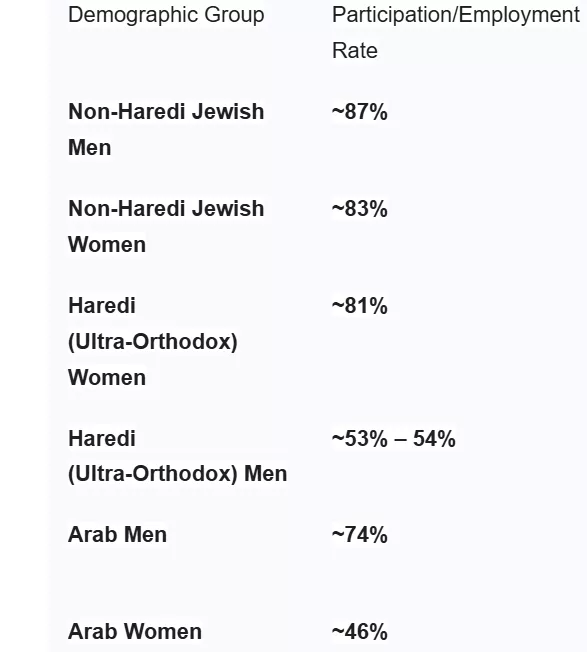
Source: Census Bureau
These labor market measurements are driving a lot of the political debate in Israel today. Those who are working are carrying a disproportionate share of the tax burden, and the resentment towards the non-working religious Israelis has been a constant element in Israeli elections. The tax burden cannot be continuously borne by secular Israelis when the religious groups have such low participation rates. The burden is accenturated by the fact that Haredi women work in very low valued activities.Subsidizing the Haredi community is no longer a viable option, simply because it puts too much pressure on the working population to supply tax revenues needed for military and non-military purposes.The Bank of Israel has warned that if the participation rate of Haredi men does not increase to match the general population by 2040, the tax burden on the working population will have to increase by roughly 16% to maintain existing public services.
The task before the Haredis is to improve their education levels and work experience to match that of the secular Israelis. Currently, the sectors with the greatest growth opportunities require secondary and university level education. These industries include:
….Banking and finance
….Health services
…. Defense & Aerospace
…. Hi Tech, eg. AI, cybersecurity
More By This Author:
Economists Did Not Get It Wrong When It Comes To Assessing The Impact Of Tariffs
China Just Did An End Run Around The U.S.
The Rise In Japanese Bonds Is Starting To Pressure The Global Bond Market


Comments
Log in or sign up to join the conversation.