


Image Source: Pixabay
As we approach the one year anniversary of the Trump presidency, we expect a lot of debate on just how effective Trump’s tariff policy has been. Today’s Wall Street Journal seems to kick off this derby with its headline, Why Everyone Got Trump's Tariffs Wrong. The difficulty in framing this issue is that the Trump Administration had too many objectives, some in conflict with one another. To make matters worse, tariff rates were initially imposed at absurdly high rates, e.g., 145% on Chinese imports, only to be walked back almost as quickly as they were initially imposed. Some tariffs were aimed at specific sectors, e.g., steel, while others were aimed at changing the overall bilateral trade patterns, e.g., China. The confusion as to their purpose made it impossible to determine success.
Trade Balances. Economists never bought into the proposition that trade imbalances are harmful. For decades, the U.S. has been the beneficiary of foreigners recycling their current account surpluses into reinvesting in the US and contributing to its economic expansion. Any reduction in the nation’s trade balances has come from a reduction in imports, as export performance stagnates. Such a reduction in the trade deficit is reflective of an economy that is softening, hence the tariffs are having a negative impact on consumers' budgets.
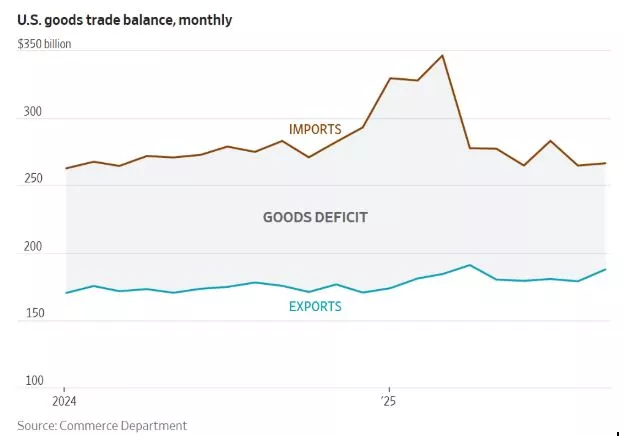
Politically, the most important trade imbalance is the US-China relationship. China's end run around the US market has resulted in diverting massive amounts of goods into new markets in Asia and Europe. China is on target to generate a trade surplus in excess of $ 1 T by year’s end, a historical high. Now, Mexico is the number one trading partner with the U.S., followed closely behind by Canada, and China slipped into the number three slot.
Domestic growth from re-shoring. Economists were highly skeptical that promises made to invest heavily in the US would ever materialize. The estimates were wildly formulated and had no real substance. The Administration had long promised that tariffs would encourage foreigners to set up operations in the U.S. under its protectionist umbrella. Asian countries, especially, got considerable tariff relief on the backs of promises to invest billions of dollars in the US. However, these foreign entities are still able to exploit their competitive advantage in labour costs to avoid undertaking shifting operations to the U.S. Jumping a tariff wall is not easily done for manufacturers, and this is made more risky in light of the mercurial trade policies pursued in Washington.
Jobs. Employment growth tied to the imposition of tariffs remains elusive. The Federal Reserve staffers now believe that employment data could be overestimating job creation by up to 60,000 jobs a month. Since April, the economy has averaged an increase of 40,000 jobs, suggesting that the economy is actually experiencing job losses of around 20,000 a month. No matter how one slices it, tariffs have not been a source of employment growth, and along with 3% inflation, stagflation is the order of the day.
Inflation. Economists have been struggling with tariffs and their expected impact on prices. To date, the CPI continues to hover around the 3% level, and this is a great challenge to the Federal Reserve in setting its policy rate. The rate is above their target 2% and remains rather sticky, despite recent rate cuts. At the intermediate level, manufacturers and distributors have been forced to reset prices in a somewhat chaotic environment as the Administration alters the tariff rates frequently, largely on the whim of the President. At the consumer level, tariff-induced price changes are just starting to hit the family pocketbook. The Administration is under considerable pressure to respond to the rising cost of living, especially in those areas where tariffs are hurting.
Initially, when the tariffs were announced, economists immediately revamped their predictive models and called for a recession. We are not in a recession. But, at the same time, the economists can correctly claim that tariffs have not achieved the major goals set out by Trump. As for the recession, the jury is still sequestered.
More By This Author:
China Just Did An End Run Around The U.S.The Rise In Japanese Bonds Is Starting To Pressure The Global Bond Market
Why The Silence On Canada-U.S. Tariffs Negotiations?

Comments
Log in or sign up to join the conversation.