

Amidst households’ equity allocation at a fresh record and continued support from margin debt, large-cap indices are giving out signs of fatigue, while small-caps are quick off the blocks in 2026.

Margin debt and the S&P 500 tend to have a tight correlation (Chart 1). In 2022, they both dropped and then rose the next three years, with accelerating momentum for margin debt and a decelerating one for the S&P 500. In 2025, the large cap index increased 16.4 percent, versus gains of 23.3 percent in 2024 and 24.2 percent in 2023. Margin debt, on the other hand, jumped 36.3 percent last year, preceded by 28.3 percent in 2024 and 15.5 percent in 2023.
Arguably, as the S&P 500 rallies to new – and newer – highs, margin debt is getting a smaller bang for its buck. That is one way of looking at this. The other is that the fact that the rally in equities accompanies a desire on the part of traders to take on leverage is a good sign. That said, margin debt goes both ways, and it does not take long before a cut in leverage begins to negatively impact equity indices.
So far so good. In December, margin debt increased $11.3 billion month-over-month to $1.23 trillion – a fresh record. It is now up 44.1 percent from last April’s low of $850.6 billion.

On 9 April (last year), the S&P 500 bottomed at 4835. Last Friday, it tagged 6986 intraday before closing at 6940. From last year’s low, the large cap index is up 44.5 percent. These are massive gains, which in due course can give rise to temptation to lock in at least a portion.
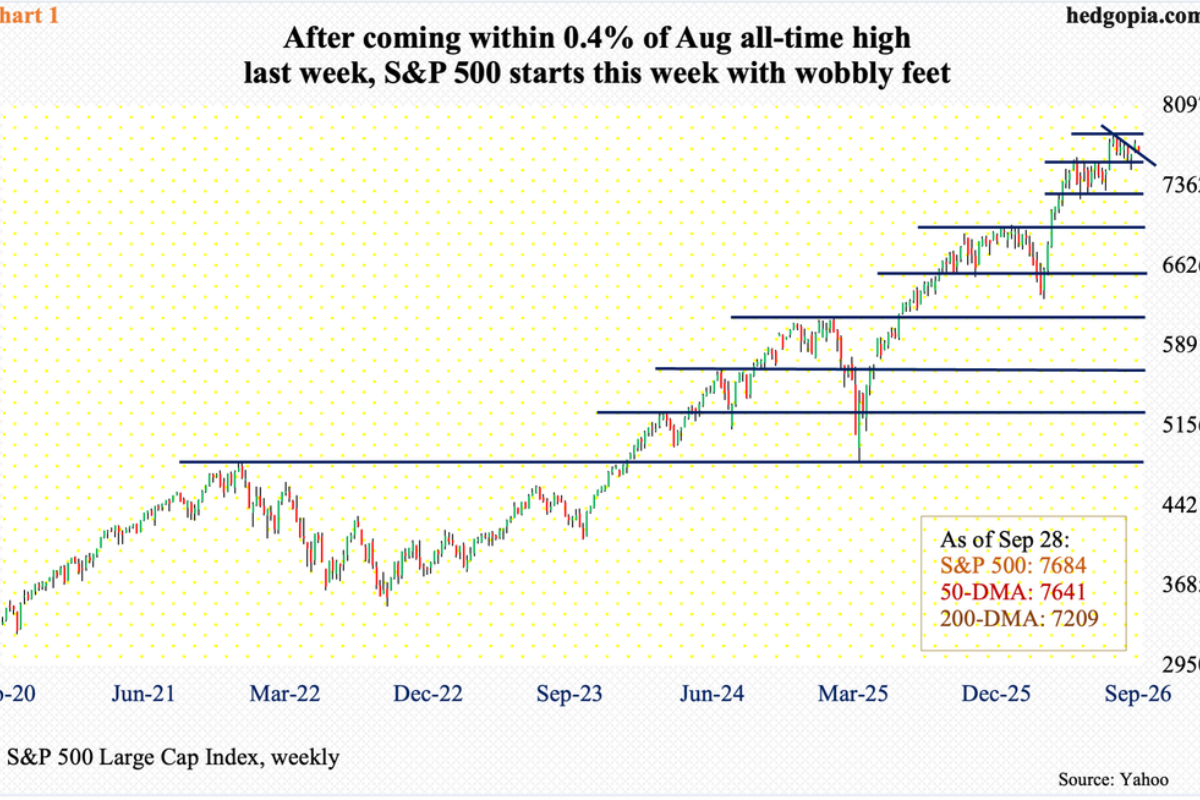
From traders’ perspective, S&P 500 momentum is intact, but risks are rising. Last week, the index gave back 0.4 percent, forming a weekly doji. In fact, it has now straddled 6920s for 12 weeks now (Chart 2). It is also caught in a rising wedge, a technical pattern that can resolve with a break to the downside.
Should things evolve this way, this would have followed a back-to-back potentially bearish candles of November and December, with the former forming a monthly hanging man and the latter a spinning top.

Thanks to the handsome rally post-April bottom, households’ equity allocation ended the September quarter with yet another record, coming in at 42.2 percent. There is a parabolic look to it after the allocation finished the March quarter at 38.7 percent. In fact, one can go back to 3Q22 when the equity allocation totaled 32.8 percent and notice that the green line in Chart 3 since has essentially gone vertical.
In the December quarter, it is a near certainty the equity allocation made another high. During the quarter, margin debt went up $99.1bn, and the S&P 500 rallied 2.3 percent, which mirrors the performance of the Nasdaq 100 during the period.

Since last April’s low, the Nasdaq 100 surged 58.3 percent through the late-October high of 26182 before it gave back 8.9 percent to bottom three weeks later. Since then, the tech-heavy index has been caught in a symmetrical triangle (Chart 4).
Last week, the index dropped 0.9 percent to 25529, for a weekly spinning top. The rather lethargic action of late comes on the heels of the candles November and December produced – a hanging man and a doji respectively. Signs of fatigue are subtle, but they are showing up.

The Russell 2000, too, experienced a sideways congestion for 12 weeks before breaking out of 2540s in the week before, when it added 4.6 percent, followed by last week’s two percent rise. Before that, three weeks ago, the small cap index had a successful breakout retest at 2460s, which is turning out to be a significant level (Chart 5). In November 2024, the Russell 2000 retreated after ticking 2466. Three years before that, in November 2021, the index rose to 2459 and then went the other way. On 18 September (last year), those highs were surpassed, but not before a stretched bull-bear tug of war followed around those highs.
With nine sessions to go this month, small-cap bulls have rallied the index hard. It is up 7.9 percent to 2678. If these gains are kept, longs stand a good chance of decisively rejecting the potentially bearish candles of November and December, which respectively produced a hanging man and a shooting star. The risk of a triple top at 2460s has been quashed.
Incidentally, the Russell 2000 has a tighter correlation with margin debt versus the S&P 500 – albeit not by a whole lot. January is not done, but if small-cap momentum continues for the rest of the month and the candles of November and December are discredited, the bigger question is if this action will have diverged from the large-cap indices or the latter will follow suit and break out themselves.
More By This Author:
CoT: How Hedge Funds Are Positioned, Peek Into Future Through Futures
Amidst Potentially Bearish Candles Of Nov And Dec Comes Last Week’s Breakout
CoT: Peek Into Future Through Futures, How Hedge Funds Are Positioned...
Comments
Log in or sign up to join the conversation.