

Breakouts galore – some potentially significant, some feeble. But it is too soon to lend significant weight to last week’s action given potentially bearish candles of November and December.

The Russell 2000 cleanly broke out of 2540s last week. After first reaching that price point mid-October and then coming under pressure to successfully retest 2300 five weeks later, the small cap index struggled at 2540s for three months before taking down the hurdle. Last week, it rallied 4.6 percent to 2624. In the prior week, small-cap bulls successfully defended breakout retest at 2460s, which has proven to be an important price point going back more than four years.
In November 2021, the Russell 2000 ticked 2459 and reversed lower. Three years later, in November 2024, it hit 2466 and came under pressure. Bulls were finally able to break out last September, but the positive momentum stopped at 2540s, followed by a drop to test 2300 in November. A rally thereof once again stopped at 2540s, until last week (Chart 1).
Last week’s breakout looks clean, but it also comes at a time when two potentially bearish candles have formed on the monthly. January is not even halfway through, and the month is already up 5.7 percent. This follows a December’s shooting star and November’s hanging man after a massive rally post-April bottom. How the rest of January unfolds, therefore, would have a lot of meaning.

The sell-side is yet to jump onto the bullish bandwagon; alternatively, it can be argued that they did so a little earlier and are now forced to pull back their horns. Last February, these analysts were expecting $106.48 in operating earnings from S&P 600 companies this year. As of last Thursday, they had brought their estimates down to $96.55, which is just about flat from early June. Between then and now, the consensus swung from $98.92 to $95.73 in November.
The sell-side does show a tendency to start out with a lot of optimism and then gradually lower their numbers as time passes (Chart 2). For 2025, with the fourth quarter on deck shortly, these companies were penciled in to ring up as much as $102.88 in May 2024; including three quarters of results, the blended estimates currently stand at $66.68, up 7.8 percent from 2024, which was the first up year after down 14.2 percent and down five percent in 2023 and 2024 respectively.
If next year’s consensus is hit, earnings would have grown a whopping 44.8 percent!

Small caps tend to do well when the economy is firing on all cylinders, as these companies have a larger share domestically versus their mid- to large-cap cousins. The job market is softening, but this can also mean lower rates as the Federal Reserve responds by easing monetary policy. The sell-side does not seem convinced that this would result in a scenario which they themselves were convinced of 11 months ago.
Last Friday, December’s jobs report was published, and the economy added 50,000 non-farm jobs during the month. Since June, there have been three months in which jobs were lost, including October’s huge loss of 173,000. For all of 2025, a meagre 49,000 jobs were added monthly; this compares with gains of 168,000 in 2024, 216,000 in 2023 and 380,000 in 2022. The trend is in clear deceleration, with the unemployment rate – at 4.38 percent in December – approaching a rising trendline from 3.45 percent in April 2023 (Chart 3).

Thus far, investors are betting that the resultant easing in interest rates would result in growth. Or, they are just being traders, expecting that the expected looser monetary policy would set in motion a risk-on attitude. It has thus far, with the risk that traders tend to be momentum-driven – both up or down; they can easily go the other way once momentum changes course. Hence the potential significance of the last two monthly candles on the S&P 500.
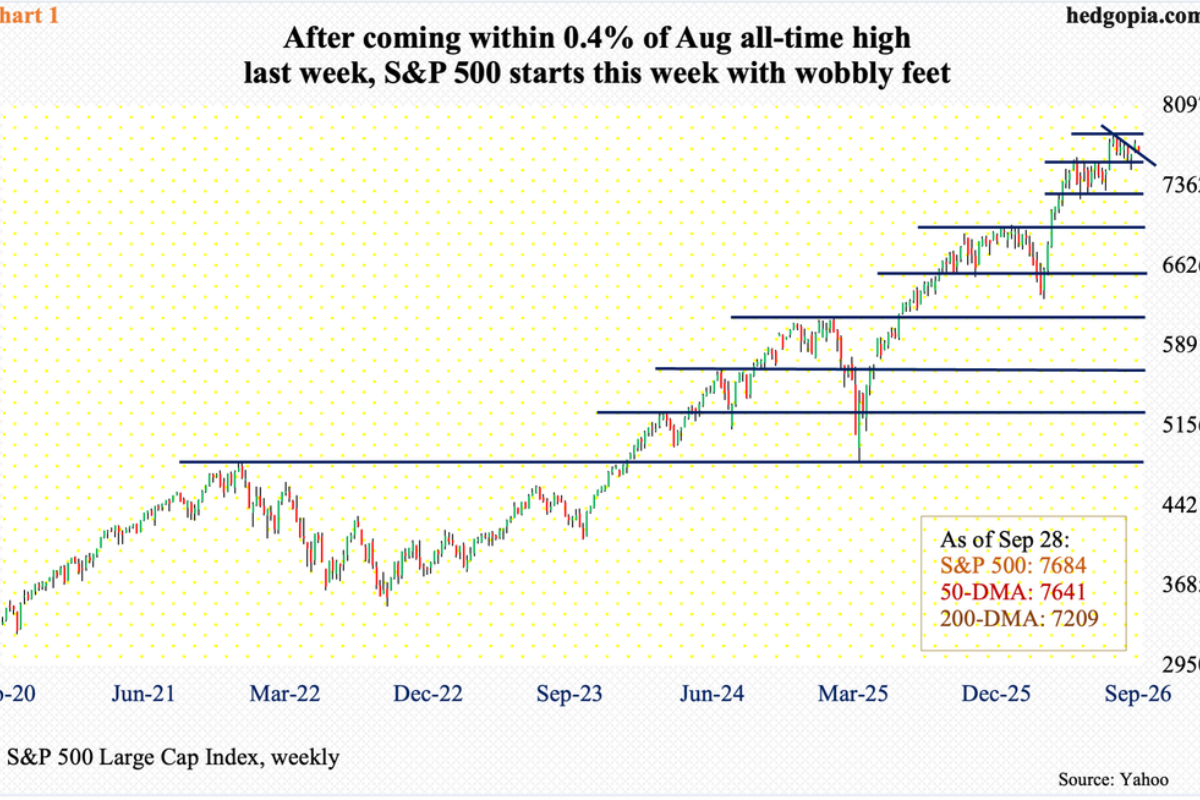
The large cap index bottomed last April at 4835 and rallied feverishly to tag 6978 last Friday. After these kinds of gains, it is not out of the ordinary for the index to take a breather. November produced a hanging man, which can appear at the end of an uptrend. This was followed by December’s spinning top.
Equity bulls can still nullify these candles by showing up strongly this month. So far so good. With seven sessions gone, January is up 1.8 percent. Last week, the S&P 500 jumped 1.6 percent to 6966, breaking out of 6920s, although it can hardly be described as decisive (Chart 4). Breakout retest will be telling.

Dynamics are similar on the Nasdaq 100, except that it remains below last October’s high. On the 29th that month, the tech-heavy index tagged a new all-time high of 26182. This was followed by lower highs of 25835 on the 10th and 25717 on the 26th last month. A resultant falling trendline provided resistance all week except Friday last week, when the index poked its head out of a symmetrical triangle it was trapped in (Chart 5).
For the month, the Nasdaq 100 is up 2.1 percent. Tech bulls will need to build on this in the sessions to come. A failure to do so would raise the odds that fatigue was setting in. The index rallied non-stop post-April bottom for seven months before a monthly hanging man showed up in November; December followed with a doji. Last week’s symmetrical triangle breakout would mean nothing if these monthly candles begin to exert control.
More By This Author:
CoT: Peek Into Future Through Futures, How Hedge Funds Are Positioned...Major US Equity Indices Feverishly Rallied For 7 Months Post-Apr Bottom
Small-Caps, Tech Trudge Higher In Seasonally Favorable Period
Comments
Log in or sign up to join the conversation.