

Following futures positions of non-commercials are as of Jan 6, 2026.
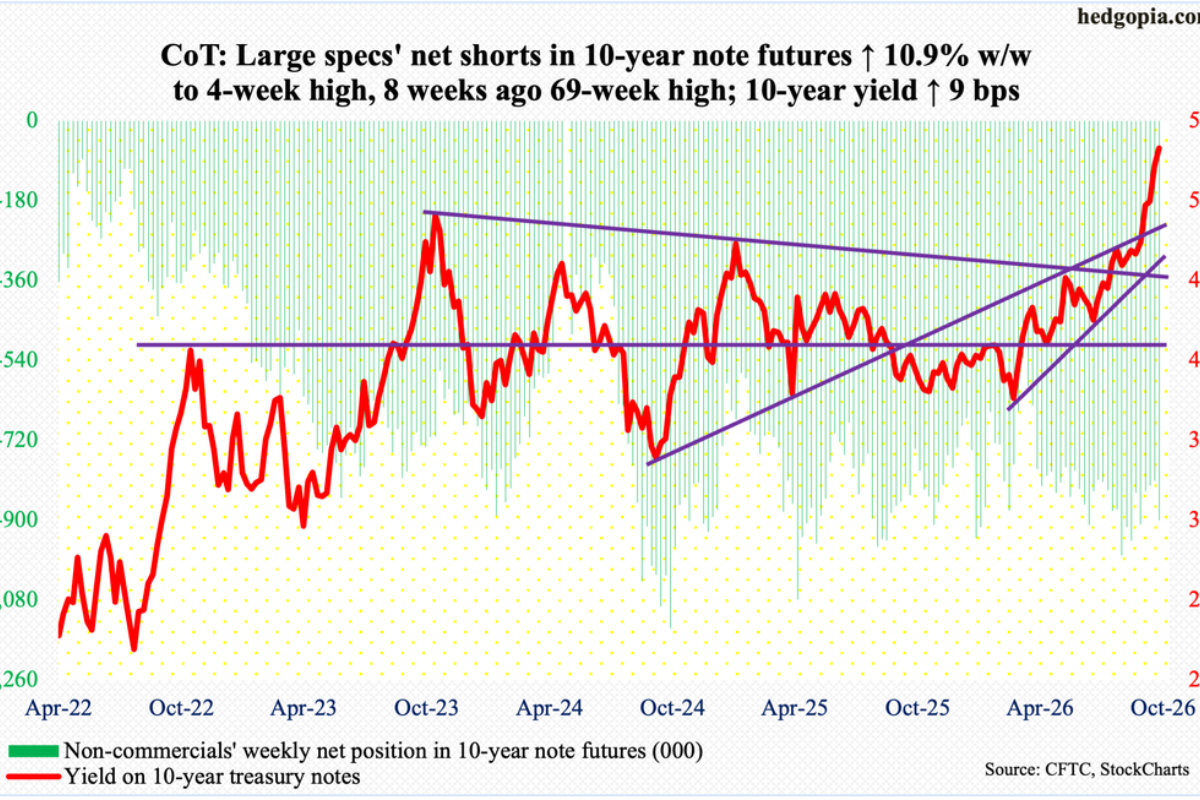
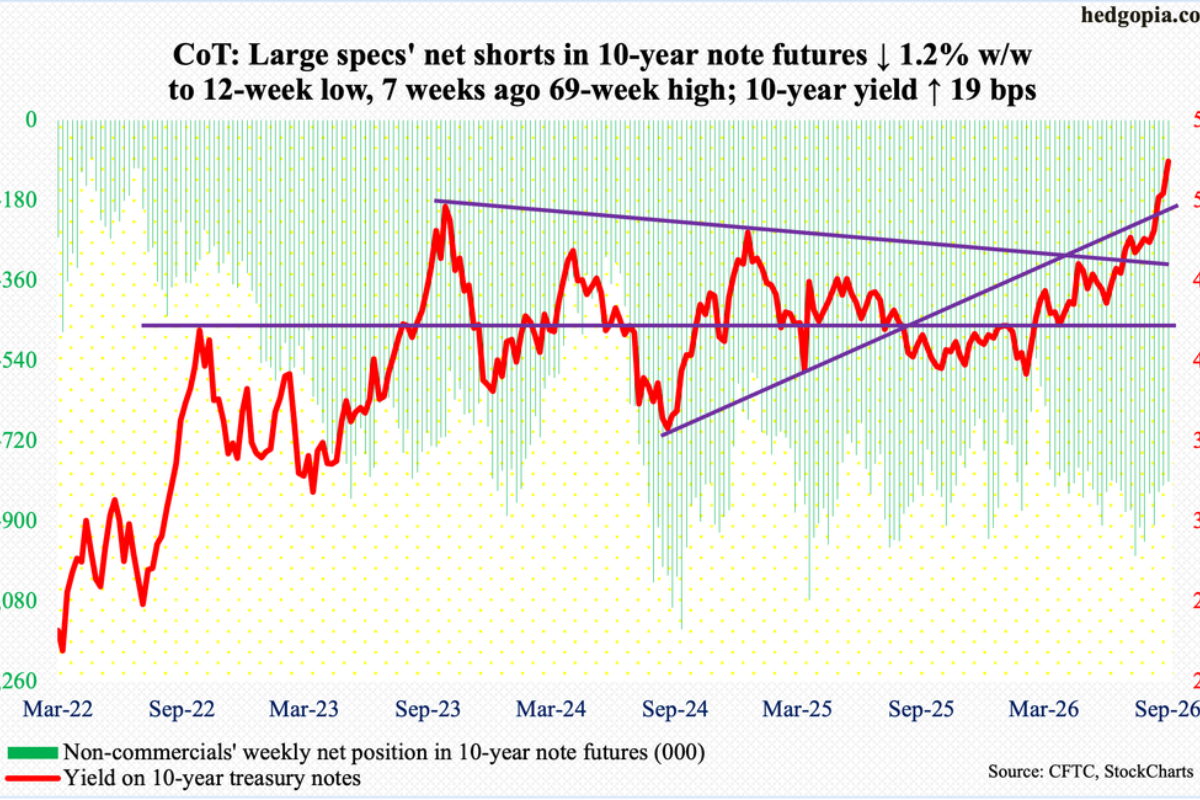
10-year note: Currently net short 915.6k, down 24.1k.

Going into December’s jobs report out Friday, futures traders were extremely confident that the fed funds rate would be left unchanged at a range of 350 basis points to 375 basis points in the upcoming FOMC meeting, scheduled for 27-28 this month. The economy created 50,000 non-farm jobs last month, versus the downwardly revised 56,000 in November and the expected 73,000, while the unemployment rate came in at 4.4 percent versus the consensus 4.5 percent. December showed the job market was still showing weakness but probably not weak enough to deserve a cut this month. In the futures market, traders are now pricing in a near-zero cut this month.
The 10-year treasury yield responded to December’s jobs report by dropping one basis point to 4.17 percent, reversing from the intraday high 4.21 percent. There is stiff horizontal resistance at 4.20s going back at least three years. The 10-year has been denied at this hurdle for five consecutive weeks now. Odds favor lower yields in the sessions ahead.
Non-commercials, on the other hand, are aggressively positioned for higher yields. Net shorts in 10-year note futures have steadily risen from 670,108 contracts four weeks ago to the current 915,552 contracts. The all-time high of 1.14 million was recorded in October 2024.
30-year bond: Currently net short 6.8k, up 21.1k.

Major US economic releases for next week are as follows.
The NFIB optimism index (December), the consumer price index (December) and new home sales (September) are due out Tuesday.
Small-business job openings in November rose a point month-over-month to 33. The metric remained unchanged at 32 for three straight months through October, which was the lowest reading since July 2020.
In the 12 months to November, headline and core CPI increased 2.7 percent and 2.6 percent respectively. On the core, this was the lowest reading since March 2021.
New home sales shot up 20.5 percent m/m in August to a seasonally adjusted annual rate of 800,000 units, which was the highest since January 2022.
Wednesday brings retail sales (November), the producer price index (November) and existing home sales (December).
October retail sales edged up 0.03 percent m/m to a fresh high $732.6 billion (SAAR). From a year ago, sales were up 3.5 percent.
In September (October data was not available for both PPI and CPI), headline and core wholesale prices increased 2.7 percent and 2.9 percent from a year ago, in that order.
Sales of existing homes inched up 0.5 percent m/m in November to 4.13 million units (SAAR) – a nine-month high.
Industrial production (December) and the NAHB housing market index (January) are scheduled for Friday.
Capacity utilization nudged up 0.05 percent m/m in November to 76 percent – a two-month high.
In December, homebuilder optimism inched up a point m/m to 39, which was an eight-month high. September’s 32 was the lowest since December 2022.
WTI crude oil: Currently net long 126.7k, down 404.

On 16 December, West Texas Intermediate crude ticked $54.98 intraday; this was the lowest price point since February 2021. Going back to at least last April, $56 consistently drew bids. This time around, the support was breached briefly, but, once again, has held its ground.
After last month’s low, the crude tried to mount a rally but was negated at the 50-day ($58.60) several times; last Friday, in a volatile session made up of a high of $59.77 and a low of $57.61, the average was reclaimed, although not by a whole lot. WTI finished last week up 2.6 percent to $58.78/barrel.
As things stand, odds probably favor the bulls, who need to take care of $60 – or just underneath – for continued momentum.
In the meantime, US crude production in the week to January 2nd decreased 16,000 barrels per day w/w to 13.811 million b/d; output registered a record 13.862 mb/d in the week to November 7th last year. Crude imports rose 1.4 mb/d to 6.3 mb/d. As did stocks of gasoline and distillates, which respectively rose 7.7 million barrels and 5.6 million barrels to 242 million barrels and 129.3 million barrels. Crude inventory, however, dropped 3.8 million barrels to 419.1 million barrels. Refinery utilization was unchanged at 94.7 percent.
E-mini S&P 500: Currently net short 106.1k, up 11.7k.

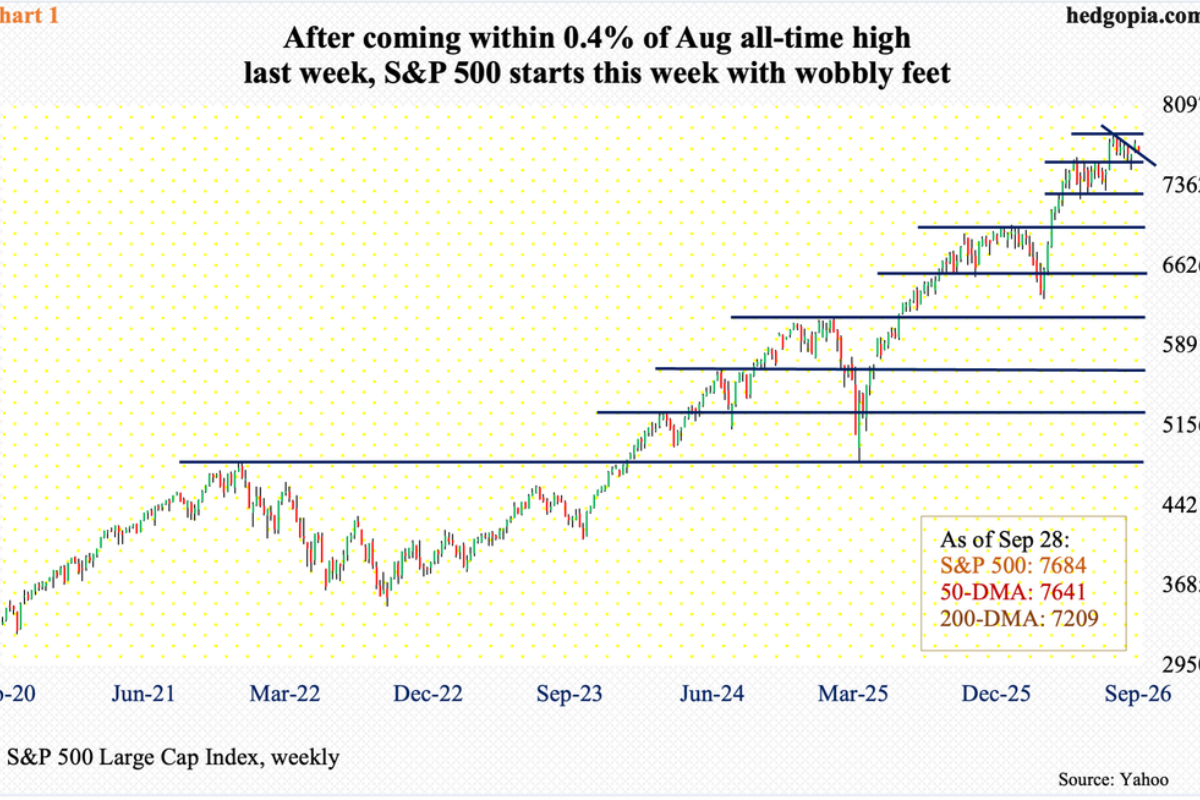
Equity bulls are doing their utmost to nullify the potentially bearish candles of November and December. After the S&P 500 bottomed last April, it rallied for seven consecutive months before giving out signs of fatigue, with November forming a hanging man and December a spinning top on the monthly. A strong – and decisive – January can negate the significance of these candles.
With 1/3 of the way through, January is up 1.8 percent. Last week, the large cap index jumped 1.6 percent to 6966. But action is lethargic. Bulls have done a good job of breaking out of 6920s, with Friday attracting bids at that support within the first hour, but with the daily stretched, the real test lies ahead as to if they will continue to enjoy a successful retest.
In the event of downward pressure, once 6920s give way, the 50-day rests at 6818.
Euro: Currently net long 162.8k, up 5.3k.

The euro bottomed at $0.954 in September 2022. A higher low of $1.018 was posted a year ago; the currency then rallied feverishly until it hit $1.1830 in June. Barring briefly touching $1.1919 last September, $1.18 has stood like a rock. Most recently, the level was unsuccessfully tested for a couple of sessions through Christmas Eve, before unraveling.
This week, the euro gave back 0.7 percent to $1.1636 – a second weekly drop in succession and a third in four; Friday, the 50-day at $1.165 was breached. The 200-day lies at $1.158, and it likely gets tested in the sessions ahead.
Gold: Currently net long 227.6k, down 3.5k.

Gold hit a fresh high $4,550 on 26 December, before coming under slight pressure but only to then rally back to come within shouting distance of the old high. Last week, the metal added 4.1 percent to $4,509/ounce. For the month, it is up 4.1 percent. This follows five up months in a row; as a matter of fact, in the last 27 months, there have only been five down months. Such has been the positive momentum enjoyed by gold bugs. In October 2023, gold bottomed at $1,810.
This obviously has pushed most technical indicators into gross overbought territory, but there has not been a serious breach of momentum. One after the other, resistance has fallen, and support has held. Nearest support currently lies at $4,370s.
Nasdaq (mini): Currently net long 32.6k, up 7.5k.

On 29 October, the Nasdaq 100 reached a fresh high of 26182. Since then, the tech-heavy index has found itself caught in a symmetrical triangle. Last week, it managed to poke its head out of the triangle, rallying 2.2 percent to 25766.
As is the case with the S&P 500, tech bulls have a responsibility of not letting November’s and December’s potentially bearish candles become real. The Nasdaq 100 formed a hanging man in November and a doji in December. This came on the heels of seven up months in a row post-April bottom.
It is too soon to say if tech bulls will succeed in their endeavor to deny the bears any chance. Amidst this bull-bear duel, the 50-day (25342) is beginning to point lower, albeit ever so slightly.
Russell 2000 mini-index: Currently net short 2.1k, down 1.5k.

January is young, but if the Russell 2000 finishes the month anywhere near the current price, small-cap bulls would have reasons to rejoice.
Last November was slightly up – for seven successive up months – but at the same time finished with a monthly hanging man. This was followed by December’s shooting star. These candles were a shot across the bows of small-cap bulls, who, however, have refused to buckle under. They have rallied January 5.7 percent to 2624.
Last week, the Russell 2000 rallied 4.6 percent, cleanly breaking out of 2540s. In the prior week, breakout retest at 2460s was just about defended. In November 2024, the small cap index retreated after ticking 2466. Three years before that, in November 2021, it rose to 2459 and then went the other way. On 18 September (last year), those highs were surpassed, but not before a stretched bull-bear tug of war followed around those highs. With last week’s action, the risk of a triple top has been taken away.
US Dollar Index: Currently net short 3.8k, down 129.

A year ago, after a three-plus-month rally, the US dollar index reversed hard at 110.18, subsequently reaching 96.38 in June and testing that low with success in September when it reversed higher tagging 96.22.
On 21 November, the index tagged 100.39 and was repelled. There is stiff resistance just north of 100, and it goes back more than a decade. Last Friday, rising in 12 of 13 sessions, it ticked 99.26 intraday, closing the week up 0.7 percent to 99.14.
Dollar bulls may have an edge here, although on the daily the index is extended. They would have scored major victory only when 100-plus is reclaimed.
VIX: Currently net short 88.3k, down 2.2k.

On Christmas Eve, VIX tagged 13.38 – a one-year low. The subsequent trudge higher ended last Thursday when the volatility index hit 15.85 intraday. By Friday, it closed at 14.49, although for the week it only gave back 0.02 points.
On the weekly, VIX acts like it wants higher prices, but for that to occur, the daily needs to cooperate, and on this front, the daily RSI was just rejected at the median. Also, 14-plus needs to hold.
Thanks for reading!
More By This Author:
Major US Equity Indices Feverishly Rallied For 7 Months Post-Apr Bottom
Small-Caps, Tech Trudge Higher In Seasonally Favorable Period
Buybacks, Earnings, And Margin Debt Solid Pillars Of Support For Equity Bulls
Comments
Log in or sign up to join the conversation.