

Earlier today, the Department of Labor released a surprisingly strong jobs report. This report stated that the number of Americans filing for unemployment benefits fell to 190k, well below the 214k consensus estimate:

Source: Zero Hedge, Bloomberg
This report was, to put it mildly, incredibly strange. Over the past few months, we have seen a number of technology companies and others lay off very large numbers of workers. Here is just a basic summary:
- Salesforce (CRM) is laying off 10% of its staff.
- Vimeo (VMEO) is laying off 11% of its staff.
- Stitch Fix (SFIX) is laying off 20% of its salaried workforce.
- Cryptocurrency firm Genesis is laying off 30% of its workforce in its second round of layoffs (and is expected to file for bankruptcy)
- Silvergate Capital (SI) is laying off 40% of its workforce.
- SuperRare Labs (NFTs etc) is laying off 30% of its workforce.
- Biocept (BIOC) is laying off a third of its staff.
- Compass (COMP) has now done three rounds of mass layoffs.
- Amazon (AMZN) has so far announced 18,000 job losses in a series of mass layoffs.
- McDonald's (MCD) has announced plans to lay off a large percentage of its 200,000 corporate employees.
This does not even include the mass layoffs that have now been announced at Microsoft (MSFT), CapitalOne (COF), and elsewhere. It is very curious that the job market continues to look very tight according to government data in such an environment. This only continues the string of very strange data that we have been seeing in a number of job reports recently.
Looking At Real Data
One complaint that many people have levied against the official government data is that it does not appropriately discriminate between full-time work and part-time work. When we actually take a look at this data, we see a very different story than the official narrative. For example, as we can see here, from April 2021 until November 2022, the number of Americans working full-time declined by 1,000 while the number of workers in part-time positions increased by a whopping 679,000 over the period:
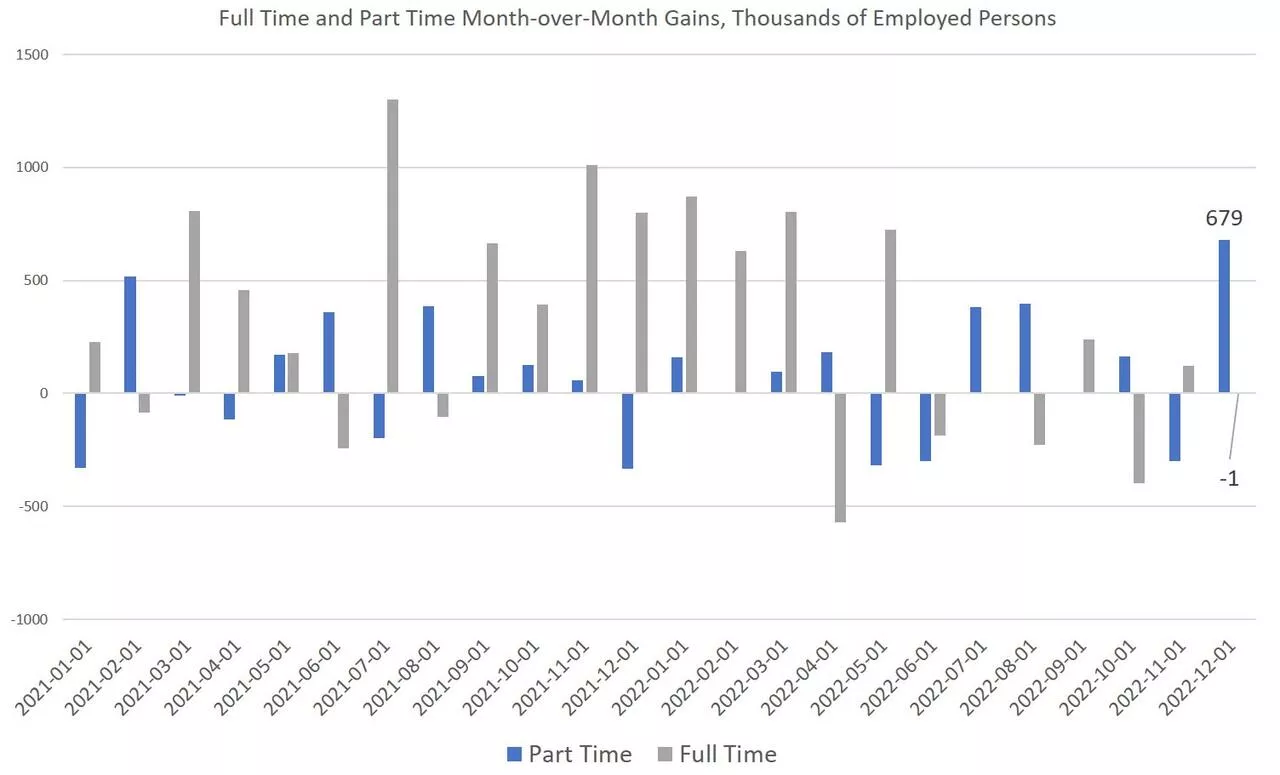
Source: Zero Hedge
This goes back to one of the points that I have been making in many of my recent articles and blog posts. In short, inflation has forced many people to take on second jobs or enter the gig economy simply to make ends meet. According to a recent Prudential Pulse survey, approximately 77% of Millennials and 81% of Generation Z members have either entered or are considering entering the gig economy because they cannot afford to support themselves in today's economy. This is a direct result of the high inflation that the economy has been suffering from, which has resulted in real wages declining for 21 straight months.
This is hardly a sign of a strong economy. The jobs report today was certainly not a sign of strength in the economy. Rather, what we are seeing is a massive number of people being forced to take on second jobs simply to support themselves and their families.
Conclusion
In conclusion, the market appears to be taking the surprise miss in the initial jobless claims figures as a sign that the economy is still strong and the jobs market is still tight. However, the fact that we are seeing massive layoffs of full-time workers, a surge in part-time jobs, negative real income growth, and high inflation tells a very different story. It seems certain that this will pressure those companies that are highly reliant on discretionary consumer spending. Meanwhile, those companies that are providing necessities should still continue to do well.
More By This Author:
Oil Prices Cannot Decline Too Much From Today's Levels
The S&P 500 Continues To Look Expensive
US LNG Exports Surge, Why Aren't You Profiting?



Comments
Log in or sign up to join the conversation.