

Following futures positions of non-commercials are as of Jan 27, 2026.
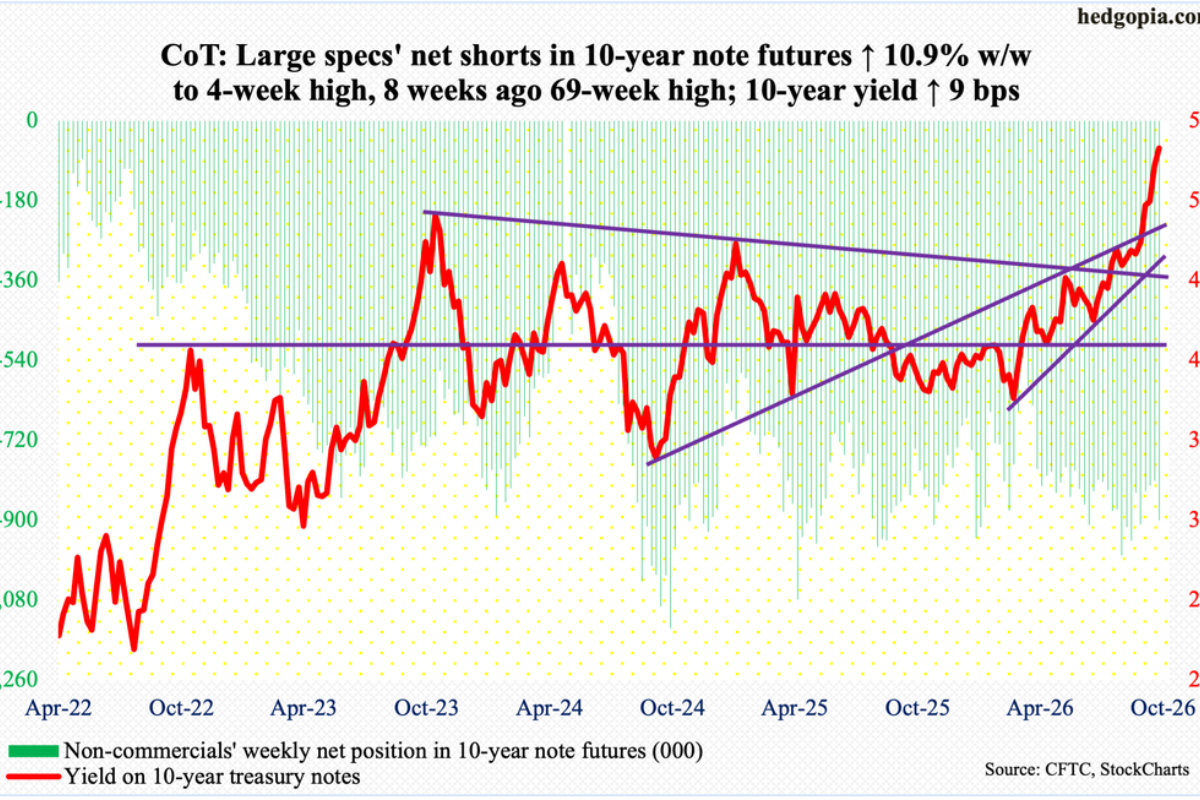
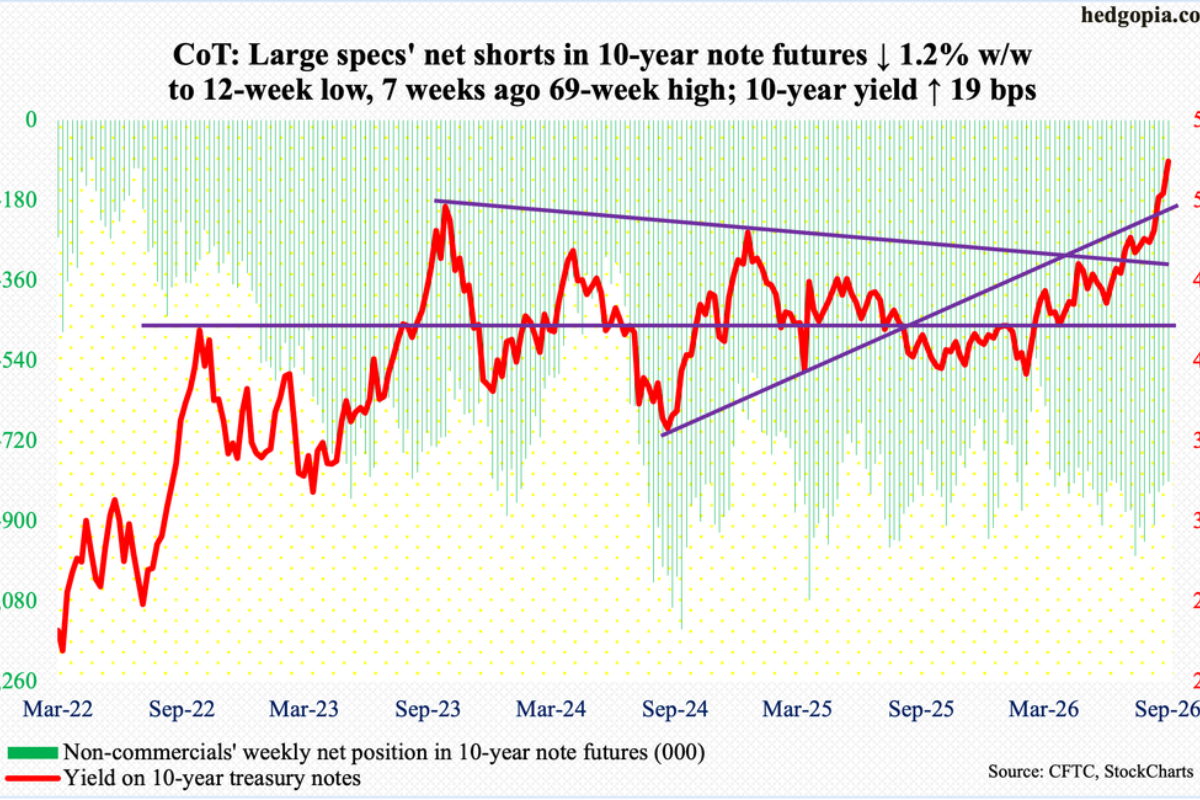
10-year note: Currently net short 726.2k, up 70.5k.

As expected, the fed funds rate was left unchanged at this week’s FOMC meeting at a range of 350 basis points to 375 basis points. There were two dissents, with Governors Stephen Miran and Christopher Waller voting for a quarter-point cut; at the December meeting, Miran, who until September served as chairman of the Council of Economic Advisors, had voted for a 50-basis-point reduction. Miran has consistently voted for lower rates.
Waller, on the other hand, has been a governor since December 2020, and supposedly was one of the four finalists in President Trump’s list of candidates to replace Jerome Powell. The other three were: National Economic Council Director Kevin Hassett, BlackRock chief investment officer for fixed income Rick Rieder and former Fed Governor Kevin Warsh. Warsh has been picked as a Powell successor.
Powell retires in May and has the option of serving out the remaining two years on his governor’s term. He has come under persistent pressure to lower the rates much more than the FOMC (Federal Open Market Committee) already has. The Federal Reserve has reduced the fed funds rate by 75 basis points – in three 25-basis-point increments – since last September, and by 175 basis points since September 2024. Speaking to the press after the rate decision on Wednesday, Powell conveyed no urgency for further reduction. He chairs two more meetings before he departs; rates are not likely to change at least until then. The futures market agrees, with traders pricing in a couple of 25-basis-point reductions this year – one in June and the other in October.
Warsh has a tough balancing act ahead. Trump, who obviously wants to goose up the economy under his watch, not to mention the midterm elections this year, wants lower rates – not only on the short end but also on the long. To have lower yields on the 10-year, for instance, Warsh will have to expand the balance sheet. Unless he is a changed man now, he has had a hawkish past. As Fed governor between February 2006 and March 2011, he was not a big fan of continued quantitative easing even during the financial crisis. With this as a background, it must have taken some skill to convince Trump that he is the right man for the job. If confirmed, Warsh’s is just one vote; there are 11 more FOMC members who equally wield voting power. On Wednesday, Powell gave some advice for his successor: “Don’t get pulled into elected politics.” On Friday – the day Warsh’s nomination was announced – the dollar, up 0.9 percent, and precious metals gold and silver, down 9.1 percent and 26.9 percent respectively, seemed to be pricing out concerns about Fed independence.
30-year bond: Currently net short 8.2k, down 14.9k.

Major US economic releases for next week are as follows.
The ISM manufacturing index (January) is on schedule for Monday. In December, manufacturing activity dropped three-tenths of a percentage point month-over-month to 47.9 percent. This was the 10th straight month of sub-50 reading – preceded by two months of expansion and 26 months of contraction before that.
Job openings (JOLTs, December) will be published Tuesday. Non-farm job openings declined 303,000 m/m in November to 7.15 million, within striking distance of the September 2024 reading of 7.1 million, which was the lowest since December 2020.
The ISM services index (January) will be out Wednesday. Non-manufacturing activity in December firmed up 1.8 percentage points m/m to 54.4 percent.
Labor productivity (4Q25, preliminary) is scheduled for Thursday. Non-farm output per hour grew 1.9 percent in 3Q25 from a year ago. This was the fastest pace in four quarters.
Friday brings payrolls (January) and University of Michigan’s consumer sentiment index (February, preliminary).
The economy only created 50,000 non-farm jobs in December. For all of 2025, an average 49,000 was added each month – puny compared to a monthly average of 168,000 in 2024, 216,000 in 2023 and 380,000 in 2023.
Consumer sentiment increased 3.5 points m/m in January to 56.4 – a five-month high.
WTI crude oil: Currently net long 166.4k, up 22.5k.

West Texas Intermediate crude put up another solid performance this week, rallying 7.7 percent to $65.74/barrel. This was the 6th up week in a row.
On 16 December, the crude undercut horizontal support just north of $56 by tagging $54.98 but soon stabilized; this was the lowest price point since February 2021. Going back to at least last April, $56 consistently drew bids.
The subsequent rally has brought WTI to an important juncture – pricewise. In March 2022, it hit $126.42 intraday and reversed lower. A falling trendline from that peak extends to where the crude closed this week. Right around there lies horizontal resistance going back many years. For now, this hurdle is less likely to give way.
In the meantime, US crude production in the week to January 23rd decreased 36,000 barrels per day week-over-week to 13.696 million b/d; output registered a record 13.862 mb/d in the week to November 7th last year. Crude imports dropped as well, down 805,000 b/d to 5.6 mb/d. As did crude inventory, which fell 2.3 million barrels to 423.8 million barrels. Stocks of gasoline and distillates rose – respectively up 223,000 barrels and 329,000 barrels to 257.2 million barrels and 132.9 million barrels. Refinery utilization decreased 2.4 percentage points to 90.9 percent.
E-mini S&P 500: Currently net short 99.8k, up 18k.

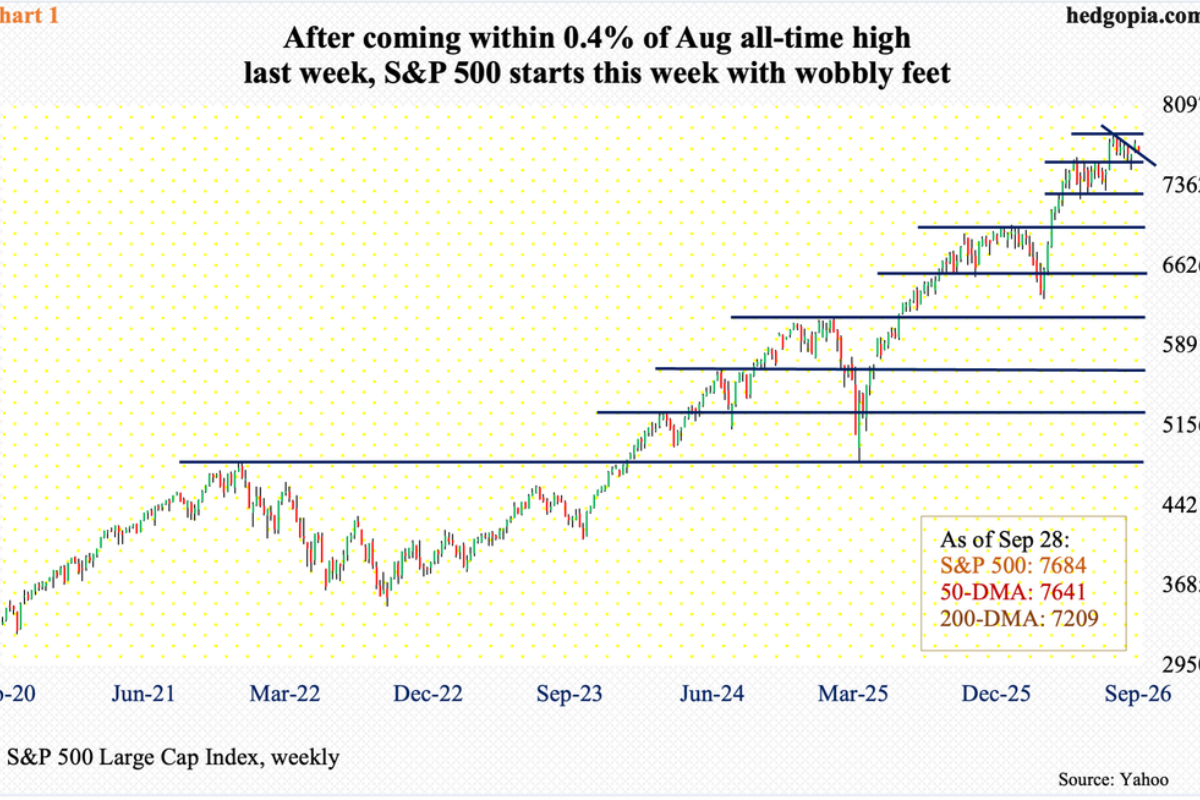
Both bulls and bears were very active this week. On Wednesday, the S&P 500 crossed 7000 for the first time, ticking 7002 intraday, but bulls were unable to keep the gains. In the very next session, the large cap index tagged 6871, but this time bears failed to hang on to that price point. Amidst this push and pull, the week ended up 0.3 percent to 6939, forming a weekly spinning top, which has now showed up twice in the last three weeks.
For the month, the S&P 500 added 1.4 percent, but not before forming a monthly spinning top. This comes on the heels of December’s spinning top and November’s hanging man. After the index bottomed last April at 4835, it rallied for seven consecutive months before trudging higher and acting lethargic.
Besides the horizontal resistance, the S&P 500 is also caught in a rising wedge, which often breaks to the downside. The 50-day moving average is the nearest support at 6858.
Euro: Currently net long 132.1k, up 20.4k.

No sooner did the euro break out of $1.18 than it was tested. Last week, it jumped two percent to $1.1829, breaking a three-week losing streak. Resistance just north of $1.18 goes back to at least last June. By Tuesday this week, this hurdle was broken with authority, with the currency rising as high as $1.2083 and closing at $1.2023. But the air began to leak out in the subsequent sessions. When it was all said and done, the euro edged up 0.2 percent for the week to $1.1852, forming a weekly gravestone doji, which is a bearish reversal pattern.
The euro remains above $1.18 but is vulnerable. There is lateral support at $1.15s.
Gold: Currently net long 205.4k, down 39.4k.

Gold’s weekly chart using closing price belies the volatility it sustained during the week. The metal’s parabolic run of late culminated in Thursday’s wild run touching $5,608 intraday but closing at $5,377 with a low of $5,096. Thursday’s low was decisively breached Friday when the metal fell as low as $4,698 to close at $4,887/ounce.
For January, gold still rallied 13.1 percent, although it was up as much as 29.7 percent at Thursday’s high; as a result, a monthly shooting star formed. This week’s price action could prove to be a bearish exhaustion candle. Time will tell.
The yellow metal has now rallied for seven months in a row; in fact, over 27 months, there have only been five down months. In October 2023, gold bottomed at $1,810.
Nearest support lies at $4,630s, followed by $4,540s and then $4,370s. The 50-day lies at $4,458.
Nasdaq (mini): Currently net long 28.2k, up 7k.

There was mixed reaction this week to four of Magnificent 7’s December-quarter results. Shares of Apple (AAPL) and Facebook parent Meta Platforms (META) drew bids, while those of Microsoft (MSFT) and Tesla (TSLA) were sold off post-earnings. Two more are on dock this week, with Google parent Alphabet (GOOG) publishing its numbers on Wednesday and Amazon (AMZN) doing so on Thursday. NVDA does not report its January quarter until February 25.
Leading into this, the Nasdaq 100, having rallied 58 percent between the intraday low of 16542 on 9 April and the all-time high of 26182 posted on 29 October, was showing signs of fatigue. November and December, which were both down months, albeit nominally, produced a hanging man and a doji, in that order. It was also caught in a symmetrical triangle from the October high. January again finished with a doji.
This week, the tech-heavy index tested the October high with Tuesday’s intraday high of 26165 and was rejected, finishing the week down 0.2 percent to 25552. On both Thursday and Friday, the 50-day at 25387 was just about tested. The average likely gets tested again, with heavy odds of a breach ahead.
Russell 2000 mini-index: Currently net long 12.3k, down 8.2k.

Powell sticking to his rather hawkish message on Wednesday probably did not sit well with small-cap bulls, who pulled the Russell 2000 down 2.1 percent to 2614 this week. The index did peak on the 22nd at 2735 and has come under pressure a tad since. For January, it still managed to rally 5.5 percent, although the small-cap index was up as much as 10.2 percent at its high. As a result, January produced a candle with a very long wick. It is hence too soon to say if January’s action is enough to nullify the potentially bearish candles of November and December, which respectively produced a hanging man and a shooting star.
How things transpire at 2540s, followed by 2460s, will be key. If these breakouts are real, then there should be bids waiting.
US Dollar Index: Currently net short 4.4k, down 2k.

In January last year, after a three-plus-month rally, the US dollar index reversed hard at 110.18, subsequently reaching 96.38 in June and successfully testing that low with a lower low of 96.22 in September. This week, another lower low of 95.55 was ticked Tuesday, and that, too, drew aggressive buying interest from dollar bulls, ending the week down 0.5 percent to 97.14.
Both the lows of June and September were followed by decent rallies. This one should be no different. The only question is if the imminent rally will sustain itself or fizzle out soon. The good thing for dollar bulls is that 96 was not lost.
There is stiff resistance just north of 100, and it goes back more than a decade. On the 15th and 16th (January), the US dollar index was denied at 99.49 and 99.48 respectively. Before 100 gets tested, there will be offers at just under 98.
VIX: Currently net short 75k, down 14.2k.

On Christmas Eve, VIX ticked 13.38 intraday and has been on an uptrend since. On the 20th (January) it ticked 20.99 and came under pressure, but only to find support at the trendline in question.
This week, amidst all the heightened volatility, VIX could only rally to 19.74 intraday – lower than the high on the 20th – and finished the week up 1.35 points to 17.44.
Bulls’ consolation is that the volatility index remains solidly above 14 where downward pressure has tended to stop since August. This week, VIX also pushed above the 50-day (16.68) but was unable to stay above the 200-day (17.91).
Thanks for reading!
More By This Author:
4 Of Mag 7 Publish Calendar 4Q25 Numbers This Week
Commitment Of Traders: Noncommercial Positions And Futures
Margin Debt In Cooperation, Equity Allocation At Record
Comments
Log in or sign up to join the conversation.