

Four of the Magnificent 7 report this week and carry potential to sway large-cap indices that are weighted by market cap. It is also possible these results will hurt or help small-caps in a roundabout way.

The December-quarter earnings season just got underway. This week, four tech heavyweights report – Microsoft (MSFT), Tesla (TSLA) and Facebook parent Meta Platforms (META) on Wednesday and Apple (AAPL) on Thursday. Combined, these four sport a market cap of over $10 trillion, so their results will matter. This will be followed next week when Google parent Alphabet (GOOG) will publish its numbers on Wednesday, and Amazon (AMZN) will do so on Thursday. Nvidia (NVDA) does not report its January quarter until February 25.
Heading into this, consensus estimates have essentially remained unchanged over the past 60 days for all four, while they have slightly trended higher for AAPL, META and MSFT going out to 90 days (Table 1).

The four tech bellwethers reporting this week account for over 21 percent of QQQ (Invesco QQQ Trust); the seven in Chart 1 – also known as Magnificent 7 – make up over 38 percent. That is how dominating these companies are. In market cap-weighted indices such as the Nasdaq 100, these entities will naturally have an outsize influence.
All the focus hence is on post-earnings trader reaction to the share prices. The fact that the sell-side has left their estimates untouched the past two months probably lowers the bar. This can be interpreted as favoring the bulls. The other side of this coin is that the flattish estimates could also be viewed as the sell-side not showing conviction to raise their numbers into the earnings print.

Traders are indeed confused, and they have acted this way for a while now. The Nasdaq 100 has had a phenomenal rally when it bottomed on 9 April at 16542 and peaked on 29 October when it reached an intraday high of 26182 – up a massive 58.3 percent. Since that high, the tech-heavy index has been caught in a symmetrical triangle. This pattern tends to be neutral, indicating an equal match between bids and offers. A break can occur in either direction – up or down.
Tech bulls hope the current consolidation resolves with an upside breakout. This week did indeed begin with Monday’s session in which the index rose 0.4 percent, helping it poke its head out of the triangle, but it was hardly decisive (Chart 2). Bears, on the other hand, are eyeing with lots of hope the potentially bearish candles of November and December; they were down months, albeit nominally, and formed a hanging man and a doji, in that order. How January – up 1.8 percent – fares, therefore, will carry meaning. With four sessions to go this month, the results from the four tech biggies this week can shape how January looks.

November and December also produced similar candles on the S&P 500. The Magnificent 7 also wield a big influence on the large cap index, accounting for nearly 31 percent of SPY (SPDR S&P 500 ETF). What reaction their results will ignite post-earnings will be key as to how January shapes up; the month is up 1.5 percent thus far.
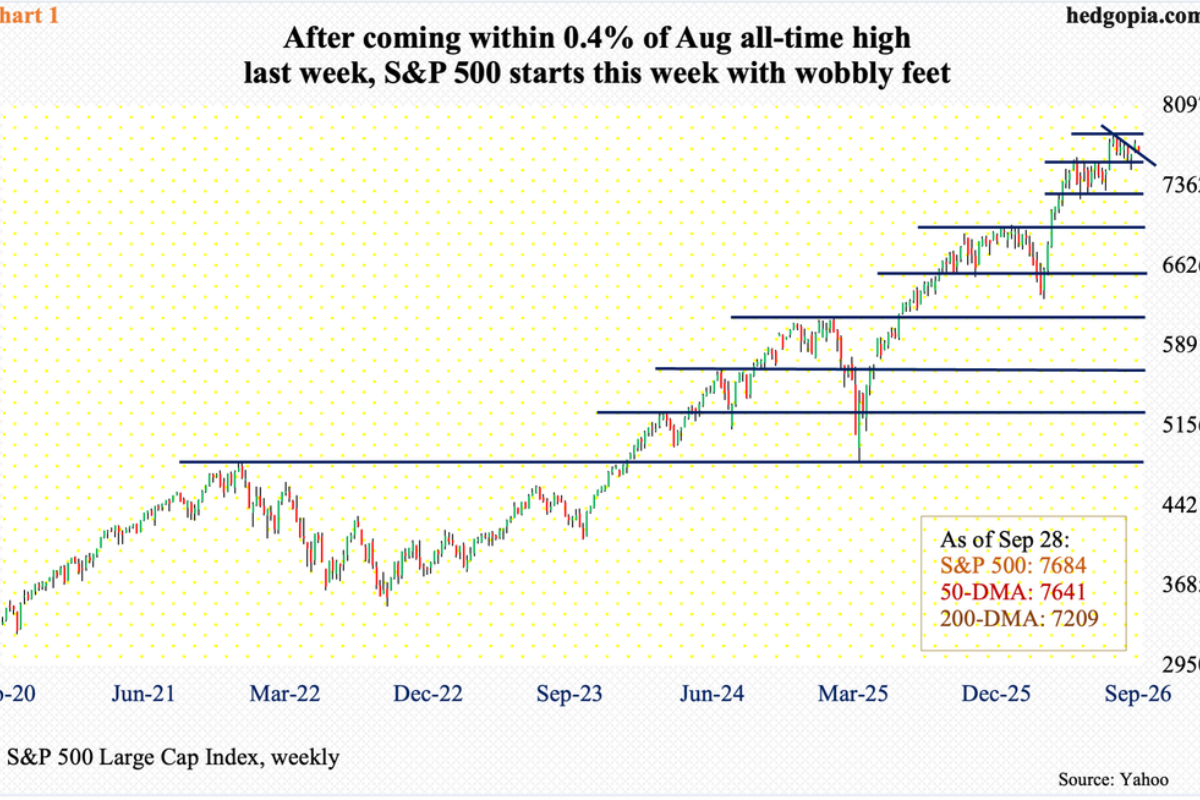
The S&P 500 jumped 44.5 percent between the intraday low of 4835 on 9 April and 6986 printed on the 12th this month, then essentially went sideways around 6920s for 13 weeks. Monday, there were bids waiting at 6922 in the very opening minutes, ending the session up 0.5 percent to 6950. A decisively strong January should cast doubt over the candles November and December produced – a hanging man and a spinning top respectively. But that is yet to happen; hence the importance of tech earnings this Wednesday and Thursday.
Besides the horizontal resistance at 6920s, the S&P 500 is also caught in a rising wedge, which often breaks to the downside (Chart 3).

Small-caps were not immune from back-to-back bearish-leaning candles in November and December, which respectively produced a hanging man and a shooting star. This followed a 57.8-percent surge from 9 April when the Russell 2000 bottomed at 1733 through last Thursday’s 2735. This month, it has gained 7.1 percent, albeit with a little bit of a wick on the candle. Regardless, if the bulls can hang on to these gains, this would probably have poked a hole in bears’ optimism.
With all that said, last week produced an ugly looking shooting star on the weekly, with Thursday’s high meaningfully lost by Friday when the session/week ended at 2669, down 0.3 percent for the week (Chart 4). Last week’s tentative price action comes on the heels of back-to-back strong price action coinciding with a clean breakout at 2540s; in the week before that, breakout retest at 2460s was successful.
Last week’s shooting star was followed by a 0.4-percent drop on Monday.
The Russell 2000 tracks the 2000 smallest companies in the US. The four tech companies reporting this week are excluded from the index. But trader sentiment can get influenced depending on how the S&P 500 trades. It is equally possible money gravitates toward small-caps in a tech selloff; this is a perfect scenario for small-cap bulls looking to nullify the candles of November and December.

In the meantime, the sell-side is showing caution in raising their 2026 numbers. As of last Wednesday, these analysts were expecting $96.27 in operating earnings of S&P 600 companies (Chart 5). Estimates are flat over the past six months, with a little fluctuation along the way.
Another way of looking at this is that the sell-side was way optimistic in February last year when they were modeling in $106.48 for this year. This usually happens. These analysts start out optimistic and gradually lower their numbers as the year progresses.
Viewed this way, estimates are likely not done going down. Currently, earnings this year are expected to soar north of 44 percent, which would have followed the expected growth rate of nearly eight percent last year. For 2025, the sell-side in May 2024 was expecting $102.88; with one quarter of earnings remaining, 2025 is on pace to ring up $66.68.
More By This Author:
Commitment Of Traders: Noncommercial Positions And FuturesMargin Debt In Cooperation, Equity Allocation At Record
CoT: How Hedge Funds Are Positioned, Peek Into Future Through Futures
Comments
Log in or sign up to join the conversation.