

Following futures positions of non-commercials are as of Jan 20, 2026.
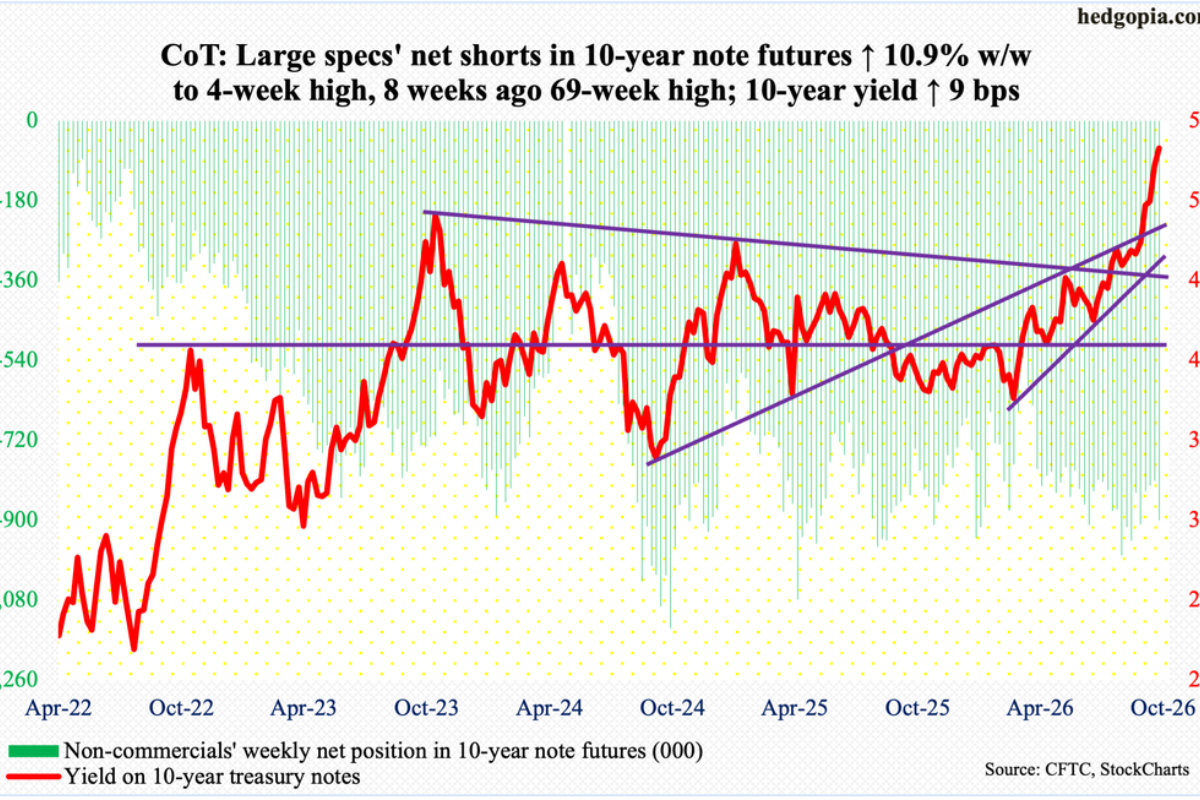
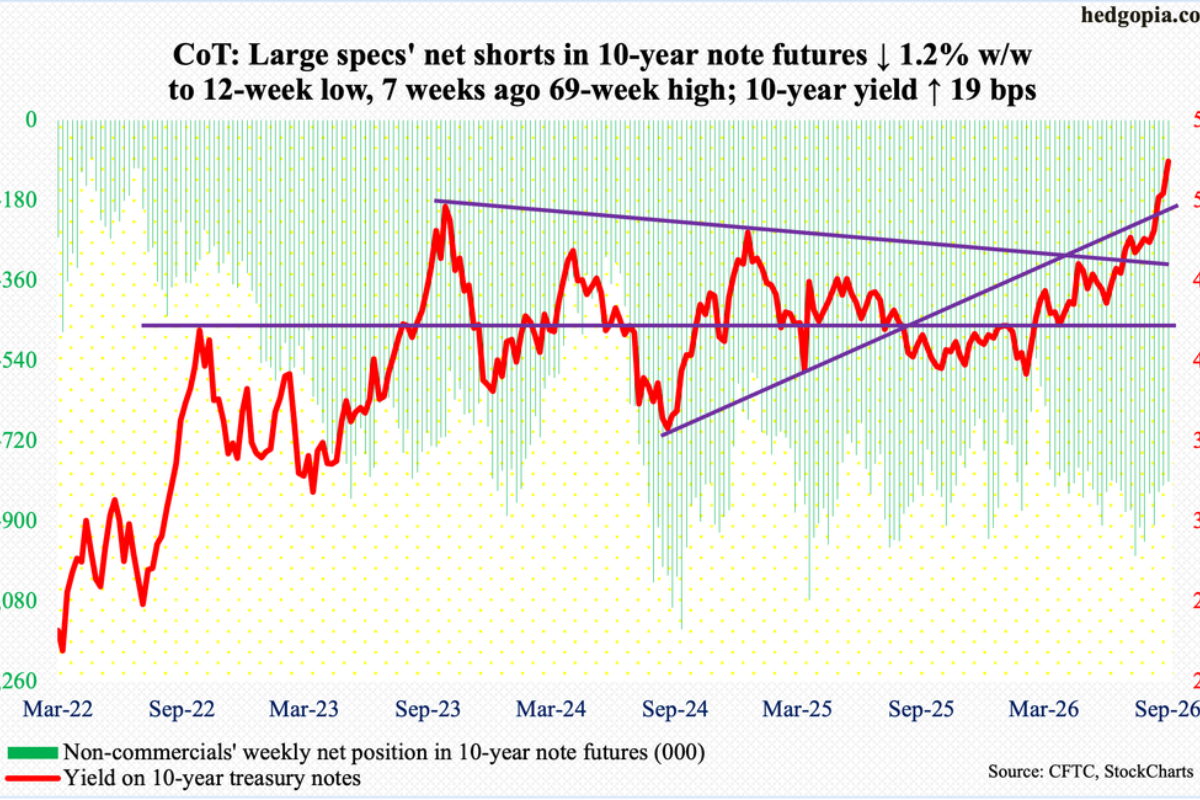
10-year note: Currently net short 655.6k, down 214.9k.

The FOMC meets next week. In the futures market, under five percent of traders are currently pricing in a 25-basis-point cut, meaning the majority expects the fed funds rate to be left unchanged at a range of 350 basis points to 375 basis points. A cut in June is expected, followed by another in December, although December probabilities are not that high.
By June, we will have a new Federal Reserve chief, as Jerome Powell retires in May. President Donald Trump wants lower rates and is taking time to nominate a Powell replacement. Trump would obviously want someone who he believes shares his interest-rate outlook, although it is not a guarantee that the new Fed head would acquiesce to these demands once he takes up the job.
Regardless, at least for now, non-commercials are getting ready for lower rates on the long end. They have reduced their net shorts in 10-year note futures by over 30 percent this month. Technically, too, the 10-year seems headed lower. On Tuesday, rates rallied as high as 4.31 percent, but only to then end the week at 4.24 percent.
Going back at least three years, 4.20s has proven to be an important level for both bulls and bears. Once 4.2 percent is lost, the 10-year can hurriedly drop towards the 50-day moving average at 4.14 percent. Right around there lies a rising trendline from last October when yields bottomed at 3.95 percent; a break of this support would open the door to a sub-four scenario.
30-year bond: Currently net short 23.1k, up 36.9k.

Major US economic releases for next week are as follows.
Durable goods orders (November) are due out Monday. In October, orders for non-defense capital goods ex-aircraft – proxy for business capex plans – increased 0.5 percent month-over-month to a seasonally adjusted annual rate of $78 billion, which is just below the August 2022 record of $78.1 billion.
On Tuesday, the S&P-Case Shiller home price index (November) comes out. From a year ago in October, home prices nationally rose 1.4 percent. September’s 1.3-percent increase was the lowest year-over-year appreciation since July 2023.
Thursday brings productivity (3Q25, revised). Preliminarily, 3Q25 output per hour grew 1.9 percent from a year ago. This was the highest growth rate in four quarters.
The producer price index (December) is on schedule for Friday. In the 12 months to November, headline and core wholesale prices rose at a seasonally adjusted rate of three percent and 3.5 percent – four- and eight-month high, in that order.
WTI crude oil: Currently net long 143.9k, up 14.5k.

Last Wednesday, West Texas Intermediate crude hit $62.36 intraday and found stiff resistance at the 200-day. This week, it found support at the 50-day tagging $58.53 intraday Monday, ending the week up 3.3 percent to $61.28/barrel.
Since last month’s low, the crude has now rallied for five weeks in a row, but more gains could be in store once the 200-day gives way. There is decent horizontal resistance just north of $65.
In the meantime, US crude production in the week to January 16th decreased 21,000 barrels per day week-over-week to 13.732 million b/d; output registered a record 13.862 mb/d in the week to November 7th last year. Crude imports dropped as well, down 645,000 b/d to 6.4 mb/d. Stocks of crude, gasoline, and distillates all rose – respectively up 3.6 million barrels, six million barrels and 3.3 million barrels to 426 million barrels, 257 million barrels and 132.6 million barrels. Refinery utilization declined two percentage points to 93.3 percent.
E-mini S&P 500: Currently net short 81.8k, down 40.5k.

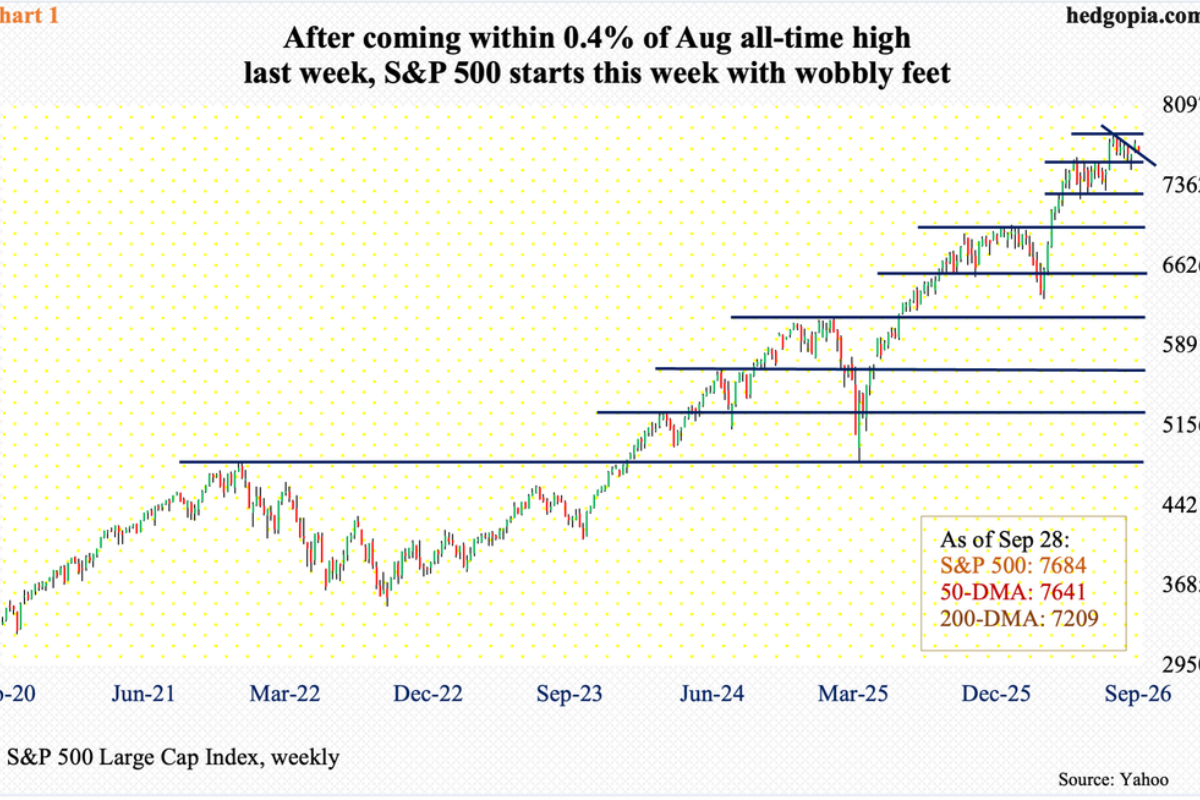
The S&P 500 dropped 0.35 percent this week to 6916. This was the second down week in succession, having reached a fresh intraday high of 6986 on the 12th. Bulls and bears are fighting over control of 6920s, which the large cap index has straddled for three months now.
This week belonged to the bears, but kudos to the bulls for putting their foot down on Tuesday, when the index was down to 6789 intraday. By the end of the week, the index was back to testing the 6920s hurdle.
Besides the horizontal resistance, the S&P 500 is also caught in a rising wedge, which often breaks to the downside. Should things evolve this way, this would have come on the heels of potentially bearish candles of November and December, with the former forming a monthly hanging man and the latter a spinning top. After the index bottomed last April, it rallied for seven consecutive months before trudging higher and showing signs of fatigue.
Euro: Currently net long 111.7k, down 21k.

On 24 December, the euro ticked $1.1808 and headed lower, breaching the 50-day along the way. But last Friday, the 200-day was defended as the currency ticked $1.1585 at the low. This opened the door to this week’s two-percent surge to $1.1829, breaking a three-week losing streak; the 50-day ($1.168) has been reclaimed.
Resistance just north of $1.18 goes back to at least last June. A decisive break higher will have significantly built on this week’s move, which has come against the backdrop of non-commercials reducing their net longs the last couple of weeks.
Gold: Currently net long 244.8k, down 6.5k.

With five sessions to go this month, gold is up 15.4 percent. An up January would represent a sixth up month in a row; in fact, in the last 27 months, there have only been five down months. In October 2023, the metal bottomed at $1,810.
This week, gold shot up 8.6 percent to $4,989/ounce, forming a bullish marubozu candle and rallying in all four sessions. Needless to say, the yellow metal remains overbought – way overbought, in fact – but positive momentum remains intact.
Nearest support lies at $4,630s.
Nasdaq (mini): Currently net long 21.1k, down 8k.

Intel (INTC), a one-time tech heavyweight, disappointed this week and was punished, losing four percent to $45.07. But it also had a phenomenal move since August when it began rallying from $19, where it went sideways for a whole year. With this week’s drop, INTC’s market cap dropped to $225 billion – a minnow compared to the likes of Nvidia (NVDA, $4.6tn), Apple (AAPL, $3.7tn), Microsoft (MSFT, $3.5tn), Amazon (AMZN, $2.6tn), Google parent Alphabet (GOOG, $1.8tn), Tesla (TSLA, $1.5tn), Broadcom (AVGO, $1.5tn) and Facebook parent Meta Platforms (META, $1.4tn).
On Friday, reacting to December-quarter results, INTC shares tumbled 17 percent, and the overall markets did not bat an eyelid. Traders wouldn’t have that luxury when the heavyweights report. Next week, several are on deck, with MSFT, TSLA and META on Wednesday and AAPL on Thursday. Their results will matter. NVDA does not report its January quarter until February 25.
Ahead of this, the Nasdaq 100 edged up 0.3 percent this week to 25605 and remains trapped in a symmetrical triangle originating from 29 October when the tech-heavy index reached a fresh high of 26182. At Tuesday’s low of 24954, in fact, the triangle would have been breached to the downside, but tech bulls got their act together to push the index back into the pattern by Friday.
The Nasdaq 100 rallied for seven straight months after bottoming last April at 16542. Then came November and December, which were both down months, albeit nominally, but the more important thing is the candles the months produced – a hanging man and a doji, in that order. Reports from Big Tech next week and the week after will be key.
Russell 2000 mini-index: Currently net long 20.6k, up 9.1k.

Small-cap bulls were sitting pretty this week until Friday when the Russell 2000 dropped 1.8 percent to 2669; at Thursday’s session high, the index touched 2735 – a fresh intraday high. As a result, the weekly produced a shooting star and comes against the backdrop of a back-to-back strong price action when the index broke out of 2540s; two weeks ago, breakout retest at 2460s was successful.
Month-to-date, the index is up 7.5 percent, albeit with a small wick on the monthly. If these gains can be held, this would probably be enough to nullify the potentially bearish candles of November and December, which respectively produced a hanging man and a shooting star.
If Friday’s action is a preview of what is to come, then 2540s once again hold the key.
US Dollar Index: Currently net short 6.4k, up 2.7k.

There is stiff resistance just north of 100, and it goes back more than a decade. On the 15th and 16th this month, the US dollar index was denied at 99.49 and 99.48 respectively. The subsequent drop brought it to 97.46 last week, down 1.95 percent, ending a three-week bullish run.
A year ago, after a three-plus-month rally, the US dollar index reversed hard at 110.18, subsequently reaching 96.38 in June and testing that low with success in September when it reversed higher tagging 96.22. The index could very well be gravitating toward those lows. It will be a problem for dollar bulls if 96 is decisively lost.
VIX: Currently net short 89.2k, down 3.1k.

Tuesday’s gap-up to 20.99 intraday ended the session with a spinning top, closing at 20.09 and a low of 18.64. Come Wednesday, VIX once again tried to put up a rally, with an intraday high of 20.81 but only to reverse hard to end the session lower at 16.90. Volatility bulls’ misery continued Thursday, but Friday’s mini rally salvaged the week, rising 0.23 points to 16.09.
Bulls’ consolation is that the volatility index remains solidly above 14 where downward pressure has tended to stop since August. The problem continues to be their inability to hang on to the gains. Even a small rally in volatility tends to attract sellers; in other words, dip-buying continues in equities, hence the significance of Big Tech results the next couple of weeks.
Thanks for reading!
More By This Author:
Margin Debt In Cooperation, Equity Allocation At Record
CoT: How Hedge Funds Are Positioned, Peek Into Future Through Futures
Amidst Potentially Bearish Candles Of Nov And Dec Comes Last Week’s Breakout
Comments
Log in or sign up to join the conversation.