

On 1/21, I suggested two alternative ETFs to State Street SPDR S&P 500 ETF Trust (SPY), one that owns the same stocks but at equal weight rather than weighted by market cap and another that aims to track the Russell 2000 Dividend Growth Index. Today, I want to add Invesco High Yield Dividend ETF (PEY).
What PEY Does
Launched over two decades ago, PEY invests to track the Nasdaq US Dividend Achievers™ 50 Index. It appears to be the only ETF tracking this index, which is the top 50 securities that are in the Nasdaq US Broad Dividend Achievers™ Index. The index selects stocks based on their dividend yields and consistent growth rates in the dividends. Invesco maintains a page for PEY on its website, which shares a lot of information and also links to its Fact Sheet.
The index is reconstituted annually, a process that next takes place in March, and rebalanced quarterly. It currently has a sector allocation that is light on Information Technology, which is the largest sector in the S&P 500. and that is heavy on Financials and Utilities relative to it as depicted by Invesco at year-end:
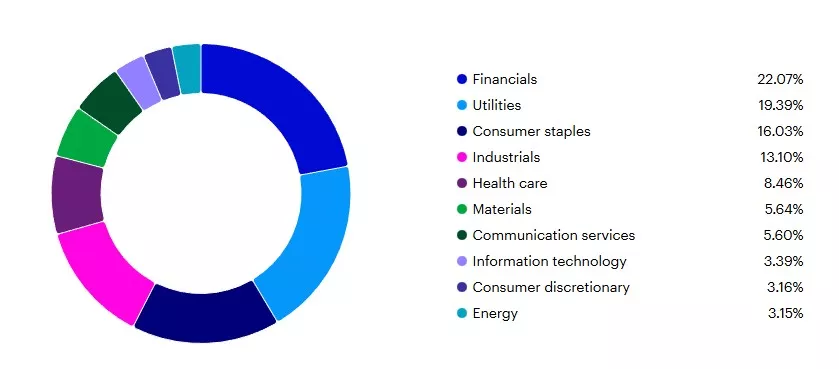
The current dividend yield on the ETF is 4.6%, which is a bit higher than its peers and a lot higher than the 1.1% dividend yield on the S&P 500. The ETF currently has a net asset value of $1.06 billion, which is much smaller than many peers but big enough in my view to assure liquidity. Over the last month, it has averaged daily trading of 1.02 million shares.
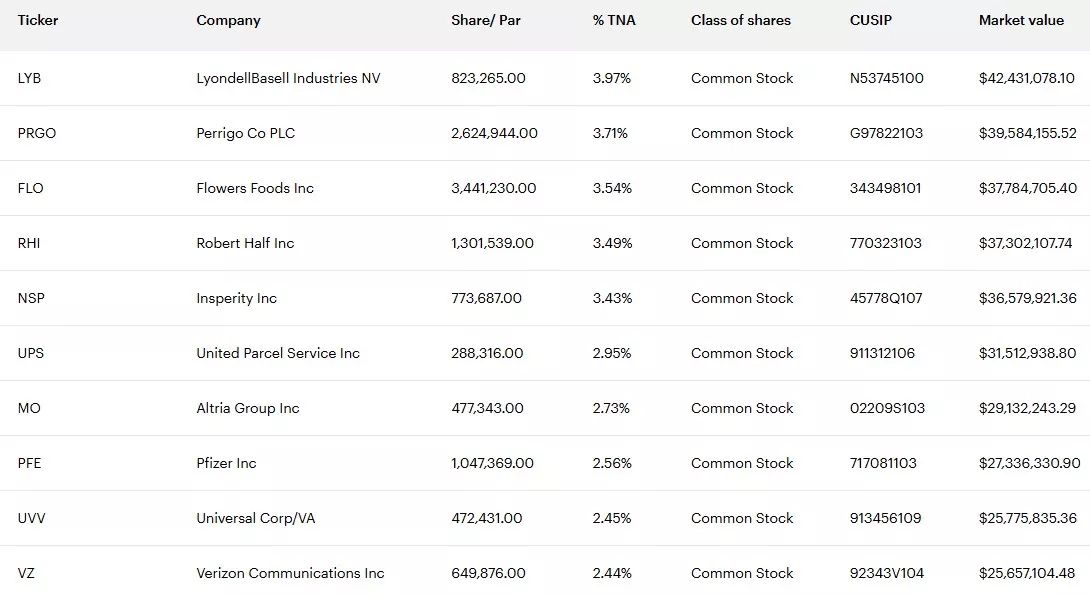
While 50 stocks is a lot fewer than what the S&P 500 includes, the ETF is pretty diversified by security. The largest holding currently is just under 4%, and the top 10 names add up to 31.3%, which is lower than the top 10 of the S&P 500, which make up 39.2% of it. According to Invesco, the forward PE at year-end was just 10.7X, with a price/book ratio of 1.6X. The average market cap of the 50 stocks in the ETF was about $32 billion. Here are the top 10 names:
PEY's Challenges
PEY has underperformed the S&P 500 by a lot over the past few years. In 2025, the return net of fee was just 0.62%. It did better in 2023 and 2024, but the three-year return was just 4.33% per year, which was substantially lower than the S&P 500 return. Even with a very strong 2022, the five-year total return was only 46.7%% compared to the 95.4% return of SPY.
A big challenge for the ETF has been that it has been missing out on the Information Technology sector, which has been quite strong. The 5-year total return of XLK has been 130.2% through the end of 2025.
I think that another obstacle has been the fee, which is 0.54% on a net expense basis. This is much higher than for SPY at 0.09% and other large ETFs like iShares Core S&P 500 ETF (IVV) and the Vanguard S&P 500 ETF (VOO), both of which are at 0.03% That 0.54% includes a 0.4% management fee. I don't find this fee to be too high, but it does reduce the total return and it probably reduces demand from many investors.
PEY Is Bouncing
2026 has seen a move higher by PEY and its dividend-focused peers. A lot of the stocks in the ETF had a tough 2025 and may have endured some tax-loss related selling late in the year. This is one of the reasons that some stocks are doing so well in 2026. The ETF has increased in price by 4.62%. Including the dividend that it paid this month, the total return has been 5.02%. Here is the chart over the past year:
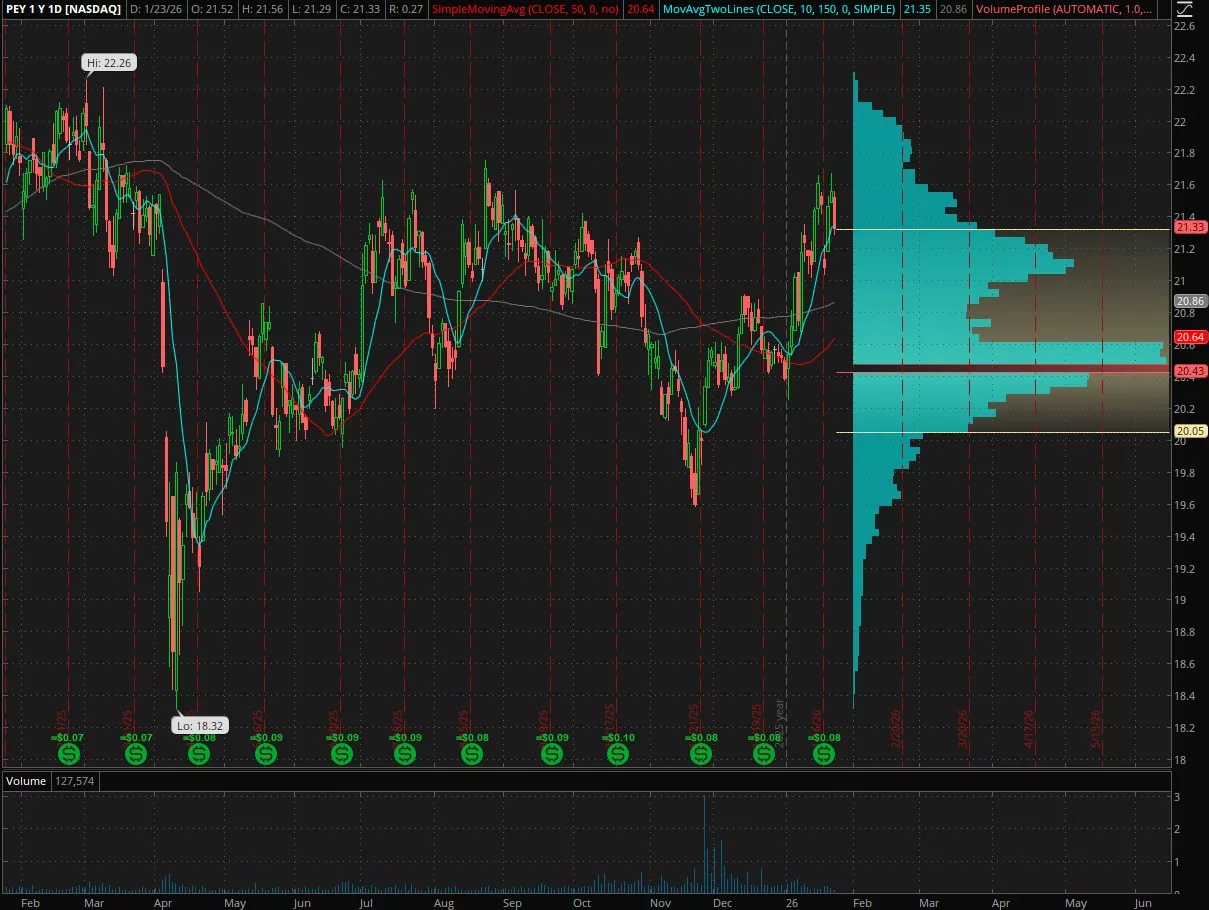
In April, it traded as low as 18.32 but rallied sharply, failing to break the high from earlier in the year. In November, it pulled back to about $19.60 and has bounced, but still is below the summer high of $21.75. Ths stock is bouncing but not soaring. It currently trades just 2.2% above its 150-day moving average price. SPY, which has gained 1.07% this year, trades 4.6% above its 150-dma.
A Look at PEY Relative to Large-Caps
Last week, I suggested that readers consider the Invesco S&P 500 Equal Weight ETF replacing investments in SPY, and I include both of those ETFs here in a comparison to PEY over the past decade:
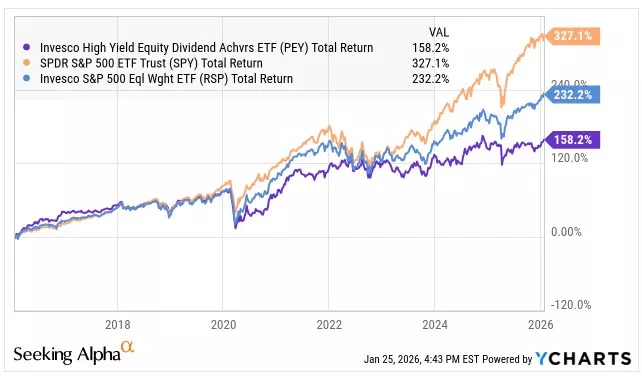
PEY has lagged even RSP, and the underperformance relative to it and to SPY has taken place since 2022. That total return of 158% has trailed the large and popular Vanguard High Dividend Yield Index Fund ETF (VYM) at 218% and also the Schwab U.S. Dividend Equity ETF (SCHD) at 232%.
Conclusion
For investors who are concerned that stocks could correct, an outlook that I have, PEY should hold up much better due to its low exposure to Technology stocks. Investors should not get too concerned about the higher expenses on PEY in my view. I am not super-bullish on the ETF due to my concerns about stocks (and bonds), but I do have a 10.2% position in my ETF model portfolio that aims to beat an index of 60% S&P 500 and 40% Aggregate Bond Index. That model portfolio is up 3.0% year-to-date, while the balanced index is up 0.7%.It currently holds a 15.1% position in RSP and a 15.4% position in SMDV for its equity exposure, which totals 40.6%.
More By This Author:
Be Careful With The Stock Of Curaleaf
Consider These ETFs To Diversify
OGI: My Favorite Canadian LP



Comments
Log in or sign up to join the conversation.