


I think that investors should be concerned about inflation, for reasons I explain below, and Treasury Inflation-Protection Securities (TIPS) look like a good way to protect portfolios. I follow 88 passive ETFs closely, including three that hold TIPS: Vanguard Short-Term Infl-Prot Secs ETF (VTIP), iShares Lehman TIPS Bond Fund (TIP), and PIMCO ETF Trust (LTPZ). There are several others, but these three are all different, with the group covering the offerings. VTIP, which has assets of $19.3 billion, has TIPS with maturities between zero and five years. TIP, at $14.5 billion in AUM, covers the entire maturity range, and LTPZ, which is much smaller at $691 million, has maturities that are 15 years or longer.
I like TIPS a lot right now, and my ETF model portfolio, which is measured against a 60/40 blend of stocks (SPY) and bonds (AGG), is currently holding 53.8% in these three ETFs, with the one I like best, LTPZ, at 24.2%, and the most recent new addition, TIP, now at 7.3%. I increased VTIP this week, and it is at 22.3%.
In this piece, I explain why TIPS in general make sense and why LTPZ makes the most sense.
The TIPS Market
TIPS were launched by the government in 1997. Currently, the federal government sells them with maturities of five years, ten years, and thirty years by auction. TreasuryDirect, which is a U.S. official website, shares the history. The government will be auctioning on July 23rd a new 10-year TIPS. There are currently 62 different TIPS outstanding, and the amount outstanding totals $2.16 trillion, which represents 7% of all federal Treasury securities.
TIPS have lower coupons than regular Treasury securities because they are paid for inflation as well. The way that investors get paid is through the accretion of principal rather than through interest. If there is deflation, the principal can go down, but the maturity value will always be greater than or equal to the original principal amount. The principal is adjusted for inflation as measured by the CPI-U, which does include energy inflation.
How TIPS ETFs Have Performed
TIPS did very well early in the pandemic, when inflationary pressure hit the market. The move away from inflation depressed the TIPS and the TIPS ETFs after that surge. Here is the total return action for the three ETFs that I follow from the end of 2019 to the present:
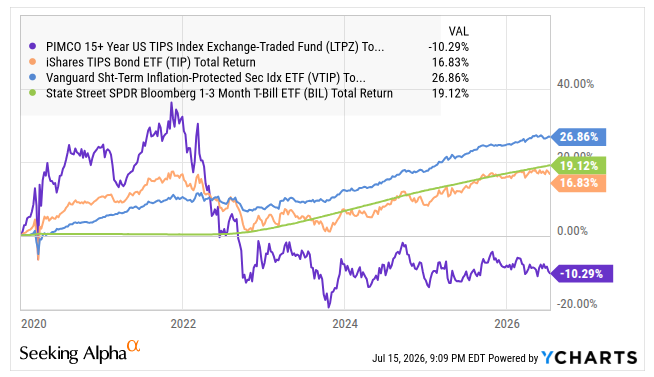
VTIP is the only one of these ETFs that has outpaced cash returns, while TIP has been modestly lower and LTPZ has been substantially lower.
Relative to Treasury ETFs
I like to compare the returns of the TIPS ETFs to similar-maturity Treasury ETFs. Here is the action in 2026:
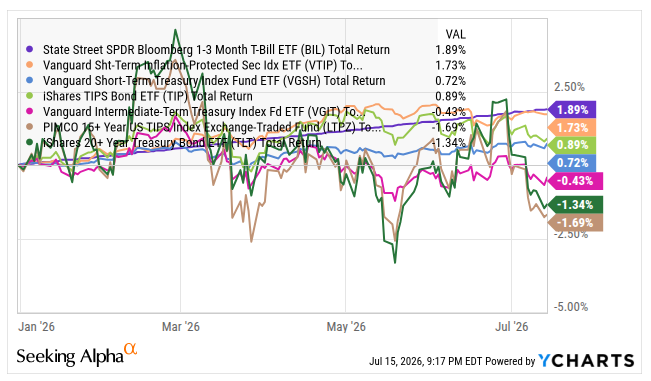
LTPZ is the only TIPS ETF that has lagged a similar maturity Treasury ETF, and all of the TIPS ETFs are returning less than cash.
Relative to Precious Metals
Precious metals have been traditionally used to preserve capital during inflationary times, but they are lower this year despite the pick up in inflation. Taking a look, though at the last three years relative to LTPZ, they have soared:
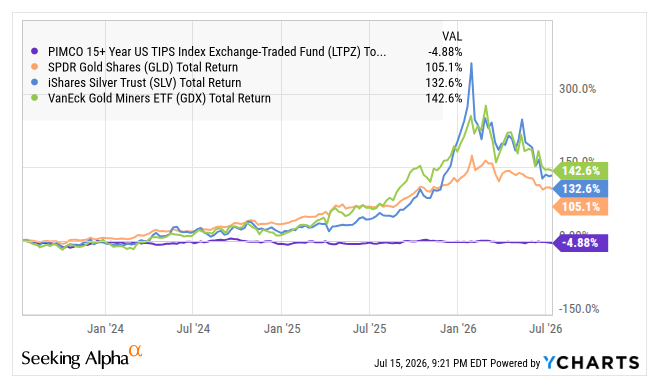
Inflation remains a concern to the Federal Reserve Board. The high amount of federal debt is one big issue, and the soaring oil prices compound the struggle.
The Current TIPS Offerings
Bloomberg shares a page that lists Treasury rates and TIPS rates, too. Here is the current one as of 7/15:
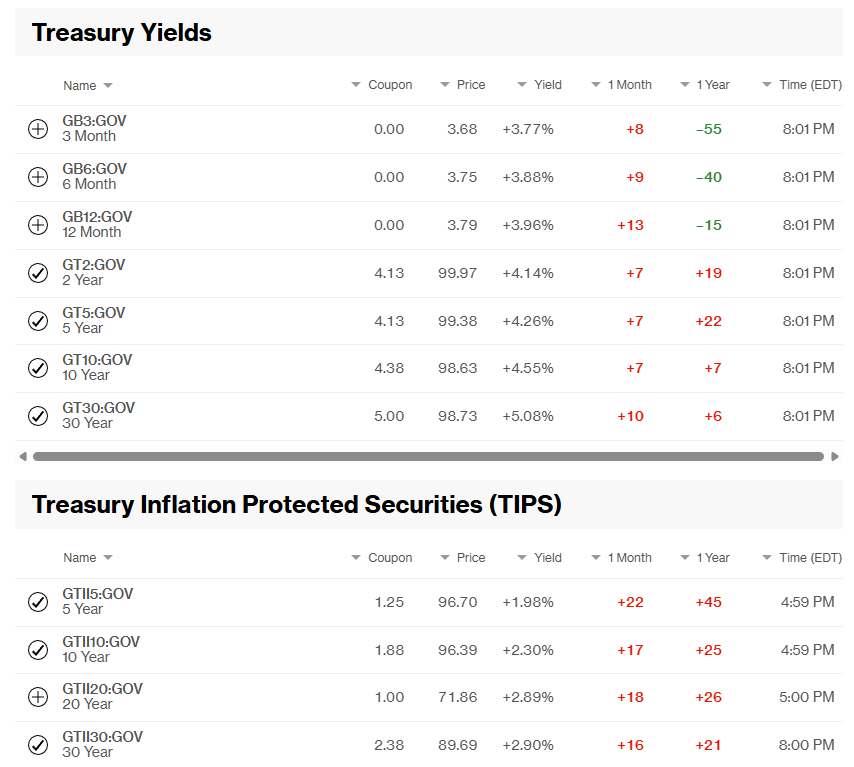
The 5-year TIPS issue yields 1.98%, which is 2.28% below the 5-year Treasury yield. At the 10-year maturity, the difference is 2.25%, and it is 2.18% at the 30-year level. The break-even, then, is about 2 1/4% inflation, and it is currently running higher than that.
In December 2024, the 5-year TIPS yielded 1.9%, which was 2.14% lower than the 5-year Treasury. The 10-year TIPS yielded 2.08%, and the 30-year TIPS yielded 2.14%. So, the yields on the TIPS have increased, especially for the long-dated ones. The spreads then were 2.07% for the 10-year and 1.8% for the 30-year. Due to increased inflation concerns, the differences have gotten wider, especially for the 30-year.
LTPZ Holders Get Inflation Protection and Potential Capital Gains
No matter the maturity of the TIPS, holders are protected from inflation. At higher rates of inflation, the amount of principal increases. The current breakeven is about 2 1/4%, and the returns of the TIPS and the TIPS ETFs will be aided by this mechanism.
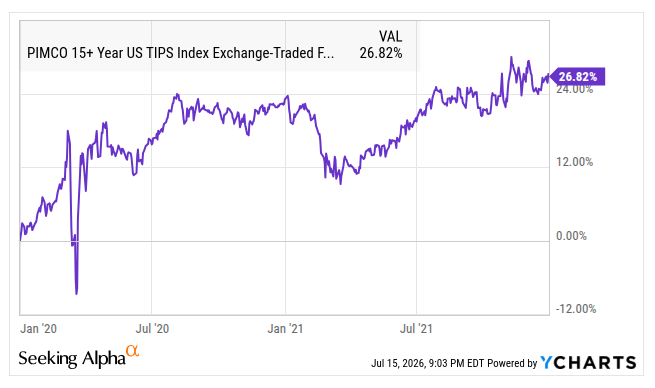
Longer-dated TIPS have more exposure to price changes, and for those investors who believe that the implied inflation rate will rise from the current level to 3%, this could mean big price increases for the longer-dated TIPS. Assuming an unchanged yield curve, the 5-year TIPS would yield 1.26%, which would suggest a decline of 0.72% in yield. This would suggest an increase in price of about 3.6%. For the 30-year, the move from 2.90% to 2.08% would increase the price by about 19.1%.
The price action on LTPZ from 2020 to 2022 shows how much it can move:
Conclusion
I like TIPS, and I especially like LTPZ. If inflation remains at its current levels or increases, TIPS will likely perform much better than regular Treasuries. I see the potential for large price gains in long-dated TIPS and, hence, LTPZ.



Comments
Log in or sign up to join the conversation.