


On January 25th, I discussed why investors should buy Invesco High Yield Dividend ETF (PEY), and it has rallied. Earlier that month, I had initiated coverage on another ETF, the ProShares S&P 500 Dividend Aristocrats ETF (NOBL), which I upgraded at Seeking Alpha about a month ago. For anyone who might own PEY, I think it makes sense to swap out of it into NOBL.
A Look at NOBL
NOBL is focused on large-cap stocks, and you can learn more about it by visiting the website that ProShares maintains. A Dividend Aristocrat is one that has increased its dividend for each of the past 25 years. Barron's shared a piece that mentioned this ETF this weekend when author Andrew Bary focused on Dividend Kings, which have increased dividends for 50 years.
ProShares launched NOBL in 2013, and its expense ratio is 0.35%. The number of stocks is currently 69, and the assets under management total $11.3 billion. Here are the top names by weight:
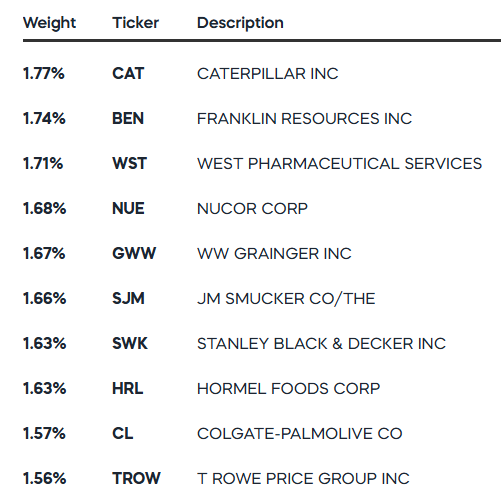
The ETF is the only one that focuses on S&P 500 Dividend Aristocrats, and it is reconstituted each January based on data as of the end of December. It is rebalanced quarterly, with the qualifying companies being set equally weighted.
The sector exposure of NOBL is very high in Consumer Staples and Industrials and very low in Technology and Consumer Discretionary relative to the S&P 500:
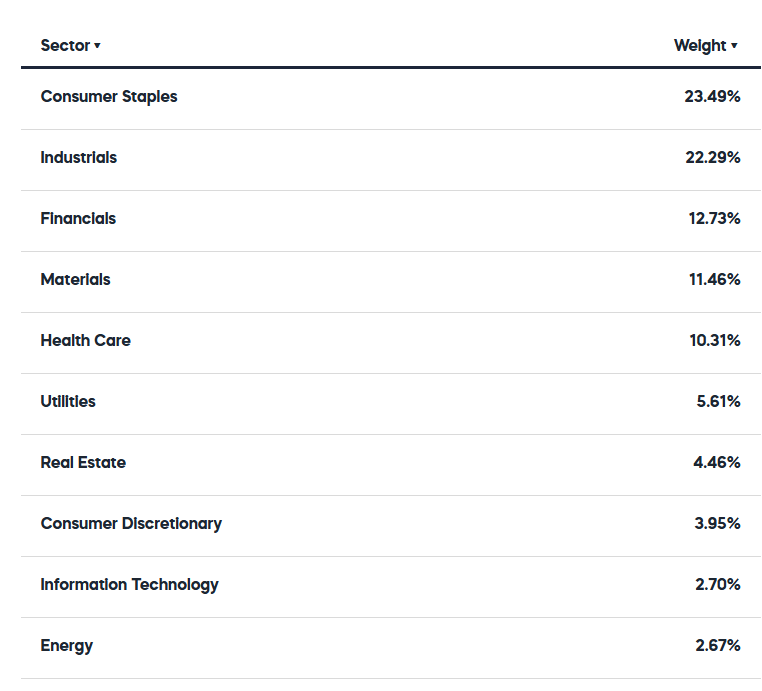
I am cautious on Technology currently, and I like this underweighting. NOBL has a reasonably low fee, a long track record, good size and liquidity and is lagging the S&P 500.
An Update on PEY
PEY is also focused on dividends, but it tracks a different index, the NASDAQ US Dividend Achievers 50 Index. Invesco maintains a page for PEY on its website. One big difference from NOBL is that there is no rule regarding being in the S&P 500, and PEY has much smaller names. NOBL reports that its average market cap was $107 billion as of May 31st. The range that I see is from $8 billion to $932 billion currently,with a median of $46 billion. PEY market caps frun from $1.3 billion to $343.3 billion, with a median of $10.7 billion.
The ETF has been around longer (since 2004) and does charge slightly more (0.40% but a total expense ratio of 0.54%) than NOBL. It has fewer stocks than NOBL, and it is more concentrated in its holdings. It is a lot smaller than NOBL with $1.1 billion in assets under management. Here are the top 10 names currently:
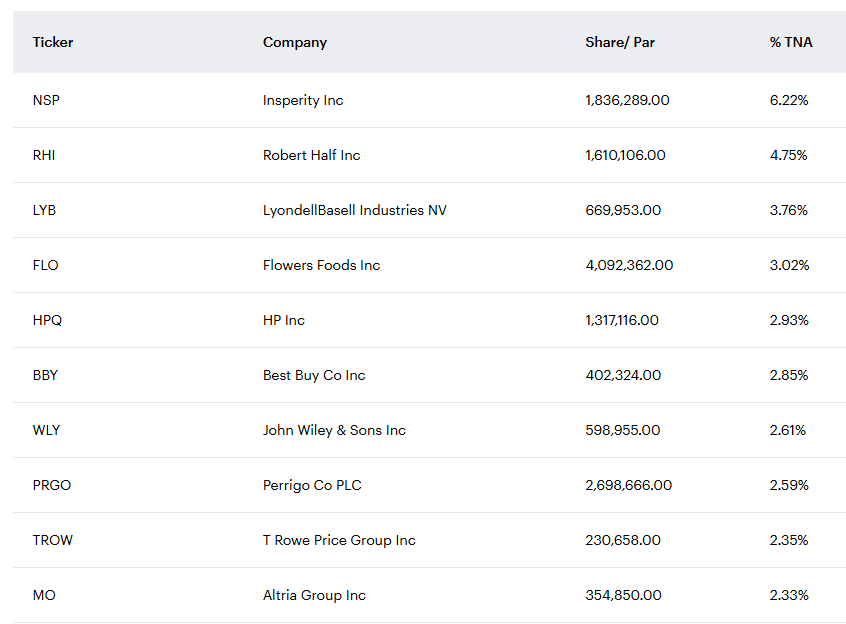
The Top 10 total 26.5%, which is higher than the 16.6% in NOBL. The overlap among the Top 10 for the two ETFs is small, with just one name, T. Rowe Price (TROW) in both. Also different is the sector exposure, with PEY very heavily weighted towards Financials. Here is the PEY exposure by sector at the end of May:
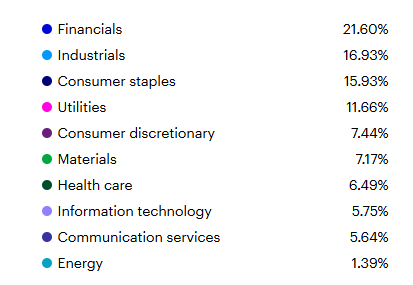
While the Technology exposure is higher than it is in NOBL, it is very low compared to the S&P 500.
NOBL Has Underperformed PEY
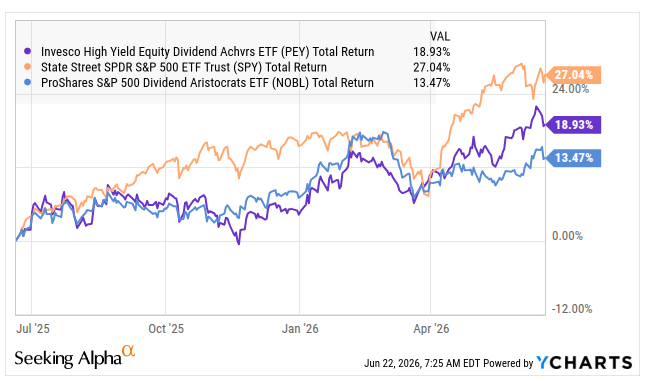
In 2026, NOBL has increased in price by 5.6% for a total return of 6.1%, while PEY has gained 12.0% for a total return of 14.1%. When I wrote about PEY here at TalkMarkets in January, it was at $21.33. and now, at $22.83, it has increased in price by 7.0%.It has also paid its monthly dividend. The total return since January 23rd has been 8.7%, while NOBL has returned 1.0%.
Over the past year, PEY has outpaced NOBL, while underperforming the S&P 500:
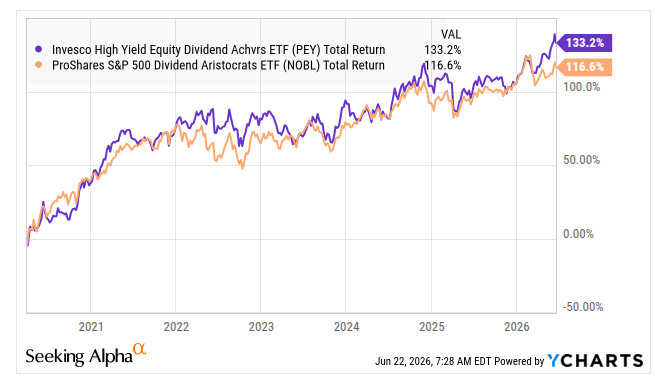
Since the end of Q1 2020, after the pandemic hit, PEY has outperformed NOBL too:
Why NOBL Is a Better Buy Right Now
My ETF model portfolio holds a position in NOBL of 6.2%. The model portfolio, which is measured against a balanced index that is 60% S&P 500 , has three other ETFs in it, and the total equity exposure is just 28.9% currently. NOBL is the second-largest equity ETF, and I exited PEY earlier this year.
Buying the laggard does not always work, but it can give investors an opportunity. There are some issues that are favorable for NOBL, like a lower fee, less Technology and better diversification by name, but these aren't driving my view either. I like NOBL due to its sector exposure and overall attributes relative to the S&P 500 and to PEY, which I also prefer to the S&P 500.
I think that the low exposure to Technology and Energy for both ETFs leaves room to focus on two other sectors, Consumer Staples, the largest in NOBL, an Financials, the largest in PEY. On Financials, which I just downgraded to Sell for the large-caps, I am not so negative on smaller companies, as M&A could be strong. PEY has just three names with more than $20 billion market cap, so I don't hold my negativity for large-cap Financials against it.
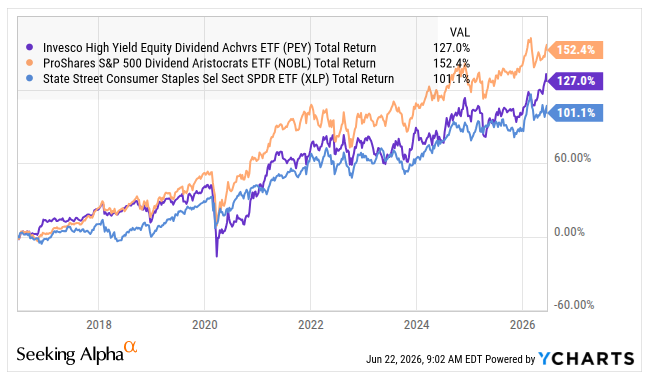
I am not a big fan of Consumer Staples, but the sector typically does better than stocks generally during periods of economic weakness. I am very cautious on the economy right now, seeing inflationary pressures from not only the elevated price of oil due to the war with Iran but, more importantly, the challenge of dealing with a very large and growing level of federal debt. In 2026, large-cap Consumer Staples, as measured by a State Street fund, have returned 7.8%, which is less than PEY and more than NOBL. Over the last decade, it has lagged both:
In 2026, small-caps are doing better than large-caps. The Russell 2000 Index has returned 20.6%, almost double the return of the S&P 500 at 10.7%.The S&P 400 Mid-Cap Index This may be helping PEY relative to NOBL. I discussed the market cap differences above, and now I would like to share some overall attributes for the two ETFs.
PEY does have a higher dividend yield, with a median among its holdings of 4.6% and an average of 5.4%. NOBL has about half the yield. PEY members have dividends ranging from 3% to 12.7%, while the NOBL dividend yields run form 0.3% to 6.3%. 6 of the 50 names in PEY have yields above the maximum yield of NOBL members, including four of the largest ten names above. Those four names include three that are down in total return so far in 2026.
There is more to valuation that the dividend yield, and looking at some of the characteristics, PEY does have a low PE near 12X for the year ahead, and this is lower than the level for NOBL, which is closer to 20X. The EV/EBITDA for NOBL holdings is a median of 13X with an average of 14X, and PEY is considerably lower. What is the catch? NOBL has higher quality names! It goes beyond the fact that they have been increasing their dividends for the past 25 years. NOBL names have better balance sheets. The net debt to EBITDA less CapEx over the past year has been a median of 2.6X and an average of 3.4X. For PEY, it has been a median of 3.4X and a weighted average of 8.0X.
PEY is performing very well in 2026 so far despite the weak performance of 7 names (14%) that have returned less than -10%, including the two largest names in the ETF. How has it overcome this? Three of the largest ten names are up more than 20%.
Conclusion
I am downgrading PEY from Buy to Hold and initiating coverage here of NOBL as a Buy. PEY is a well-run ETF, but it is smaller and slightly more expensive than NOBL. The main reason to swap is to avoid certain smaller names that have rallied sharply and to avoid the large exposure to other names that have rallied substantially.
I am not so sure that NOBL will keep rallying, as I am cautious on stocks. I do think that it will hold up better than the S&P 500. I mentioned above that it is my second-largest equity ETF, as I have reduced another one that has rallied substantially. I still like it, the ProShares Russell 2000 Dividend Growers ETF (SMDV), but it is down to just 4%. My largest holding among equity ETFs is ProShares S&P MidCap 400 Dividend Aristocrats ETF (REGL).
If one is bearish on stocks, like me, it is important to protect one's portfolio by reducing exposure to the riskiest parts of it, like the Magnificent 7 or Elite 8. PEY, which I am downgrading, does not have exposure to that, and neither does NOBL or the other ETFs that I just mentioned. PEY does have have exposure to smaller stocks, and they are rocking right now. It has exposure also to companies with worse balance sheets. I am downgrading PEY to Hold, and I am upgrading NOBL to Buy.



Comments
Log in or sign up to join the conversation.