
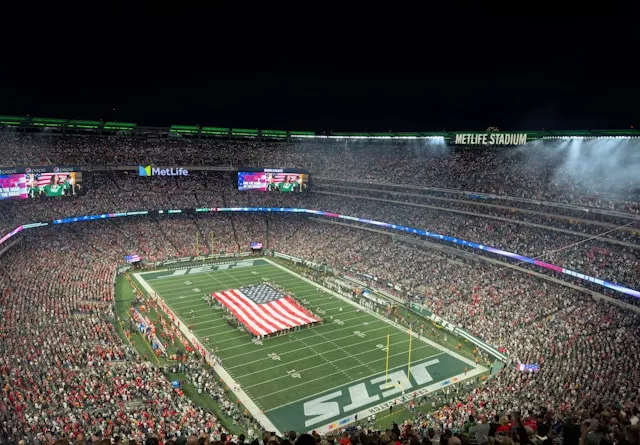
Photo by Myron Mott on Unsplash
Below are some of the most interesting stats we came across related to this weekend's Big Game. Enjoy!
Super Bowl Stocks
NFC Bulls. In the 30 years that the NFC won the Super Bowl, the S&P 500's average gain for the rest of the year was 9.6%, with positive returns 77% of the time. In the 29 years that the AFC came out on top, the S&P 500's average rest of year gain was 7.0%, with gains 72% of the time. (Source: Bespoke)
Seahawks! Win or Lose The Seahawks have previously appeared in 3 Super Bowls, winning one and losing two. In the two years they lost, the S&P 500 averaged a gain of 7.3% for the remainder of the year, with gains both times. After they won in 2014, the S&P 500 rallied 15.5% through year-end. (Source: Bespoke)
Go Pats! The Patriots already have the record for most Super Bowl appearances with 11, winning six and losing five. Following the six victories, the S&P 500's average rest of year performance was a gain of 4.6%, with gains five times. After their five losses, the S&P 500's average rest of year gain was 1.0%, with gains three out of five times. (Source: Bespoke)
Hoping For a Blowout. The S&P 500's average rest of year gain after a Super Bowl blowout (21 or more points) has been 12.9%, with positive returns 12 out of 13 times. In the 10 years when the game was decided by a field goal or less, the S&P 500's average rest of year gain was 3.1%, with positive returns 7 out of 10 times. (Source: Bespoke)
Bears Want Defense. When the total points scored in the Super Bowl was 60 or more, the S&P 500's average rest of year gain was 12.3%, with gains 11 out of 12 times. When the total score was 30 or less, the S&P 500's average rest of year gain was 5.7%, with positive returns just 4 out of 7 times. (Source: Bespoke)
Bowl Business
The "Big Game" Trademark Trap. Because the NFL strictly enforces its trademark on the term "Super Bowl," thousands of businesses are legally forced to use the phrase "The Big Game" in advertisements to avoid multi-million dollar fines.
A $50,000 Icon. Despite the game generating billions in revenue, the Vince Lombardi Trophy, handcrafted by Tiffany & Co. over four months, is valued at only about $50,000, less than the weekly salary of many players on the field. (Source: FanDuel Research)
Sick Day Sunday. An estimated 16.1 million Americans plan on calling in sick to work the Monday after the Super Bowl, making it one of the least productive workdays of the year. (Source: The Journal Record)
A Lake of Beer. Americans will collectively consume enough beer on Super Bowl Sunday to fill 492 Olympic-sized swimming pools. (Source: Simpleview)
The Pizza Perimeter. If every pizza eaten on Super Bowl Sunday were lined up side-by-side, the chain would extend from New York City to Phoenix, Arizona. That’s roughly 2,368 miles of medium pizzas. (Source: Hungry Fan)
The "Crispy Equator" Consumption. For Super Bowl LX, Americans are projected to consume 1.48 billion chicken wings; if laid end-to-end, they would circle the Earth nearly three times. (Source: National Chicken Council)
The Big Feast. Super Bowl Sunday is the second-largest food consumption day in the U.S. after Thanksgiving. Americans consume over a billion chicken wings and tens of millions of pounds of snacks during the game. (Source: Barron’s)
Ads
For those that remember, the January 2000 Super Bowl ended up being dubbed "The Dot Com Bowl" because of all the internet commercials.That turned out to be poor timing because the Nasdaq was getting ready to hit its bubble peak in a couple months.
The February 2022 Super Bowl ended up being dubbed "The Crypto Bowl" because of all the crypto ads.That too turned out to be right around the time that crypto was peaking and stocks were entering a new bear market.
This year's Super Bowl is expected to have quite a few AI ads.We can only hope it doesn't get dubbed "The AI Bowl" based on the prior Dot Com and Crypto experiences!
The 20% Inventory Takeover. In 2000, 14 different companies with ".com" in their name bought airtime, accounting for nearly 20% of the total available ad spots. (Source: Wikipedia)
Betting the Entire Seed Round. The startup Computer.com famously spent $3 million of its $5.8 million in total seed funding on a single Super Bowl ad before the website had even officially launched. (Source: The Hustle)
A "Puppet" Production. The infamous Pets.com ad in 2000 required a massive production team of 150 people, 40 companies, and a 20-piece orchestra; the company liquidated and went defunct less than a year later. (Source: Sports Business Journal)
Irony in Retrospect. The FTX ad featuring Larry David in 2022 used the tagline "Don't Miss Out," a message that aged poorly when the exchange filed for bankruptcy just 10 months later. (Source: Bespoke)
The "Fortune Favors the Brave" Decline. Following Crypto.com's high-profile ad featuring Matt Damon in 2022, the company’s native token (CRO) dropped approximately 83% in value within the following year. (Source: Bespoke)
Alexa, Play “For the Love of Money.” Amazon holds the record for the most expensive Super Bowl commercial with its Alexa Mind Reader ad in 2022 that ran 90 seconds and featured real-life couple Scarlett Johansson and Colin Jost. The cost to produce and air the ad was $26 million. (Source: Qualtrics)
The Game
Not Super at First. The first Super Bowl in 1967 was not even called the "Super Bowl" at the time; it was officially titled the "AFL-NFL World Championship Game," a name that was later scrapped for having "no ring to it."
Looking to Even the Score. Through the first 59 Super Bowls, the NFC has won 30 times versus the AFC's 29. Since the Packers won Super Bowl I, the two conferences have only been tied in the number of championships five times, and in the 29-year stretch from 1991 through 2019, the NFC held the title lead. (Source: Bespoke)
Rematch. Super Bowl LX is the 11th rematch between two teams who previously played each other in a prior Super Bowl. In the ten prior occurrences, the winner of the 'rematch' was the same as the previous winner six times. (Source: Bespoke)
The 108-Ball Handcraft. Wilson Sporting Goods hand-stitches exactly 108 footballs for each team (54 for practice and 54 for the game), each one specially stamped with the "Commissioner" signature and the Super Bowl logo. (Source: CBS News)
The White Jersey Advantage. In a strange statistical trend, teams wearing white jerseys have won 16 of the last 21 Super Bowls and hold a 37-22 overall record in the big game. (Source: Sports Illustrated)
The Losing MVP. Only one player in history—Cowboys linebacker Chuck Howley in 1971—has ever won the Super Bowl MVP award while playing for the losing team. (Source: Wikipedia)
A "Worst to First" Record. The 2026 New England Patriots are the first team in NFL history to reach the Super Bowl immediately following a season in which they lost 13 or more games. (Source: CBS Sports)
The 34-Minute Blackout. In 2013, Super Bowl XLVII was famously suspended for 34 minutes due to a partial power failure in the Superdome, an event that became a marketing goldmine for Oreo, which tweeted "You can still dunk in the dark" during the delay. (Source: Digiday)
Gridiron Gridlock. Only two Super Bowls have ever gone to OT, both in the last decade. It took more than 50 years to get to a Super Bowl OT. The first came in Super Bowl LI, when the Patriots came back from down 28-3 against the Falcons. The second was when the Chiefs came from behind against the 49ers in Super Bowl LVIII. (Source: DraftKings)
House Call. Devin Hester opened Super Bowl XLI by returning the opening kickoff 92 yards for a touchdown — the only opening kickoff return TD in Super Bowl history.There has never been a punt returned for a TD in a Super Bowl. (Source: Pro Football Hall of Fame)
Safety First. The first score in Super Bowl IX was a safety, the first in Super Bowl history, due to a botched snap. (Source: SB Nation)
Bets
The "Omaha" Over/Under. In 2014, sportsbooks set an over/under line of 27.5 on how many times Peyton Manning would shout his signature "Omaha" cadence; he said it 44 times, leading to a massive "Over" payout that forced books to rethink cadence betting. (Source: New York Post)
The "Fridge" Payout. In 1986, Caesars Palace offered 20-1 odds that 335-pound William "The Refrigerator" Perry would score a touchdown; the public bet so heavily on the "Yes" that his third-quarter score cost Vegas over $100,000 on a single player prop. (Source: ESPN)
The Gatorade "No-Show." In 2021, bettors were stunned when no Gatorade was poured on the winning coach, sparking a massive controversy in the betting community as "No Gatorade" was not an option on many prop sheets. (Source: Yahoo Sports)
The Preseason Longshots. The 2026 matchup (Patriots vs. Seahawks) is the first since 1981 to feature two teams that both had preseason odds of 50-1 or longer to make the game. (Source: CBS Sports)
The Crossover King. In 1990, a "cross-sport" prop bet asked if the 49ers would score more points than Michael Jordan would for the Bulls on that same day; the 49ers won the bet by outscoring "His Airness" 55-39. (Source: Audacy)
Halftime
The Disney Marketing Gimmick. In 1995, the halftime show was an elaborate Indiana Jones-themed stunt used primarily to promote a new theme park ride, featuring impersonators rather than the actual actors. You can watch it here. (Source: Yahoo)
The "Super Flush" Phenomenon. Municipalities often see a massive surge in water usage during the Super Bowl halftime; in some years, the volume of water used simultaneously is equivalent to seven minutes of flow over Niagara Falls. (Source: San Jose Water)
The Unplugged Performance. During the 2014 halftime show, eagle-eyed fans noticed that Flea of the Red Hot Chili Peppers was "playing" a bass guitar that wasn't actually plugged into anything, later confirming the band had pre-recorded the instruments for better audio quality. (Source: Time Magazine)
More By This Author:
Average Software Stock Now Down Since Tariff Tantrum Lows
Bitcoin To 52-Week Lows
Walmart: The First Trillion Dollar Big Box

Comments
Log in or sign up to join the conversation.