

Inflation is gaining speed and spreading well beyond the energy sector, necessitating a much more serious concern with the possibility of central banks raising rates. US debt markets were jolted, last week, by the release of consumer and producer price increases that went well beyond the 2 %target rates used to guide central bankers. Prior to the beginning of the Iranian war in late February this year, investors anticipated that central banks would gradually cut rates over the next 12-18 months .Now investors are, at best, expecting rates to remain unchanged, over that same time period.
Consumer Price Index rose at a seasonally adjusted 0.6% for the month of April, putting the one-year pace at 3.8% . Excluding food and energy, the index was up 4.4% , an acceleration from the 3.7% rate in March. These price changes may not have fully worked their way into the consumer sector as yet , but it is most likely they will do so in the next couple of months.
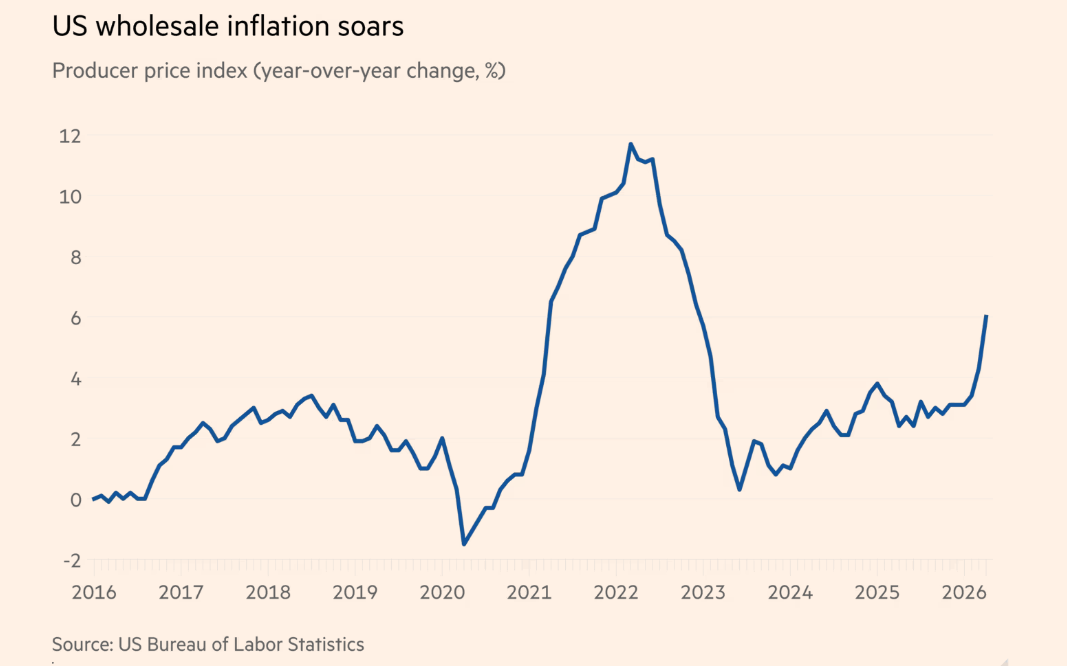
Wholesale Price Index is primarily used to monitor inflationary pressures in the economy, particularly in the production and distribution sectors. April’s Producer Price Index jumped 1.4%, marking the biggest advance in more than four years. Year over year, wholesale prices have climbed 6%, nearly double the rate at the beginning of 2026.
Oil prices are under continued pressure. US energy authorities reported a tightening trend in domestic inventories.The drawdown in inventories is widespread, especially in jet fuel, owing to the ongoing disruptions in tanker flows through the Persian Gulf.
Tariffs are still sticky. Although US courts have ruled that President Trump acted illegally in slapping tariffs on thousands of imports, he has placed a 10% duty on an array of tariffs temporarily, ending on July 24th. In addition, the US has placed specific tariffs, up 50% on steel, aluminium and copper. The application of tariffs is very uneven with respect to the country of origin. China has an average tariff rate of 31%, while Canada and Mexico face an average rate of 5%. In short, the whole tariff situation is somewhat confusing,nonetheless they contribute to inflation at both the producer and consumer segments.
Often, first to respond to inflation, is the bond market. The long bond is the most sensitive to investor inflation expectations. Last week’s auction of the 30-year US bond exceeded a 5% yield, the first time since 2007. The prospects for a sustained renewal of hostilities in the Persian Gulf, clearly has spooked bond investors who fear a new wave of inflation in the making. Internationally, long-dated bonds in Japan and UK, dropped in price ( increased in yield) in lock-step with developments in the US market.
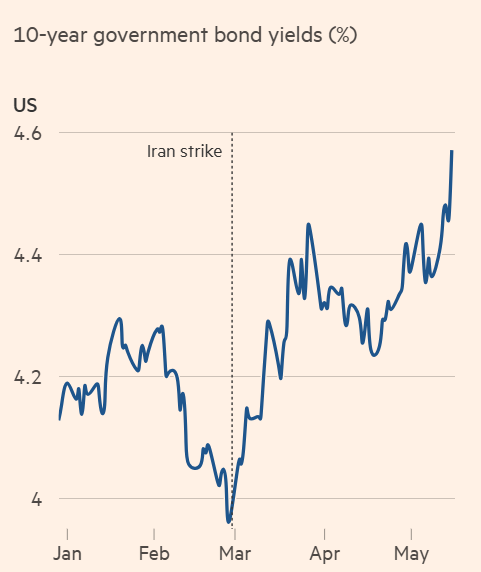
Central bankers are reticent , and have been careful not to speak about the need to raise interest rates to combat this surge in prices. Nonetheless, there are musings within the banking community of the possibility of rate increases. Susan Collins, president of the Fed’s Boston branch, said that she envisions a scenario where the US central bank would need to raise interest rates to combat the surge in inflation. Globally, the tenor of monetary policy has definitely shifted, away from stimulative rate cuts, to a tightening bias to deal with this new wave of inflation risk. At the Fed, some dissenting voices are pushing for a tightening bias, given that the labor market is healthy, but inflation remains unchecked. ECB members are clearly concerned that the supply shocks are now hitting the economy . Lastly, the Bank of Japan has signalled that it has abandoned its ultra-loose monetary policy, and investors expect rate hikes in the very near future.
Comments
Log in or sign up to join the conversation.