

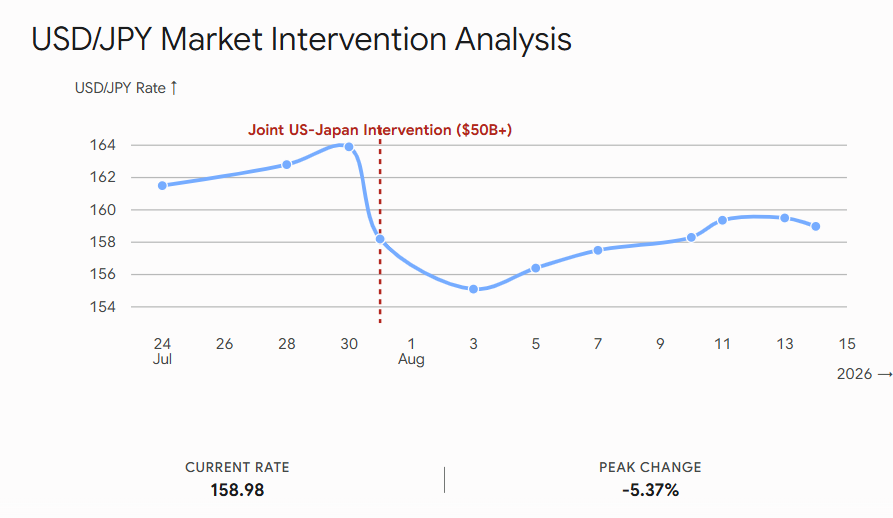
When the US Treasury Secretary Bessent, revealed that the US was intervening to stabilize the yen, in late July, the currency traders were put on notice that it was in the best interest of all concerned that the yen recover. The yen is one of the most heavily traded currencies in global trade, and it declines signifies that current conditions in the Japanese economy are a growing concern. Initially, the intervention resulted in the yen recovering considerable lost ground, appreciating from ¥164 to the dollar to almost ¥155. It has since been around ¥159, giving up about half of its gains. In a word, the intervention has been met with modest success, underscoring how little faith traders have in US intervention.
Many factors are driving the yen down, including interest rate differentials between the two nations, Japan’s outsized government debt, and a widening trade imbalance. Economic theory suggests that any one of these conditions would result in a weaker currency. Collectively, they are a powerful punch that is keeping the yen on its backfoot.
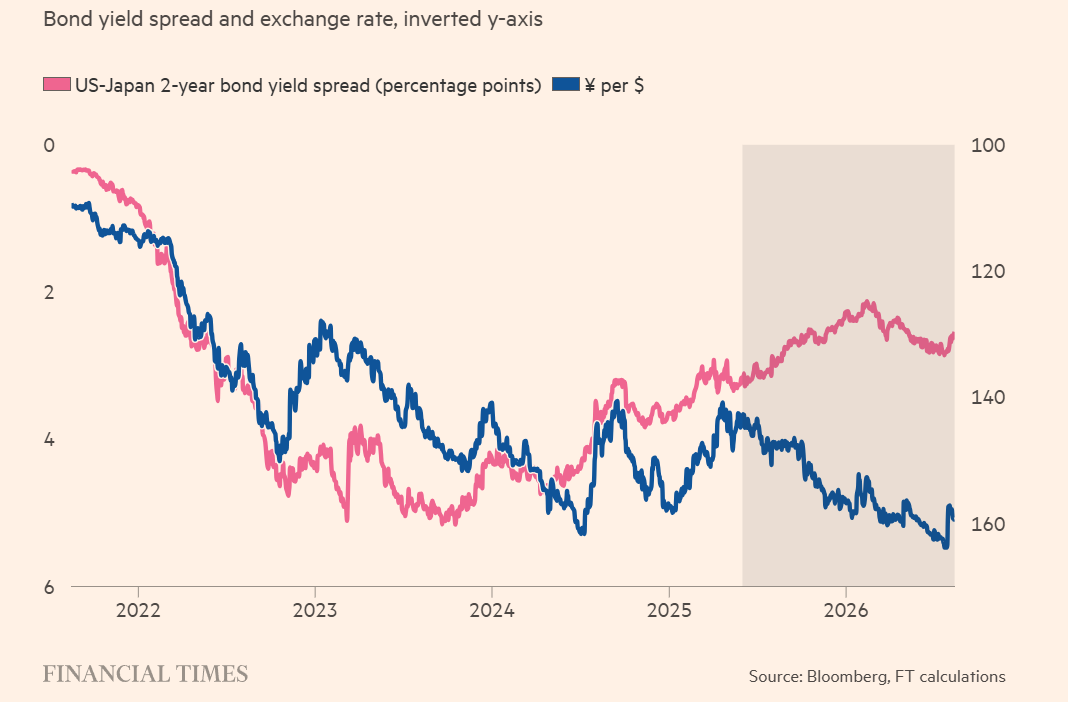
Money flows to the highest rate of return. In the case of the yen, the widening differential spread in favour of US rates is the dominant reason why the yen has been under so much pressure. The negative correlation between the US two-year rates rising and the yen falling has increased this year. The sinking of the yen is signaling that the Bank of Japan (BOJ) needs to become more aggressive in setting its bank rate. As it stands, Japanese companies and households have every incentive to place their money overseas to earn higher returns. Secondary factors, such as fiscal tightening, can play a role in boosting the yen, but it is highly unlikely the Japanese government will ease up on spending to promote growth. After years of stagnation, anything that will result in positive growth will be welcomed.
For years, US and EU investors have borrowed yen to take advantage of near zero percent rates offered by the Japanese banks, the familiar “carry trade”. That trade generally depressed the value of the yen as the yen was sold to purchase high-yielding foreign assets, e.g. US debt or equities. As long the interest rate differentials remain this wide, there is no incentive for investors to unwind their trades and to sell dollars to buy yen to pay back Japanese banks. Japan’s low borrowing costs relative to the US — and to other big economies such as the Eurozone — essentially account for the yen underperformance.


Comments
Log in or sign up to join the conversation.