


As bond investors bite their nails daily in response to rising Treasury yields, the bond giant, PIMCO warns that in the US the benchmarked borrowing rate could easily hit 6% after weeks of relentless selling. The pile-up of fears, starting with high oil prices, an ever - expanding US debt market, now at $32 trillion, and inflation well above the 2% target, have come together to form a perfect storm, forcing investors to seek shelter elsewhere. Just prior to the start of the Iranian conflict in February, 10-yr yields hovered around 4%, and today it trades at 5.25%, an unprecedented run up in such a short time. This surge in yield has rippled through the mortgage market and corporate bonds in rapid fashion, leaving little time for investors to adjust their portfolios. Since Treasuries are the most liquid, many funds were obligated to sell them forcing other Treasury investors to do the same to minimize losses, only to contribute to a further rise in yields.
PIMCO did introduce the idea that investors need not just own US Treasuries to enjoy “very high-quality credit “ and reasonably competitive returns. They point to Canada and Germany as having “very attractive yields and a better starting fiscal position”.
Let's look at credit quality first. Canada enjoys the highest credit quality rating, AAA and has for many years. The US federal deficit now exceeds 6.2%, often cited as a high- risk watermark, compared to 1.2%. Similarly, US outstanding debt equals 123% of national income; Canada’s is just 41%.
The US is facing a circular situation, or sometimes referred to as a “doom loop”. The deficit continues to rise as interest rate costs amass, only to force the federal government to issue more debt, ultimately contributing to higher interest rate expenses. With net interest payments becoming one of the largest line items in the US budget, the supply of Treasuries required to fund both operations and interest expense is structurally pushing up the need for more investor protection in the form of higher interest rates.
(One caveat. Canadian provinces carry much more of the debt burden associated with health care and education than that exists among the US states. Even taking that into account, Canadian overall debt burdens are much lower. Canadian provinces have the implicit guarantee of the federal government, and are able to borrow at very competitive rates.)
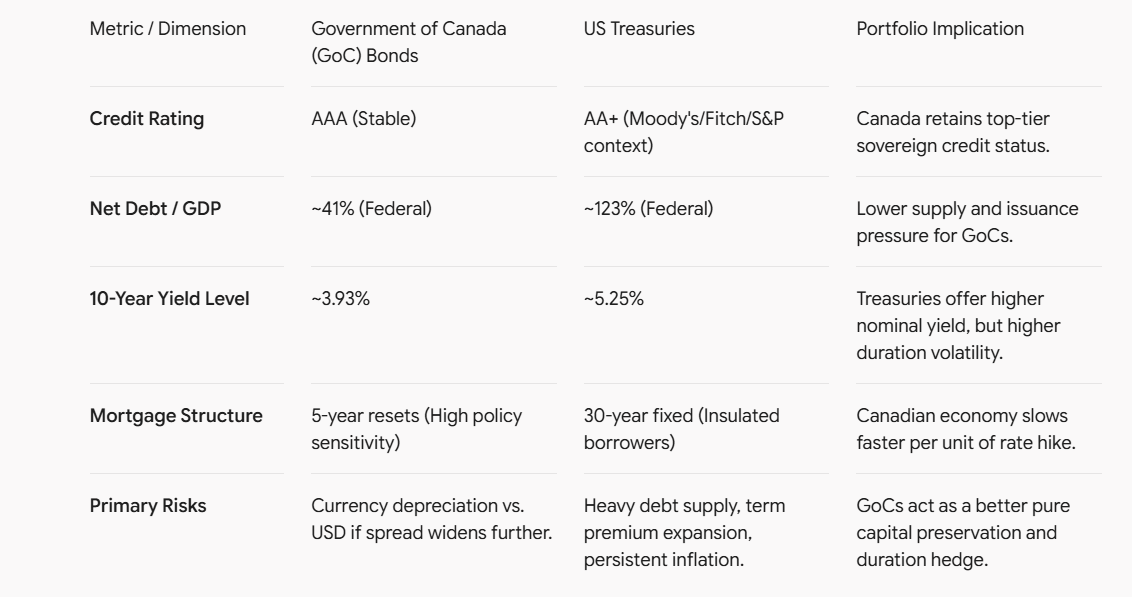
Canadian bonds trade at approximately 130 bps below US Treasuries, largely reflecting the expectation that the Bank of Canada will keep its policy rate well below that of the Federal Reserve. Canada's inflation rate is not the same as the US. While both countries face the same higher oil prices that are pushing up total inflation, the US is dealing with the impact of tariffs applied universally. The US is contending with widespread price increases throughout the economy above 3%. Canadian inflation is tied mostly to oil prices, and is not as widely felt. In other words, the underlying inflation conditions are not the same, and the risks facing Treasury holders is much greater. The Bank of Canada is not expected to raise rates anytime soon, whereas the Fed is likely to have more rate hikes in the coming months. Hence, we can expect short term interest rate spreads to continue favouring Treasuries .
In sum, while the investing world focuses on the US Treasuries—and rightly — other nations with excellent credit ratings offer another choice involving less fiscal risk from the issuer.

Comments
Log in or sign up to join the conversation.