


Trump’s onslaught of tariffs and threats to Canadian sovereignty have galvanized the Carney government to instigate a series of major resource development projects, unprecedented in the country’s history. These projects are designated as public-private partnerships.
So far, the private sector involvement has not materialized and currently, these ambitious projects remain under public ownership. PM Carney is staking his reputation on fast-tracking projects in new energy corridors, extraction of critical minerals, port and transportation expansion, and defense of the country’s Arctic region. Although it is early days,the capital costs are expected to hit the C$1 trillion mark over the next five years. Canada will have to become a much larger borrower of long-term debt than ever before.
The message from the international bond markets has been loud and clear—-- too much government debt exists and more is forthcoming. Borrowing rates are surging in the G7 nations, as long term rates exceed 5%, a level not experienced in over two decades. Leading the skeptics in the bond market are Treasury investors, soon to be followed by a raft of corporate bond issues financing the buildout of AI data centres and related expansions from the so-called hyperscalers leading the way.
Surveying the major industrialized nations, Canada enjoys a very favourable position among international creditors. Overall, its AAA credit rating puts it in a select category of borrowers. Canada’s gross-debt-to GDP is 86%, well-below the G-7 average of 125%. The federal government share is just 41%, while the provincial governments account for the remaining balance. Canadians are savers, and factoring in savings in public pension plans, Canada clearly has the lowest net debt-to-GDP ratio in the G-7 by a considerable margin.
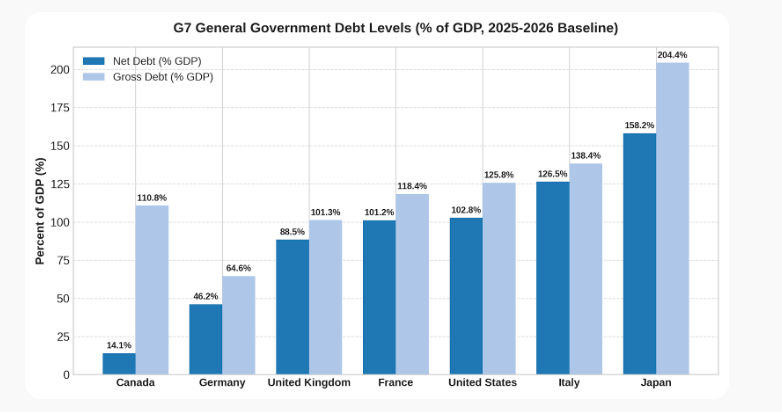
Moreover, Canada’s federal government debt is heavily weighted in the long end of the bond market.A major portion of capital infrastructure project funding is explicitly matched with long-duration 10-year and 30-year paper to align the debt's maturity profile with the long-term economic lifespan of the physical assets built (e.g., ports, transit corridors, sovereign defense infrastructure). Supply dynamics still count towards borrowing costs, and issuing a large amount of 10-year and 30-year Canada bonds over five years could cause the rates at the long end to steepen.
So far, international bond investors consider these capital programs are manageable. Granted, Canada is not immune to the recent rise in long- term interest rates. However, these relatively favourable debt measures explain, in large measure, why the Canadian 10-year bond yield is currently 135 bps lower than that of the US 10-year . What remains now is for the Carney government to execute on these capital projects.


Comments
Log in or sign up to join the conversation.