

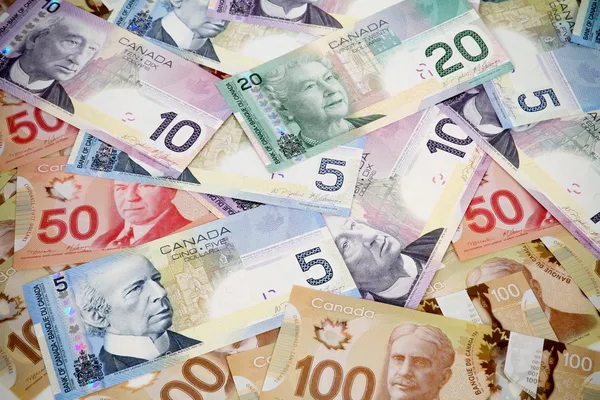
Quietly, the Canadian dollar has been falling, as the world adjusts to the surge in US interest rates. USD/CAD started the year at 1.34. The rate is now trading at 1.41, and most trading activity points to the rate continuing to sink, as the US is expected to raise its lending rate once again next month.
For most part of 2025, both the Fed and Bank of Canada (BoC) were on a similar path, maintaining low rates in response to slowing economies. In 2026, the underlying conditions in both countries diverged, forcing Canadian rates to be cut faster and deeper. The decoupling in rates started because US inflation rates remained stubbornly well above the 2% target, labor markets were tight, and, of course, the surge in world oil prices generated inflation in both countries. The Fed responded earlier this month by issuing a 25 bp hike, and rate forecasters are calling for another rate hike before year’s end. Meanwhile, the BoC kept its rate unchanged at its recent September meeting and offered no hint of a future rate increase.
This growing rate differential has placed downward pressure on the Canadian dollar, as higher U.S. interest rates make American assets relatively more attractive to global investors. Early this summer, the US- Canada spread for 3-month notes was 1.37bps, only to steadily rise to reaching a high of 1.79 bps earlier this month.
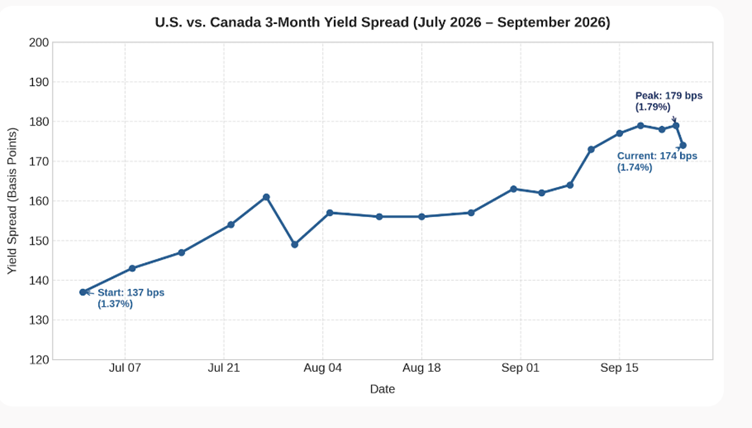
The fundamental reason behind this widening yield spread is that the BoC kept its overnight rate at 2.25% for seven consecutive meetings up to and including this month. Domestic considerations took over everything. Growth slowed, there were real fears about the impact of US tariff policy, and house prices were falling. On the other hand, the Federal Reserve started to take a more hawkish stance, setting its target rate at 3.75%-4.00%. The stage was set for a 150-175 bps policy gap, pushing short-term Canadian bond yields relatively lower, and ultimately the decline in the Canadian dollar we are witnessing today.
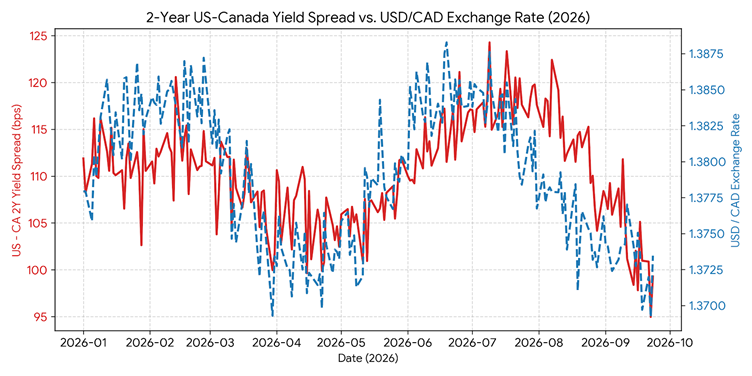
The very close correlation between the Canada-US 2-year spread and the USD/CAD is very convincing.
Short-term fixed-income investors increasingly shifted capital to US Treasuries to lock in 4.70%+ yields versus sub-3.40% Canadian yields. As institutional investors sold CAD to buy USD for Treasury allocations, USD/CAD appreciated toward 1.41 -- 1.42 levels (dropping CAD/USD to ~$0.707).
Some analysts have argued that the decline in the CAD is directly related to the relative performance of the Canadian economy. This argument claims that higher interest rates, especially at the long end, signal stronger economic performance in the US and, hence bolstering USD. However, the 2026 foreign exchange dynamics were heavily driven by rate policy divergence rather than long-term growth expectations alone.

Comments
Log in or sign up to join the conversation.