


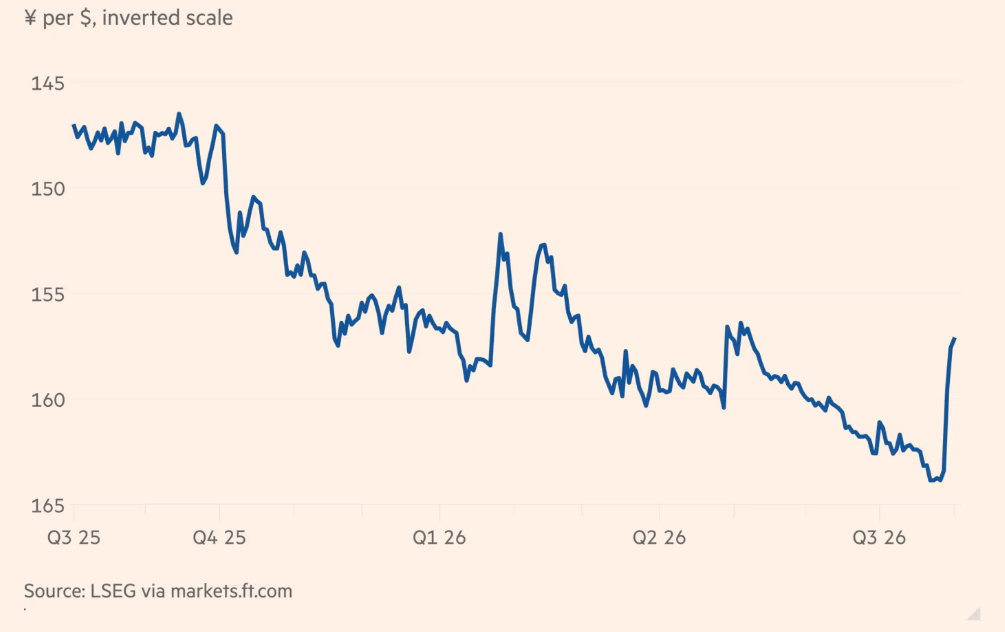
The fall in the value of Japanese yen has fostered a major intervention in one of the world’s most important currencies. Since mid 2025, the yen has dropped by14%, forcing Washington and Tokyo to engineer a joint intervention in support of the currency. Washington’s intervention is historic, the first in over three decades. The decision to act jointly signifies how serious the yen’s decline is viewed by both nations.
A drop in a nation’s currency can be traced to both failures in monetary and fiscal policies, alerting traders to a likely depreciation. And, in the case of Japan, both aspects of economic policy are at play.
Japanese interest rates were and continue to be too low. For many years, the Bank of Japan (BoJ) maintained the lowest interest rates in the world; 10 year Japanese bonds were under” yield control” whereby the BoJ intervened in the bond market to maintain long rates at yield 0% in an effort to stimulate growth and keep the government’s borrowing costs virtually free. The Bank was able to manage a very loose monetary policy, while the nation was undergoing steady deflationary pressures. An entire generation of Japanese grew up during a period of no inflation and modest income expansion. For international investors, Japanese banks offered a way to borrow cheaply in yen, invest in USD or euro-based assets, taking advantage of the higher-yielding foreign assets ( the so-called “carry trade”).
Japanese government debt levels are too high. These low borrowing costs encouraged the Japanese government to borrow heavily, creating a massive debt-to-GDP ratio of 240%, well in excess of any other developed nation. Given these debt ratios, the BoJ is hesitant in raising rates which would put the government under further pressure to service the debt. Over the past three years, Japan, along with the UK and US have been raising their policy rates in response to the inflation experienced worldwide. The UK and US central banks overnight rates are set at 3.75% and 3.50%, respectively. Japan’s rate is far back at 1%, reluctantly moving up, but not far enough to deal with domestic inflation. Simply put, the currency markets realize that Japan is much too slow in raising rates, and have sold off the yen.
Japan’s trade deficit is worsening. Japan imports virtually all of its oil and natural gas, so the recent spike in global energy prices has significantly widened the Japan’s trade deficit. Nothing moves currencies like rapid changes in trade balances, especially since trade flows are primarily denominated in US dollars. Japanese importers were forced to sell yen to pay for higher energy bills.
Both nations see the need to stop the decline. The US decision to intervene is supported by a real concern that US Treasuries may be sold off to take care of those caught long in the yen market. Japan is the largest holder of US debt and could destabilize the markets should the situation become more acute. For Japanese authorities, the sell off will add to domestic inflation via imports, adding further to stresses in the huge Japanese government bond market.
However, we should not expect this intervention in the currency markets will, by itself, address the forces driving the yen lower. The yen faces formidable headwinds; rising oil prices; need for greater government spending at home; and a reluctant BoJ to raise rates to contend with inflation. Currency analysts argue that the interventions are only buying time and that the real heavy lifting is going to fall on the shoulders of the BoJ and on Japan’s fiscal policy.



Comments
Log in or sign up to join the conversation.