


Israel is not immune to the dramatic shifts in the high-tech industry worldwide, as artificial intelligence (AI) sweeps through the industry and the economies at large.
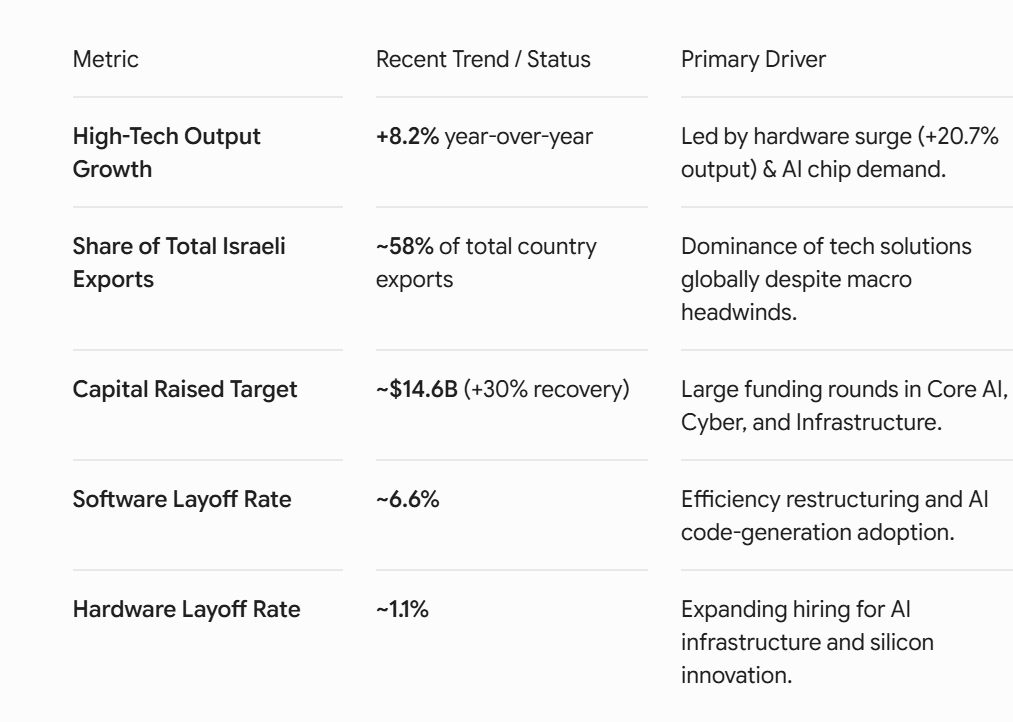
In the early days of this century, the country was dubbed a “start up nation”; today, the high-tech sector is the single largest component contributing to the economy. Israel's Ministry of Innovation reports that in 2025, capital investment in the high-tech industry reached $14.6 billion, the highest annual total since the boom years of 2021 and 2022.
Technology companies accounted for 58% of the nation’s exports and nearly half of the country's overall 2.9% GDP growth. The industry's share of GDP reached a record 18.3%. Recently, the huge influx of foreign capital plus a positive balance of trade has contributed to a surge in the the value of the shekel.
Source: Gemini
The industry has repeatedly shown resilience to the impact of war and political unrest of the last four years. But now the industry is experiencing a fundamental change. Strategically, more Israeli companies are relocating to the US and Europe to get closer to the marketplace. This shift results in a gradual relocation of the corporate decisions away from Israel.
Understandably, Israeli companies are moving their operations and many of their employees overseas to better position themselves to serve customers,support sales operations, and deal with product management. Viewed differently, Israeli companies grow larger and more in line with multinational companies operating globally. Some observers argue that this development speaks to a brain drain arising out of political and security considerations in Israel. In reality, the corporations say they are just undertaking efforts to better serve overseas clientele. This evolution is inevitable, especially in the tech sector, where there is no such concept as a domestic market - the market is global.
There is a dramatic shift taking place within the industry related directly to the impact of AI. Operationally, software workers have been increasingly replaced with more efficient AI coders which feature smaller teams with greater productivity per worker. Meanwhile, the hardware and deep-tech divisions are expanding, driven by the global race for AI computing. The industry is far from weakening, rather it is shifting into the next phase of the tech world. On balance the industry retains its outsized contribution to overall employment and national income.


Comments
Log in or sign up to join the conversation.