

At a time when inflation is forcing central banks to pivot toward a tightening bias, the Bank of Israel cuts its lending rate by a ¼ point. Why is the Bank acting so unconventionally?
The Israeli economy relies heavily on international trade and on foreign direct investment to fund its high-tech sector. Over 20% of Israel’s GDP originates in the tech sector and over 50% of all exports are tech related. The Bank of Israel estimates that foreign direct investment (FDI) accounts for roughly 50% of the nation’s external liabilities, much higher than the average in other OECD countries. Unlike other developed nations, Israeli monetary authorities have to take directly into account the value of its currency and its impact domestically.
In November 2025, the Bank cut its benchmark once there was an agreed-upon ceasefire in Gaza. Inflationary pressures were abating, and a rate cut would assist businesses and households to recover from the war with Hamas. Since that rate cut, the shekel has appreciated by 8.3% against the USD, by 7.2% against the Euro and 7.4% in terms of the nominal effective exchange rate. Once trading at 4/USD, the shekel hit a high of 2.8/USD at the time of this week’s rate announcement.
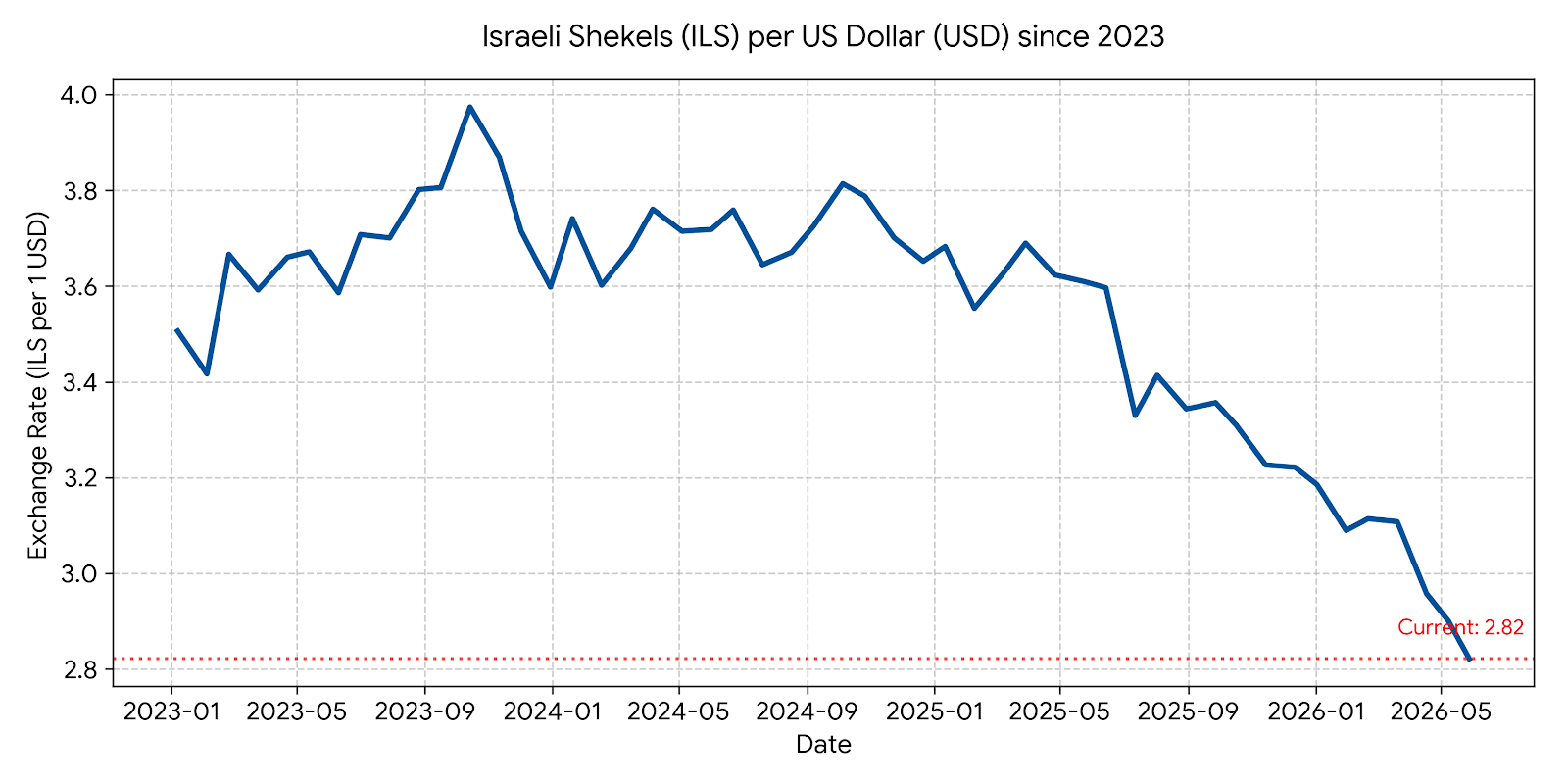
While Israelis took great pride in the strength of their currency, Israeli exporters were struggling to remain competitive overseas. The tech sector felt the impact of the currency’s rise, as their sales were dominated in dollars or euros, but personnel were paid in shekels. Not only reduced margins, but made it more difficult to attract talent worldwide. The currency needed to be managed to allow exporters to continue to hold market shares.
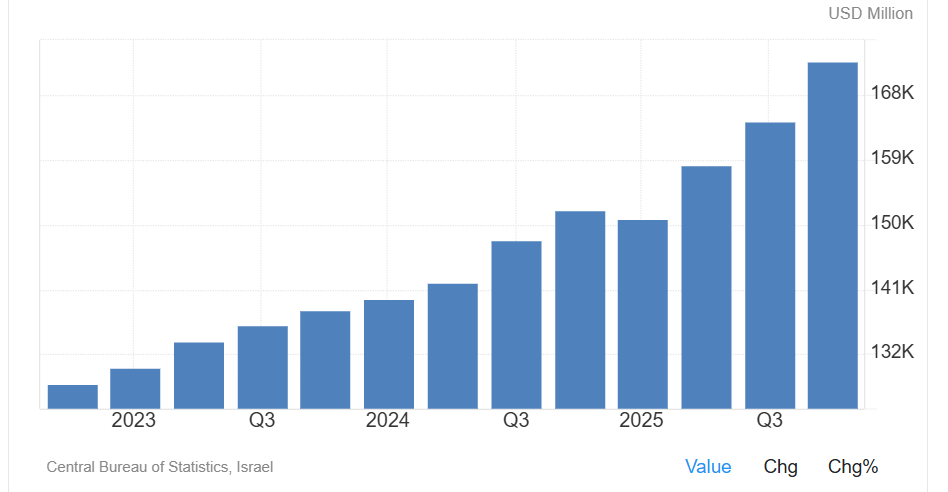
The currency appreciation can be directly traced to the continuous trade surplus and a steady rise in foreign direct investment. According to the latest IMF forecast, Israel’s current account surplus is on track to hit US$ 14 billion for all of 2026. Moreover, these surpluses have been developing for many years to the point that the Bank of Israel sits upon over US$ 235 billion in foreign reserves, representing 38% of its GDP, a historic high. Foreign direct investment, most importantly to the tech sector, increased to record levels. Hostilities did not affect overseas investors’ appetite for Israeli start-ups.
Foreign Direct Investment, Israel
The decision to cut the rate was made easier given domestic conditions. Inflation was 1.9% over the past 12 months, aided, to a large degree, by the rise in the shekel. Although there was a widespread contraction in the private sector during the recent hostilities involving Iran and Hezbollah in the north, early indications reveal that the economy has resumed its trend-line expansion.


Comments
Log in or sign up to join the conversation.