

There was a strange press conference yesterday when the Federal Reserve Chairman, Kevin Walsh, essentially gave no real insight into how the Fed will consider taming inflation now or in the future. He told us that the central bank will be judged by its “ performance”. Whatever that means? In the past, Fed chairs provided guidance as to how the FOMC would act in time to bring inflation under control. Yesterday, the Fed provided no forward guidance, no insights into how it views the current and expected inflation. Instead, Walsh described the current environment as “ a period of watchful thinking, not watchful waiting “. Again, what does this mean?
Rate decisions need to be supported with a perspective on how economic conditions will likely develop over a reasonable time horizon. The Fed is charged with a dual mandate to keep inflation under 2% while maintaining full employment. However, the Chairman gave no insight into how he expects inflation or labour conditions to evolve over the short to medium term. The economy is growing, allowing for unemployment of 4.3%. But stubbornly remain high at 3.5%, well above the target of 2 %. The Iranian war is no closer to ending, raising the continual prospect of surges in oil prices and a general worsening of the cost of living. Yet, not a word about how this geopolitical situation will likely influence rate decisions.
Making matters worse, the Fed is now a house divided, as three voting members opted for a rate increase in yesterday’s meeting. In essence, the Fed left it to the bond market to protect itself from future inflation. The bond market is challenging the Fed’s credibility as an inflation fighter.
The bond market acted immediately, as long-dated interest rates shot up even while the Chairman was holding his presser. The decision to hold rates steady was a signal to the bond market that the Fed is not credible when it insists that it is vigilant in combating inflation. The 30-year rate hit 5.24%, a rate level last seen in 2007. The steady drumbeat of long-term rate increases has been relatively swift since 2024. Additional inflationary pressures, originating in the oil markets and now spreading into the generalized cost of living, have added further to this bond sell-off. Equity investors cannot help but be concerned with rate jumps and their implications for today’s valuations.
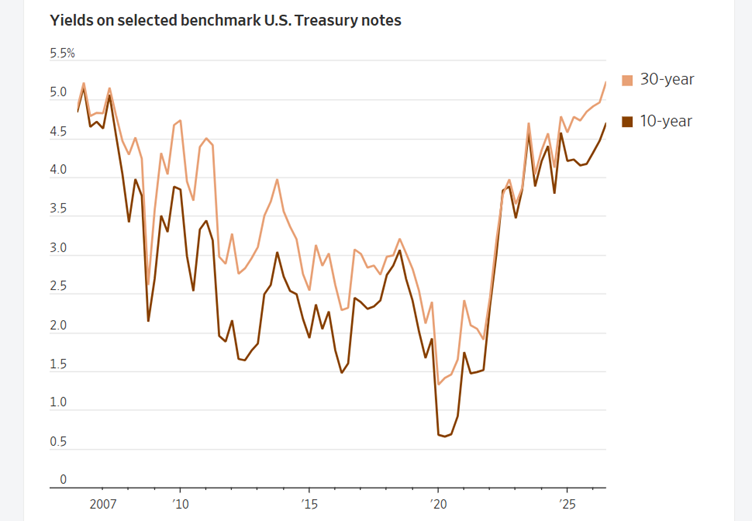
Walsh took office on a platform featuring a bare minimum of information to guide investors. He has provided no forward guidance and no insight into what inflationary measures to consider. He explicitly noted that the bond market was doing some of the heavy lifting already needed to tighten up monetary policy. Hence, the Fed has introduced more uncertainty regarding the forward path of rates in the future. The bond market now commands a greater premium to offset this uncertainty.
Comments
Log in or sign up to join the conversation.