


Bond investors always live in a world of worry, especially at times of such geopolitical turmoil. Today, long -dated bond yields hit a multi-decade high as concerns mount on many different levels. The bellwether 30-year US Treasuries clocked in at 5.3%, having passed the 5% threshold in July. Similarly, the long-dated German Bund traded at 3.8%, the highest since the 2011 Eurozone financial crisis. Japan, a laggard for years in the bond market, yield hit a record high 4.1%.
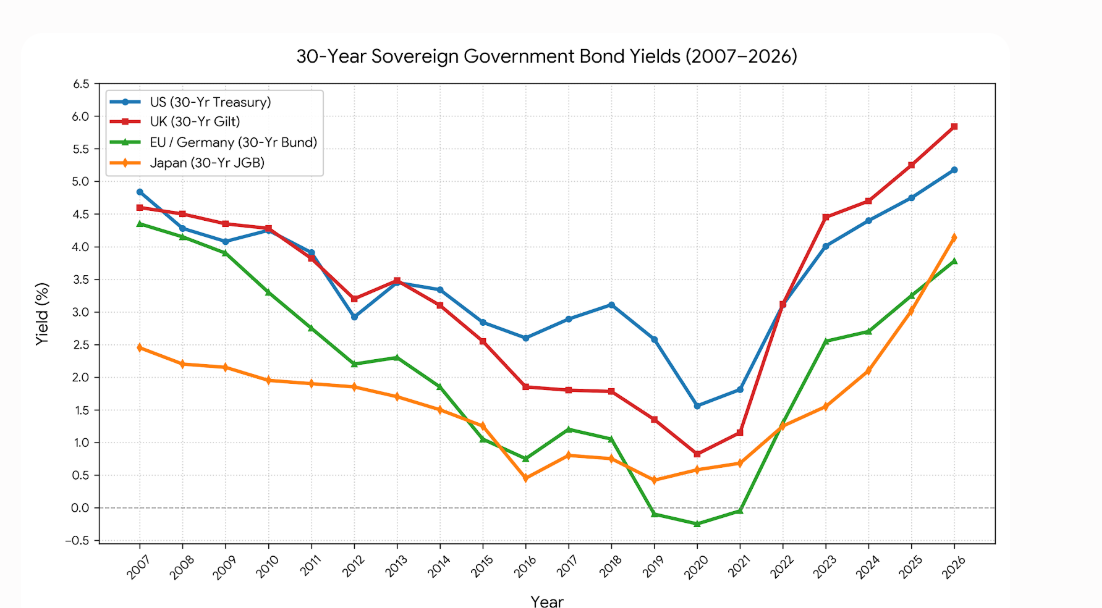
The bond market is under considerable pressure to absorb debt from both public and private issuers in the coming months.
Sovereign debt rates have been on a steady rise, starting in 2022, prior to the start of the US-Iran conflict. That conflict has pushed up energy costs , accompanied by fears of a prolonged inflationary bout. Oil prices at $90 pose a serious threat of further inflation. It is dawning upon traders that President Trump has no strategic policy to end the Iranian war, and the constant rhetoric out of Washington and Tehran is providing no guidance for the free flow of tankers through the Straits of Hormuz. Oil traders no longer hang on every pronouncement by the President. Instead, the traders are focussing on the fundamentals of supply and demand as dictated by disruptions in the Straits of Hormuz.
Government borrowings expanded, as the US debt hit $40 trillion, a mark that will likely crowd out business borrowing, forcing rates to rise throughout the bond market. As the US Congress continues to spend, the bond market will be asked to absorb additional debt, however, at higher interest rates. Of note, the Japanese government bonds yields are surging , pressing global interests to move up even further. Japanese rates are now forcing a repricing of long term debt throughout Asia and Europe.
Hyperscalers, such as Google (GOOGL), Microsoft (MSFT), Meta (META), and Oracle (ORCL), are on a spending spree to build out specialized data centers and power grid connections. These companies can no longer generate sufficient cash flow to build out their data centers and accompanying energy infrastructure. These giants are expected to spend roughly $800 billion to $1.1 trillion, the vast majority of which will be raised in the corporate bond market. The surge in the yields at the very long end of the curve is simply a reflection that investors are demanding more compensation to support additional supply.
Finally, there has been a steepening of the yield curve, as the long term rates move up much faster than short term rates. Such steepening reflects the very concerns mentioned earlier, namely massive government new issuances and a sense that inflation will continue unabated.

Comments
Log in or sign up to join the conversation.