


TM Editors' note: This article discusses a penny stock and/or microcap. Such stocks are easily manipulated; do your own careful due diligence.
Investment Setup
Palladyne AI (PDYN) is not a normal cheap-stock idea. It is a speculative micro-cap corporate turnaround where the market is still partly valuing the company through the old Sarcos failed-SPAC lens, while the current business is being rebuilt around defense autonomy, embodied AI, BRAIN/components, U.S. manufacturing, autonomous systems, Palladyne IQ, SwarmOS, Pilot and the IAI loitering-munitions opportunity. [Investor Update] [Q2 2026 Results]
The simple version is this: Sarcos fell hard because the old model was too hardware-heavy, too expensive and too early. Palladyne is now trying to rise from those ashes with a more practical platform built around defense autonomy, software, components, systems and domestic manufacturing. The phoenix is not fully flying yet, but Q2 2026 and the latest product updates show that the new company is becoming more real.
Since my original TalkMarkets article, the stock has moved from the reference price of about $5.28 to roughly $6.10, or about 16% higher. I do not read that move as the market suddenly discovering Palladyne. In my view, Palladyne remains largely undiscovered and is probably where ONDS, RCAT and UMAC were roughly 12+ months ago, except the drone/autonomy theme trade was in full motion then and is much quieter now. So I would not over-read the share-price move; it may still reflect the trading environment more than fundamentals. The main issue remains whether Palladyne can convert demos, development funding and early awards into repeatable product revenue. [Original Article] [Market Data]
Current Setup After The Q2 2026 Update
Item | Updated Read | Why It Matters |
Original article reference price | ~$5.28 | Starting point for the original TalkMarkets thesis [Original Article] |
Recent share price used in this update | ~$6.10 | Stock is up roughly 16%, but I do not treat this as discovery; trading conditions may still matter more than fundamentals [Market Data] |
Shares outstanding | ~49.1m as of 30 June 2026 | Share count moved higher, so dilution still matters [Q2 2026 Results] |
Current market value | ~$300m | Still a micro-cap despite defense / AI optionality [Market Data] |
Cash, cash equivalents and marketable securities | ~$43.7m as of 30 June 2026 | Important because cash burn and dilution risk remain central [Q2 2026 Results] |
Q2 2026 revenue | $5.8m, +470% YoY and +63% sequentially | Revenue is finally moving off the old small base [Q2 2026 Results] |
Q2 2026 backlog | $24.6m, +43% sequentially, with ~$13.0m of new awards | Better visibility, but backlog still has to convert [Q2 2026 Results] |
FY2026 revenue guidance | $24m-$27m, reiterated | The first real proof year for the reset [Q2 2026 Results] |
FY2026 operating cash burn guidance | ($32m)-($36m), reiterated | Burn is still high, but H2 reduction toward ~$6m-$8m per quarter would extend runway [Q2 2026 Results] |
This table is important because it shows the thesis becoming more measurable. Palladyne is still not profitable, and it still has dilution risk. But the company is no longer only a story about future technology. It now has growing revenue, a larger backlog, multiple defense and industrial programs, and better public evidence that its autonomy software can operate in real-world military environments.
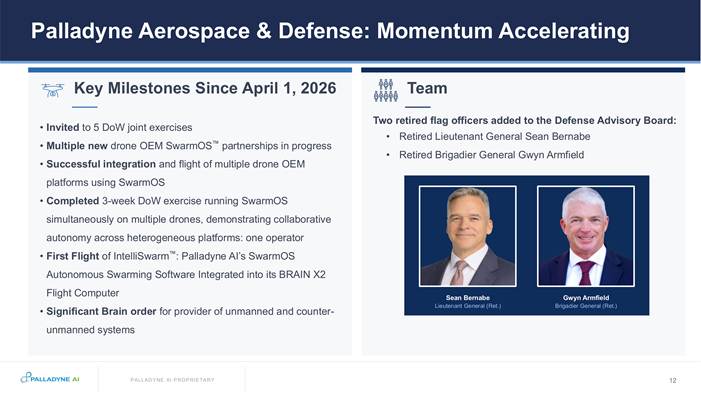
Source snapshot: Palladyne investor update slide showing key milestones since April 2026, including DoW exercises, SwarmOS drone integrations, IntelliSwarm/BRAIN work and defense advisory additions. [Investor Update]
Why The Opportunity Exists
The opportunity exists because the public-market memory is still bad. Investors remember Sarcos, the failed SPAC, the product pivots, the high burn and the missed commercialization story. That memory is fair, but it may now be incomplete.
The current Palladyne is not simply the old Sarcos hardware story. It is trying to become a small defense-autonomy supplier with software, components, UAVs, avionics, engineering and U.S. manufacturing under one roof. The 2025 acquisitions of GuideTech, MKR and Warnke matter because they gave the company more vertical integration and more routes to revenue. [Investor Update]
This is why the setup is interesting. If Palladyne fails to convert backlog, the old Sarcos discount remains justified. But if the company converts backlog and proves customers want SwarmOS, IQ/Pilot, BRAIN/components, autonomous systems and eventually IAI, the equity can rerate quickly because the starting market value is still small.
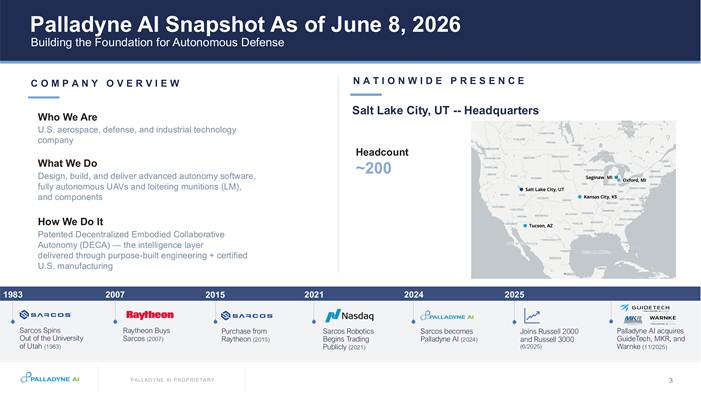
Source snapshot: Palladyne investor update showing company history, national footprint, headcount and the 2025 acquisitions of GuideTech, MKR and Warnke. [Investor Update]
What Changed Since The Original Thesis
The first Palladyne write-up already captured the main turnaround argument. The August 2026 updates make the story more concrete. Q2 confirmed financial traction, SwarmOS has now performed in more demanding Army operational testing, BRAIN has defense-prime orders, and IAI is a clearer strategic option. The Orkid partnership is a more subtle change, but it is encouraging because it brings Pilot back into the conversation after it had been barely discussed since the 2025 acquisitions. There is nothing material to model from Pilot yet, but its return as part of the autonomy stack supports the idea that Palladyne is trying to build a hardware-agnostic platform rather than only one drone or one hardware product. [Q2 2026 Results] [PC-C6 Release] [BRAIN Contract] [IAI Partnership] [Orkid Release]
Update | What Happened | Investment Read |
Q2 financials | $5.8m revenue, $24.6m backlog, ~$13.0m of new contract awards and FY2026 guidance reiterated [Q2 2026 Results] | The old "only hype" short case is less clean |
SwarmOS at PC-C6 | Integrated with Anduril Lattice and enabled multi-drone, multi-vendor autonomous operations [PC-C6 Release] | Shows the software is working in relevant Army testing environments |
Impact Level 5 | SwarmOS achieved IL5 certification during PC-C6 [PC-C6 Release] | Helpful for higher-sensitivity unclassified mission data and C2 workflows |
BRAIN orders | $2.6m of BRAIN flight-computer orders, including $2.3m for a low-cost kinetic counter-UAS interceptor [Q2 2026 Results] [BRAIN Contract] | Supports design-in component revenue with defense primes |
IAI partnership | Exclusive U.S. rights to Americanize, manufacture, integrate and market HARPY, HAROP and Mini HARPY [IAI Partnership] | Large option if U.S. DoW procurement emerges |
Orkid partnership | Pilot and SwarmOS to be integrated with Orkid fixed-wing VTOL UAVs [Orkid Release] | Subtle but encouraging; Pilot had been almost an afterthought and is now back in the conversation |
The key point is not that the turnaround is finished. It is not. The key point is that the proof points are now more visible and easier to track. The thesis can now be tested by revenue conversion, product orders, follow-on deployments, gross margin, second-half cash burn reduction and dilution instead of only by future promises.
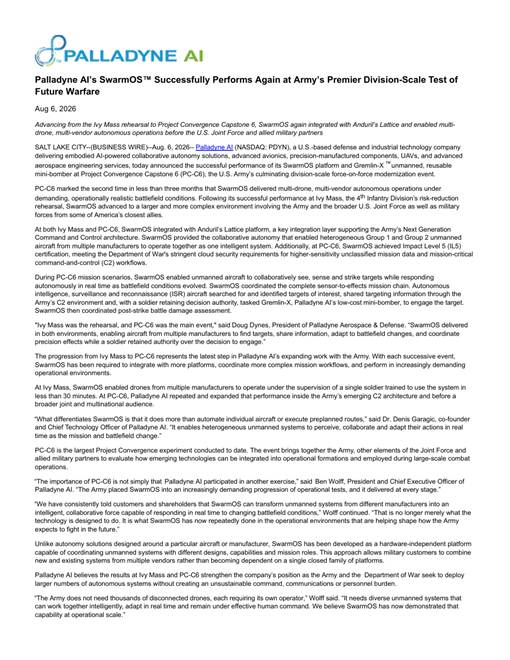
Source snapshot: Palladyne PC-C6 release highlighting SwarmOS performance, Anduril Lattice integration, multi-vendor autonomy and operational testing. [PC-C6 Release]
The Business Is Now Six Different Pieces
The key to the thesis is not simply the word AI. The key is that Palladyne is becoming a collection of related but different business lines. Treating all of them as one pure software company would be wrong. Treating all of them as old Sarcos hardware would also be wrong. The right framework is a sum-of-the-parts model.
Business Piece | What It Is | How I Value It | Why It Matters |
BRAIN / components / manufacturing | BRAIN flight computer, FLEX software, avionics components and precision manufacturing | Hardware / component revenue multiple, not pure software | Can become repeat product revenue if designed into third-party platforms |
Autonomous systems | Gremlin-X, SwarmStrike, ALRRM and future Palladyne systems | Defense systems scenario value | Moves the company beyond services into product-led defense revenue |
SwarmOS / autonomy layer | Collaborative autonomy software across drones and domains | Higher-quality software/autonomy value if it scales | Could become the core intelligence layer across multiple systems |
Pilot / fixed-wing UAV autonomy | Drone autonomy software, now back in the conversation through Orkid fixed-wing VTOL UAVs | Software-led optionality tied to platforms | Subtle and not material yet, but it supports the hardware-agnostic software model [Orkid Release] |
IAI loitering munitions | Exclusive U.S. strategic partnership around HARPY, HAROP and Mini HARPY | Option value, not near-term base revenue | Could be much larger than current revenue if U.S. demand materializes [IAI Partnership] |
Engineering services / development contracts | Aerospace design, program work and customer-funded development | Lower multiple services engine | Creates design-ins, relationships and internal products |
Palladyne IQ / industrial and commercial | Embodied AI for stationary robots and industrial automation tasks | Software-led optionality if deployments grow | Potential upside outside defense, including aerospace and defense use cases [STRATFI IQ Option] |
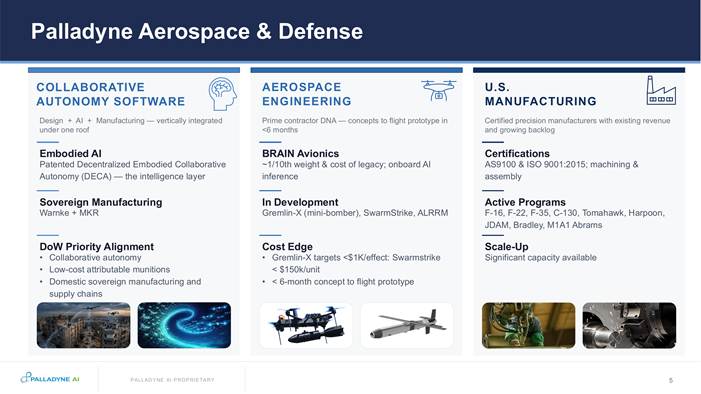
Source snapshot: Palladyne Aerospace & Defense slide showing collaborative autonomy software, aerospace engineering, BRAIN avionics and U.S. manufacturing. [Investor Update]
SwarmOS, Pilot And IQ: The Bridge From Demo To Product Sales
The most important lesson from the latest update is that the thesis should not be described as broad “AI optionality.” The right bridge is much more specific. Palladyne has to move from demos, development contracts and military exercises into product sales for SwarmOS, Palladyne IQ and Pilot. Pilot is the subtle change here. It had been almost an afterthought after the 2025 acquisitions, but the Orkid announcement puts it back into the conversation. I am not giving Pilot material valuation credit yet, but it is another sign that the autonomy stack may be broader than just SwarmOS.
SwarmOS is the clearest defense-autonomy product. It is designed to coordinate heterogeneous drones under one operator, reduce operator burden and allow multiple unmanned systems to act as one intelligent system. At PC-C6, Palladyne said SwarmOS again integrated with Anduril Lattice and enabled multi-drone, multi-vendor autonomous operations before the U.S. Joint Force and allied military partners. [PC-C6 Release]
Palladyne IQ is the industrial and commercial embodied-AI software layer. The attraction here is that IQ can sit on stationary robots and, over time, extend into aerospace and defense applications. Pilot adds another autonomy layer for drones and industrial platforms. The Orkid partnership matters because it extends Palladyne Pilot and SwarmOS into fixed-wing VTOL UAVs, but the right framing is still cautious: it is encouraging, not yet material. The point is that Palladyne may be building a broader hardware-agnostic software layer rather than remaining trapped in one hardware product. [STRATFI IQ Option] [Orkid Release]
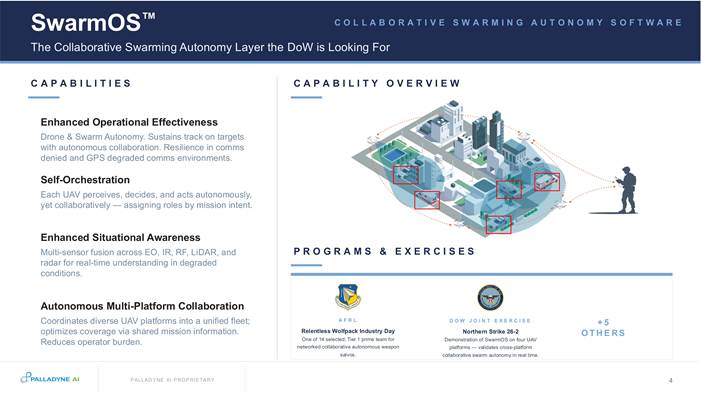
Source snapshot: Palladyne investor update slide on SwarmOS as a collaborative swarming autonomy layer for multi-platform drone and swarm coordination. [Investor Update]
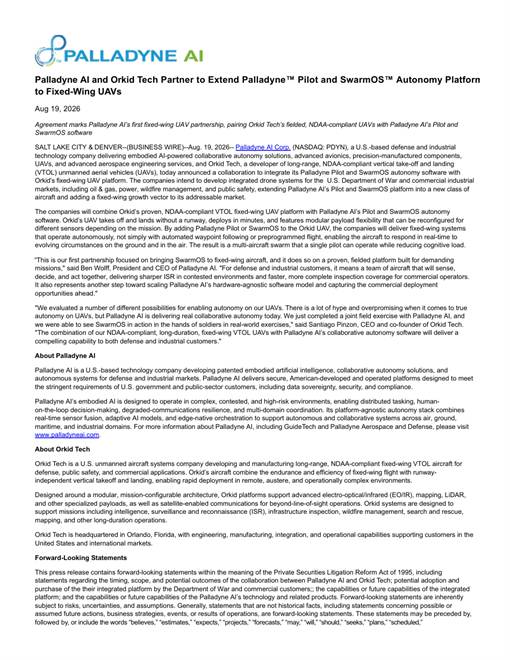
Source snapshot: Palladyne and Orkid Tech partnership release extending Palladyne Pilot and SwarmOS to fixed-wing UAVs for defense and industrial markets. [Orkid Release]
BRAIN, Components And Manufacturing Matter
BRAIN and components should not be treated as pure software. BRAIN is closer to avionics, compute and component revenue, and it belongs with Palladyne’s manufacturing and aerospace/defense capabilities. That is not a weakness. In defense, being able to provide software, components, subsystems and U.S. manufacturing can be a strength, especially when customers want low-cost, domestically produced and rapidly deployable systems.
The Q2 update showed $2.6 million of BRAIN flight-computer orders from a defense prime, including a $2.3 million contract supporting a low-cost kinetic counter-UAS interceptor. This is still small in absolute dollars, but it supports the idea that Palladyne can become part of other defense platforms rather than only selling its own finished systems. [Q2 2026 Results] [BRAIN Contract]
This design-in logic is important because one good component or compute product can lead to repeat orders if it becomes embedded in a program. It also makes the business less dependent on one moonshot system.
IAI Is The Large Option, Not The Near-Term Base Case
The IAI partnership is the most exciting upside option, but I still would not force large IAI revenue into the near-term base case. Palladyne has exclusive U.S. rights to Americanize, manufacture, integrate and market IAI’s HARPY, HAROP and Mini HARPY loitering-munition systems to the U.S. Department of War. The Q2 release also said the partnership had no upfront payment and up to ten years of exclusivity. [Q2 2026 Results] [IAI Partnership] [Investor Update]
The reason IAI matters is that the payoff could be much larger than Palladyne’s current revenue base. The reason I keep it separate is timing. Loitering munitions can be a large opportunity, but a U.S. program still needs customer interest, Americanization, domestic manufacturing, integration, testing, certification and procurement. If that bridge appears, the ceiling case changes materially. If it does not, IAI should remain only option value.
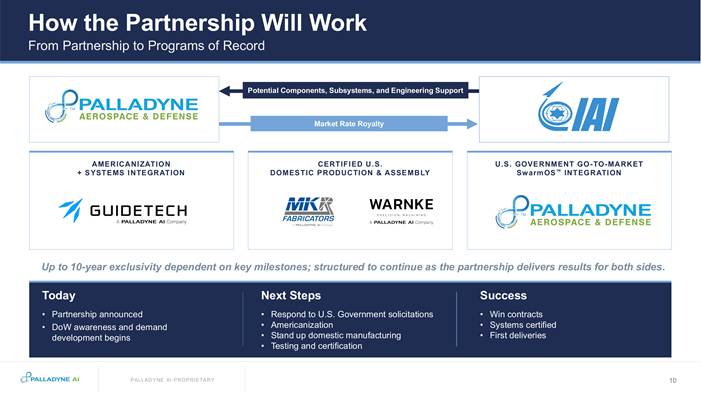
Source snapshot: Palladyne investor update slide showing the pathway from IAI partnership to Americanization, domestic production, U.S. government go-to-market and potential programs of record. [Investor Update]
Financials: The Turnaround Is About Scale, Mix And Cash Discipline
The financials explain why the stock still has a credibility discount. In 2025, Palladyne generated only about $5.2 million of revenue. That is not enough scale for a public defense technology company. The reason 2026 matters is that it is the first real year where the new structure starts to show up in reported numbers. The other important item is second-half cash flow. If Palladyne can bring quarterly cash usage down toward the $6 million to $8 million range, instead of remaining near the higher early-year run-rate, the existing cash balance could support the company for multiple additional quarters. That would reduce near-term financing pressure and make the turnaround more investable. [2025 10-K] [Q2 2026 Results]
Metric | FY2025 / Prior Base | Q2 2026 Update | Read-Through |
Revenue | ~$5.2m in FY2025 [2025 10-K] | $5.8m in Q2 2026 [Q2 2026 Results] | One quarter now exceeds the old annual quarterly run-rate |
Revenue growth | Reset year / small base | +470% YoY and +63% sequentially [Q2 2026 Results] | Q2 is the first stronger proof point |
Backlog | ~$13.9m at FY2025 | $24.6m at Q2 2026 [Q2 2026 Results] | Visibility improving, but conversion still has to be proven |
Cash and securities | ~$47m at FY2025 | $43.7m at Q2 2026 [Q2 2026 Results] | Liquidity is still meaningful, but burn matters |
FY2026 guidance | N.A. | $24m-$27m reiterated [Q2 2026 Results] | Second half has to ramp materially |
Cash burn guide | N.A. | ($32m)-($36m) reiterated [Q2 2026 Results] | Burn must trend lower; $6m-$8m per quarter would extend runway by multiple quarters |
Margins should not be modeled like a pure software company too quickly. Q2 gross margin was around 29%, and the company has engineering services, components, manufacturing, systems and integration work. My updated model still assumes margin improvement, but not an 80% or 90% software margin. This remains a hybrid defense-autonomy platform, not a mature SaaS company. [Q2 2026 Results]
Valuation: Base And Bull Raised, Bear Case Less Severe
My original base case was around $9.20 per share. After Q2, PC-C6, the Orkid partnership and broader product progress, I think the base case should move higher to about $11.50 per share. I am not raising the valuation because Palladyne is now safe. It is not. I am also not raising it because the stock has moved up; that move may still be more about the trading environment than fundamentals. I am raising it because the probability-weighted evidence is better: backlog is higher, customer activity is broader, field validation is stronger, Pilot is back in the conversation, and H2 cash-burn reduction could extend runway. [Original Article] [Q2 2026 Results] [PC-C6 Release] [Orkid Release]
Scenario | Old Value / Share | Updated Value / Share | Upside / Downside vs ~$6.10 | Read-Through |
Bear | ~$0.40 | ~$1.25 | ~80% downside | Turnaround still fails, but Q2/backlog and potential runway extension reduce zero-style risk |
Conservative | ~$2.37 | ~$4.75 | ~22% downside | Company improves, but product conversion is too slow |
Base | ~$9.19 | ~$11.50 | ~89% upside | Revenue conversion, product adoption and cash-burn control become credible |
Successful | ~$35.37 | ~$42.00 | ~589% upside | Defense-autonomy platform scales across systems, software and components |
Anduril-light ceiling | ~$92.45 | ~$105.00 | ~1,621% upside | Strategic ceiling if Palladyne wins scaled defense programs |
The important point is not that $105 per share is a target. It is not. The important point is that the scenario range has shifted upward because the company is starting to show evidence that the new Palladyne is different from the old Sarcos. The bear case is still real because of cash burn, low gross margin, dilution and execution risk, but the bear case is no longer as clean as it was before Q2.
What Would Make The Base Case Work
The bridge is not “$24.6 million of backlog equals a much larger revenue base.” The bridge is: FY2026 proves backlog conversion and cash-burn control, FY2027 proves repeat customer adoption, FY2028 proves product revenue scale, and FY2029 is where the platform can look like a real defense-autonomy business if SwarmOS, IQ/Pilot, BRAIN/components, internal autonomous systems and IAI all begin contributing. A second-half drop in cash burn toward roughly $6 million to $8 million per quarter would matter because it would extend the runway with existing cash and reduce the need to fund the ramp too aggressively through equity.
Milestone | Why It Matters |
Q3 sequential revenue growth | Confirms Q2 was not a one-off and that backlog is converting |
Backlog above ~$25m and book-to-bill above 1.0x | Shows demand is still growing after the Q2 step-up |
SwarmOS / IQ / Pilot product sales | The key bridge from development work to repeatable revenue |
Contracts for internally developed autonomous systems | Proves Palladyne can move beyond demonstrations |
BRAIN and component order growth | Supports repeatable design-in revenue with primes and OEMs |
IAI Americanization and DoW procurement progress | Could materially change the strategic ceiling case |
H2 cash burn reduction toward ~$6m-$8m per quarter | Extends runway with existing cash and reduces near-term dilution pressure |
Gross margin improvement from Q2 levels | Shows the business can scale without remaining services-heavy |
The near-term proof point is not more announcements. It is conversion from demo and development work into repeatable product revenue across SwarmOS, IQ/Pilot, autonomous systems, BRAIN/components and eventually IAI, while also showing that H2 cash usage can come down as revenue and margins ramp.
Risks
The first risk is execution. Palladyne can have good technology and still fail as an investment if development awards do not become product revenue. If backlog does not convert, if Q3 does not grow sequentially, or if FY2026 guidance is missed, the thesis weakens quickly.
The second risk is margin mix. Q2 revenue was strong, but cost of revenue was also high, and gross margin was still far from software-like. BRAIN, manufacturing, engineering, systems and IAI are not pure software businesses.
The third risk is dilution. The company used equity issuance in the first half of 2026, and if burn remains high while margins lag, shareholders can still be diluted even if the product story is improving. The offset is that if management can reduce quarterly cash usage toward the $6 million to $8 million range in the back half of 2026, the existing cash balance could last multiple quarters longer and the dilution risk would become less immediate. The fourth risk is government timing. Defense revenue can be large, but contract awards, testing, requirements, appropriations and customer adoption can move slowly and unevenly. [Q2 2026 Results]
The fifth risk is complexity. Palladyne now has SwarmOS, BRAIN, IQ, Pilot, GuideTech, manufacturing, Gremlin-X, SwarmStrike, ALRRM and IAI. That is a better opportunity than old Sarcos, but it also creates execution risk. The company must avoid trying to do too many things before one or two economic engines are clearly proven.
Final Thoughts
My updated view is simple. The original thesis was that Palladyne was an underfollowed corporate turnaround where the market was still focused on the ashes of Sarcos. The latest updates do not prove that the phoenix is fully flying, but they show more signs that the new company is real.
Q2 revenue and backlog improved. SwarmOS performed again in Army operational testing. BRAIN has defense-prime orders. IAI gives the company a large strategic option. The Orkid partnership expands the software opportunity into fixed-wing UAVs. That is enough for me to raise the base and bull cases and reduce the severity of the bear case. But it is not enough to call the turnaround finished.
Overall, I still see Palladyne AI as a speculative micro-cap defense-autonomy turnaround. I do not think the stock has become widely discovered yet. The company may still be in the phase where ONDS, RCAT and UMAC were more than a year ago, except the broader drone and autonomy theme trade is much quieter now. That is why I would not over-interpret near-term share-price moves. The real proof remains operational: hit guidance, keep backlog growing, convert demos into product sales, improve gross margin and reduce cash burn. If that happens, the market may start valuing Palladyne less like a failed SPAC and more like a small defense-autonomy platform. If not, the old Sarcos discount will remain justified.



Comments
Log in or sign up to join the conversation.