


A leveraged portfolio clean-up with a credible path to $7.25 and strategic upside above $10
TICKER NYSE: BGS | POSITION Long | REFERENCE PRICE $3.61 | BASE VALUE $7.25 | TIME HORIZON 18-24 months |
Investment Summary
B&G Foods is not statistically cheap on a consolidated basis. At $3.61 per share, the company trades at roughly 8.0x the midpoint of 2026 adjusted EBITDA guidance. The opportunity exists because nearly all of the enterprise value belongs to creditors: the equity is only about 13% of enterprise value. A modest rise in enterprise value, combined with real debt reduction, can therefore produce a much larger move in the stock.
The market has good reasons to be cautious. B&G has spent years buying smaller food brands, carried too much debt, and struggled with the Green Giant frozen business. It has also used part of its recent divestiture proceeds to buy College Inn and Kitchen Basics. The June 2026 refinancing removed the 2027 maturity wall but replaced 5.25% debt with 11.00% notes. This is not a passive rerating thesis. The balance sheet must improve.
The central insight The 50% dividend cut saves about $30.8 million a year, but the new 11.00% notes add roughly $25.5 million of annual coupon cost versus the notes they replaced. The dividend cut mostly pays for the refinancing. The real equity upside must come from asset sales, retained free cash flow, lower working capital, no new acquisitions and debt repayment. |
I believe a practical self-help plan can support a value of about $7.25 per share over 18 to 24 months. That case assumes 2027 adjusted EBITDA of $290 million, about $175 million of net debt reduction and an 8.2x exit multiple. It does not require a sale of the whole company or a high strategic multiple. A later separation or sale of the better Meals and Spices & Flavor Solutions assets creates upside above $10 per share, but I treat that as optionality rather than the main case.
Current valuation | Amount | Why it matters |
Share price (July 30, 2026 close) | $3.61 | Near the 52-week low |
Diluted shares / basic shares used | 81.2m | Market value of about $293m |
Gross debt after refinancing | ~$2.003bn | Debt dominates the capital structure |
Cash after refinancing | ~$39m | Limited equity cushion |
Net debt | ~$1.964bn | About 7.0x 2026 guidance midpoint |
Enterprise value | ~$2.257bn | Equity is only about 13% of EV |
FY2026 adjusted EBITDA guidance | $275m-$290m | Midpoint of $282.5m |
Current EV / EBITDA | ~8.0x | Not cheap without deleveraging |
Operating guidance and Q1 results. Capitalization is adjusted for the June 2026 refinancing using the SEC-filed presentation and note terms. B&G Foods Q1 2026 results
Why the Market Has Given Up
B&G was built by buying established brands that larger food companies no longer wanted. That model worked when debt was cheaper and acquired brands produced stable cash flow. It became much less attractive when volume weakened, inflation raised manufacturing costs and Green Giant frozen required heavy seasonal working capital. Investors now see a collection of slow-growth brands attached to expensive debt.
That view is understandable, but it treats every part of B&G as if it had the same quality. The portfolio includes weak and capital-heavy assets, but it also includes category brands such as Ortega, Crisco, Clabber Girl, Cream of Wheat, Dash, Spice Islands, Weber, College Inn and Kitchen Basics. Some are large enough to matter to a strategic buyer, while others can be sold as smaller packages. The key is to stop managing B&G for total revenue and start managing it for cash return and debt reduction.
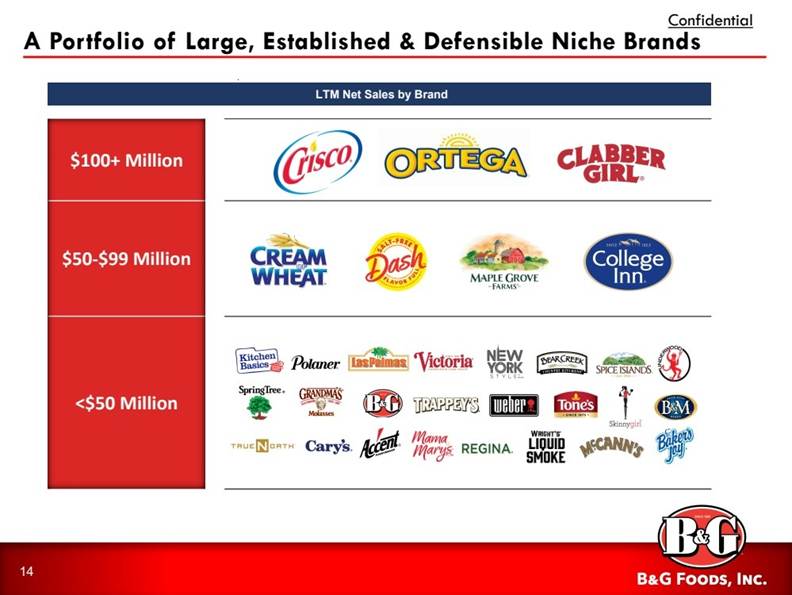
The portfolio contains several scaled brands, but it also has a long tail of sub-$50 million brands that creates complexity and potential disposal opportunities. B&G Foods June 2026 investor presentation
The Capital Structure Creates Both the Risk and the Upside
Following the June refinancing, I estimate gross debt of about $2.003 billion, cash of roughly $39 million and net debt of about $1.964 billion. Against a market value near $293 million, the enterprise value is approximately $2.257 billion. The equity is therefore a thin residual claim. This is why the stock can fall sharply if EBITDA weakens, but it is also why $150 million to $200 million of debt reduction can materially change the equity value.
The company reports a covenant net leverage ratio of about 6.1x. That figure uses covenant adjusted EBITDA of roughly $323 million, which includes permitted add-backs and pro forma adjustments. On the midpoint of the company’s normal adjusted EBITDA guidance, leverage is closer to 7.0x. I use the lower, more conservative earnings measure when judging the balance sheet.
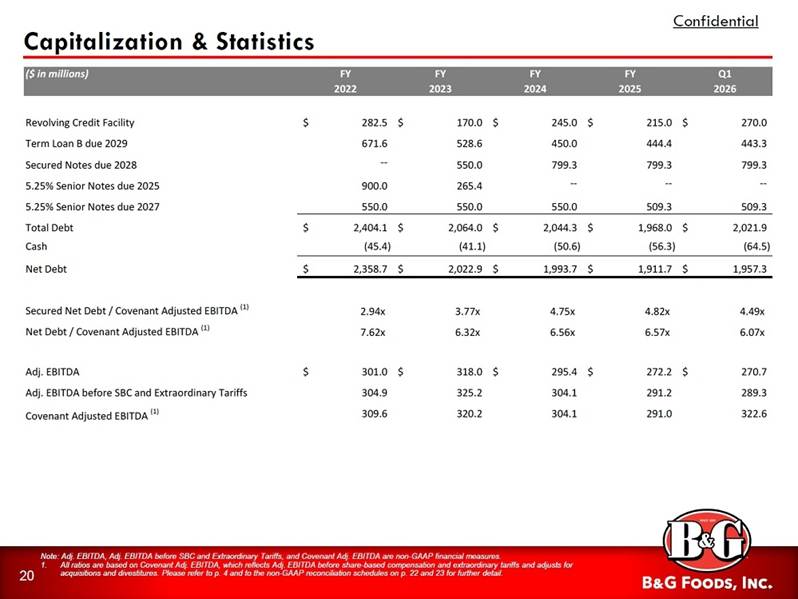
The company’s own slide shows the large gap between normal adjusted EBITDA and covenant adjusted EBITDA. The latter is useful for compliance, but it should not be treated as cash earnings. B&G Foods June 2026 investor presentation
What Changed in 2025 and 2026
The restructuring is already under way. Management has sold several vegetable and tomato assets, cut the dividend and pushed out the nearest bond maturity. These actions reduce immediate risk. However, the purchase of College Inn and Kitchen Basics shows that management still sees acquisitions as part of the model. The next phase must be different: B&G should retain cash and shrink debt rather than recycle proceeds into more brands.
Action | Cash / economics | Investment read-through |
Don Pepino and Sclafani sale (May 2025) | ~$10.5m proceeds | Small portfolio clean-up |
Le Sueur U.S. sale (August 2025) | ~$59m proceeds | Exited a non-core vegetable asset |
Green Giant U.S. frozen sale (March 2026) | ~$61.5m proceeds | Exited brand ownership but retained Mexico plant and co-manufacturing |
College Inn / Kitchen Basics acquisition (March 2026) | $110m purchase price; $18m-$22m projected EBITDA | Good brands bought at a reasonable multiple, but cash was not used for debt |
Green Giant Canada sale (pending at July 31) | About $60m based on September 2025 inventory | Near-term debt-paydown catalyst |
Dividend cut (May 2026) | Annual rate cut from $0.76 to $0.38 | About $30.8m annual cash saving from 2027 |
11.00% notes due 2031 (June 2026) | $475m principal; issued at 97.67 | Removes 2027 maturity risk but raises cash interest |
Transaction amounts and policy summary. The Green Giant Canada transaction had not been announced as closed by July 31, 2026. B&G Foods June 2026 investor presentation
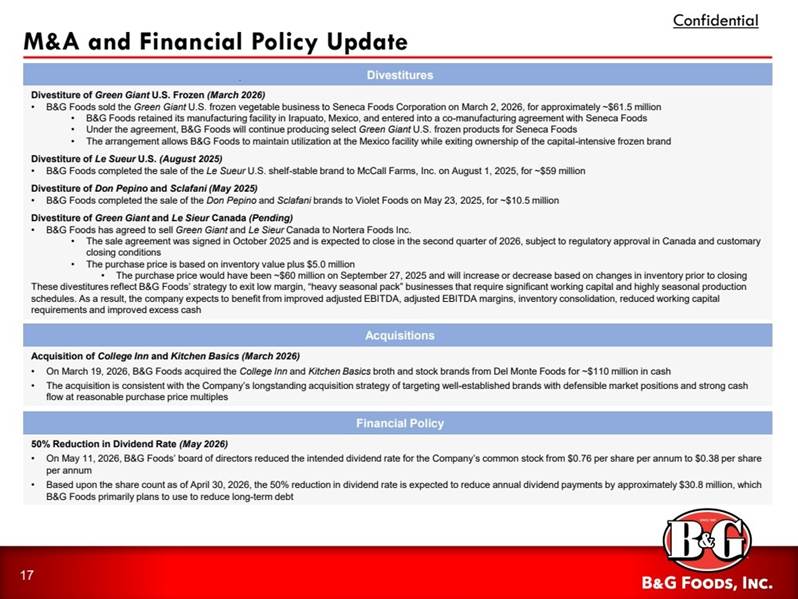
Management has taken meaningful actions, but the same slide also shows the tension in the story: asset sales, a dividend cut and another acquisition all occurred within a short period. B&G Foods June 2026 investor presentation
The Business Is Better Than the Consolidated Numbers Suggest
The segment data show a mixed portfolio rather than one broken company. Spices & Flavor Solutions is the best current operating asset. Meals has attractive brands and now includes College Inn and Kitchen Basics, but its first-quarter margin was pressured by raw materials, manufacturing costs, trade spending and marketing. Specialty produces strong segment profit, although Q1 EBITDA fell sharply. Frozen & Vegetables is becoming a smaller manufacturing and Canada business after the U.S. exits.
Segment | FY2025 sales | FY2025 segment EBITDA | Q1 2026 EBITDA / change | Forward EBITDA used |
Specialty | $630.0m | $159.7m | $26.1m / -22.1% | $145m |
Meals | $444.4m | $106.6m | $19.9m / -20.1% | $118m |
Frozen & Vegetables | $358.6m | ~$0m | $4.6m / improved | $8m |
Spices & Flavor Solutions | $395.7m | $99.9m | $29.7m / +13.1% | $105m |
Corporate / unallocated | — | -$90.5m | -$22.7m in Q1 | -$85m |
Total / analyst estimate | — | ~$275.7m reported segment bridge | $57.6m adjusted EBITDA | ~$291m |
FY2025 segment results; Q1 2026 data from the first-quarter release. Forward values are author estimates, not company guidance by segment. B&G Foods 2025 annual report
Spices & Flavor Solutions
Spices is the clearest proof that the company owns more value than the share price suggests. Q1 2026 sales rose 9.1% and segment adjusted EBITDA rose 13.1% to $29.7 million. Growth came from volume, pricing and mix, partly offset by garlic, black pepper and tariff pressure. I use $105 million of forward EBITDA, below a simple annualized Q1 run-rate, to avoid capitalizing one strong quarter.
Meals
Meals includes Ortega, Cream of Wheat, Victoria, College Inn and Kitchen Basics. The newly acquired broth and stock brands are expected to add $18 million to $22 million of annual EBITDA on $110 million to $120 million of sales. B&G paid $110 million, or about 5.5x projected EBITDA before expected tax benefits. That purchase price is useful evidence that branded food assets can still be bought and sold at reasonable values. The problem is not that the acquisition was expensive; it is that B&G used cash for an acquisition while leverage was still near 7.0x.
Specialty and the Long Tail
Specialty contains Crisco and Clabber Girl, which are large and defensible, but it also contains many smaller brands across baking, spreads, household products and snacks. I would not force a sale of the entire segment at a low price. The better plan is to sell the non-core tail in packages, keep the strongest baking staples and use the proceeds to repay debt. The large number of sub-$50 million brands makes this work possible, but it also makes stranded-cost control essential.
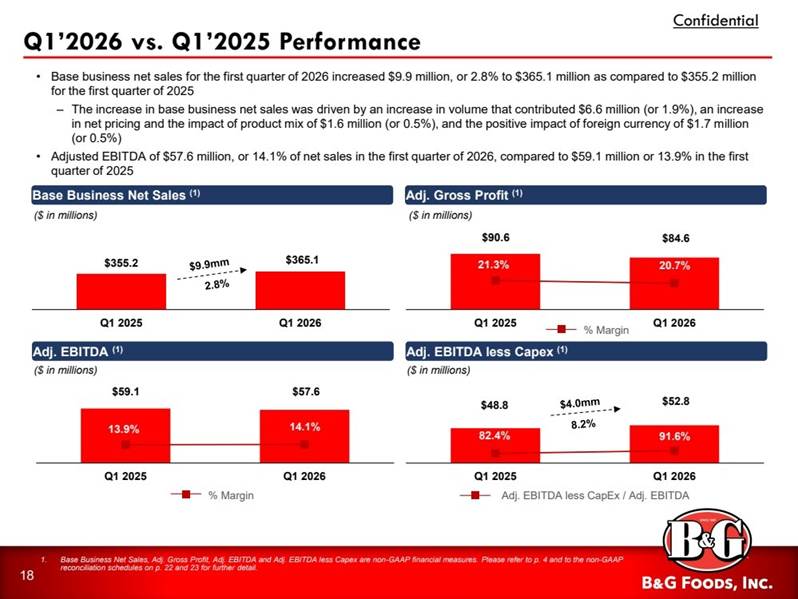
Q1 2026 showed 2.8% base-business sales growth and a small improvement in adjusted EBITDA margin, even though reported sales fell after divestitures. B&G Foods June 2026 investor presentation
Variant Perception: The Dividend Cut Does Not Solve the Interest Problem
The market may see the dividend cut and refinancing as a complete balance-sheet repair. I see them as necessary but incomplete. The company replaced $509.3 million of 5.25% notes with $475 million of 11.00% notes. A simple coupon comparison shows why the equity still needs asset sales and debt repayment.
Cash item | Old annual amount | New annual amount | Change |
Coupon on refinanced notes | $26.7m | $52.3m | -$25.5m cash |
Common dividend | ~$61.7m run-rate | ~$30.8m run-rate | +$30.8m cash |
Net annual improvement | — | — | Only about +$5.3m |
This is a rough comparison before issuance fees, the note discount and changes in revolver borrowings. It still captures the main point: the dividend cut largely offsets the higher coupon. It does not create enough cash to repair the balance sheet on its own. Every $100 million of debt repayment should save roughly $8 million to $10 million of annual pre-tax interest, depending on which debt is repaid. That is the most direct way to raise free cash flow and equity value.
The new notes carry an 11.00% coupon, were issued at 97.67 and mature in June 2031. Dividend savings are from the Q1 2026 release. B&G Foods 11.00% senior notes pricing
The Plan I Would Ask the Board to Follow
The current management team deserves credit for beginning the clean-up. The next decisions matter more because the company has little room for another cycle of acquisitions and leverage. The best plan is simple and measurable:
· 1. Close the Green Giant Canada sale and use all cash proceeds to repay debt. Do not treat the proceeds as acquisition capacity.
· 2. Suspend acquisitions until net debt is below 5.0x normal adjusted EBITDA, not covenant EBITDA. At current earnings, that requires several hundred million dollars of debt reduction.
· 3. Sell the non-core brand tail in packages. Household products, subscale snacks, spreads and weaker niche brands should be tested against private equity and strategic buyers. Keep Crisco, Clabber Girl and other strong staples unless pricing is compelling.
· 4. Remove $15 million to $20 million of stranded corporate cost as the portfolio shrinks. Selling brands without reducing central cost can destroy the value of a break-up.
· 5. Keep Spices and the core Meals assets while leverage is high. These businesses provide the best earnings quality and would be easier to sell at a fair value after debt is lower.
· 6. Do not raise the dividend or begin buybacks until leverage is below 4.5x. At the current capital structure, debt repayment is the highest-return use of cash.
This plan does not require a hostile process or a full liquidation. It requires the board to accept that a smaller B&G can be worth more than a larger B&G. The company’s own stated focus on spices and seasonings, meals and baking staples gives a logical end-state for the portfolio.
Valuation: A Credible Base Case and Strategic Optionality
I use three scenarios. The bear case assumes operating pressure continues and management makes limited progress. The base case is a self-help outcome built on modest EBITDA improvement, debt reduction and an ordinary packaged-food multiple. The bull case uses a conservative sum-of-the-parts value after a larger portfolio clean-up. The base case is the most important because it does not require a buyer.
Scenario | Key assumptions | Equity value / share | Return vs. $3.61 |
Bear | $255m EBITDA; $1.92bn net debt; 8.0x EV/EBITDA | $1.50 | -58% |
Base | $290m EBITDA; $1.789bn net debt; 8.2x EV/EBITDA | $7.25 | +101% |
Strategic / SOTP | Moderate segment multiples; post-Canada debt; $250m execution reserve | $10.50 | +191% |
Base Case: $7.25 Per Share
Base-case bridge | Amount |
2027 adjusted EBITDA | $290m |
Exit multiple | 8.2x |
Enterprise value | $2.378bn |
Starting net debt | $1.964bn |
Canada sale proceeds used for debt | -$60m |
Retained free cash flow over 18-24 months | -$80m |
Tail sales / working-capital release | -$35m |
Ending net debt | $1.789bn |
Equity value | $589m |
Shares | 81.2m |
Implied value per share | $7.25 |
The base case assumes only $7.5 million of EBITDA improvement from the midpoint of 2026 guidance. It also assumes $175 million of debt reduction over 18 to 24 months. That is demanding but achievable if the Canada transaction closes, the dividend cut is retained, no acquisitions are made and the company releases cash from smaller brand sales and working capital. The 8.2x multiple is only slightly above the current multiple and remains below the value implied by many strategic food transactions.
Strategic SOTP: More Than $10 Per Share
Business / adjustment | EBITDA or value | Multiple | Gross value |
Specialty | $145m EBITDA | 6.5x | $943m |
Meals | $118m EBITDA | 8.0x | $944m |
Spices & Flavor Solutions | $105m EBITDA | 10.5x | $1,103m |
Remaining Frozen / plant value | Asset value | — | $60m |
Gross asset value | — | — | $3,049m |
Less post-Canada net debt | — | — | -$1,904m |
Less taxes, fees and stranded-cost reserve | — | — | -$250m |
Equity value | — | — | $895m |
Value per share | 81.2m shares | — | $11.03 |
I round the strategic case down to $10.50 per share. The Spices multiple of 10.5x is below the 12.5x Planters precedent and far below the headline RB Foods and Cholula multiples. I also deduct a $250 million reserve for taxes, fees and stranded costs. This is deliberately more conservative than valuing Spices at 12.5x to 15.0x and assuming every other asset sells cleanly.
Transaction Evidence
Transaction | Approximate EBITDA multiple | Read-through |
B&G purchase of ACH spices (2016) | ~9.1x-9.6x | Direct lower-end precedent for a scaled spices portfolio |
Hormel (HRL) purchase of Planters (2021) | ~12.5x | Large branded-food asset with strategic value |
McCormick (MKC) purchase of RB Foods (2017) | 15.9x incl. synergies / 19.6x headline | Shows strategic value of sauces and flavor assets |
McCormick purchase of Cholula (2020) | 18x incl. synergies and tax / 25x headline | Too high for the base case, but confirms buyer appetite |
Precedent figures are drawn from buyer and company transaction materials; multiples are not perfectly comparable. B&G Foods acquisition of ACH spices business
Catalysts
The thesis has several visible checkpoints. None is sufficient alone, but together they can show whether the company is moving from portfolio churn to real deleveraging.
· Q2 2026 results on August 11, 2026: the first important test of guidance, Spices momentum and the full-quarter effect of College Inn and Kitchen Basics.
· Closing of the Green Giant Canada sale and clear disclosure that all proceeds were used to reduce debt.
· A formal pause on acquisitions or a stated leverage threshold before any new deal.
· Additional non-core brand sales, especially from the long tail outside spices, meals and baking staples.
· Lower interest expense and working capital after debt repayment and the frozen exits.
· A corporate cost programme that prevents stranded overhead from absorbing the value of divestitures.
Risks and What Would Break the Thesis
This is a leveraged equity, so downside is real. The stock is not protected by a low enterprise-value multiple, and the company has limited room for execution mistakes. The most important risks are:
· Adjusted EBITDA falls below roughly $260 million because volume, tariffs, raw materials or manufacturing costs remain weak.
· The Green Giant Canada sale is delayed, produces less cash than expected or the proceeds are used for another acquisition.
· Spices growth reverses. The asset deserves a premium only if its volume and margin quality remain stronger than the rest of the portfolio.
· Management relies on covenant EBITDA and add-backs while cash interest and working capital remain high.
· Brand sales create more taxes, transaction costs and stranded overhead than expected.
· The board raises the dividend, begins buybacks or issues equity before leverage is under control.
I would reconsider the long thesis if 2026 adjusted EBITDA guidance falls materially below $260 million, if net debt does not decline after the Canada sale, or if management completes another acquisition before leverage is below 5.0x on normal adjusted EBITDA.
Conclusion
B&G Foods is not a clean compounder and it is not a simple low-multiple stock. It is a leveraged portfolio with several real brands, a weak history of capital allocation and a small equity cushion. The debt is the reason the stock is cheap, but the brands provide a way out.
The June refinancing gives the company time, not a solution. The dividend cut mostly pays for the higher coupon. The next step must be to close the Canada sale, stop acquisitions, sell the non-core tail, cut stranded cost and use every available dollar to reduce debt. If management follows that path, modest EBITDA improvement and an ordinary 8.2x multiple can support about $7.25 per share. A later strategic separation can support more than $10 per share.
The core of the idea is therefore not a heroic break-up value. It is a measurable change in capital allocation. B&G does not need every brand to become a growth asset. It needs the weaker assets to fund debt reduction and the better assets to remain visible long enough for the market, or a strategic buyer, to value them properly.


Comments
Log in or sign up to join the conversation.