


Figma: Up 43% Since My First Thesis, But Q2 Shows The AI Rerating May Not Be Done
I first wrote about Figma here: Figma: The Stock Fell On AI Fear, But AI May Be The Rerating Trigger. At that time, the stock was around $19 and my view was simple: the market was treating Figma mainly like a design tool, while actually the company could become a much bigger product-creation platform. Since then, the stock has moved by about 43% from that level. So, I do not want to present this update like the stock is still as cheap as before. The stock has already started to re-rate. But the Q2 update gives more proof that the original AI thesis is becoming real.
Investment Thesis
To me, the main change after Q2 2026 is that Figma is no longer just an AI fear trade. The first thesis was that AI may not destroy Figma because AI-created work still needs structure, review, design systems, product context and developer handoff. The new thesis is stronger because Q2 showed that customers are already using AI inside Figma, and Figma is starting to charge for some of that usage.
Figma reported Q2 revenue of $370.1 million, up 48% year-over-year. The company also said this was the third straight quarter of accelerated revenue growth. That matters because the bear case was that AI could reduce paid seats and slow growth. But the business did not slow in Q2. It accelerated.
The most important new point is AI credit monetization. Q2 was the first full quarter of AI credit monetization, and over 80% of paid customers with more than $10,000 in ARR were consuming AI credits weekly. This is not a small detail. It means AI is not only a feature that costs Figma money. It may become a usage-based revenue layer on top of the normal seat model.
Therefore, my updated view is simple. Figma is more expensive now, but it is also more proven. It should not be written like a cheap stock anymore. It should be written like a disruptive platform stock where the market has started to understand the story, but may still not be giving full credit for the AI workflow opportunity.
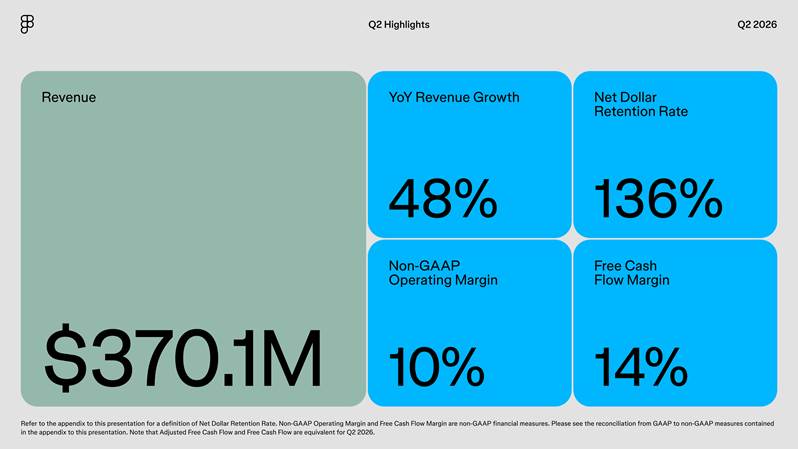
Figure 1. Q2 highlights: revenue, NDR, operating margin and free cash flow margin from the latest quarter. Source: Figma Q2 2026 Presentation
What Changed In Q2
The first article was about a possible misunderstanding. The market was worried that AI would hurt Figma. I argued that AI may instead make Figma more important because AI outputs still need one place where teams can review, organize and improve them. Q2 moves this from theory toward evidence.
Revenue grew 48% year-over-year to $370.1 million. Net Dollar Retention was 136%. Customers with more than $10,000 in ARR increased to 15,964, growing 34% year-over-year. Customers with more than $100,000 in ARR increased to 1,635, growing 46% year-over-year. Figma also raised full-year 2026 revenue guidance to $1.463 billion to $1.467 billion, implying 39% growth at the midpoint and a $40 million raise to the previous guidance.
This tells me the business is not broken. The stock had fallen earlier because investors were worried about AI, valuation and margins. But the latest quarter shows that Figma is still expanding inside customers and still growing at a high rate. The stock price has already reacted, but the business update also justifies why the stock reacted.
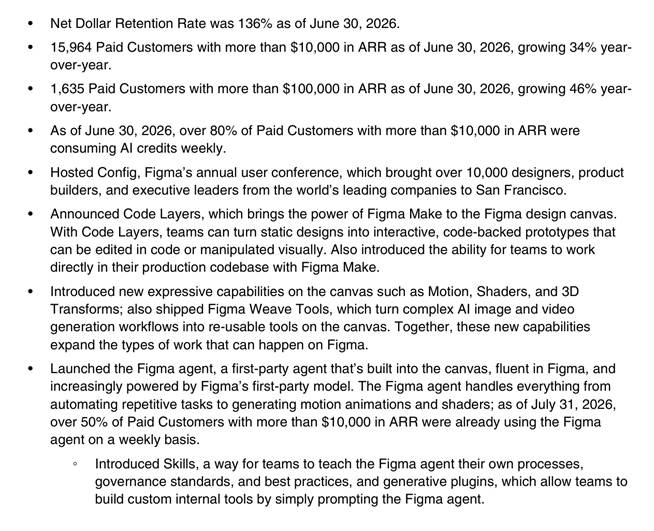
Figure 2. Press release snapshot: NDR, customer growth, AI credit usage, Code Layers and Figma agent. Source: Figma Q2 2026 Press Release
AI Credits Are Now A Bigger Part Of The Thesis
The biggest update is AI credits. In the old thesis, AI credits were one of the most important future possibilities. In Q2, that possibility became more real. Management called Q2 the first full quarter of AI credit monetization. More than 80% of paid customers with more than $10,000 in ARR were consuming AI credits weekly.
This is where I think the market may still be too slow. Many investors look at AI only as a cost problem. That is fair because inference costs and model costs are real. But Figma is showing that AI can also become a monetization layer. If customers use more AI inside the platform and then pay for AI credit add-ons, AI becomes more than a cost risk.
This does not mean the risk is gone. AI products still cost money to run, and Figma still needs to prove that AI revenue can grow faster than AI costs. But the Q2 update gives a cleaner answer than before: customers are using the AI features, and some of this usage is now being monetized.

Figure 3. Q2 presentation snapshot: Figma is now directly pointing investors to AI credit add-ons. Source: Figma Q2 2026 Presentation
The Customer Numbers Still Support The Platform View
The customer data is also very important. If Figma was only a design tool being disrupted, I would expect retention to weaken and large customer growth to slow. But Q2 still showed strong expansion. NDR was 136%, and the $10,000 ARR and $100,000 ARR customer groups both continued to grow quickly.
This matters because Figma is not only adding small users. It is growing inside bigger customers. This supports the idea that Figma is becoming part of how teams work, not just a tool used by one design person. That is the part of the story I think the market may still not fully price in.
Metric | Q2 2026 |
Revenue | $370.1M, up 48% YoY |
Net Dollar Retention | 136% |
Customers >$10k ARR | 15,964, up 34% YoY |
Customers >$100k ARR | 1,635, up 46% YoY |
AI credits | >80% of >$10k ARR customers consuming weekly |
Free cash flow | $53.2M, 14% margin |
Cash and marketable securities | $1.7B |
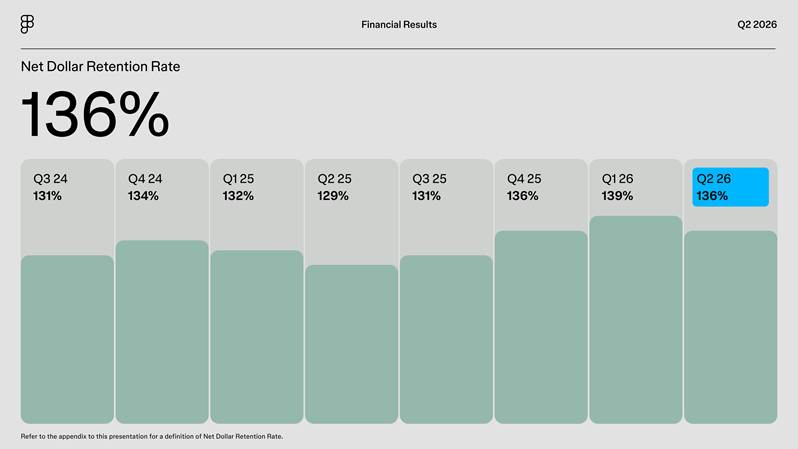
Figure 4. Q2 presentation snapshot: NDR remained strong at 136%. Source: Figma Q2 2026 Presentation
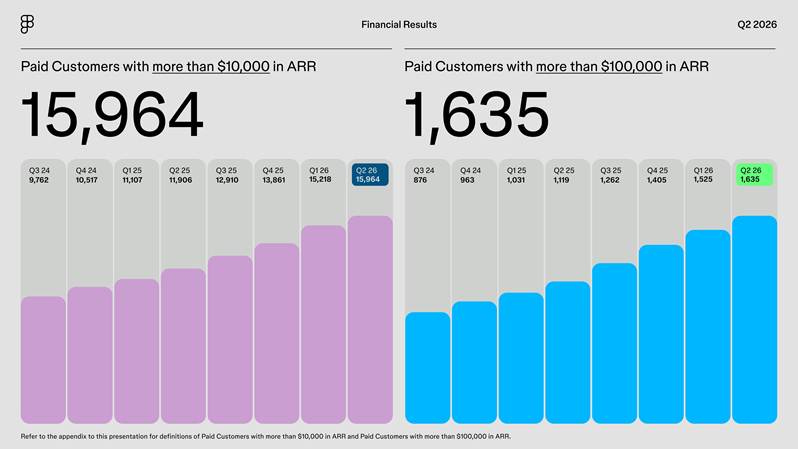
Figure 5. Q2 presentation snapshot: large customer counts continued to grow strongly. Source: Figma Q2 2026 Presentation
Figma Agent And Code Layers Make The Story Bigger
The second big update is that Figma is now talking more clearly about agents, code and the canvas together. This is important because the strongest thesis is not simply that Figma has AI. The stronger thesis is that Figma can become the structured workspace where product teams, developers and AI agents work together.
Figma launched the Figma agent, a first-party agent built into the canvas. As of July 31, 2026, more than 50% of paid customers with more than $10,000 in ARR were using the Figma agent weekly. That is an important number because it shows that agent usage is not only a future promise.
Code Layers also matters because it brings the power of Figma Make into the design canvas. Teams can turn static designs into interactive, code-backed prototypes that can be edited in code or changed visually. This supports the same direction of travel from my first thesis: idea to design, design to prototype, prototype to code, and then into something that can be used.
So, in simple words, Figma is trying to move from design tool to product workflow platform to AI agent and code canvas. It is not doing the same thing as Palantir or Zeta, but in its own category it may become the structural layer around product work.
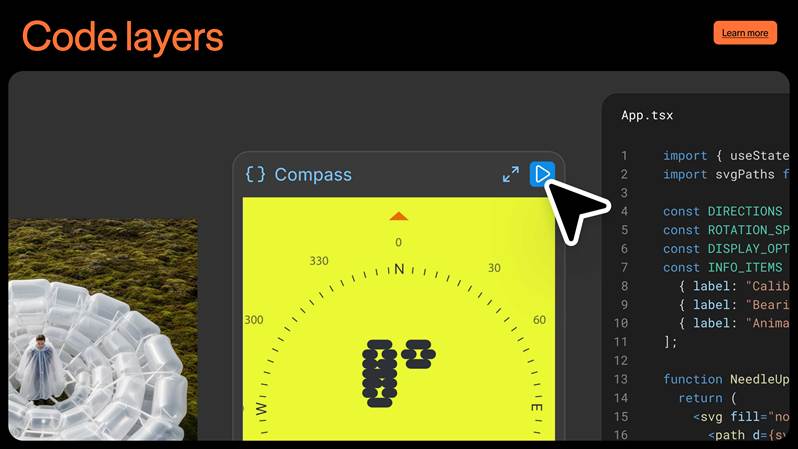
Figure 6. Q2 presentation snapshot: Code Layers connects the design canvas with code-backed prototypes. Source: Figma Q2 2026 Presentation
Valuation: Less Cheap, But More Proven
This is where the updated thesis needs to be honest. The stock is up about 43% from the earlier thesis level of around $19. So, the valuation is not the same anymore. In the first thesis, Figma was closer to 5.7x forward revenue. Now, using a market value around $14.4 billion, about $1.7 billion of cash and marketable securities, and updated 2026 revenue guidance of about $1.465 billion at the midpoint, Figma trades closer to 8.7x forward revenue.
That is a clear re-rating. So I would not say the stock is cheap in the same way. The better point is that the business has also become more proven. Growth accelerated, guidance was raised, AI credits are being consumed weekly by larger customers, and the Figma agent already has real weekly usage.
To keep the model simple, I would now use an updated 2027 scenario table. The upside is lower than before because the stock already moved, but the base case can still work if the market starts to value Figma as a broader AI product-creation platform.
Item | Approximate Value |
Current share price | Around $27 |
Move since first thesis | About +43% from ~$19 |
Market value | About $14.4B |
Cash and marketable securities | About $1.7B |
Enterprise value | About $12.7B |
FY2026 revenue guidance midpoint | About $1.465B |
Forward EV / revenue | About 8.7x |
Scenario | 2027 Revenue | EV / Revenue | Implied EV | Add Cash | Equity Value | Upside |
Bear | $1.90B | 7x | $13.3B | $1.7B | $15.0B | ~4% |
Base | $2.05B | 9x | $18.5B | $1.7B | $20.2B | ~40% |
Bull | $2.20B | 11x | $24.2B | $1.7B | $25.9B | ~80% |
This table is not a perfect model. It is only a simple framework. Dilution, future free cash flow and the final share count can change the numbers. But it shows the main point. The stock is not as cheap as before, but if Figma becomes seen as a real AI product-creation platform, the re-rating may not be done.
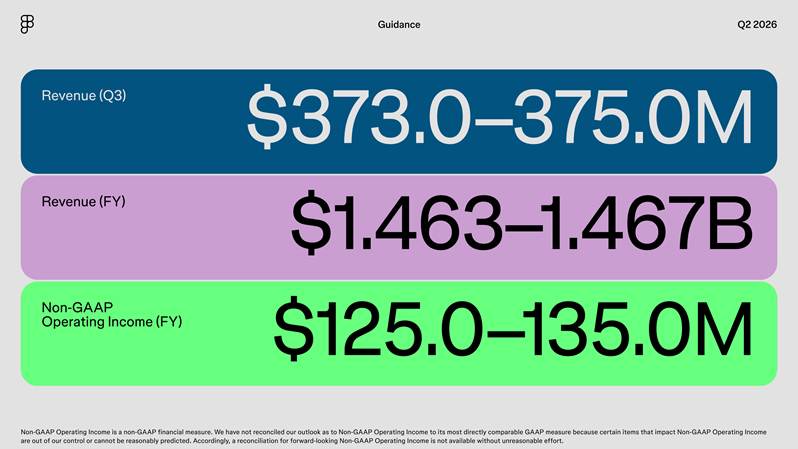
Figure 7. Q2 presentation snapshot: updated Q3 and FY2026 guidance. Source: Figma Q2 2026 Presentation
Risks
The first risk is valuation. The stock has already moved up sharply from the first thesis level. If Figma has one weak quarter, the stock can fall because the market is now giving it a higher multiple.
The second risk is margin pressure. Free cash flow margin was 14% in Q2, down from the very strong Q1 level. Figma is still investing behind AI, product launches and Config. If AI usage grows but AI monetization does not keep up, margins can remain under pressure.
The third risk is AI competition. OpenAI, Anthropic, coding agents, website builders and internal company tools can all create first drafts, prototypes and code. I still think Figma has an advantage because of workflow, design systems and team context, but the competition is real.
The fourth risk is dilution and stock-based compensation. Figma needs to show that it can grow while also becoming more disciplined on profitability and shareholder dilution. The business quality is strong, but public investors will want to see operating leverage over time.
The fifth risk is that the agent thesis may take time. Figma agent weekly usage is encouraging, but the market will need to see whether this turns into durable revenue, higher retention and wider platform usage over several quarters.
Conclusion
My original Figma thesis was that the market was pricing AI mostly as a threat, while AI could actually become the reason Figma becomes more important. After Q2 2026, that thesis looks better supported. Revenue accelerated to 48%, guidance was raised, NDR stayed strong at 136%, AI credits are being consumed weekly by more than 80% of larger customers, and Figma agent already has over 50% weekly usage among larger customers.
The stock has also moved. That matters. At around $27, Figma is no longer the same simple upside case as it was near $19. The easy re-rating has started. But the new evidence also supports a stronger thesis: Figma may be moving from design tool, to product workflow platform, to AI agent and code canvas.
So, my updated view is simple. Figma is more expensive now, but also more proven. I would not present it as a cheap stock anymore. I would present it as a disruptive platform stock where Q2 gave real confirmation that AI can expand usage and monetization, not only threaten the old seat model. If Figma keeps proving this over the next few quarters, the re-rating may not be done.



Comments
Log in or sign up to join the conversation.