


So Circle is about to keep less of every reserve dollar than at any point since mid-2025, and the margin it reports on November 4 could still go up. The keep is the share of reserve income Circle holds onto after it pays its distributors. On my numbers, it drops to about 36.4% in the third quarter, from 38.5% in the second. On about $656 million of reserve income, that is around $14 million a quarter. Or 5 cents a share before tax, and about $5 off my price target.
So if the margin does go up, it's courtesy of the token sale. Circle has around $180 million of ARC presale revenue to recognize this year as Arc hits its milestones, and there's no distribution cost against it. I assume half of it lands in the third quarter. That takes the reported margin to about 46.1% from 41.2%, while the business without it falls to around 39.0%. GAAP EPS would come in near $0.41, just a touch above the $0.38 consensus. Strip ARC out and we are left with 9 cents, on revenue of around $689 million against $740 million a year earlier. In other words, the business underneath shrinks about 7%. And if Circle books all of it in the fourth quarter, the third quarter misses badly on the headline instead.
The biggest single cause of the fall is something we can actually measure. Since June 13, Hyperliquid's USDC has sat almost entirely in a Coinbase address. Nine dollars for every one in Circle's wallet next to it. I read both balances every day and ran them through Circle's contract with Coinbase. Then, on October 29, Coinbase (COIN) confirmed it from its side. Its $22 billion of USDC in its products "Reflects full quarter impact of Hyperliquid USDC balance, which arrived in June." Now, if we run Coinbase's numbers through the contract, Circle pays Coinbase about $333 million in the third quarter. All of this is happening while USDC shrinks. On DefiLlama, it stood at $71.35 billion on October 29, against $75.77 billion a year earlier, and Circle still guides to 40% a year through the cycle.
Circle's 10-Q settles this on November 4. So I'm writing down what I expect before it reports: a payment to Coinbase of $327 million to $338 million, a keep of 34.6% to 38.3%, and USDC of $73.8 billion to $75.1 billion at the end of September.
Then we have Binance. After the close on October 29, Binance disclosed a security breach with an estimated total impact of around $6.3 billion. Circle said it had frozen more than 800 million USDC with law enforcement. CRCL closed at $72.54 on October 30, down 9.3% from $79.99 the day before. Coinbase reported that same evening too, so I wouldn't pin the whole drop on Binance. None of this even touches Q3, which ended on September 30. But Binance is the partner Circle signed a new five-year deal with on September 17, and it held $7.18 billion of its customers' USDC on October 1. That is about a tenth of all USDC. So what those customers do over the next few weeks matters more for the fourth quarter than anything in this report.
I rate Circle Internet Group (CRCL) a HOLD with a 12-month price target of $73, that is 8% below the $79.99 close on October 29. Every number in this piece is priced off that close. Now, yes, there are a few things that argue for a higher price, and I'll put those on the table. The options market puts more weight on the bull case than I do and gets $84 in a year. Circle may be sharing in the Hyperliquid deal in a way neither company shows. And the average Wall Street target is $107.48, way above mine.
How Circle Earns, and Who Gets the Yield
Let's start with how the money moves. Circle issues USDC and holds the reserves, mostly short Treasuries and repo. Reserve income was $667.7 million of its $701.3 million of revenue in the second quarter, and most of it doesn't even stay. Circle's agreement with Coinbase, dated August 18, 2023, is Exhibit 10.1 to the 2025 10-K. It runs the reserve income down in a fixed order each month. Circle first takes its cost of capital and a tiered retention (the tiers are redacted). Each company then keeps the full yield on USDC held on its OWN platform. Approved partners then get paid, and Coinbase takes "fifty percent (50%) of the Residual Payment Base" of what is left.
So a dollar of USDC earns Circle the most on its own platform and nothing on Coinbase's. Circle paid Coinbase $324.6 million in Q2, 48.6% of reserve income, and Coinbase says it earned $320 million from USDC, so the two tie. The first three-year term ended in August. Coinbase's third-quarter 10-Q says it "renewed our arrangement with Circle Internet Financial, LLC on the same terms."
Where Hyperliquid's Dollars Went
In May, Hyperliquid named Coinbase the official treasury deployer for its USDC and started winding down its own USDH stablecoin. On HyperEVM, native USDC is backed by two addresses. The explorer labels one "Coinbase: Hyperliquid Deployer" (0xc206...3c00) and the other "Circle: Core Deposit Wallet" (0x6b9e...0a24). So, I just treat the first as USDC on Coinbase's platform and the second as USDC on Circle's. At first, that rested on the labels and on Hyperliquid's own API, which names Circle's wallet as the contract its USDC links to. It also rested on the CFO's comment on the second-quarter call that about 90% of Hyperliquid's USDC sat on Coinbase's platform and about 10% on Circle's.
I read both balances at the first block of every day from December 1, 2025, on two archive nodes. Before June 13, all of Hyperliquid's native USDC sat in Circle's wallet, $4.88 billion of it on June 12. The next day, Coinbase's address held $4.43 billion and Circle's $0.49 billion. On October 28 they held $5.679 billion and $0.631 billion. Coinbase's address averaged $0.92 billion in the second quarter and $5.25 billion in the third, while Circle's wallet went from $1.45 billion to $0.58 billion.
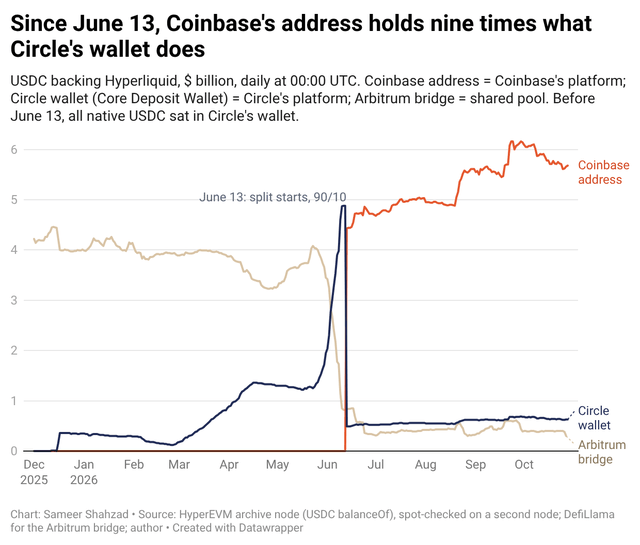
HyperEVM archive node (USDC balanceOf), spot-checked on a second node; DefiLlama for the Arbitrum bridge;
I'll be a little careful here tho. Because two nodes reading the same chain are still one source. So I checked the totals against DefiLlama, which runs its own indexer. Over 286 days, the two differ by 0.08% on average, and the quarterly averages agree to the million: $5.838 billion on my personal count for the third quarter, $5.837 billion on theirs. That confirms the size and the timing of the move. It can't confirm the split between the two addresses. Only the companies could, and on October 29 Coinbase did.
What Coinbase Reported
Average USDC held in Coinbase products rose to $22 billion in the third quarter from $20 billion, and Coinbase's deck credits the full quarter of Hyperliquid's balance. Leave out Coinbase's own corporate USDC and its revenue on customer USDC in its products rose $35 million, to $181 million. That covers the $30 million my contract math gives for the Hyperliquid move. The rest comes from other balances and the higher rates Coinbase also cites.
The total rose far less tho. Coinbase's USDC revenue went from $320 million to $328 million. Its own corporate USDC earned $7 million less, and USDC held off its platform, down to a $51 billion average from $57 billion, earned $20 million less. Both numbers are right, yet they cover different pools.
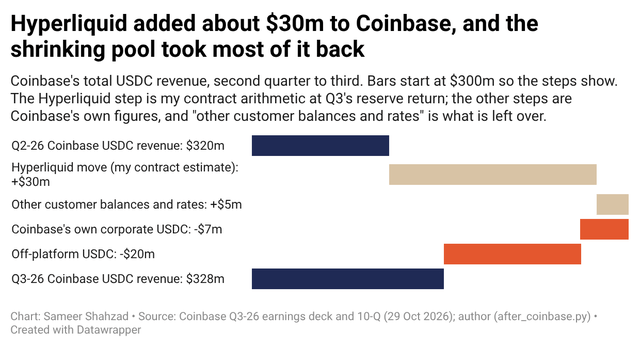
Coinbase Q3-26 earnings deck and 10-Q (29 Oct 2026);
Over the last four quarters, Circle's own payment to Coinbase has run between $1 million below and $10 million above Coinbase's figure. Put Coinbase's $328 million through that gap and Circle pays it $327 million to $338 million in Q3. That is about $333 million in the middle.
What It Does to the Third Quarter
So with Circle paying Coinbase about $333 million out of about $656 million of reserve income, and everyone else paid at the second quarter's 12.9% share, Circle itself keeps about 36.4%, in a range of 34.6% to 38.3%. That's my central estimate now, and EVERY number in the piece runs off it.
Now, the direction is settled. Just the size isn't. Note that the top of that range sits only a fifth of a point under the second quarter's 38.5%. The range also only covers what Coinbase's figures and my reserve income estimate leave open. It rests on one input I can't really check before November 4, which is everyone other than Coinbase taking the same 12.9% of reserve income they took in the second quarter. Every point they take beyond that comes straight off the keep. Binance's new deal could push it either way. Binance customers' USDC fell from $9.25 billion on May 1 to $7.18 billion on October 1 in Binance's own reserve reports, which shrinks the bill. But the 8-K doesn't say whether the new terms sit inside the Coinbase agreement, and if they stay outside, Circle now carries costs Coinbase used to share. The calls I logged before either company reported put the keep between 34.7% and 36.7%. They will stay as written and get scored as written.
Circle's guidance points to a falling margin as well. Excluding ARC, the CFO guided the full-year margin to "near the midpoint of the prior range" of 38% to 40%. The first half came in at 41.3%, which leaves 35.6% to 37.8% for the second half. If anything, my own second half without ARC, at 38.9%, is more generous than management's. So a falling margin isn't news by itself. What Circle hasn't said is why, or who even ends up with the money.
The Token Sale in the Headline
Circle sold $242.2 million of ARC tokens in the second quarter. The 10-Q says, "Proceeds received from the ARC Token presale are recognized as deferred revenue until the Company's performance obligations under the token purchase agreements are satisfied." On the call, the CFO put $180 million into 2026 guidance. Arc's mainnet went live on September 16, which kind of looks like a milestone, but Circle hasn't said how the revenue splits between the third and fourth quarters. I put $90 million in each.
Every $10 million moves quarterly EPS by about 3.5 cents. So, the third quarter could print anywhere from about $0.09 to $0.72 on the same business. The Street is split on this too. Street revenue estimates run from $714 million to $873 million, and the $788.6 million average only fits my reserve income if it carries about $99 million of ARC. A low estimate near $714 million looks like an analyst with almost none in.
What the Stock Trades On
The keep only matters if the stock trades on it too. So I went through Circle's five reports. All five came out before the open, so each move runs from the prior close.
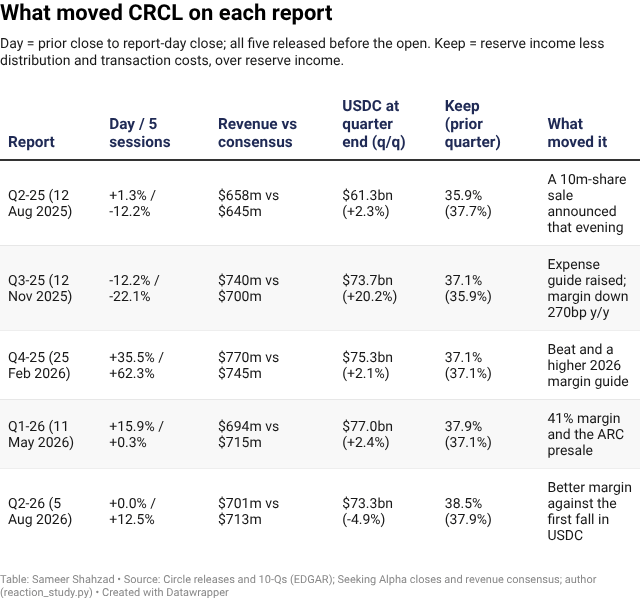
Circle releases and 10-Qs (EDGAR); Seeking Alpha closes and revenue consensus;
USDC growth on its own has never carried the stock. In November 2025, circulation was up 20% in a quarter, and the stock still fell 12.2%, after Circle raised its expense guide and its margin fell 270 basis points from a year earlier. In the four reports without a share sale in the way, margins and costs line up with the direction. It was down on the expense raise, up on the higher margin guide in February, up on the 41% margin in May, and flat in August when a better margin met falling USDC. The first day doesn't settle it either. May's gain was gone in five sessions, while February's ran to +62%.
I know five reports are a small sample, and rates and positioning moved too. Still, the pattern says the market trades on the margin, and the keep is the biggest piece of it. The real problem is which margin. Circle reports revenue less distribution costs over total revenue, and ARC sits in the total with no cost against it. So if ARC lands in the quarter, the number the stock trades on should look good on November 4. The weaker version will be out too, tho. In each of the four quarters Circle has filed a 10-Q, it came out the same morning, around 3 hours after the release and before the open, and the payment to Coinbase is in it. So anyone with the 10-Q has the keep before the stock opens.
If ARC lands as I expect and the stock still falls, USDC is the likelier reason. Circle's own quarter-end figure has run within about $0.75 billion of DefiLlama's, which puts end-September at about $74.4 billion. That's less than 1% above the $73.7 billion Circle reported a year earlier. DefiLlama shows a 1.9% gain, but a year ago Circle's count ran $0.53 billion above DefiLlama's, and lately it has run below it. The quarter's average should come in at $73.3 billion to $73.9 billion, against $76.5 billion in Q2. And if Circle gives a number for October, as it has before, it'll be near the $71 billion DefiLlama shows now.
My Numbers Against the Street
Okay, so these come from a three-statement model by quarter through 2027, with a balance sheet that ties out every quarter. Free sources do NOT carry the Street's cost lines, so where those aren't public, I show Circle's guidance next to mine.
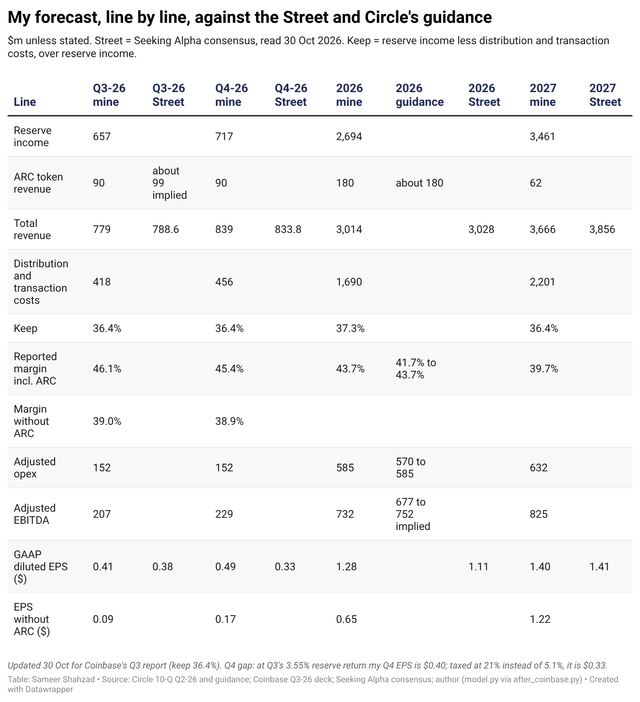
Circle 10-Q Q2-26 and guidance; Coinbase Q3-26 deck; Seeking Alpha consensus;
The third quarter sits a tad above the Street. The fourth, however, is a different story. I have $0.49 against $0.33 on almost the same revenue. Two assumptions explain all of it. At the third quarter's 3.55% reserve return, against my own 3.90%, I'd be at $0.40. Tax that at 21%, against the 5.1% Circle paid in the first half, and I'm at $0.33. I don't know that's what the Street did, but both look stale to me. The 3-month bill averaged 3.94% in the third quarter and 4.24% so far in October, and Circle's tax losses sheltered its U.S. income in the first half, which is why its rate was just 2.5% and 7.8% in the first two quarters.
For 2027, I'm at $1.40, in line with the $1.41 consensus. The 10-K shows $478.8 million of federal tax losses at the end of 2025. Used at the 80% annual limit, they run out during 2027, which puts the year's tax rate near 17%.
Management
Jeremy Allaire co-founded Circle and runs it as chairman and CEO. Class B shares carry five votes each, capped at 30% of the vote. Insiders sold $267.5 million of stock in 2026 through October 27, with most of it under pre-set 10b5-1 plans, and bought none. Co-founder Sean Neville, the largest seller at $117.2 million, left the board on September 25, the same day the CFO Jeremy Fox-Geen said he'd leave by the end of December. So the 2027 guide, the first without much ARC and with tax losses running out, will come from someone new. Stock pay was 7.6% of second-quarter revenue, and I count it as a cost.
The Competition
Tether's USDT is 60.2% of all stablecoins on DefiLlama, and USDC is 23.8%, down from 24.8% a year ago. All stablecoins fell 1.7% over the year to $300.3 billion. USDC fell 5.8%. Meanwhile, the smaller dollar coins grew. Paxos's Global Dollar (USDG) went from $0.97 billion to $3.07 billion, Ripple's RLUSD from $0.91 billion to $2.60 billion, and PayPal's PYUSD from $2.79 billion to $3.00 billion. Add World Liberty's USD1, and they put on $4.92 billion, while USDC lost $4.42 billion.
Now we have banks next. On September 1, a group of 21 banks, including Goldman Sachs, Citi and Bank of America, said it would form a company to issue a dollar stablecoin in the first half of 2027, and CRCL fell 6.4% that day. The rules land at the same time. The OCC finalized its GENIUS Act rule on October 21, and the rule and the Act take effect on January 18, 2027. The ban on paying holders yield stays. WilmerHale notes that the rule's preamble says the ban could "capture certain indirect payments", which might reach the rewards distributors pay out of what Circle pays them. Coinbase's own deck says its sales and marketing costs rose "due to higher USDC rewards".
What the Bulls See
The Street's $107.48 rests on a case worth laying out properly. From January, the GENIUS Act makes stablecoins regulated money, and bulls see Circle as the issuer best placed for that. Arc went live in September, and Circle's CEO calls the company "a 25% stakeholder in that network". Put that next to Circle's payments network and Circle starts to look like a payments company that also holds reserves. Rates have gone up too, which lifts what every dollar of USDC earns. And USDC is the leading stablecoin on Hyperliquid.
I take most of that REALLY seriously, with some of it being in my numbers. The Arc stake is in my value at its presale price, and the higher bill is in my fourth quarter. What I can't find yet is the revenue. Everything outside reserve income came to $33.6 million in the second quarter, under 5% of the total. The same rules that bless Circle also let 21 banks in. And yes, USDC leads on Hyperliquid, but 9/10 of its dollars there now earn for Coinbase.
Valuation
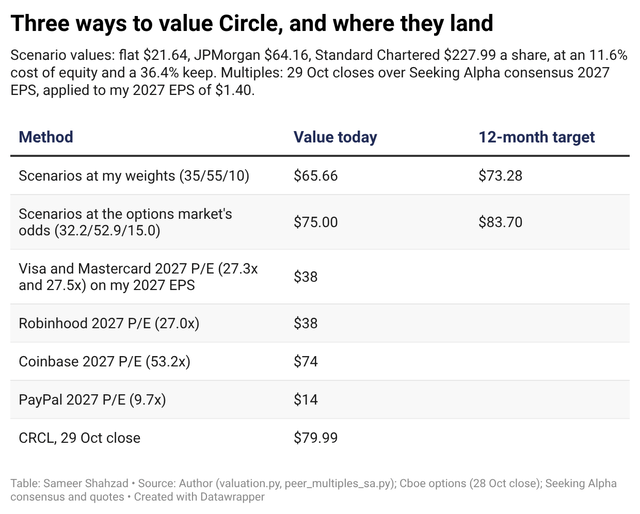
I value Circle over ten years under three published views of the stablecoin market: no growth, as in the past year; JPMorgan's $500 billion to $600 billion by 2028, and Standard Chartered's $2 trillion by 2030. USDC keeps its share. The reserve return follows the forward curve less Circle's usual gap to the bill, and the keep stays at 36.4%. Higher rates cost float. Since 2023, each point on the 3-month bill has gone with about 15.6% less stablecoin supply over six months, holding bitcoin (BTC.X) constant, in a range of 12.3% to 19.0%. The discount rate is 11.6%, from a Blume-adjusted beta of 1.57, a 4.99% 10-year Treasury, and a 4.20% equity risk premium. On top of that, I add $1.85 billion of cash and receivables, Circle's 25% of Arc at the presale value, the tax losses, and Tazapay, over 274.9 million shares.
That gives $21.64 a share flat, $64.16 on JPMorgan, and $227.99 on Standard Chartered. My weights are 35%, 55% and 10%, set on October 27. Flat gets more than a third because stablecoins have shrunk since JPMorgan published. Standard Chartered gets 10% because the bank pushed its date from 2028 to 2030 on October 14. That is $65.66 today and $73.28 in a year, so $73, up from the $72 I had before Coinbase reported.
So that leans on the bull case more than the weights let on. Standard Chartered's scenario carries 10% of the weight but $22.80 of $65.66, which is about a third of the value. If we take it out and keep the other two in the same proportion, the value is around $47.60, with a target near $53. Then that would be a Sell. At the current price, the market is effectively giving it about 18%. I keep it at 10%. Standard Chartered pushed its date out and kept the forecast and giving it nothing would be as much of a bet as giving it the market's 18%.
Cboe options (28 Oct close); Seeking Alpha consensus and quotes
I had to check it two ways. On the odds January 2028 options put on each scenario's price band, the same model gives $75.00 today. On peers' 2027 P/E, from consensus EPS, applied to my own 2027 EPS of $1.40, Visa (V), Mastercard (MA), and Robinhood (HOOD) at 27.0 to 27.5 times give about $38, and Coinbase's 53.2 gives $74. Only Coinbase's multiple and the options' weights get near the price. At $79.99, the stock is 57 times my 2027 EPS. As a matter of fact, rates matter less than float once the drag is in. Fed paths from 1.5 points below the forward curve to 1 point above it keep the target between $63 and $74, while 10% more or less USDC moves it around $8.
My rule is that a target within 15% of the price is a Hold. $73 against $79.99 is 8% below, so this is a Hold. Above $86.21 it becomes a SELL, and below $63.72 a BUY.
The November 4 Print
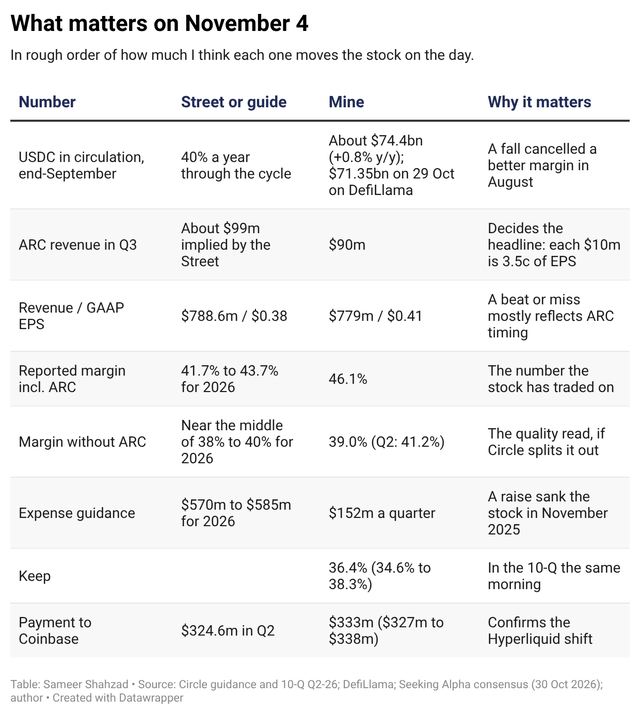
Now this is a short list, in rough order of how much I think each one moves the stock on the day.
Circle guidance and 10-Q Q2-26; DefiLlama; Seeking Alpha consensus (30 Oct 2026);
I also checked whether the options already price my view. At the October 29 close, the 20 November $80/$70 put spread cost $4.15 at mid, and the market gave 42.6% odds of CRCL finishing below its $75.85 break-even. My own odds, from a scenario tree built on the five reports, come to 42.9%. So there's no edge, and I'm not holding a position into the report. The setup I'd watch really just comes after it. If the stock jumps 10% or more on a flattered headline while the 10-Q shows a keep below 37% and USDC is still below its end-September level, the trade is a December $90/$80 put spread into that rally. With the stock near $94 I'd expect it to cost about $3.90. That's an indicative model price at 75% volatility with no skew; check a live quote first.
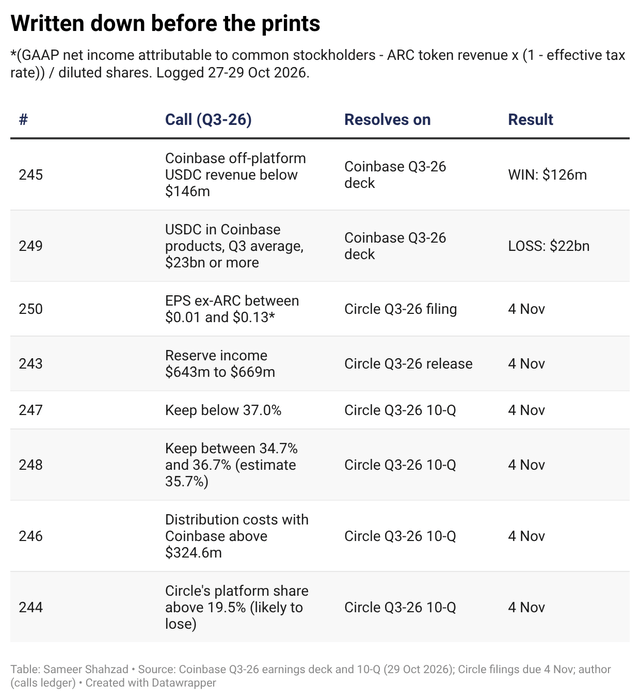
These are the calls I wrote down before either company reported. Coinbase settled two of them on October 29, one win and one loss. Once the 10-Q is out on the morning of the release, I will publish what I got right and wrong on the rest, losses included.
Coinbase Q3-26 earnings deck and 10-Q (29 Oct 2026); Circle filings due 4 Nov;
What Would Change My Mind?
Coinbase has now backed the address reading, so that risk is mostly gone. A keep at or above the second quarter's 38.5%, or a Coinbase payment at or below $324.6 million, would mean Circle earns something on the 90% after all. I have asked Circle's investor relations that question directly and have had no reply as of October 30. USDC back above $75 billion would take away the likeliest reason for the stock to fall.
Positioning
FINRA shows 27.7 million shares short on October 15, 11.8% of the Class A shares and the most going into any of Circle's reports. Borrow costs just 0.28% a year at Interactive Brokers, so that tells us shorts aren't paying that much to stay in. Back in February, about 22 million shares were short when the stock rose 35.5% in a day. In the report-week expiry, put open interest is 1.2 times call open interest, against 0.76 across all expiries.
Where I Could Be Wrong
So if Circle has a side agreement and earns something on the 90%, the keep goes back near 38.5%, and the target to around $78. Coinbase's reports make that less likely, since its revenue on customer USDC rose by more than the Hyperliquid move alone, but it doesn't rule it out. The backtest is four quarters, with the reaction history being five reports. The rate drag is a correlation over two or three cycles. With no drag, the target is about $88, and at the full-sample drag about $65. Every 5 points of weight moved into Standard Chartered adds around $9 to today's value. And every scenario holds USDC's share of 23.7%. Losing half a point a year takes the target to about $60, and a full point to around $46, which would make this a SELL.
The data, scripts, model, backtest, reaction study, option odds, and the Coinbase update, for any of you to run.
Where I Come Out
So here's this. USDC is shrinking, and the Hyperliquid move, which Coinbase has now confirmed from its side, takes reserve income from Circle to Coinbase while the shrinking pool takes some of it back. If the token sale lands in the quarter, November 4 should look fine on the surface: EPS a touch above the Street, a margin near 46%, and a business underneath that earns about 9 cents. The stock has traded on margins. But the keep will be public before the stock opens, and that is the number I'd read first. Over 12 months, I come out at $73, under the price on two of my three methods.
My rating is HOLD, with a 12-month price target of $73.


Comments
Log in or sign up to join the conversation.