

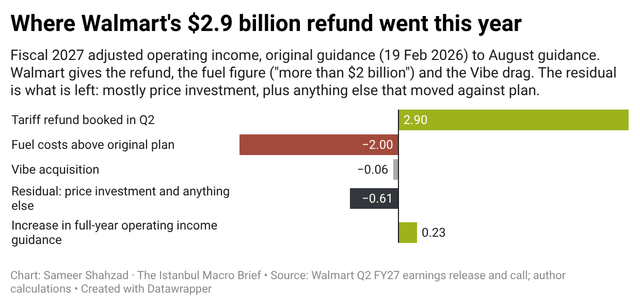
So Walmart received a $2.9 billion tariff refund this summer. In effect, most of it went to diesel.
When you put the guidance Walmart gave in February next to the one it gave in August, that is what comes out of it. The refund lifted the full-year operating income guide by $0.23 billion. Fuel took more than $2 billion just on its own. The Street has adjusted for the refund: fiscal 2028 consensus has come down about 5 cents since before the quarter, to $3.22. It's done far less about fuel. At the diesel price the futures market implies, and with half of this year's price investment still in place, $3.22 needs operating income around 15% to 18% above Walmart's February plan. Remember, Walmart's best year in the last six was 11.2%.
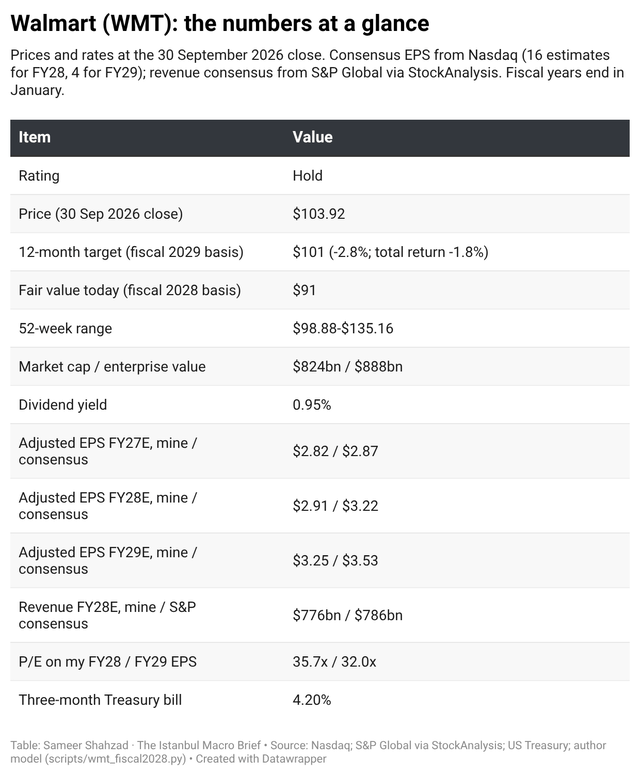
I rate Walmart (WMT) a Hold. My estimates are well under the Street's, and on my fiscal 2028 number the stock is worth about $91 today. My 12-month target, on fiscal 2029, is $101, against the September 30 close of $103.92. With the dividend, that is a total return of about minus 2%, all whilst a Treasury bill pays 4.20%. I don't think there is an accounting error here. The refund was court-ordered, and Walmart has been pretty transparent about where it went. The diesel bill can be credited to bad luck.
The numbers at a glance
Where the refund went
Walmart guided FY2027 adjusted operating income up 6% to 8% on February 19, just a day before the Supreme Court struck down the IEEPA tariffs. In August, with the refunds booked in cost of sales, it moved the range to 7% to 8.5% on a $31.0 billion base. That raised the midpoint by $0.23 billion.
The CFO accounted for most of the other $2.7 billion on the call. Walmart expects "more than $2 billion of incremental fuel-related costs this year, above and beyond our original guidance assumptions." The Vibe acquisition costs about 20 basis points. That leaves us with about $0.61 billion. Walmart says that it is putting the refund into price, so most of the leftover is just rollbacks, though it also soaks up anything else that ran against the plan.
The cost of a dollar of diesel
Walmart has given three fuel numbers. Yeah, I measure all three against NY Harbor wholesale diesel because that is what the futures trade. The pump price has tracked it all. From February to September, retail diesel rose $2.57 a gallon, and NY Harbor $2.45. In May 2022, then-CEO Doug McMillon said, "Fuel ran over $160 million higher for the quarter in the US than we forecasted." That comes out to be about $0.92 billion a year for each dollar a gallon above February's price. This May, Walmart "absorbed approximately $175 million" of higher-than-planned fuel costs, or $0.71 billion per dollar. August's "more than $2 billion," against the August price held to January, is at least $1.39 billion a dollar.
I use the average, $1.01 billion, as my mid case. That is around 10 cents of EPS for each dollar a gallon is held for a year. The quarterly and full-year figures may differ on timing, or the $2 billion might include other costs excluding diesel. I can't really tell which from what Walmart has said.
Walmart's private fleet runs about 1 billion miles a year. Walmart's IR team told me the private fleet is actually the majority of the fuel bill, with the rest being carrier surcharges. That's a lot more than the mileage suggests. At the 6.7 miles per gallon the Federal Highway Administration reports for combination trucks, 1 billion miles only comes to about $0.15 billion a dollar. So either the fleet runs further than that page says, or the bill covers more than just trucking diesel. What matters here is the total, and that comes from Walmart's own numbers. The truckload producer price index was up 13.9% year over year in August, and J.B. Hunt's fuel surcharge revenue rose 82% in its second quarter. The Cass freight expenditures index was up 18.7% in August, whilst shipments only rose 2.1%. Most of that increase is price per load.
Other retailers are noticing it too. Kroger's gross margin slipped 10 basis points, and "higher transportation costs" was one of the reasons it gave. Its CFO expects "incremental headwinds from diesel and freight costs" for the rest of the year. Dollar General's margin gain was partly offset by "increased transportation costs." Target's release didn't mention fuel or even freight at all, and excluding refunds, its gross margin rose about 100 BP as it lapped heavy markdowns.
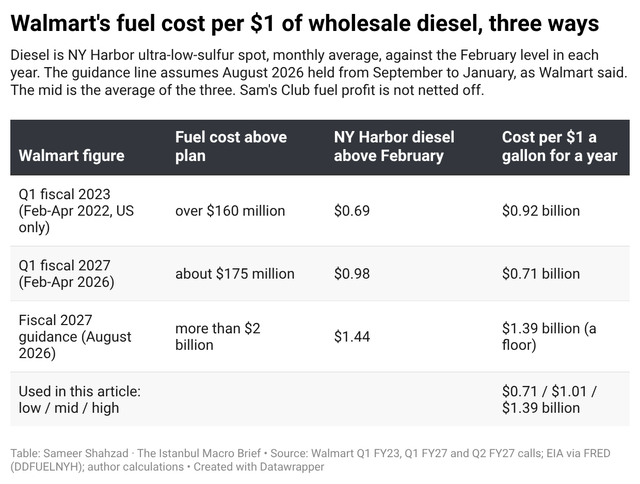
Walmart's 10-K discloses NO fuel derivatives. I've left Sam's Club fuel profit out. Retail fuel margins tend to widen when wholesale prices fall. So if anything, Sam's helps next year.
The futures curve
On September 30, the NY Harbor strip averaged $3.66 for FY28 (February 2027 to January 2028). That is $1.16 above February 2026, or about $1.17 billion of operating income at the mid, or 11 cents a share. The strip is front-loaded with about $4.11 in Q1 of FY28, falling to $3.34 by the fourth. Most of the cost just lands early.
What $3.22 needs
To earn $3.22, Walmart needs around $37.4 billion of operating income. That assumes fiscal 2027's other items and tax rate stay flat at the guided levels. Interest is at 4.5% on the extra debt my model carries, and the share count falls 0.5% a year, at the pace of the last twelve months.
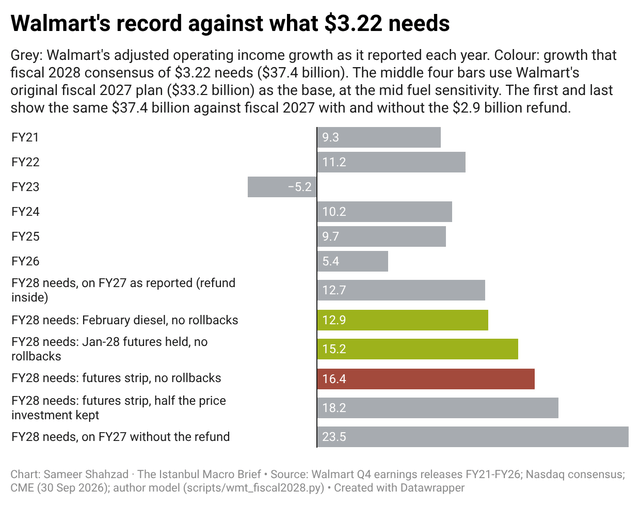
The base you pick really is the game changer here. On FY27, as it'll be reported, about $33.2 billion on my numbers, it's 12.7% growth. That does sound ordinary. But $2.9 billion of that base is a refund that will not recur, and without it, the growth needed is 23.5%. The February plan, $33.17 billion, has neither the refund nor the fuel shock in it. So that is where I start.
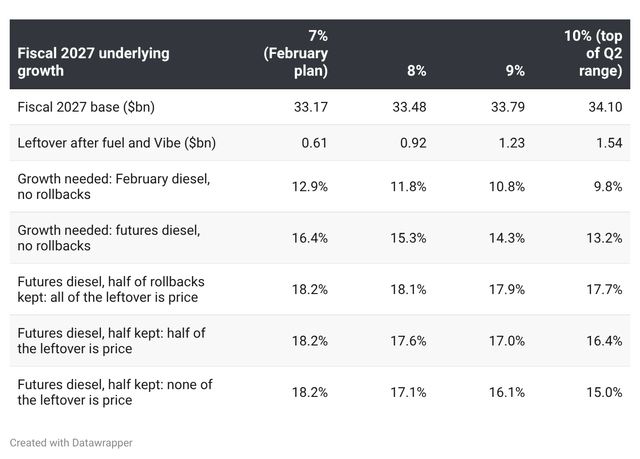
The obvious pushback is that Walmart has been beating that plan. The CFO put the second-quarter underlying growth at "the top end of our 7% to 10% guidance." So I ran the base four ways. I also split the leftover $0.61 billion three ways, because a stronger year means either more price investments or more of something else against plan.
With February diesel and no rollbacks, the growth needed falls from 12.9% to 9.8% as the base rises. At futures diesel, with half the price investment kept, it's between 15.0% and 18.2% in every combination. Even at the lowest fuel cost Walmart's own numbers support, $0.71 billion a dollar, it is 14.0% to 17.2%. That's the range I'd defend. Faster buybacks do help a little. At 1.2% fewer shares a year, the February-plan bar drops by about 0.7 points.
Walmart's record
Walmart's adjusted operating income grew 9.3%, 11.2%, minus 5.2%, 10.2%, 9.7%, and 5.4% in fiscal 2021 to 2026, respectively. The two best years were rebounds: one from COVID costs and one from fiscal 2023's decline.
Depreciation really does make this harder. It rose 13% in the first half, per the 10-Q, as capital spending climbed to about 4% of sales. My model has it rising another $1.6 billion in fiscal 2028. That's close to 5% of the plan's operating income. It's already inside my 8.5%, which is one reason I think 8.5% is a stretch on its own.
The Walmart U.S. math
Walmart U.S. comps grew 2.6% last quarter: 1.5% from transactions and 1.1% from ticket. Walmart puts the drag from the new drug-price rules at 125 BP, or 80 net of GLP-1 sales across health and wellness. Segment sales grew about 4% in the first half. I assume the same will happen next year.
The number I find the most useful is how much of each extra dollar of sales Walmart U.S. keeps as its operating income. Now hear this: in FY26, they kept about 5 cents. The first half of this year it was 17 cents, refund included. My base case needs 11 cents in FY28. Consensus needs 18 cents with February diesel and no rollbacks, and 27 cents at futures diesel with half of them kept. Advertising and membership fees can push that number above the average, and on the August call the CFO put the company's current incremental margins at "roughly double-digit, low double-digit." So my base case asks Walmart U.S. for an approximation of what management says it earns now. Consensus asks for a lot more.
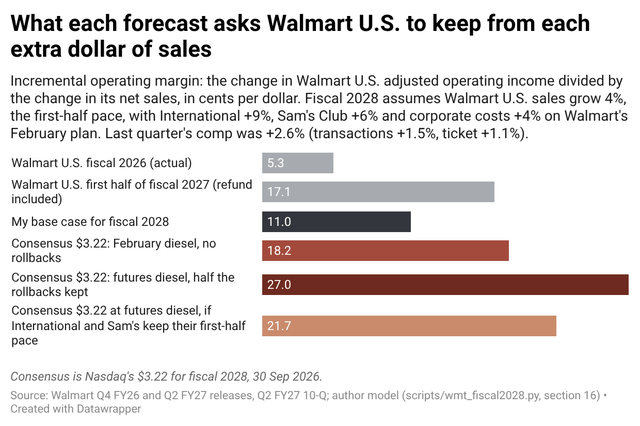
These figures are highly dependent on how I split the segments, so I ran the kinder version. International grew operating income about 20% in the first half, and Sam's Club about 19%, both again with some refund benefit. If they kept that pace next year, Walmart U.S. would have less to carry. My base case would then need under 6 cents, and consensus would need 13 cents with February diesel and 22 cents at futures diesel. 22 cents is still four times last year's figure.
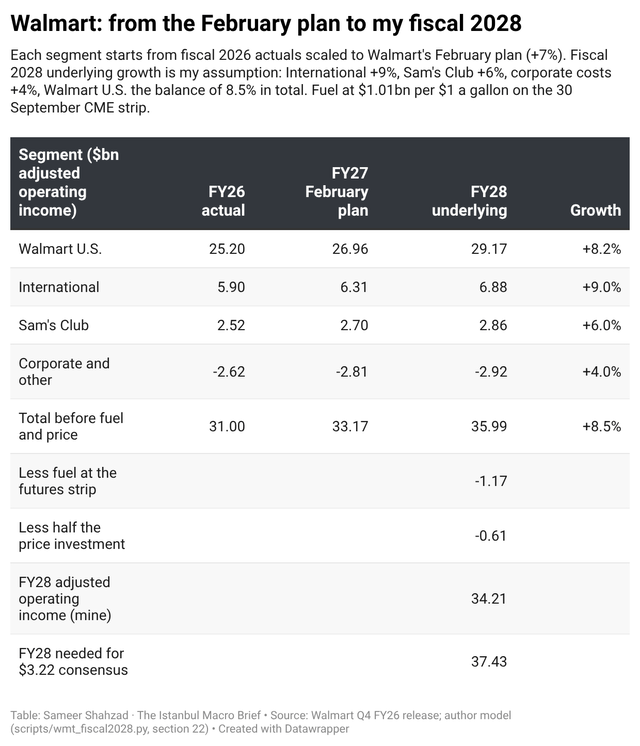
Here's the bridge from the February plan to my FY28, with each segment starting from FY26 scaled up to the plan.
My numbers
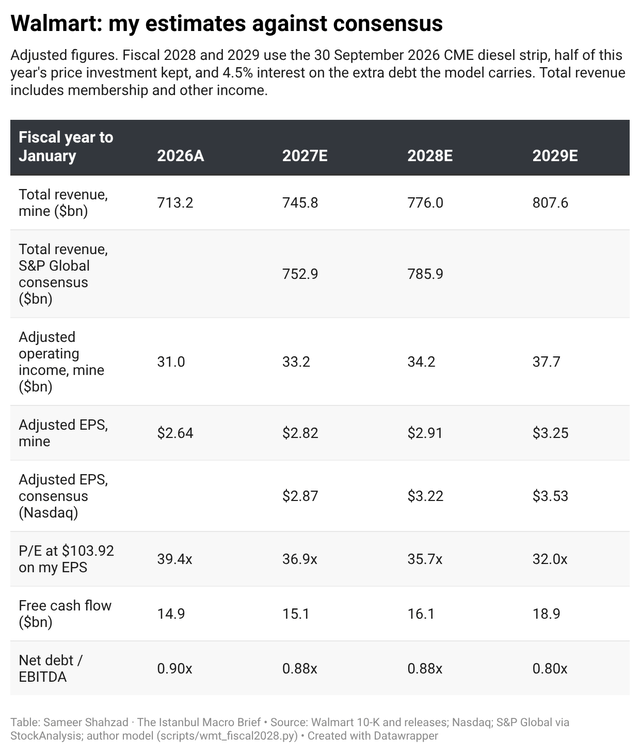
For FY28, I grow International 9% a year, Sam's Club 6%, and Walmart U.S. makes up the rest of 8.5% on the February plan. That puts Walmart U.S. at 8.2% against 4.8% last year. After fuel and half the price investment, operating income is $34.2 billion, and EPS is $2.91. For FY29, I repeat the growth rate with diesel at January 2028's $3.26 and get $37.7 billion and $3.25, against a four-analyst consensus of $3.53.
Almost all my gap with the Street is just margin. My FY28 revenue is $776 billion, 1.3% under the S&P Global consensus of $786 billion, which explains about 4 cents of the 31-cent EPS difference.
Those are top-down numbers, so I rebuilt them from the bottom up. Just as a precaution. Fuel and the refund both mostly run through cost of sales, and so does most of the price investment. If gross margin gets only last year's 8-basis-point mix gain from advertising, marketplace, and membership, and SG&A gets just enough leverage to land this year on guidance, operating income comes out $0.6 billion lower in fiscal 2028 and $0.9 billion lower in fiscal 2029. EPS would be $2.86 and $3.17. My top-down figures are, in fact, the more generous of the two.
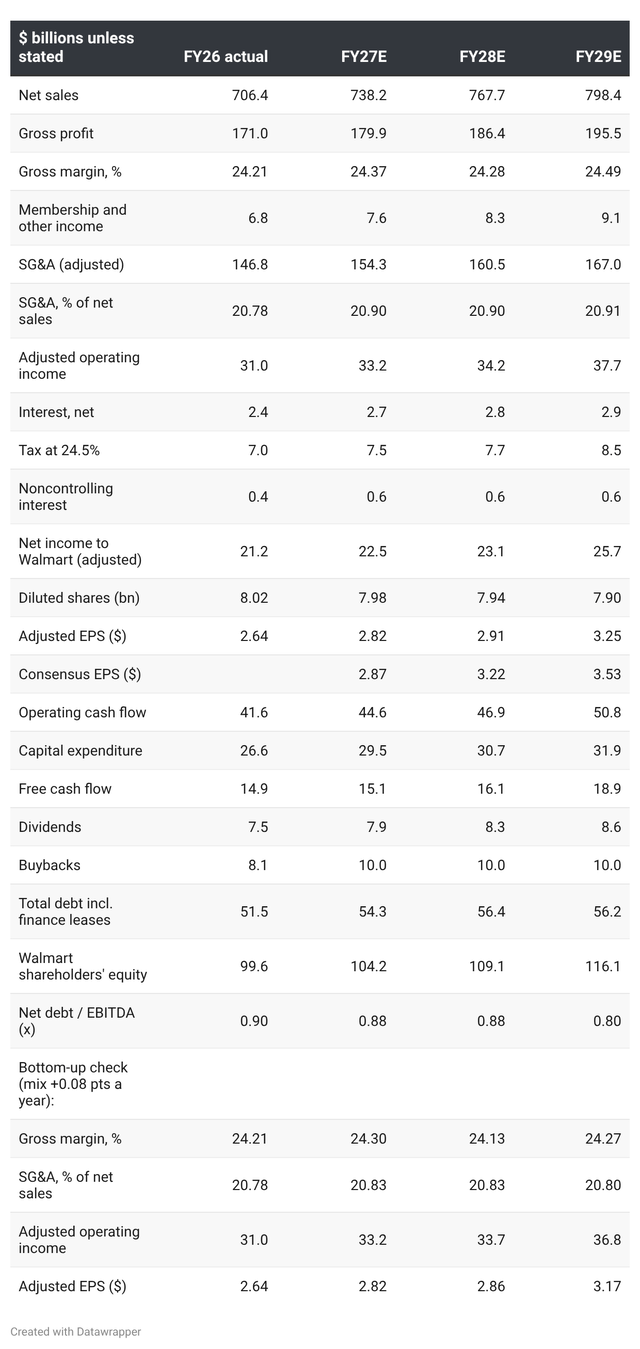
The balance sheet is boring. Free cash flow goes from about $15 billion to $19 billion, and after $10 billion a year of buybacks plus the dividends, net debt stays under one times EBITDA.
Walmart's very own guidance is already below the Street for the fourth quarter. Take the FY27 midpoint, subtract the first two quarters and the third-quarter guide, and you get $0.735. Consensus is $0.78.
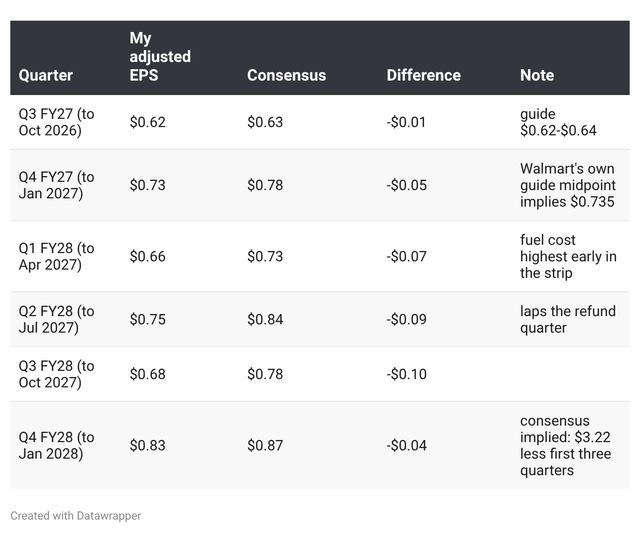
The fourth-quarter consensus for fiscal 2028 in the table is implied: $3.22 less the first three quarters.
Rollbacks
Management hasn't really said how long the rollbacks last. CEO John Furner: "A rollback has a start date, it has an end date." And: "It's probably a bit too early to call how many of these will be permanent." The CFO added: "Lapping 19% EPS growth next year will be a challenge."
A fair counterargument is that rollbacks can pay back with a lag. The CFO said, "There is a bit of a cumulative benefit that comes when you lower prices." JPMorgan, which kept its Overweight rating after the quarter, noted that the bear case assumes no lagging benefit at all. My base case splits the difference and keeps half of the price investment through FY28.
According to Walmart's earnings presentation, general merchandise like-for-like inflation was 1.7% in the second quarter. That is about 270 basis points below the first, while the rollbacks went from 7,200 to more than 11,000. If that inflation number climbs back towards the first quarter's level, the rollbacks are ending, and my base case would be light by up to 6 cents.
There's also an outside check before Walmart reports. The CPI for goods outside food and energy fell 0.1% in May and again in June, rose 0.2% in July and 0.1% in August, and is 0.7% above a year ago. September's figure comes out on October 14. Monthly prints above 0.3% would tell me retail prices are firming and rollbacks are fading. That would help Walmart's margins and hurt my case.
Valuation
I value three cases, weighted 25%, 50%, and 25%. The multiples are from Walmart's history. On each of the last five days it gave a first guide for a new year, I divided the share price by the midpoint of that EPS guide. The five readings are 20.4, 24.7, 25.5, 38.1, and 44.6 times. The bear case uses the 25th percentile (24.7 times), the bull the 75th (38.1 times), and the base the mean (30.6 times).
I used to use today's price over consensus for the base, which meant my fair value dropped every time the stock did. The mean of the five guidance days doesn't move with the price, and it's a little below today's 32.3 times. The median, 25.5 times, is harsher. I show it below, too.
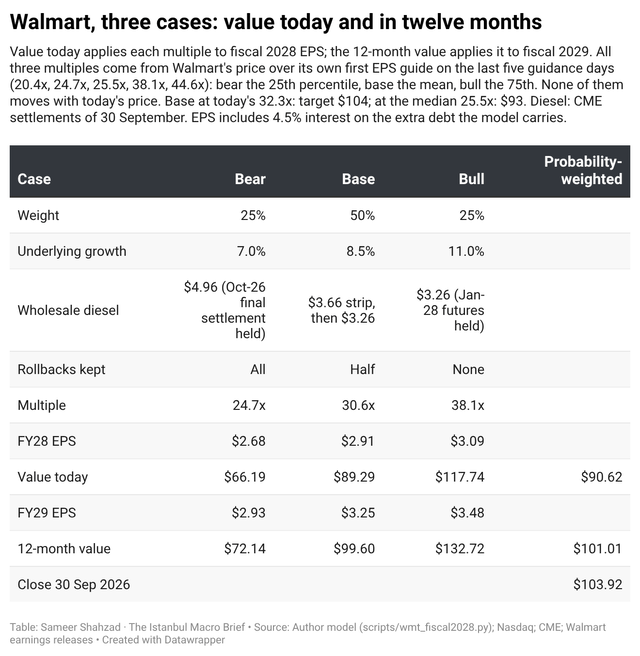
On fiscal 2028 EPS, the weighted value is $90.62, which is around 13% below the price. A 12-month target should use the year the market will be pricing in 12 months, which is fiscal 2029. On those figures, the weighted value is $101.01.
The target doesn't really move much when I change the inputs. With the base at today's 32.3 times, it's $104; at the median, it's $93. With no bear-case de-rating, it's $105. At the low fuel sensitivity, it's $102. The high one is $100, and on the bottom-up margins, $98. The grid below varies the base case's underlying growth and shifts the whole diesel strip up or down.
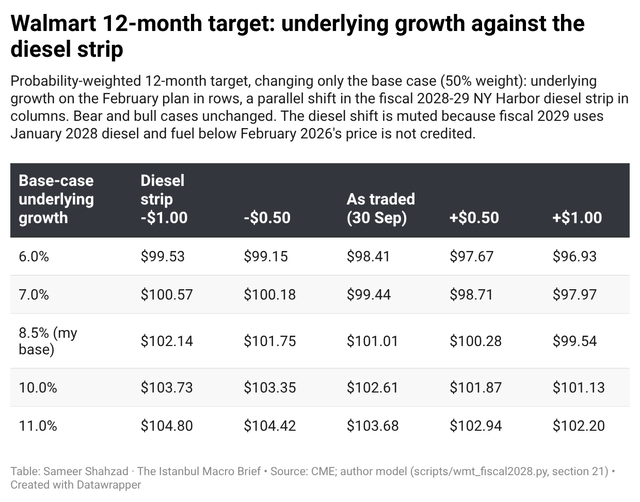
The diesel column moves less than the growth rows because FY29 uses January 2028's price, and I don't give credit for fuel below February 2026's level. Every cell is between $97 and $105.
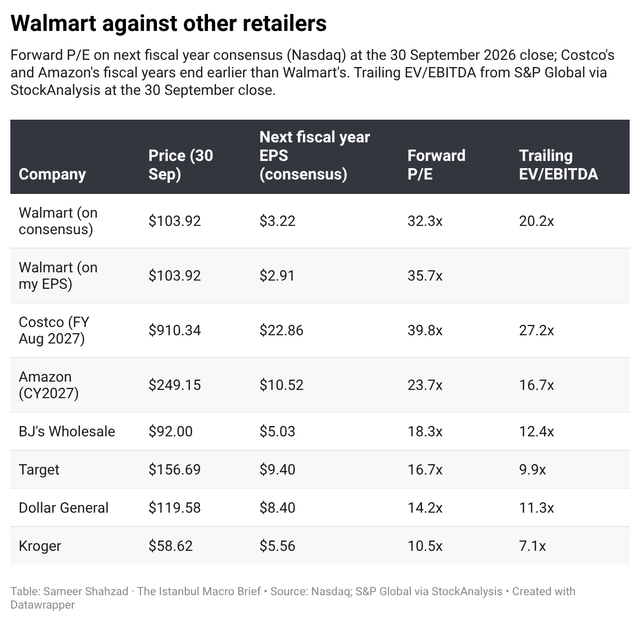
Compared with other retailers, Walmart at 32 times next year's consensus is between Costco (COST) at 40 times and Amazon (AMZN) at 24 (both have fiscal years ending earlier than Walmart's), and about twice Target at 17 and Dollar General at 14. On my own EPS, it's 36 times. On trailing EV/EBITDA, it's about 20 times, against 27 for Costco and 10 for Target.
A discounted cash flow check gives a pretty similar answer. Operating cash flow less depreciation, using depreciation as a stand-in for maintenance capex, is $27.8 billion, 3.4% of an $824 billion market value. My cost of equity is 7.7%: the 10-year Treasury at 5.29% plus a beta of 0.59 times the 4.09% equity premium Aswath Damodaran implied for September 1. If that cash flow grows at my 7.2% a year for 10 years and 3% after, it's worth about $107 a share, a bit above the price. One point on the discount rate moves the answer by $20 to $31, so I use this to sanity-check the Hold. I wouldn't set a target off it.
So I land on HOLD. My numbers are about 9% under the Street for FY28 and 8% for FY29. But Walmart grows into most of that gap within a year, and the cash-flow check puts the price near the fair value. The shares have also done some of the work already. They fell 7.3% on first-quarter results and 9.2% on second-quarter results, and they closed September 30 about 23% below the May high of $135.16.
Positioning
37 of the 43 analysts S&P Global tracks rate Walmart a Buy, five rate it a Hold, and one a Sell. The average target is $127.43. Morningstar is the big outlier, with a fair value of $81, because it thinks the price assumes operating margins well above Walmart's historical peak of about 6%. At the September 30 close, the November 20 $105 straddle cost about 8.9%, around the size of the last two earnings-day moves.
Dates to watch
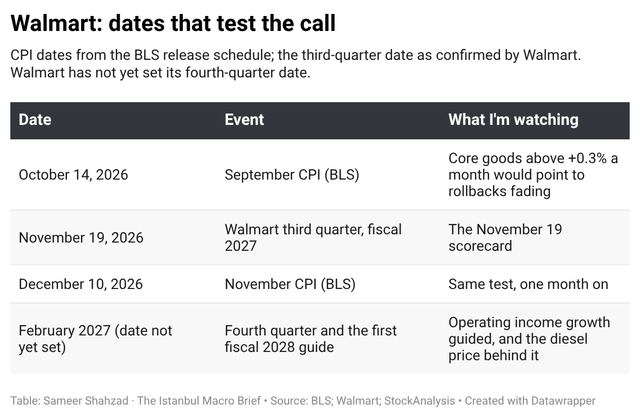
The November 19 scorecard
Walmart has guided third-quarter adjusted EPS to $0.62 to $0.64 and operating income growth to 2% to 4%. It reports on November 19. I have the quarter at $0.62.
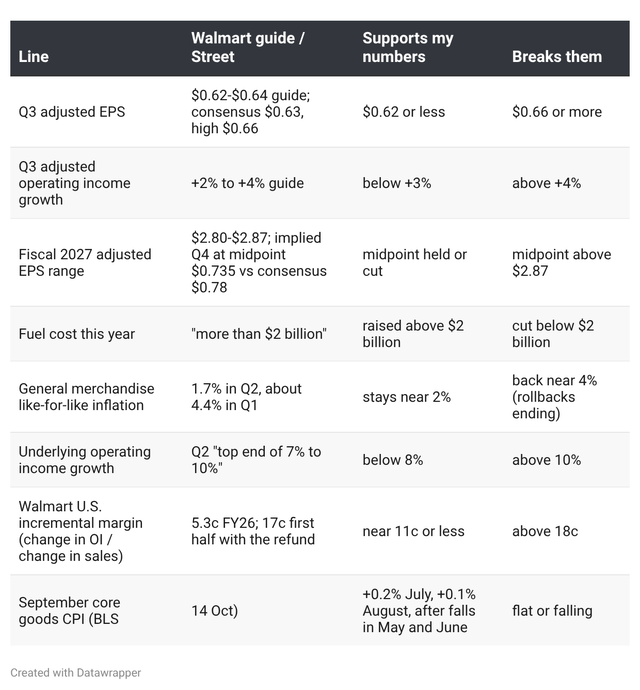
February's first guide won't settle much. Walmart's first EPS guide came in 5% to 8% under the day's consensus in each of the three years I could check, and it then beat that guide in three of the last four. The operating income growth it guides for fiscal 2028, and the diesel price behind it, will tell me more.
Walmart's IR team confirmed the February plan assumed February 2026 diesel prices. That's the same base I use, so the fuel gap stands.
Risks
On the upside, US advertising was up 38% last quarter and global membership fee income was up 17%. Walmart said its share gains came "notably from higher income consumers," and the CFO said he sees "a line of sight" to better incremental margins. If International and Sam's Club keep their first-half pace, Walmart U.S. needs much less, as above. If underlying growth runs well above 10% and the rollbacks end, consensus works and my bull case, about $133 in twelve months, is the right one. Cheaper diesel would also help quickly, since the strip puts most of next year's fuel cost in the first half.
On the downside, if diesel stays near the $4.96 the October contract settled at when it expired on September 30, and the rollbacks stay too, FY28 EPS is about $2.68. At the 24.7 times Walmart traded at on its February 2023 guidance day, that is a stock worth about $66. The last time Walmart asked investors to look through an investment year was October 2015. The stock fell 10% in a day and then did well. But it started at about 14 times trailing earnings. It's about 38 times now. And if the market settles on the median guidance-day multiple, the target is $93.
Two parts of my own model could be wrong. The fuel sensitivity rests on three Walmart figures that range from $0.71 billion to $1.39 billion per dollar, and the growth rates, segment split, fuel midpoint, and case weights are my own calls. The model is public for any of you to run.
An FY28 operating income guide above 10%, or a fuel figure from Walmart well under $0.7 billion a dollar, would move me to BUY. A third quarter below the 2% to 4% range with fuel above $2 billion, while the Street holds $3.22, would move me to SELL.
Where I come out
The Street is still counting on diesel and rollbacks going its way, and naturally the stock is priced for that. Walmart's growth covers most of the difference within a year, so I expect the shares to go roughly nowhere from here.
Hold, $101.
*Updated 3 October 2026 after a reply from Walmart investor relations: corrected the private fleet's share of fuel costs and added the diesel price behind the February guidance.

Comments
Log in or sign up to join the conversation.