


State National hasn't paid James River (JRVR) a dollar. In 2024, it sold cover on James River's 2010 to 2023 casualty book, and Enstar (ESGR) sold a layer on top. Both covers are used up on paper. In every retroactive reinsurance table filed so far, the line where reinsurer payments turn into income reads zero.
Quick answer: State National and Enstar sold covers on James River's (JRVR) 2010 to 2023 casualty book in 2024, and both are used up on paper, so from here every dollar of further loss development is James River's. The $107.8 million deferred gain stays locked in the statutory accounts until about 2028 to 2029.
Meanwhile, the book they covered is still getting worse, and from here, every dollar of it is James River's. The $107.8 million deferred gain on those covers will start reaching earnings this autumn. In the statutory accounts that govern dividends, it stays locked until about 2028 to 2029. That is around when the holding company's bank credit facility comes due. In the base case, that only slows things down. In the bad case, it means the regulator and the banks set the terms of the refinancing.
In my September 1 article, I rated James River Group Holdings (JRVR) a Sell. It has fallen about 12% since and closed at $3.53 on Thursday, near its 52-week low. I now rate it a Hold, with a probability-weighted price target of $4.28 at the end of 2027. Discounted at 11%, that's about $3.75 today, 6% above the price. Nothing here suggests anything improper. State National is A-rated. The accounting follows the rules in both sets of books, and every number comes from public filings and public market data.
The old book isn't done
Each 10-K prints, for every accident year, the company's estimate of ultimate losses and how much of it is IBNR. Losses incurred but not yet reported. Take one from the other, and we are left with what adjusters have reserved on real claims. I stitched 10 years of these into a reported-loss triangle, which James River doesn't publish. It ties out: $1,332.5 million open, less $434.6 million recoverable under the State National cover, plus $16.3 million on pre-2016 years, gives the 10-K's $914.2 million of net reserves. The triangle, the scripts, and every input are public on GitHub, so anyone can rerun it.
On the August call, the CFO said only about 15% of the $950 million of E&S net reserves relate to 2023 and prior. Comes out to around $140 million. Net of the cover, that's right. But the cover is used up, so any rise in those years now lands on James River in full, and before the cover, $692.5 million is still open from 2016 to 2023 alone. The median shortfall below is most of that $140 million again, or more.
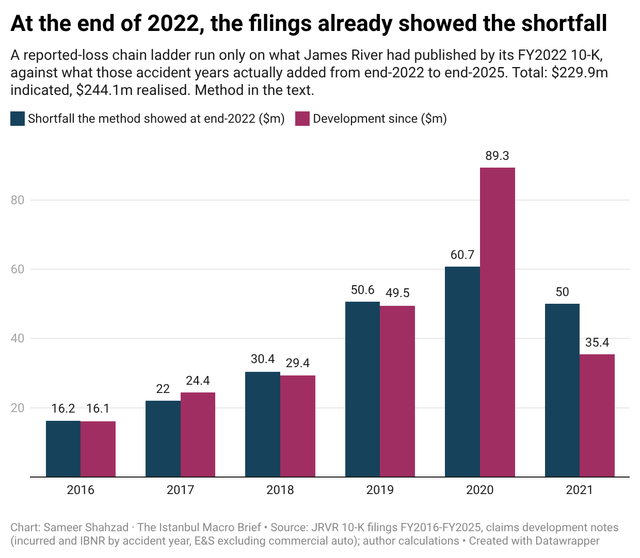
Run only on what was public at the end of 2022, a standard chain ladder on that triangle said 2016 to 2021 was $229.9 million short. Those years have since added $244.1 million. The paid-loss method, which projects cash paid and ignores case reserves, has a record too: run on the paid triangle in the FY2022 10-K with the 7% tail I use now, it said $181 million. Both were too gentle.
JRVR 10-K filings FY2016-FY2025, claims development notes (incurred and IBNR by accident year, E&S excluding commercial auto); author calculations
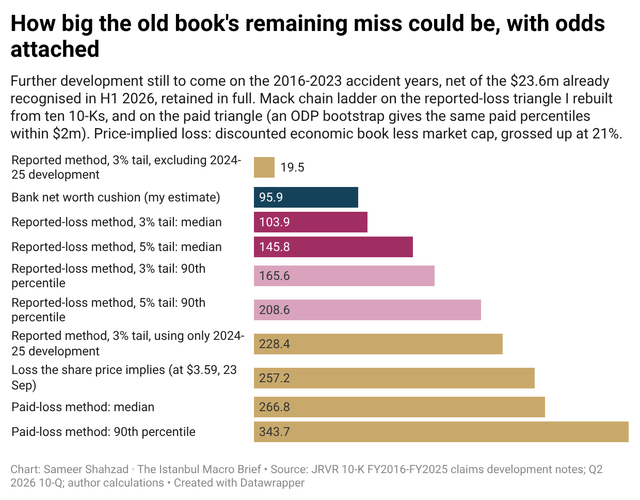
Now run today. Net of the $23.6 million recognized in the first half, a Mack chain ladder (the same method with an error estimate) puts the median still to come at $104 million with a 3% tail and $146 million with a 5% tail. The 90th percentiles are $166 million and $209 million. The paid method's median is $267 million. Faster claim payments aren't inflating it: at age four, payments run 50-55% of the company's own loss estimate for every year from 2016 to 2022.
JRVR 10-K FY2016-FY2025 claims development notes; Q2 2026 10-Q; author calculations
There is always a catch; the actuaries will spot it. Both triangles fail Mack's test for calendar-year effects, which checks whether whole diagonals move together. Reported losses developed slowly in 2019, 2020, and 2023, and fast in 2024 and 2025. Payments were slow in 2020 and 2021, the pandemic years, and fast in 2022 and 2025. So the average development factor blends two regimes. Using only the 2024 and 2025 diagonals, the reported method says $228 million is still to come. Leaving them out, it says $20 million. My $104 million to $146 million sits in between, and the real question is whether the last two years were a one-off catch-up or the new pace.
Four controls
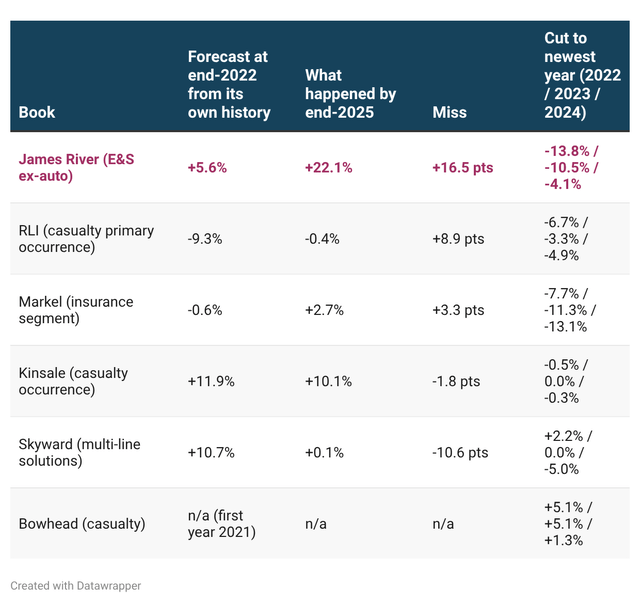
I ran the same incurred back-test on the four peers with history back to 2016 (Bowhead started writing in 2021), using only what each had published by the end of 2022. Forecast against actual for 2016 to 2021, as a share of carried reserves: Kinsale 11.9% and 10.1%, Markel -0.6% and 2.7%, RLI -9.3% and -0.4%, Skyward 10.7% and 0.1%. James River: 5.6% and 22.1%.
That 16.5-point miss is the largest. RLI (RLI)'s 8.9 points is the next-largest in the same direction, and Skyward (SKWD) missed by 10.6 the other way, so the method is rough. James River sits at the bad end of a noisy range. The sharper difference is in the early cuts. RLI's 2016 to 2021 years sit 13% to 24% below their first estimates. James River's sit 6% to 24% above. It cut 2022 by 13.8% in its second year, and that year has climbed back above where it started.
JRVR, RLI, MKL, KNSL, SKWD, BOW; author calculations
The cushion is real and locked
State National's premium was $313.2 million. Of that, $261.0 million paid for its 85% share of the $307.1 million of carried reserves above James River's $716.6 million retention, and $52.2 million bought $160.0 million of cover above the carried reserves. 38 cents per dollar of its $136.0 million share. Enstar took the next $75.0 million for $52.8 million.
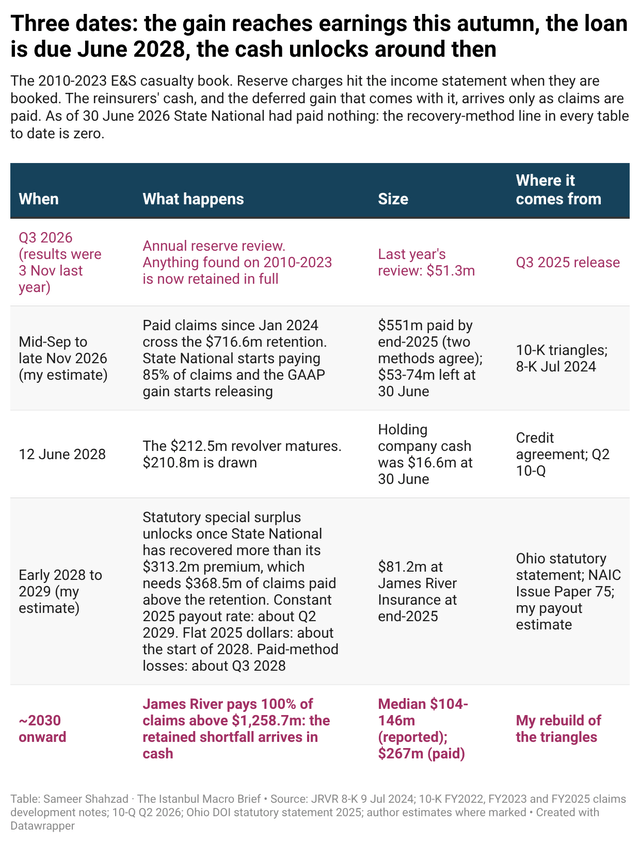
State National pays only once James River has paid $716.6 million in old claims since January 2024. Summing the paid triangles gives $551.0 million by the end of 2025, and rolling the 2023 reserve forward gives $551.1 million. At last year's pace, 20% either way, the crossing lands between mid-September and late November. The GAAP gain then releases at about 21 cents per dollar State National pays, which is around $30 million of it in 2027.
The statutory side is slower; NAIC rules say the gain "may not be classified as unassigned funds [considered earned surplus] until such time as the actual retroactive reinsurance recovered is in excess of the consideration paid." For State National, that means $313.2 million of recoveries, or $368.5 million of claims paid above the retention. James River paid out 31.7% of its outstanding old-book reserves in 2025, which is up from 25.2% in 2024. If that rate holds, the unlock comes around Q2 of 2029. If payments stay at 2025's $281 million a year, it comes around the start of 2028. Heavier losses mean more claims to pay, which pulls it to about the third quarter of 2028. The bank credit facility, $210.8 million drawn of $212.5 million, matures on June 12, 2028.
The two sets of books agree on the size: James River Insurance's locked "special surplus" was $81.2 million at the end of 2025, against a GAAP gain on the same cover of $83.8 million.
JRVR 8-K 9 Jul 2024; 10-K FY2022, FY2023 and FY2025 claims development notes; 10-Q Q2 2026; Ohio DOI statutory statement 2025; author estimates where marked
What the holding company can reach
Ohio treats any dividend paid from anything other than earned surplus, which its law defines as the insurer's unassigned funds, as extraordinary. The insurance superintendent can block it. Ordinary dividends are also capped at the greater of 10% of surplus or last year's statutory net income. James River Insurance ended 2025 with $522.9 million of statutory surplus, of which $172.0 million was unassigned. It paid $30.0 million upstream in March, leaving about $142 million. Part of the rest was borrowed: the parent paid in $40.0 million in 2025 after drawing $25.0 million on its credit facility.
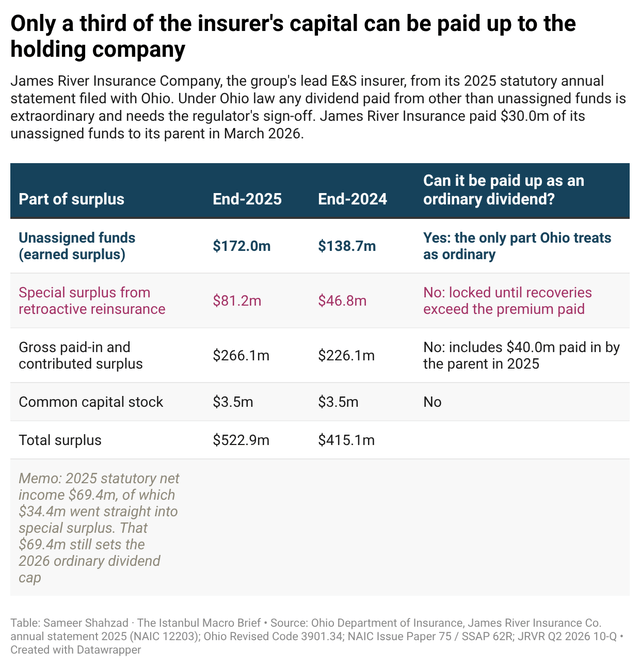
Ohio Department of Insurance, James River Insurance Co. annual statement 2025 (NAIC 12203); Ohio Revised Code 3901.34; NAIC Issue Paper 75 / SSAP 62R; JRVR Q2 2026 10-Q
This year's $69.4 million cap flatters the position. It's set by 2025's statutory net income, and $34.4 million of that income went straight into the locked account. With the covers used up, next year's cap likely falls towards 10% of surplus, about $52 million.
There is no squeeze now. The holding company needs about $32 million a year: roughly $22 million of interest, $7.9 million on the preferred, and about $1.9 million on the common. After March's dividend, the 10-Q says the insurers can still pay $66.1 million to the holding companies this year without approval, about $27 million of it from outside James River Insurance. The holding company had $16.6 million in cash and investments as of June 30.
Where the lock bites
Earned surplus gets refilled by earnings, so I ran it forward. I assume that James River Insurance earns three-quarters of the group's operating income before holding-company interest, funds the holding company's $32 million a year, and takes 75% of the retained old-book charges. I book the charges at 30%, 35%, and 20% in 2026 to 2028, faster than the triangle's own emergence pattern of 30%, 23%, and 17%, because charges in these years ran at $108.0 million in 2024 and $88.3 million in 2025. Better early than late.
On the assumptions, earned surplus ends in 2028 at about $122 million in the base case, $42 million on the paid method, and $14 million at its 75th percentile. James River Insurance holds 97% of the gain on the State National cover, so the share could be higher: at 90%, the paid method ends near $35 million. If charges instead follow the reported pattern, the paid method ends near $67 million. In every version, it still covers the holding company's interest and leaves little or nothing toward a $210.8 million credit facility due in June 2028.
The banks' tests tighten at the same time. By my reconstruction, the net worth covenant has about $96 million of pre-tax room. On the paid method, it falls to about $6 million after tax at its low point, and at the 75th percentile it is breached. Since the second quarter of 2026, the credit facility has also required James River Insurance to hold 235% of authorized control level RBC, a regulatory capital ratio the company does not publish. The rating floor is A- at AM Best, where the insurers sit, affirmed in March with a negative outlook.
Earnings, the Street, and the target
The two analysts in Nasdaq's consensus have $0.68 of adjusted EPS for 2027, and the two Hold-rated targets I can see are $4.45 (UBS) and $5.00 (Truist). E&S net written premium fell 5.5% in the first half and 11.4% in the second quarter, so I take E&S earned premium down about 7%, to around $500 million, in 2027. Then we take about $80 million of investment income, less $31 million of corporate expense, $22.4 million of interest, and the preferred. Each point of E&S combined ratio is then about $4 million after tax.
My base 2027 operating income, $32 million or about $0.66 per diluted share, needs a 94.7% E&S combined ratio. This year's underlying ratio is about 92.8%, a 64.8% accident-year loss ratio plus 28.0% of expenses. The rate rose about 3% in the second quarter. Gallagher (AJG)'s casualty practice leader told Business Insurance that loss trends remain in the high single digits. If nothing offsets that gap, it adds about 3 points a year to the loss ratio, and I take two. So I'm close to the Street before the old book. The gap is the old book: with no cover left, retained development lands in reported reserve development, which adjusted operating income includes.
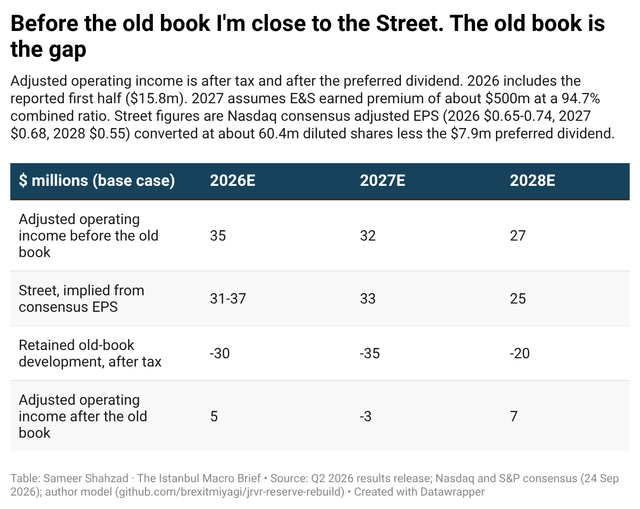
Q2 2026 results release; Nasdaq and S&P consensus (24 Sep 2026); author model (github.com/brexitmiyagi/jrvr-reserve-rebuild)
Economic book is tangible equity excluding the gain, $6.68 a share, plus the gain after tax, discounted at 11% for timing: $7.99. The market pays 0.44 times that. Eight listed specialty and commercial insurers (Kinsale (KNSL), RLI, Skyward, Bowhead, Markel (MKL), United Fire (UFCS), Amerisafe (AMSF) and Global Indemnity (GIGM)) sit on a tight line of price to tangible book against return on equity. At James River's trailing 4.9% return, which the retroactive reinsurance charges hold down, that line gives 0.54 to 0.66 times, and it trades at 0.53 on tangible equity excluding the gain. At 9%, the line gives 1.05 to 1.17 times. I use 0.65 times economic book in the base case, well under the line, because the market won't pay for a 9% return while the old book is still on the move.
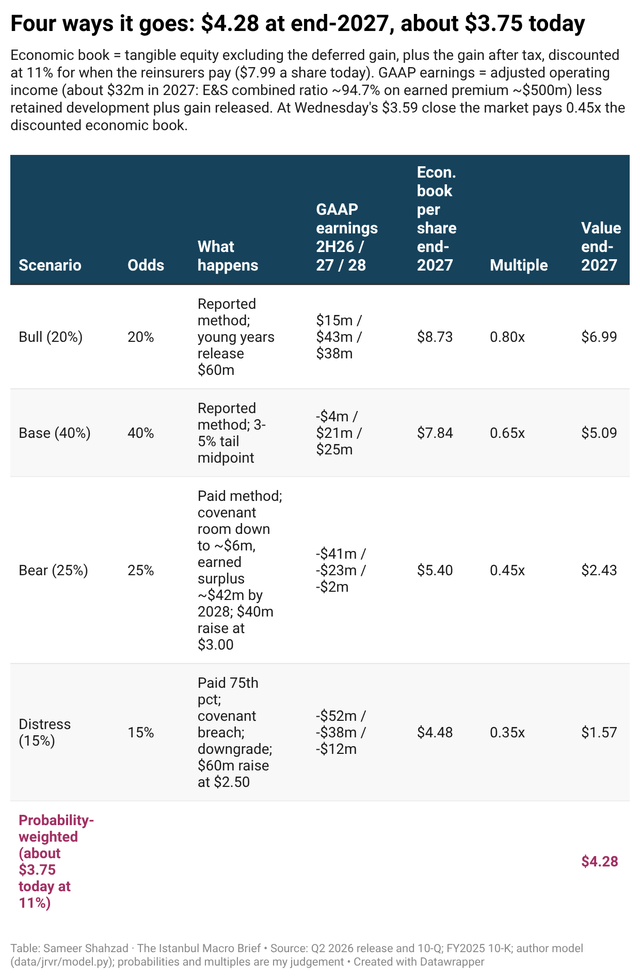
Q2 2026 release and 10-Q; FY2025 10-K; author model (scripts/model.py on GitHub); probabilities and multiples are my judgment
Base, 40%: the reported method's midpoint, $5.09. Bear, 25%: the paid method, covenant room down to about $6 million and a $40 million raise at $3.00, $2.43. Distress, 15%: the paid method's 75th percentile, a covenant breach, a downgrade, and a $60 million raise at $2.50, $1.57. Bull, 20%: young years release $60 million, $6.99. The calendar-year fork maps onto these cases. If 2024 and 2025 were a catch-up, the old book looks like the bull case. If they're the new pace, the reported method lands near $228 million, close to the paid method, which is why 40% of the weight sits in bear and distress.
Weighted, that's $4.28 at the end of 2027, about $3.75 today, with a 40% chance of ending below $3.53. Moving the base multiple 0.1 either way moves the target about 30 cents. Booking the charges at the reported pace instead lifts it to $4.43. The lock itself is worth about 8 cents through the bear-case raise.
Zimmer Partners, which owns 10.0%, said in its May 13D that it may discuss a potential strategic transaction with the board. A buyer would cap the old book first and would have to fund the preferred, which Gallatin Point can require the company to repurchase in a change of control. On that basis, I get roughly $5 to $7 a share, and I leave it out of the target as an option.
Where I could be wrong
The STRONGEST objection is that none of this binds. Ohio can approve an extraordinary dividend, and payments could run fast enough to open the lock before June 2028. Both are possible. My claim, though, is narrower. If the paid method is close, those decisions belong to the regulator and the lenders.
If 2024 and 2025 were a one-off catch-up, the old book could need as little as $20 million more. The other worry is that case reserves were strengthened after 2023, which would inflate the reported method. At age two, paid claims ran roughly 42% to 49% of reported losses for 2016 to 2020 and 50-61% for 2021 to 2024, which points to thinner case reserves in newer years. The commercial auto cover on the old Rasier book has no aggregate limit and is collateralized at 102% of James River's estimate, with cumulative cessions flat at $451.4 million since December. The exposure there is a counterparty exposure.
My payout pace, the 75% share, the earnings path, and the covenant room are just estimates. The probabilities and multiples are my judgment. Two numbers would settle a lot of this, and James River doesn't publish either: how much of the retention it has paid, and James River Insurance's RBC ratio. I've put both questions to investor relations and will post the answer, or the refusal, in the comments.
So
Hold. $4.28 at the end of 2027, which is about $3.75 today.
Third-quarter results, due around early November, are the first test of which regime is right. More than $25 million of retained development on accident years 2023 and prior, with nothing offsetting it in young years, and I go to Sell. Under $10 million, with State National's first recoveries showing, and I go to Buy. After that, watch the credit facility. A refinancing on reasonable terms before June 2028 takes more of the risk out of the lock.

Comments
Log in or sign up to join the conversation.