

So Venture Global sold its third-quarter LNG at a fee of $6.79. A spot cargo would have earned about $17.43. The difference didn't just vanish. Most of it went to the buyers.
That's the war quarter. The bigger problem is the decade after it. To justify $13.05, the fee on Venture Global's uncontracted cargoes has to average about $4.49 per MMBtu from 2032. At the midpoint of Shell's and GECF's demand forecasts, that only happens if the industry approves less than about 28 MTPA of new liquefaction a year from 2027. It approved 20.6 a year through the last glut and 41.2 a year from 2021 to 2025, and its own record since 2016 points to about 30 a year from here. And keep in mind, no fee reported on a multi-year US contract since 2023, war included, tops about $3.15.
I rate Venture Global (VG) a Sell, with moderate conviction and a 24-month target of $11.25, against the October 7 close of $13.05. The next few months will probably go against me. I expect a guidance raise with Q3 results in mid-November (no date yet). My 2027 EPS is far above consensus, and Hormuz is still disrupted. I really do not quarrel with the management here. Selling forward is how plants get financed, and Venture Global builds faster than anyone. My issue is the price.
VG at a glance
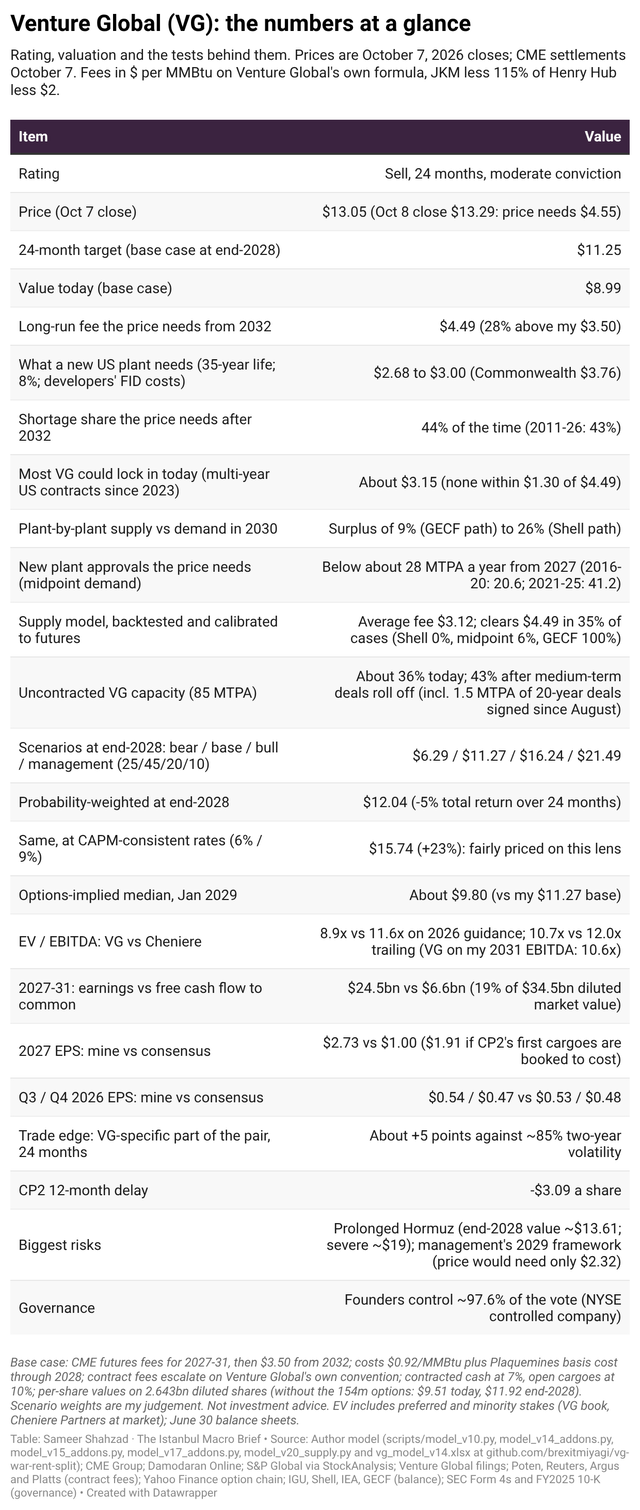
Author model; CME Group; Damodaran Online; S&P Global via StockAnalysis; Venture Global filings; Poten, Reuters, Argus and Platts (contract fees); Yahoo Finance option chain; IGU, Shell, IEA, GECF (balance); SEC Form 4s and FY2025 10-K (governance)
Who got the war money?
On October 7, Venture Global reported 465.8 TBtu sold in the third quarter at an implied liquefaction fee of $6.79 per MMBtu. On the company's own formula, JKM less 115% of Henry Hub less $2, a spot cargo would have earned a fee of about $17.43 on my estimate. That leaves roughly $7.0 billion of spread above Calcasieu's $2.36 contract fee. By my split, Calcasieu's 20-year buyers kept about 30%, the buyers of Plaquemines' forward-sold cargoes kept 41%, and Venture Global kept 29%. Those are my estimates. The company only reports one blended fee.
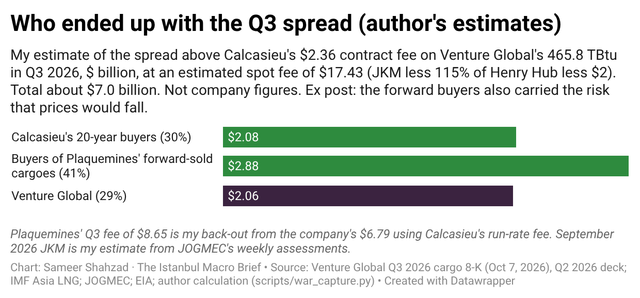
Venture Global Q3 2026 cargo 8-K (Oct 7, 2026), Q2 2026 deck; IMF Asia LNG; JOGMEC; EIA; author calculation
Even the open cargoes earn whatever the market paid on the day they were sold. The 10-K says those sales "may be uncorrelated with movements in spot LNG prices," and 69% of 2026 was already sold by February 25, three days before the war started.
The 2030s are yet more exposed. The August deck has 47 of 85 MTPA on 10-to-20-year contracts, 6 medium-term, and 32 available. CEO Mike Sabel said the bolt-ons will carry "more midterm contracts." Since then, Venture Global has signed 1.5 MTPA of 20-year deals from 2030 with China Gas and ConocoPhillips. The fees weren't disclosed. Valued at a $2.45 blended contract fee, they add in total about 3 cents a share. That leaves about 36% uncontracted today, and 43% once the medium-term deals roll off.
Why the fee history misleads
The bull case leans on a Venture Global slide with a 2010-26 fee median of $5.19. That median mixes two very different markets. On the IMF's numbers, the fee averaged $18.80 in 2021-22 and is somewhere between $10.80 and $11.90 so far this year. Through the 2015-20 supply wave, it was $0.45 on TTF and $1.62 on JKM. In between, 2023-25 paid about $7. Argus points the same way: Gulf Coast spot beat a long-term contract by $4.11 to $5.37 in each of those years. That is the best evidence the bulls have. Mind you, those were YEARS of a market healing after a shock. A wave was nowhere in sight.
Now, for me, a year is a shortage year, when a shock pushed the fee far above what a new plant needs: 2011-14 after Fukushima, 2021-22 with Russia, and 2026 with Hormuz. Those years make up 43% of the months from 2011 to September 2026. If the years in between look like the last wave, $4.49 needs 44%. Leave out 2011-14, and history gives 23%, against about 25% needed. If the in-between years look like 2015-25 as a whole, the price needs a lot less. History on its own can't settle this. It comes down to whether the 2030s look like a wave.
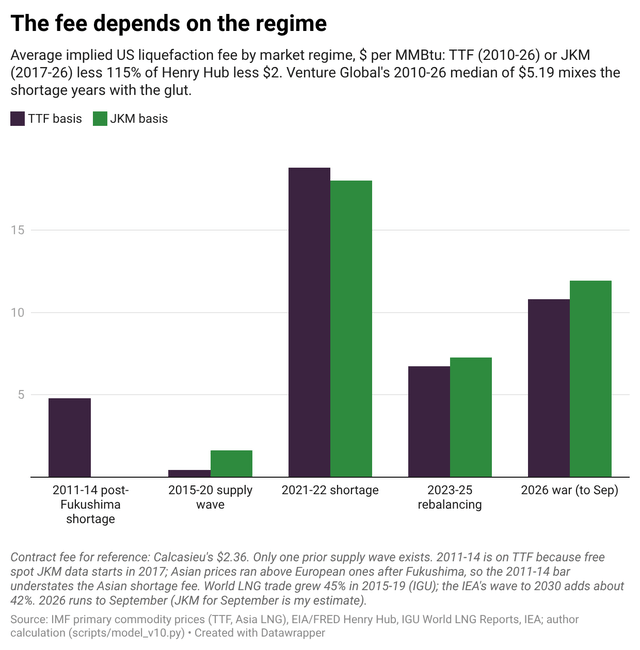
IMF primary commodity prices (TTF, Asia LNG), EIA/FRED Henry Hub, IGU World LNG Reports, IEA; author calculation
The futures think the wave is coming. On October 7 settlements, the implied fee is $15.41 for 2027, $8.03 for 2028, $5.12 for 2029, $3.80 for 2030, and $2.50 for 2031. One caveat: 2030-31 had no open interest at all, so those last two are marks. Notice that nobody traded them.
Counting the plants
That is exactly why I built supply plant by plant. I start with the 524.5 MTPA the IGU counts as operating at the end of 2025 and add 24 sanctioned projects, 249 MTPA in total, each on its developer's latest timetable. That runs from Golden Pass, Port Arthur, Rio Grande, CP2, and Woodside Louisiana (WDS) to Qatar's North Field East and South. The ones the IGU lists as under construction, plus Arctic LNG 2 (which I leave out because of sanctions), match its 234.3 MTPA to within 0.30. I run plants at 84%, the IGU's 2025 utilization, which gets 2025 trade right to within 1%. Then I take off the IEA's war losses and its estimate of feed-gas losses at older plants.
On that build, supply runs 9% above GECF's demand path in 2030, 17% above the midpoint, and 26% above Shell's.
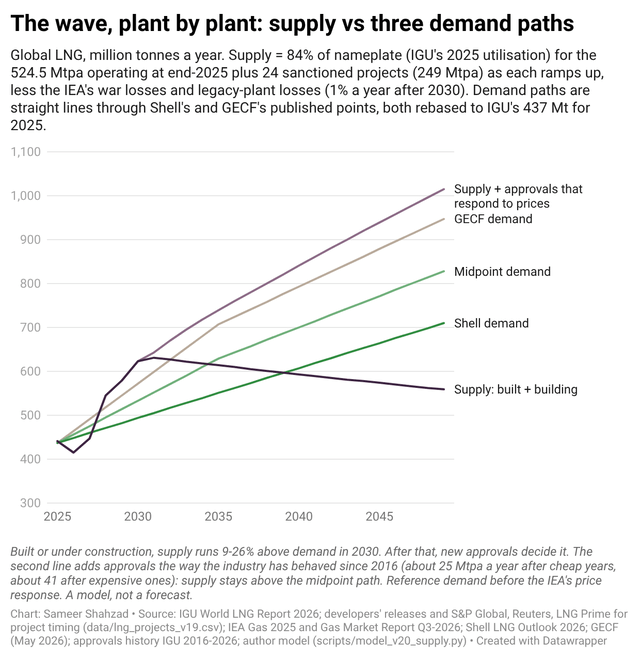
IGU World LNG Report 2026; developers' releases and S&P Global, Reuters, LNG Prime for project timing (data/lng_projects_v19.csv); IEA Gas 2025 and Gas Market Report Q3-2026; Shell LNG Outlook 2026; GECF (May 2026); approvals history IGU 2016-2026; author model
Testing it on 2015 to 2025
I wasn't going to trust that for the 2030s without checking it against the past. So I ran the same setup over 2015 to 2025: IGU capacity at 84% against trend demand, set against the fee the market actually paid. My first version sorted years into glut, balanced, and shortage, and it got only 4 of 11 years right. I tossed it away. A straight line does better. Each point of surplus took about $0.46 off the fee. The fit puts a balanced market at about $3.00. That's close to the $2.68 to $3.00 the cheapest new US plants need. The line explains about 46% of the moves outside 2021-22 and misses those two years completely, because Russia's pipeline cut came from outside the LNG balance. I model shocks like that separately.
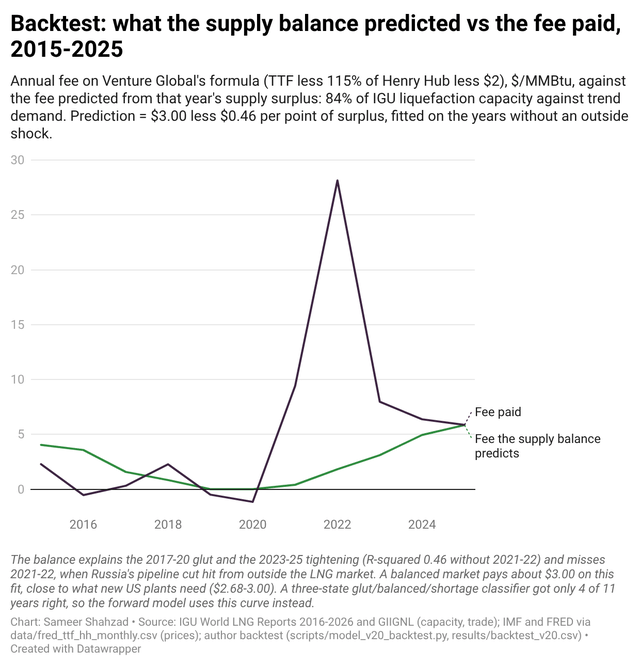
IGU World LNG Reports 2016-2026 and GIIGNL (capacity, trade); IMF and FRED via data/fred_ttf_hh_monthly.csv (prices); author backtest
On my build, the fitted line prices 2030-31 well under the futures, so I calibrated it to the strip. The market is behaving as if supply will be about 9% tighter than my build, through delays and slower ramp-ups, or more demand once gas gets cheap. That calibration helps the bull case. I keep it for every year after 2031.
How fast the industry builds
From there, the fee depends on just how quickly the industry approves new plants, and then approvals react to price. On the IGU's numbers since 2016, the industry approved about 25 MTPA a year after cheap years and about 41 after expensive ones. I model it as 24.5 MTPA plus 1.28 for every $1 of the previous year's fee. Contracts tend to come first. Buyers signed 54 MTPA with US developers in 2022. That is the most in the EIA's 2021-25 series, a year before the 2023 approvals. They signed 40 MTPA in 2025, ahead of this year's CP2 Phase 2, Commonwealth, and Delfin decisions.
On the midpoint path, the price needs approvals under about 28 MTPA a year (22 to 33, depending on how fast older plants fade), and the industry's own behavior implies about 30. On GECF's path, the price can live with 39 to 50 a year against around 34 implied. It works. On Shell's (SHEL), it needs under 6 to 17 a year against around 26, so it doesn't. Run 2000 paths per case, with Russia- and Hormuz-sized shocks arriving at their 2011-26 rate, and the fee clears $4.49 about 35% of the time: 0% on Shell's path, 6% on the midpoint, 100% on GECF's. In the end, it comes down to which demand forecast you believe.
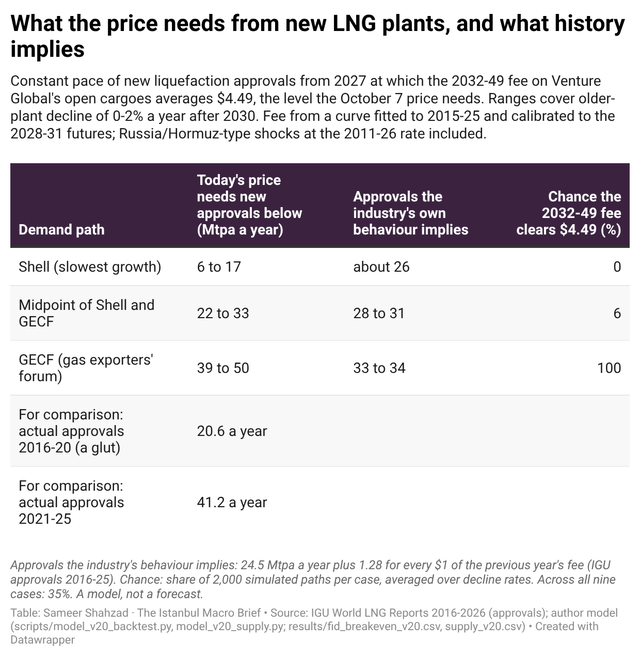
IGU World LNG Reports 2016-2026 (approvals); author model
The model's average fee for 2032-49, shocks included, is $3.12. I value the company on $3.50. At $3.12, the stock is worth about $9.39 at the end of 2028. If my target even leans anywhere, it is towards the bulls.
What VG can lock in
Remember, contract fees are NOT spot forecasts. Vitol's five-year deal, signed three weeks into the war, priced near $3 while the 2027 strip implied about $8.70. What contracts do show is what Venture Global can hedge. Since late 2023, reported 10-to-20-year fees have run from $2.30 to $2.95 (Poten, Reuters); Argus's indicative contract is 115% of Henry Hub plus $3. 5-year deals are around $3.00 to $3.15. None of them gets within $1.30 of $4.49. Any premium the 2030s pay above contract levels, Venture Global has to earn unhedged.
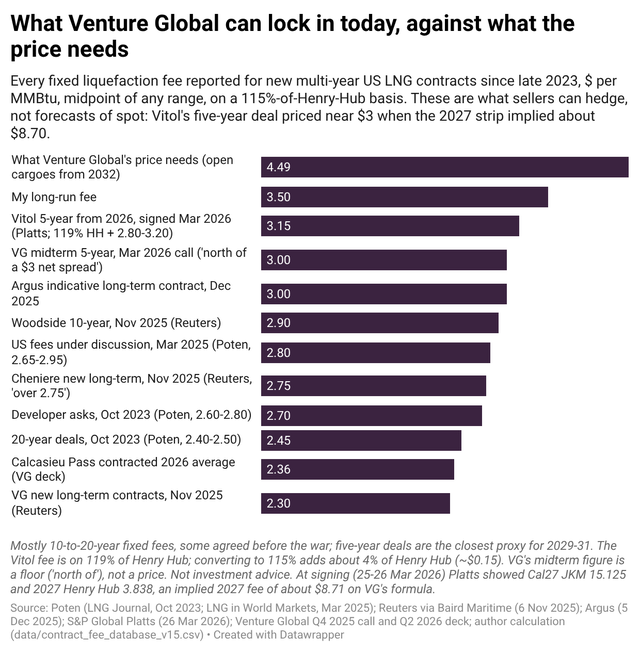
Poten (LNG Journal, Oct 2023; LNG in World Markets, Mar 2025); Reuters via Baird Maritime (6 Nov 2025); Argus (5 Dec 2025); S&P Global Platts (26 Mar 2026); Venture Global Q4 2025 call and Q2 2026 deck; author calculation
What a new plant costs
We know that replacement cost anchors the average. Using the developers' own FID costs, Woodside Louisiana, Rio Grande (excluding financing) and Port Arthur need $2.68 to $3.00 over a 35-year plant life at 8% after tax. Commonwealth needs $3.76. GECF puts the next batch of North American projects at $3.80 to $4.00. My $3.50 sits between the cheapest plants under construction and the next batch.
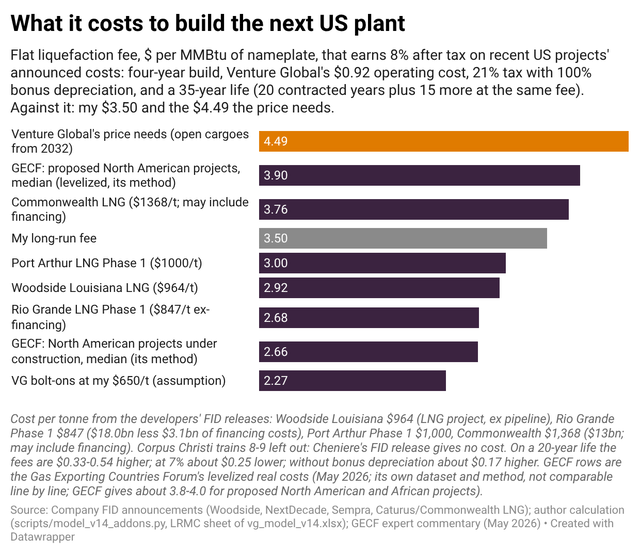
Company FID announcements (Woodside, NextDecade (NEXT), Sempra (SRE), Caturus/Commonwealth LNG); author calculation; GECF expert commentary (May 2026)
Valuation
I use the futures through 2031 and $3.50 after that. Contracted cash gets a 7% discount rate, about where Venture Global's secured debt prices. Open cargoes get 10%, since they rank behind the debt and the 9.0% preferred. Deals back this up; Sempra's Port Arthur numbers imply about 7.6% unlevered after tax. Cheniere, 90%-plus contracted, trades at about an 8.5% EBITDA yield on its run rate. After net debt, the $3.0 billion preferred, Stonepeak's 23% of Calcasieu, and half the low end of BP's (BP) claim, I get about $9.00 a share today and $11.27 at the end of 2028, on 2.643 billion diluted shares. Hence the $11.25 target. Each $1 of long-run fee is worth about $4.10 a share today.
The rating does indeed rest on that 10%. CAPM gives about 9.1%, but on a beta that explains only about 3% of the stock's moves. At CAPM-consistent 6% and 9%, the weighted end-2028 value is $15.74, and Hold would be the right call. I still say Sell, because the deal evidence tells me open commodity exposure costs more than that. It is also the reason my conviction is really only moderate. On multiples, the stock looks cheap on 2026's war-year EBITDA (8.9 times against Cheniere (LNG)'s 11.6). On my 2031 EBITDA, it's 10.6 times.
Scenarios
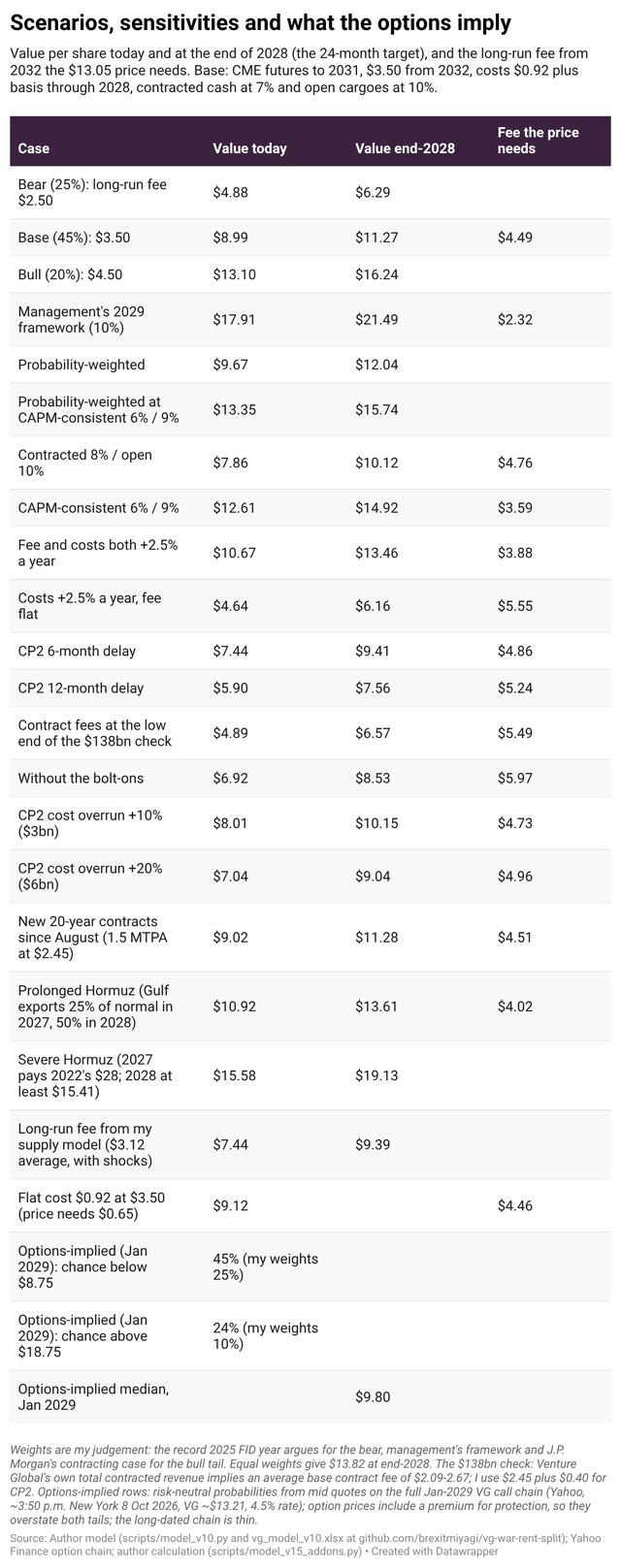
So here is the deal. I run four cases: a $2.50 fee (25%), $3.50 (45%), $4.50 (20%), and management's 2029 framework (10%). At the end of 2028, they're worth $6.29, $11.27, $16.24, and $21.49. Weighted, that's about $12.04, about 5% below today's price with dividends, while the market should earn about 20%. The January 2029 options are wider than my cases. They price a 45% chance of the stock being under $8.75 and a 24% chance of it being above $18.75, against my 25% and 10%.
Author model; Yahoo Finance option chain; author calculation
Risks
There are risks to everything. Hormuz here is the biggest one. LNG shipments through the strait were still about 75% below February levels in September. QatarEnergy extended force majeure into October and has warned the crisis could delay its expansion. If Gulf exports run at a quarter of normal through 2027 and half in 2028, with North Field East and South two years late, my model adds about $1.90 to the 2028 fee and $1.60 to 2029's. That takes the end-2028 value to around $13.61. In a severe version, where 2027 pays 2022's $28, it's about $19. Faster approvals in response keep the long-run fee roughly where it is.
Management’s number comes right after. In March, Sabel said a $3 fee gives 2029 EBITDA of "about $11 billion." I get $7.9 billion, and only about $1.1 billion of that gap comes from the company's own inconsistency. If he's right, today's price needs a fee of only $2.32. That is why that case carries a 10% weight. J.P. Morgan upgraded the stock to Overweight on "outsized" margins and has just raised its target to $19 from $17.
We can look at it on the other side too. Costs and claims add to the downside. A six-month CP2 delay takes today's value to $7.44, and a year takes it to $5.90. A 10% overrun on my $30 billion CP2 cost basis takes about $1.10 off the end-2028 value. BP's damages hearing is in May 2027 on a claim of "$3.7 billion to potentially in excess of $6.0 billion." And on October 7, a tribunal found Calcasieu liable to Galp for declaring commercial operations late. Those damages are capped at $170 million.
Earnings vs cash
My 2027 EPS is $2.73, against a $1.00 consensus. For the next two quarters, I'm in line ($0.54 and $0.47, against October 8 consensus of $0.53 and $0.48), so the Q3 print will test my calibration more than my thesis. Then why isn't five times 2027 earnings cheap? From 2027 to 2031, I get $24.5 billion of net income but only $6.6 billion of free cash flow to common. CP2 and the bolt-ons eat the rest. Earnings drop to $1.12 a share in 2030 and $0.47 in 2031, and net debt is still around $36 billion.
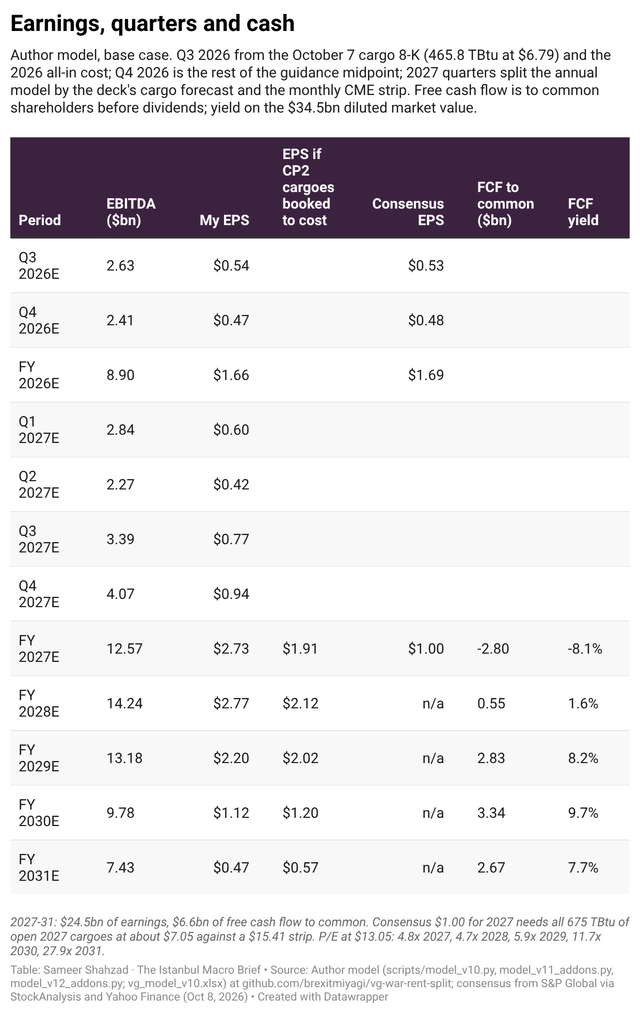
Author model at github.com/brexitmiyagi/vg-war-rent-split; consensus from S&P Global via StockAnalysis and Yahoo Finance (Oct 8, 2026)
Liquidity isn't a problem. Venture Global had $3.1 billion of cash at June 30, an undrawn $2 billion revolver, and a $3 billion 364-day facility, and refinancing the parent's 8.9% notes would cost about 7.3% at June's spreads. Minority holders don't get much say, though. Founders Mike Sabel and Robert Pender control about 97.6% of the vote through VG Partners. Insiders sold about $124 million of stock between June 15 and September 18, all after option exercises and mostly through pre-set plans. The founders themselves are still holding and have sold nothing yet.
The Street
Hear this: NONE of the 18 analysts S&P Global tracks have a Sell rating on the stock. The average target is $16.78. Goldman Sachs (GS), J.P. Morgan (JPM), and BofA (BAC) led the IPO, and several of the covering banks arranged the September facility.
Dates to watch
Cheniere reports on October 29. Plaquemines Phase 1 should reach commercial operations in the fourth quarter. Venture Global's Q3 results are due in mid-November, and the Q4 deck is due early next year. BP's hearing is in May 2027. CP2's first LNG is due in the second half of 2027.
What would change my mind
If Venture Global signs 2029-31 volume at $4.49 or more, I'd move to HOLD. Same if approvals stay below about 20 MTPA a year for two years while demand tracks GECF's path, or if Gulf exports are still near a quarter of normal at the end of 2027. It would take two of those together to get me to BUY. I've logged eight dated calls on this analysis, and they get marked win or loss as they resolve. Those calls, models, the plant-by-plant supply file, and the backtest are <a href="github.com/brexitmiyagi/vg-war-rent-split">public</a>. Every change reruns the models from scratch.
The bottom line
The stock is priced as if the 2030s will be tight. Plants already under construction say otherwise, unless demand follows GECF's path, the most bullish of the two. The near term will probably go against me. The 2030s are the real test, and that test is demand.
Sell, $11.25.


Comments
Log in or sign up to join the conversation.