

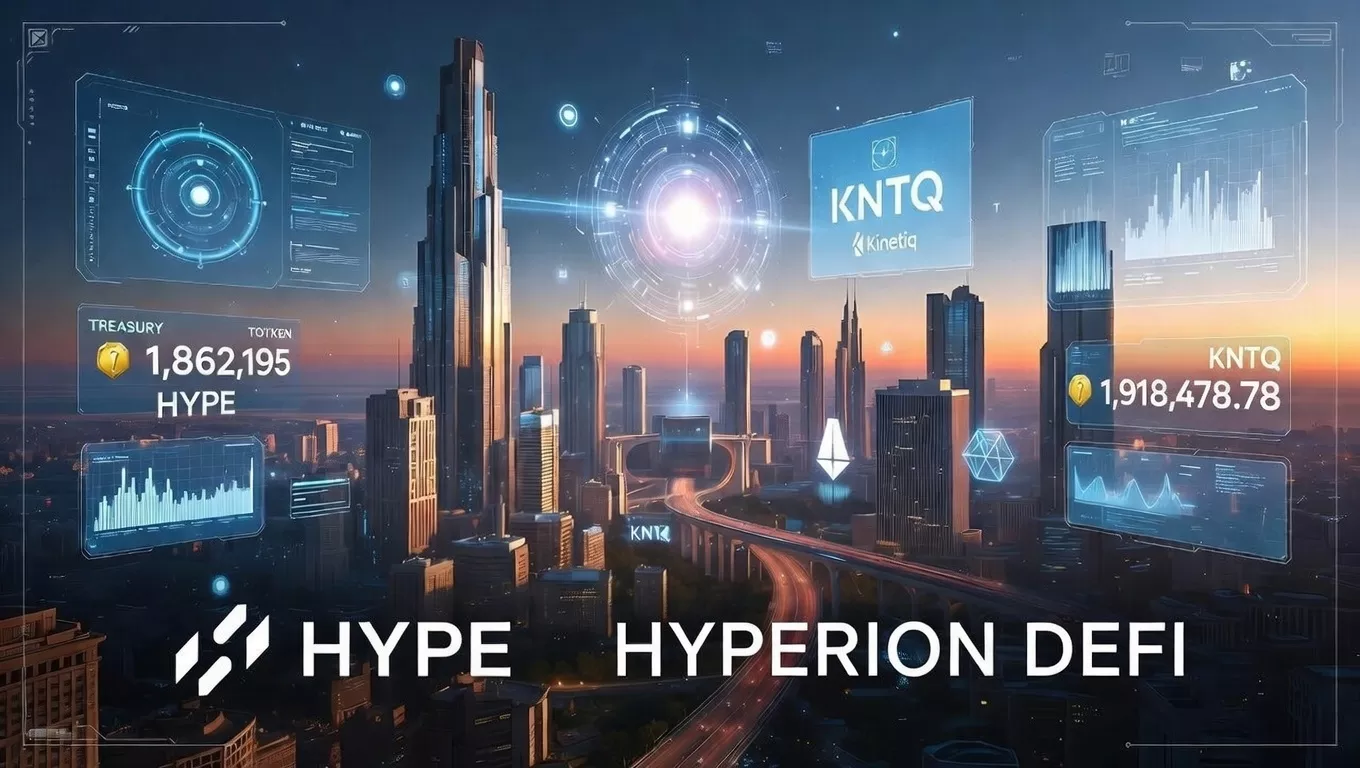
Image Source: Grok
The financial landscape is changing as traditional financial systems and models are moving towards blockchain tech and decentralized finance. Hyperion DeFi is one of several publicly listed companies that is positioning itself as a leader in holding various tokens in this new DeFi ecosystem.
Hyperion DeFi, Inc. (NASDAQ: HYPD) represents a unique bridge between traditional finance and decentralized finance (DeFi). As the first U.S. publicly traded company focused on building a long-term treasury of HYPE, the native token of the Hyperliquid layer one blockchain (L1). HYPD offers investors simplified exposure to one of the fastest-growing crypto ecosystems without the complexities of direct token ownership. This article explores the company's evolution, its crypto treasury strategy, key holdings, financial performance, share structure, leadership, potential future trajectories, and an overarching investment thesis.
Company Background: From Ophthalmology to DeFi Pioneer
Founded in 2014 as Eyenovia, Inc., the company initially developed ophthalmic technologies, such as the Optejet platform for precise eye medication delivery. It forged partnerships with entities like Bausch Health, Arctic Vision, and Formosa Pharmaceuticals for product commercialization in regions including the U.S., Canada, China, and South Korea.
With some great foresight in the evolving financial landscape, the company announced a pivot in June 2025 and rebranded to Hyperion DeFi, Inc. This shift of focus to a cryptocurrency treasury strategy is centered around the HYPE DeFi ecosystem. The transformation was funded by an initial $50 million private placement, with proceeds used to acquire HYPE tokens and establish DeFi-oriented operations.
Key milestones post-rebrand include:
Launching the "Kinetiq x Hyperion" validator node in partnership with Kinetiq and Pier Two to stake HYPE and secure the Hyperliquid network.
Announcing an institutional volatility income vault on the Rysk Protocol, using HYPE holdings as collateral for options strategies to generate premiums and fees.
Recent leadership solidifications include the permanent appointment of Hyunsu Jung as CEO effective January 1, 2026, and Robert Rubenstein as General Counsel effective January 12, 2026.
December 2025: Receipt of Kinetiq (KNTQ tokens) airdrop, partnership with Native Markets for USDH stablecoin support (allocating 300,000 HYPE), staking 28,888 HYPE to Markets by Kinetiq for 10% fee revenue, and purchase of 150,000 additional HYPE.
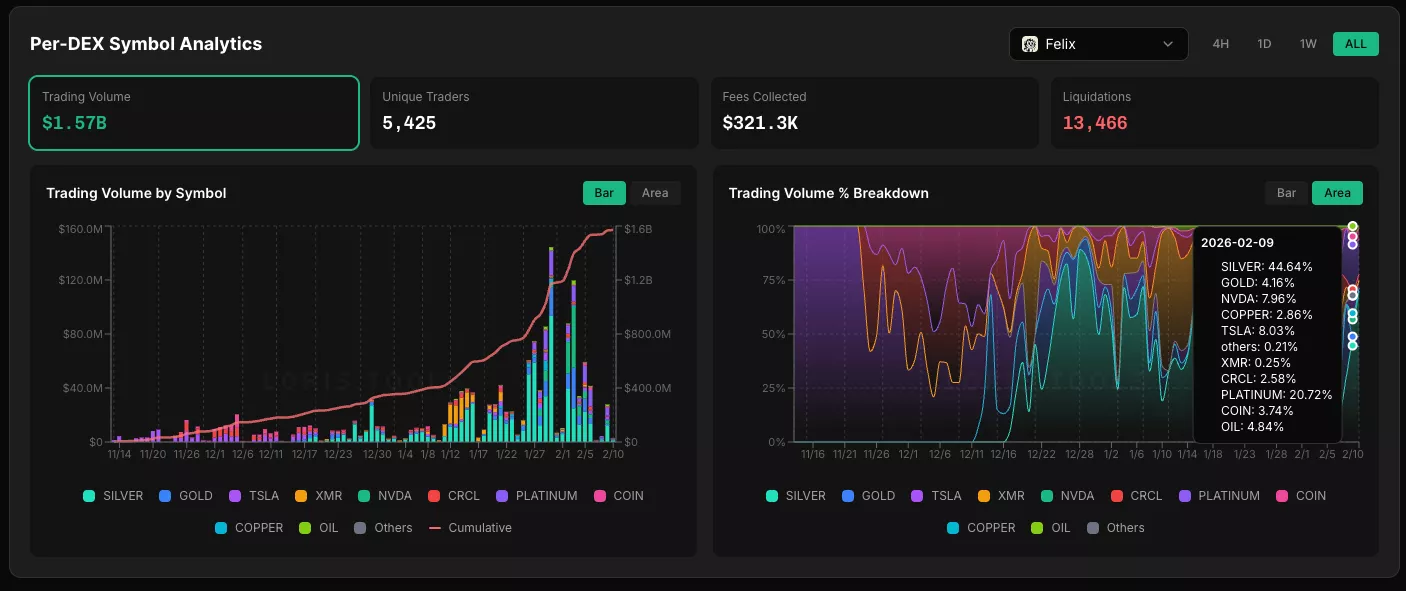
Deployment of 500,000 HYPE to power new trading markets (e.g., Gold, Silver, Equities) via partner Felix under HIP-3, contributing to cumulative volumes surpassing $1.5 billion and recent daily volumes over $100 million, generating revenue shares for HYPD.
This shift positions HYPD as a vehicle for shareholders to benefit from Hyperliquid's growth, including staking yields and on-chain utilities.
Crypto Treasury: Composition and Strategy
The company’s roadmap and strategy are to “Accumulate HYPE, generate income on HYPE, accelerate our DeFi flywheel, and support Hyperliquid’s global adoption,” says Hyunsu Jung, CEO.
Hyperion DeFi's treasury is predominantly composed of HYPE tokens, with the most recent public disclosure on December 4, 2025, reporting 1,862,195 gross HYPE tokens and 1,918,478.78 KNTQ tokens.
Holding’s Value As of Monday, Feb 9th:
1,862,195 gross HYPE tokens @ $30.90 = $57,541,825.50
1,918,478.78 KNTQ tokens @ $0.1421 = $272,615.83
The company has deployed portions for staking via HiHYPE liquid staking tokens and as collateral in options vaults on HyperEVM. Recent deployments include 300,000 HYPE to Native Markets for USDH support (offering fee reductions and rebates) and 28,888 HYPE staked to Kinetiq for revenue shares.
Through the HYPE Asset Use Service (HAUS), HYPD supplies HYPE to third-party protocols like Felix for HIP-3 markets, without formal pledging but with elements of restriction during deployment.
The strategy emphasizes compounding exposure: HYPE is staked for yields, used in governance, and leveraged for revenue-generating activities like options writing.
The funding for the HYPE Tokens came largely from financing activities, including the private placement and ATM issuances (no new debt beyond previously disclosed; primary sources are operating income, cash-on-hand, and ATM usage).
Holdings are self-custodied using regulated providers like Anchorage Digital Bank, though uninsured against losses from hacks or key mismanagement.
Treasury Component | Approximate Value / Quantity (Latest Disclosure) | Notes |
HYPE Tokens | 1,862,195 tokens (Dec 2025) | Core holding; majority staked for yields; deployed to protocols like Felix (500,000), Native (300,000), Kinetiq (28,888) |
HiHYPE Tokens | 877,871 tokens ($35.02M as of Sep 2025) | Liquid staking; post-impairment carrying value |
KNTQ Tokens | 1,918,478.78 tokens (Dec 2025) | From airdrop; enhances ecosystem exposure |
Staking Rewards | ~$0.30M (Q3 2025) | Generated via validator node; net basis under ASC 606 |
Analysis of HYPD’s Largest Crypto Holding: HYPE
HYPE, comprising nearly all of HYPD's treasury, is the native token of Hyperliquid—a high-performance Layer-1 blockchain designed around one function: high-performance decentralized trading.
It vertically integrates the entire trading stack — chain, order book, matching engine, risk system, and settlement — into a single environment optimized for perpetual futures. The key structural difference is its fully on-chain central limit order book, which allows for professional trading functionality like limit orders, tight spreads, and advanced execution strategies, but without surrendering custody to a centralized exchange.
In market plumbing terms, it’s attempting to replicate the performance of venues like CME or Binance while keeping clearing and collateral on-chain. Hyperliquid's native token, HYPE, powers its Layer-1 blockchain and decentralized perpetual futures exchange, focusing on high-throughput trading with deflationary mechanics (97% of fees buy and burn HYPE). In contrast, Binance's BNB token supports its centralized exchange ecosystem, including fee discounts and staking.
As of Feb 9th, the overall Market Cap of HYPE is about $7.99B and is ranked #12 on CoinMarketCap. There are 259.66M HYPE coins in circulation.
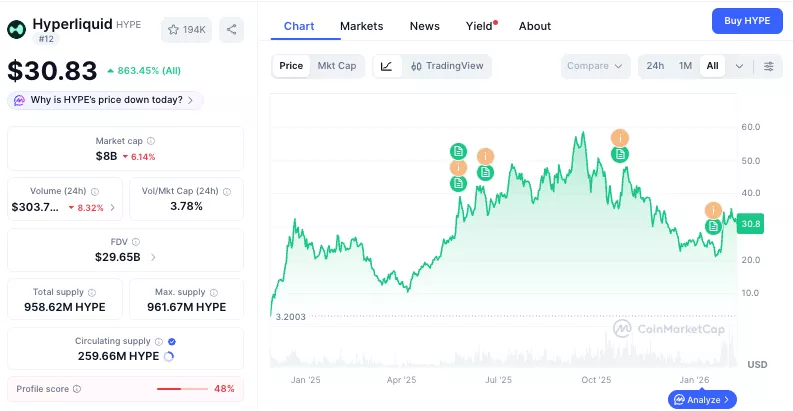
To learn more about Hyperliquid and the HYPE Token, visit the CoinMarketCap HYPE page.
Hyperliquid's ecosystem is booming: It ranks among the highest revenue-generating chains. HIP-3 ecosystem metrics show cumulative trading volume of $57.4 billion, with Felix markets (powered in part by HYPD's HYPE) achieving $950.3K in 24-hour volume and $13.63 million in open interest as of early February 2026.
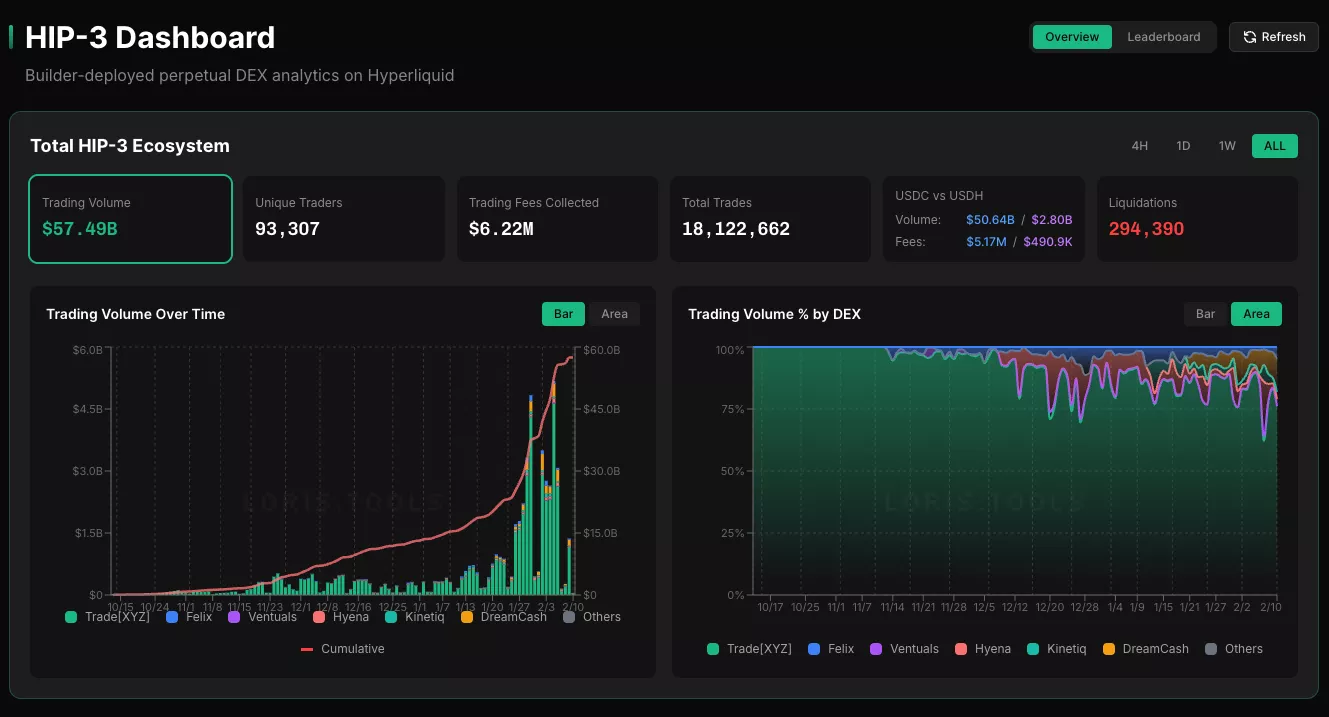
HyperLiquid allows traders to allocate capital into vaults run by specific traders, market makers, or strategies. Instead of trading perps yourself, you can deposit collateral into one of these vaults, and your capital is traded according to that strategy’s execution model. Examples of these vaults include Felix, Ventuals, Hyena, Kinetiq, and DreamCash, which are simply branded vault managers or trading desks operating on the platform. Each runs its own approach: some are high-frequency market making, some directional macro perps trading, others liquidity provisioning or basis strategies.
Risks include volatility (e.g., industry-wide liquidations), but HYPD's strategy mitigates this through diversified revenue streams like options premiums. Additional risks include HYPE's price fluctuations, network outages, validator concentration (24 validators), smart contract vulnerabilities in staking (e.g., HiHYPE), and regulatory uncertainties (potential security classification). Overall, HYPE's utility and ecosystem growth make it a high-conviction asset, with HYPD trading at a potential discount to its NAV.
Overview of Kinetiq (KNTQ)
KNTQ is the governance token of Kinetiq, a leading native liquid staking protocol built on the Hyperliquid blockchain (specifically its HyperEVM layer). Kinetiq allows users to stake HYPE, the native token of Hyperliquid, and receive kHYPE, a liquid staking token that accrues staking rewards (typically 2-3% APY) while remaining fully usable and composable in DeFi applications like lending, trading, liquidity provision, or looping strategies.
StakeHub, Kinetiq's autonomous system, delegates staked assets to top-performing validators for optimal yields. Launched in November 2025 via a token generation event, KNTQ enables holders to vote on protocol upgrades, treasury management, MEV routing, and other decisions, while capturing value from revenue streams such as validator commissions, staking fees, and integrated market fees. It trades primarily on Hyperliquid DEXs (e.g., KNTQ/USDH pair), with a circulating supply of around 270 million tokens and a market cap in the $35-40 million range as of early February 2026.
For Hyperion DeFi, Inc. (HYPD), owning KNTQ is strategically important as it provides diversified, earned exposure to the Hyperliquid ecosystem beyond its core HYPE treasury holdings. HYPD received 1,918,478.78 KNTQ tokens through an airdrop on November 27, 2025, directly tied to its early participation in Kinetiq. This allocation enhances shareholder value by granting access to Kinetiq's growth as one of Hyperliquid's largest protocols, potential recurring revenue from integrations (e.g., staking HYPE to Markets by Kinetiq for fee shares), and governance influence over a key DeFi primitive. In shareholder communications, HYPD highlights KNTQ as extending exposure to Kinetiq's ecosystem expansion, supporting its active treasury deployment strategy and compounding yields in a high-conviction chain.
Overview of Felix
Felix is a major DeFi protocol on the Hyperliquid blockchain's HyperEVM layer, specializing in on-chain borrowing, lending, and stablecoin issuance. It is built as a fork of Liquity V2 and allows users to mint feUSD, a dollar-pegged stablecoin backed by collateral such as HYPE, UBTC, or liquid staking tokens. Felix also offers variable-rate lending pools and supports fast liquidations, making it a core liquidity and leverage infrastructure on Hyperliquid. It ranks among the largest protocols by TVL (often $265–340 million in recent periods).
For Hyperion DeFi, Inc. (HYPD), Felix is strategically important due to an October 2025 partnership under the HYPE Asset Use Service (HAUS). HYPD allocated 500,000 HYPE from its treasury to Felix to help launch and sustain HIP-3 perpetual futures markets for non-crypto assets (e.g., equities like TSLA and NVDA, commodities like Gold, Silver, and Oil). These markets have driven substantial volumes—cumulatively over $1.5 billion in some cases, with daily figures frequently exceeding $100 million—and generate shared trading fees among Hyperliquid, Felix, and HYPD. This deployment creates recurring, volatility-agnostic revenue for HYPD, supports tokenized real-world assets and TradFi-style derivatives on-chain, and aligns with HYPD’s active treasury strategy of earning yield beyond passive HYPE holding.
HYPD’s Financial Overview
HYPD's pivot has driven profitability. The Q3 2025 10-Q reports net income of $6.63 million for the quarter (up from a $7.89 million loss in Q3 2024), fueled by $6.94 million in realized gains and $6.44 million in unrealized gains on digital assets, offset by a $6.29 million impairment on HiHYPE.
For the nine months ended September 30, 2025, net loss narrowed to $5.55 million from $29.86 million (mostly from the previous ophthalmic technologies industry business), with revenue of $0.32 million (primarily $0.30 million from staking). Since it is no longer pursuing the ophthalmic technologies business, the company should not incur any losses from that business unit going forward, and has growth potential from staking and token holding asset appreciation.
Trailing twelve-month revenue is $345k, with high quarterly growth potential from staking positions. Cash holdings stand at $8.22 million as of September 30, 2025 (up from $2.12 million at year-end 2024), with total debt of $8.3 million (extended to July 2028 at 8% interest, payable half in cash/half in-kind, secured by all assets). Enterprise value is ~$33.8 million.
Total assets had reached over $80 million, driven by digital assets appreciation during the Sept 2025 high price for HYPE, while stockholders' equity flipped to $70.76 million from a deficit. Cash flows for the nine months showed $10.71 million used in operations, $65.64 million in investing (HYPE buys), and $82.45 million from financing (ATM and private placement).
The company classifies HYPE gains/losses as non-operating, focusing core ops on treasury management.
Key Financial Metric | Value (Q3 2025 / Nine Months) |
Net Income (Q3) | $6.63M |
Net Loss (Nine Months) | $5.55M |
Revenue (Nine Months) | $0.32M |
Cash & Equivalents | $8.22M |
EPS (Q3 Basic) | $0.26 |
EPS (Nine Months Basic) | -$1.64 |
Market Cap and Share Structure
As of early February 2026, HYPD's market cap is approximately $29-34 million, classifying it as a micro-cap stock. A February 5, 2026, Schedule 13G/A filing reveals Forsakringsaktiebolaget Avanza Pension (a Swedish insurance company) holds 856,666 shares, representing 10.11% beneficial ownership, implying approximately 8.47 million common shares outstanding. As of September 30, 2025, shares outstanding were 7.16 million common (authorized 600 million), with 5.44 million Series A Preferred (convertible to ~16.3 million common at 3:1 ratio) and 33.82 million warrants outstanding (average exercise $3.54).
Recent conversions include 100,000 Series A Preferred to 300,000 common shares on January 5, 2026. Implied shares: 8.17 million; Float: 6.43 million. Insiders hold 29%, with institutions at ~11% (931,800 shares held by 31 institutions, including UBS, Vanguard, and BlackRock). Since November 2025 filings (mixed shelf + ATM), additional ATM share sales have occurred, with the program expanded to $100 million on September 24, 2025, raising $30 million net YTD through 4.38 million shares sold; no new securities issuances beyond ATM usage are specified in recent disclosures.
Debt includes $8.25 million in notes payable (net $7.66 million), extended to 2028 with an 8% interest rate (half cash, half in-kind), secured by all assets and subject to covenants restricting additional indebtedness or dividends.
Management Team
Leadership has been overhauled to align with the DeFi focus:
CEO: Hyunsu Jung (Appointed January 2026; previously CIO since June 2025). Former portfolio manager at DARMA Capital; Vassar College graduate.
CFO: David Knox (Appointed September 2025). Ex-PayPal, SoFi, Cantor Fitzgerald; expertise in capital markets and asset-backed finance.
Board highlights: Includes Michael Geltzeiler, Julia Jacobson, Ellen Strahlman (MD), and Happy Walters (blockchain/fintech veteran).
Possible Future Outcomes
Bullish scenario: Hyperliquid's growth (e.g., mainnet upgrades, USDH stablecoin) boosts HYPE value and HYPD's yields. Vault expansions, partnerships like Felix (with growing volumes), and Kinetiq/Native integrations could drive recurring revenue, pushing market cap toward treasury NAV of about $58M based on HYPE & KNTQ tokens holdings.
Bearish risks: Crypto downturns, regulatory scrutiny on DAT companies, or execution failures could erode value, including HYPE volatility, slashing penalties, smart contract bugs, and uninsured custody risks. HYPD's low debt and diversified yields provide a buffer. Medium-term: More treasury deployments (e.g., on HyperCore) and selective vault access for institutions.
Why Digital Asset Treasury Matters
A Digital Asset Treasury (DAT) company is a publicly traded firm that strategically holds cryptocurrencies—most commonly Bitcoin, but sometimes Ethereum, Solana, or others—as a core component of its corporate treasury. These companies treat them as long-term reserve assets similar to gold or cash equivalents, often funded through equity raises, debt, or operational cash flows to provide shareholders indirect exposure to crypto price appreciation. Here are a list of some companies that own or mine Crypto as part of their DAT strategy:
MicroStrategy (MSTR - NASDAQ) - Owns BTC
MARA Holdings (MARA - NASDAQ) - Own BTC via mining and treasury purchases.
Hut 8 Corp (HUT - NASDAQ) - Owns BTC from mining and treasury stratetgy.
Tesla Inc. (TSLA - NASDAQ) - Owns BTC as a diversification asset.
SharpLink (SBET - NASDAQ) - Holds Ethereum (ETH) as its primary treasury asset.
Forward Industries (FWDI - NASDAQ) - Allocates treasury to Solana (SOL) for diversification.
BitMine Immersion Technologies (BMNR) - Owns ETH.
DeFi Development Corp. (DFDV) - Accumulated SOL for DeFi lending/yield stategies.
Solana Company (NASDAQ: HSDT) - Holds ~2.2–2.3 million SOL; formerly Helius Technologies (a medical device firm), it rebranded in 2025 to become a dedicated Solana treasury vehicle.
Investment Thesis
HYPD offers leveraged exposure to HYPE and Hyperliquid via a regulated public stock, ideal for investors avoiding direct crypto custody. With 8.47 million common shares outstanding, increasing profits, and insider/institutional interest (e.g., Swedish pension fund's 10.11% stake), it trades at a potential 50% discount to NAV.
8.47M Shares Outstanding x $3.97 = $33.6M Market Cap.
Treasury NAV of about $58M based on HYPE & KNTQ token holdings.
$58M NAV - $33.6M MC = $24.4M Undervalued.
If HYPE token holds its NAV value at $58M, the shares of Hyperion DeFi, Inc. (NASDAQ: HYPD) should be worth $6.85 right now, so it is definitely trading at a discount to its Token holdings value, let alone the potential for increasing revenues from staking in Felix and Kinetiq.
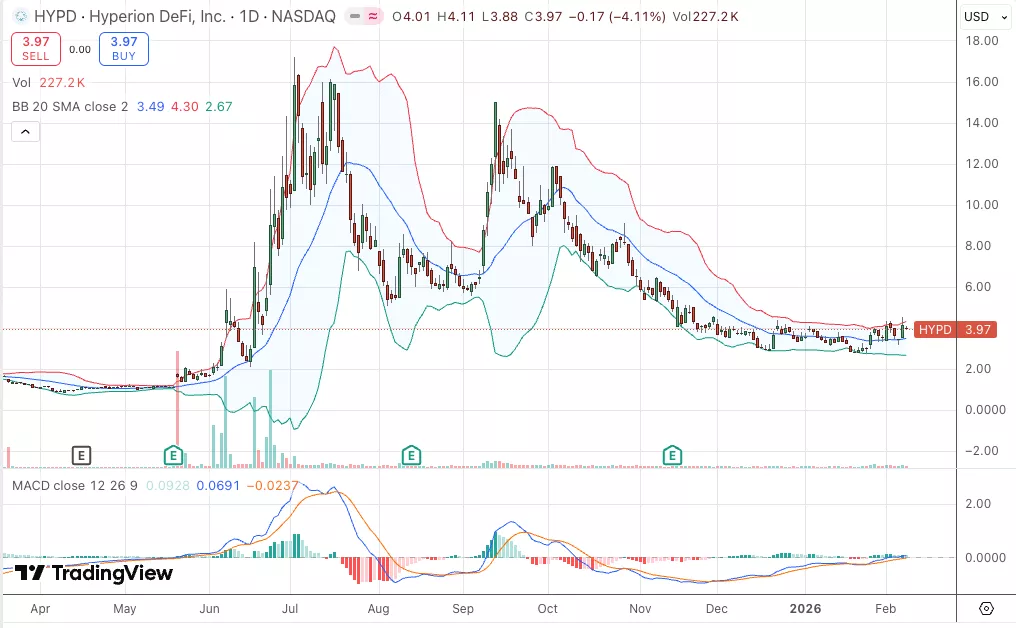
The thesis hinges on Hyperliquid's ecosystem momentum—deflationary mechanics (Token burned from earnings) and DeFi innovations—compounding shareholder value through yields and burns.
As with any security, there are some risks, and HYPD is considered a Micro-cap stock in a sector known for volatility. They do have a concentrated treasury exposure, and regulatory/tax uncertainties exist in this space and Token ownership. Overall, HYPD is a speculative but substantiated play on tokenized finance infrastructure.
For years, I have been saying the financial world is in a transition period, and Crypto/Tokens & Blockchain will be a major part and rails of the new financial system as we go through this paradigm shift. It is my firm belief that most assets will be tokenized and traded on the blockchain, including precious metals & commodities. The fact that Hyperliquid is a Layer 1 Blockchain and is becoming a leader in decentralized finance (ranked #12 on CoinMarketCap), I think it has tremendous potential going forwards and it will be part of the rails for this new Digital Financial World.
Hyperion DeFi (Nasdaq: HYPD) is currently undervalued based on the current tokens owned & NAV, so there is upside here as long as the price of the HYPE token holds current levels. If you are looking for an easy way to participate in the growth of the DeFi sector as it becomes the rails of the new financial system, without the hassles or learning curve of token ownership and staking, then HYPD is a good option to consider. What I also like about buying shares of HYPD is that you can use current funds in your brokerage account or in a 401(k) and gain the upside that the HYPE network and DeFi ecosystem bring as it continues to grow globally.
More By This Author:
Gold And Silver Prices: What You’re Seeing — And What You’re Not
Bitcoin: A Completed Elliott Wave Pattern, A Possible Bear Market, And A Bigger Question About Its Long-Term Viability
Mexico Could Have One Of The Strongest Currencies In The World… If It Backed The Peso With Silver



Comments
Log in or sign up to join the conversation.