

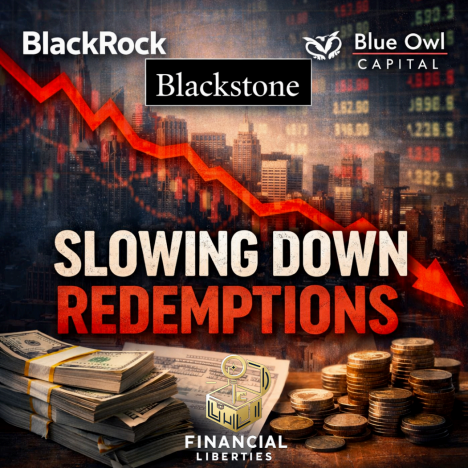
The private credit story is starting to show a few cracks. Nothing systemic yet, but enough signals to remind investors how these structures actually work when the cycle turns.
In the first quarter of 2026, BlackRock’s (BLK) $26B HPS Corporate Lending Fund (HLEND) received about $1.2B in redemption requests — roughly 9.3% of the fund’s NAV. The fund’s structure allows only 5% of NAV to be redeemed per quarter, so investors received about $620M, with the rest deferred. HPS is a large private credit manager that originates and manages loans to companies that typically cannot or do not want to borrow from traditional banks.
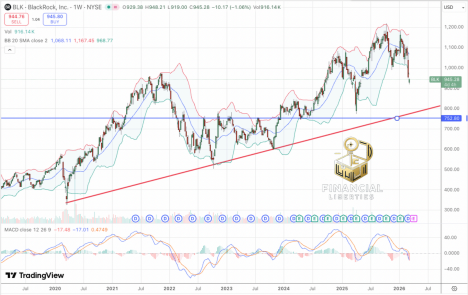
This is the first time HLEND has hit its redemption cap. That doesn’t mean the fund is failing. It means the mechanism designed to prevent forced selling of illiquid loans was activated.
That distinction matters, especially if this continues into Q2.
Private credit funds hold loans that don’t trade daily like public bonds. When investors want liquidity faster than the assets can realistically be sold, gates and redemption caps are in place, and that keeps the structure from breaking.
At the same time, another data point surfaced inside BlackRock’s private credit book. A $25M second-lien loan tied to an e-commerce aggregator was written down from par to zero in just three months. It’s the second “hero-to-zero” markdown in consecutive quarters for their private credit arm. That raises a more subtle issue in this space: valuation lag. In opaque loan markets, prices often adjust slowly, until they suddenly don’t and we are seeing major cracks in these market as conditions deteriorate.
Meanwhile, Blackstone’s (BX) flagship private credit vehicle BCRED (the largest non traded BDC at roughly $82B) also saw elevated redemption requests. About 7.9% of shares were tendered in Q1, or roughly $3.8B.
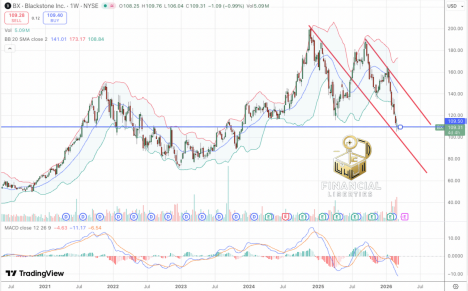
A BDC (stands for Business Development Company) is a regulated investment vehicle created by U.S. law (1980 Investment Company Act amendments) that allows investors to invest in private company loans and equity.
Instead of gating investors, Blackstone increased its redemption offer from the typical 5% to 7% and committed about $400M of internal capital to help meet demand. After accounting for new inflows, the fund still experienced about $1.7B in net outflows.
It’s the third time BCRED has faced redemptions above the 5% threshold. But so far the firm has chosen to meet requests rather than restrict them — largely because scale and liquidity allow them to manage it.
Then there’s Blue Owl Capital (OWL), which took a different approach. In its $1.6B OBDC II fund, the firm eliminated regular quarterly redemptions entirely. Investors will now receive capital back through periodic distributions funded by loan repayments and asset sales. To accelerate that process, the firm sold about $1.4B of assets across several funds.
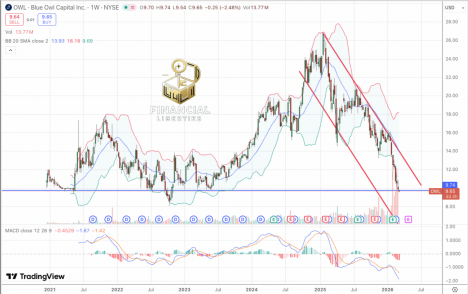
Executives framed the move as an “acceleration of liquidity,” but the reality is simpler as the cracks appear: when liquidity mismatches appear, the structure adjusts similar to what we have seen with margin increases in the gold and silver sector by the CME.
The market reaction was immediate. Shares of major alternative asset managers — including BlackRock, Blackstone, and Blue Owl Capital — sold off sharply in a single session as investors digested the news.
Stepping back, the broader market trend is becoming more clear… I think we have topped out in the major indexes and now risk is getting revalued and repriced.
Private credit grew rapidly over the past decade because it offered yield in a world starved for income. Low rates, stable defaults, and constant inflows created ideal conditions for the model to expand. But private credit works best in stable environments. When rates stay higher for longer, growth slows, and liquidity tightens, the underlying cracks in the market plumbing becomes more visible… we are seeing this now.
Industry data already shows redemptions rising across this sector and I think that spills over to the boarder market. At the same time, inflows have begun to slow and analysts expect significantly lower capital formation for BDCs this year.
These funds were built with gates, redemption caps, and delayed liquidity precisely for moments like this. I don’t know if this means the private credit market is outright collapsing yet, but the cracks are appearing and people are looking to exit them before a potential dam break.
But it is a reminder of something many investors forget during long bull markets: illiquid assets are easy to hold when no one asks for their money back. The real test comes when they do.



Comments
Log in or sign up to join the conversation.