


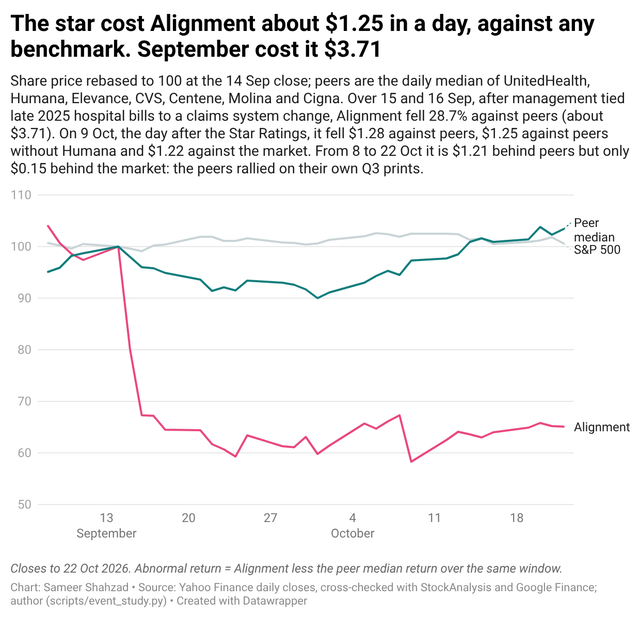
So the star cost Alignment Healthcare (ALHC) about $1.25 a share in a day. On October 8, CMS cut its BIGGEST contract, California HMO H3815, from 4 stars to 3.5, and the next day the stock lost around $1.25 against peers or the market, whichever you pick. I rebuilt CMS's ratings for every contract, and I got $0.98 for that half star. The star was priced in a day.
September did more damage. On September 15, at Baird's healthcare conference, management said a claims system change had left 2025 hospital bills arriving very late, and that nursing-home stays were running long. Over that day and the next, the stock fell 32.7%, from $12.94 to $8.71. The median managed-care peer fell 4.0%.
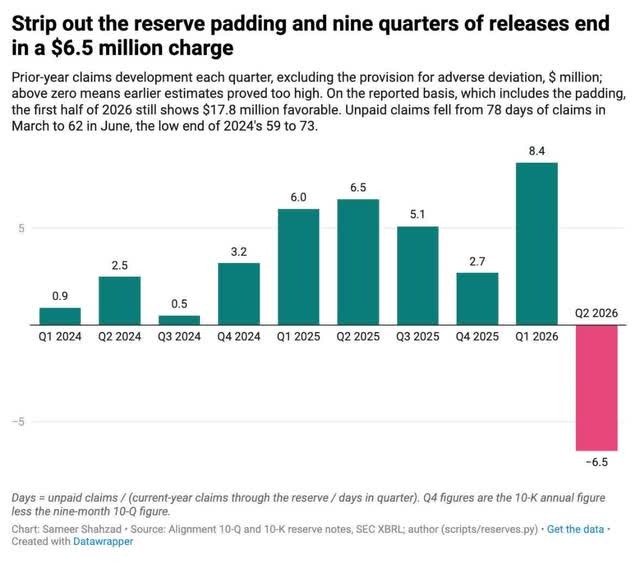
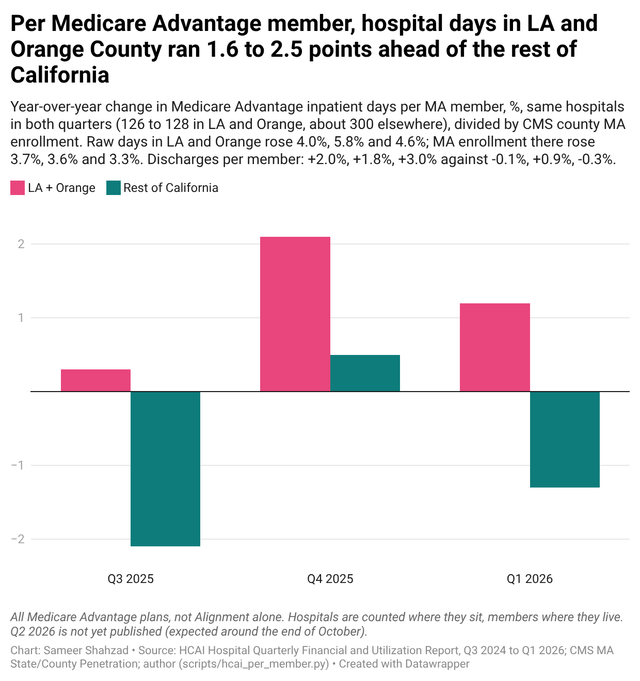
What the price really leaves out is the cost side. Weighted by members across all 55 counties where it sells, Alignment's 2027 general plans give back about $820 a year in Part B premium reductions and spending allowances. That's 2.7 times its rivals' average and 2.1 times SCAN's. Per Medicare Advantage member, hospital days in Los Angeles and Orange County, its largest market, ran 1.6 to 2.5 points a year ahead of the rest of California in each of the three quarters through March. When you strip out the reserve padding, nine quarters of reserve releases end in a $6.5 million charge in the second quarter. My 2027 estimates are within half a percent of consensus, so the disagreement is over how those numbers are counted and how safe they are.
The valuation comes down to just one convention. Count stock pay as a cost, the way peers count their earnings, and a peer multiple gives $8.21 a share before the star and $7.23 after it. Leave stock pay out, as the company and the Street do, and the same multiple gives $11.06. Stock pay is 37% of Alignment's 2027 adjusted EBITDA and just under 3% of the median peer's. That is why I count it. Just that $3.83 gap is my real disagreement with the Street, so I'm gonna put it up front.
I rate Alignment Healthcare a SELL with a 12-month price target of $7.23, 14% below the $8.43 close on October 22. Now, yes, there are a few things that argue the other way. I'll put those on the table. Its own seasonal pattern and the peer prints so far point to an October 29 quarter better than mine. A DCF says the price only needs margins to hold where they are. Plans win roughly four in ten star-rating lawsuits that reach a ruling. And that reserve charge may turn out to be a one-off from the backlog. If the quarter comes in clean, the rules below take me back to HOLD.
What the market has already charged
Yahoo Finance daily closes, cross-checked with StockAnalysis and Google Finance; author
I measure each move three ways: against the median of UnitedHealth, Humana, Elevance, CVS, Centene, Molina and Cigna, against the same group without Humana (which rose 11.6% on its own rating that day), and against the S&P 500 at Alignment's beta of 1.14. On the stars day, the answers are $1.28, $1.25, and $1.22. That one-day move is the number I rely on. Longer windows depend on the benchmark. The peers have rallied on their own Q3 prints since, so from October 8 to October 22, Alignment trails them by $1.21 but trails the market by only $0.15. Whichever benchmark you use, the September window is way bigger than the star: 28.7 points behind the peers, about $3.71 a share.
The cost base
Alignment 10-Q and 10-K reserve notes, SEC XBRL;
Let's start with reserves, considering that is what the management pointed to. The unpaid-claims reserve ran between 59 and 73 days of claims through 2024 and reached 95 days at the end of 2025. That is what a claims backlog looks like on a balance sheet. The backlog cleared in Q2: Alignment paid $245.4 million of prior-year claims in the first half against an opening estimate of $297.4 million, 83% against 76% a year earlier. The reserve fell to 62 days. Now, take out the provision for adverse deviation, the padding Alignment keeps on top of its best estimate. Prior-year development was $6.5 million unfavorable in the second quarter, after nine favorable quarters. CEO John Kao put it this way at Baird: "Whenever you go through a claims application implementation, those are messy and noisy."
SEC XBRL company facts, FY2024-2025 10-Ks; author
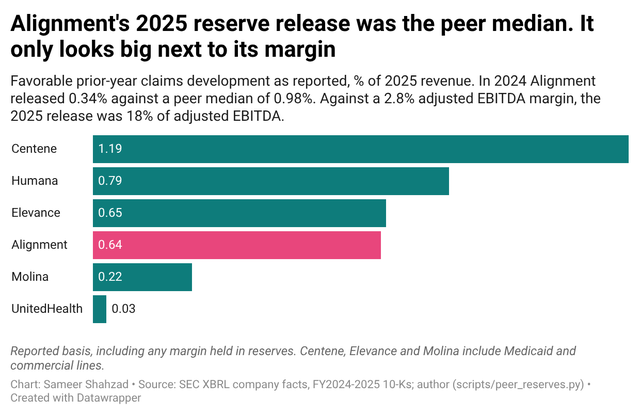
I really need to be careful here. On the reported basis, which includes the padding, Alignment's 2025 release was 0.64% of the revenue. The median of UnitedHealth, Humana, Centene, Molina, and Elevance was 0.65%. Its first half of 2026 still shows $17.8 million favorable. So the releases are normal for a health insurer. Where they really bite is the margin: 2025's release was 18% of adjusted EBITDA. What the second quarter tells you is smaller than that. The best estimates stopped proving conservative, and the reserve now sits at the low end of its range. Each day of claims it holds is about $4.3 million. That is a fifth of the low end of the third-quarter EBITDA guide.
HCAI Hospital Quarterly Financial and Utilization Report, Q3 2024 to Q1 2026; CMS MA State/County Penetration; author
Hospital use is the cost that drives the rest. California's HCAI quarterly hospital filings, matched on the same hospitals each year, show Medicare Advantage inpatient days in Los Angeles and Orange County up 4.0%, 5.8%, and 4.6% YoY in the third and fourth quarters of 2025 and the first quarter of 2026. Most of that is just enrollment. CMS's county files put Medicare Advantage membership there up 3.7%, 3.6%, and 3.3%. Per member, days rose 0.3%, 2.1% and 1.2%, while in the rest of the state they fell 2.1%, rose 0.5% and fell 1.3%. That is a gap of 1.6 to 2.5 points in every quarter. Discharges per member make it even more obvious: up 2.0%, 1.8%, and 3.0% against around flat elsewhere, and days per discharge edged down, 5.72 against 5.82, so the growth really is admissions. There are two caveats. Hospitals are counted where they sit, and members where they live, and these are all plans' patients, with Alignment's inside the total but not broken out. So in reality the effect is smaller than the raw volumes suggested. It still matches what management said about hospital costs in its home market. HCAI has not posted the second-quarter file yet. Last year's came out at the end of October, so this one should come out around then.
What Alignment is selling for 2027
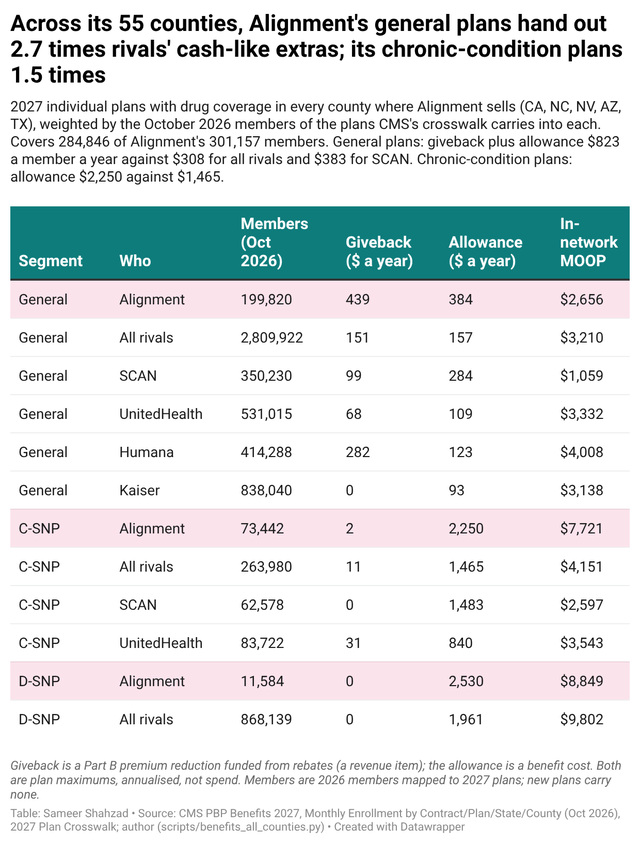
CMS PBP Benefits 2027, Monthly Enrollment by Contract/Plan/State/County (Oct 2026), 2027 Plan Crosswalk; author
CMS's 2027 benefit file, weighted by the October 2026 members of the plans its crosswalk carries into each 2027 plan, covers 284,846 of Alignment's 301,157 members across California, North Carolina, Nevada, Arizona and Texas. In general plans, Alignment gives back $439 a year per member in Part B premium reductions and offers $384 in over-the-counter and flexible allowances. That is $823 altogether. It is against $308 for all rivals in the same counties and $383 for SCAN, the closest senior-focused competitor. The gap holds in every state. In chronic-condition plans, a quarter of Alignment's members, the allowance is $2,250 against $1,465.
Let's all remember that the two pieces aren't the same thing. The giveback is a premium reduction paid for out of rebate dollars, so it comes out of what Alignment keeps per member. Its medical costs do NOT see it. The allowance is a benefit cost. Both figures are plan maximums, and I don't have an actual spend. Alignment is also leaner where members pay: its general plans carry a lower out-of-pocket cap than rivals, $2,656 against $3,210, though its chronic-condition plans carry a higher one. Generous extras are what new members see. New members cost more than mature ones for their first two years. Put those together, and you get a strong January and a cost ratio that really doesn't get easier.
Keep the timing in mind, too. For 2027, the largest insurers are cutting yet again. By Healthcare Dive's read of CMS's landscape file, UnitedHealthcare is dropping around 690 plans and Humana about 2,400. Insurers also project Medicare Advantage enrollment falling by about 2 million. Aetna has made some plans non-commissionable, which takes them out of brokers' pitches, and Becker's reports that UnitedHealthcare, Elevance, Cigna, and Blue Shield of California pulled commissions on some plans in the last two cycles. These are all national figures, btw. I don't have a California split. Still, seniors pushed out of those plans are shopping in the enrollment period that opened on October 15, and plans with the richest extras are an obvious place to land. Alignment gets the growth. It also carries the first-year cost in 2027.
Where the members are
CMS's October enrollment file puts 301,157 members in eight Alignment contracts. H3815 ALONE has 225,609. That's three-quarters of the members and, on my allocation by county benchmark, about $4.9 billion of my $6.5 billion of 2027 revenue. Every other rated contract scored 4 stars or better, so in 2027 payments, nearly every Alignment member sits in a bonus-earning contract. In 2028, a quarter do. A ninth contract, the new California H6697, starts in 2027 with no members yet. It inherits Alignment's member-weighted average of about 3.71, short of the bonus.
The star, in brief
My rebuild of CMS's method matches the published overall rating for 503 of 508 drug-plan contracts, and all three of H3815's. H3815 averaged 3.37. It missed on two survey measures CMS tripled in weight this year, by one point each, and those measures barely repeat from year to year: across 253 contracts, the correlation is 0.24 and 0.20, against 0.95 for breast cancer screening. A simulation that moves every measure together the way they move in the data puts H3815 back at 4 stars 32% to 38% of the time next year. I backtested it on the 2027 ratings. The 132 contracts it gave 15% to 45% odds averaged 29%, and 30% got there.
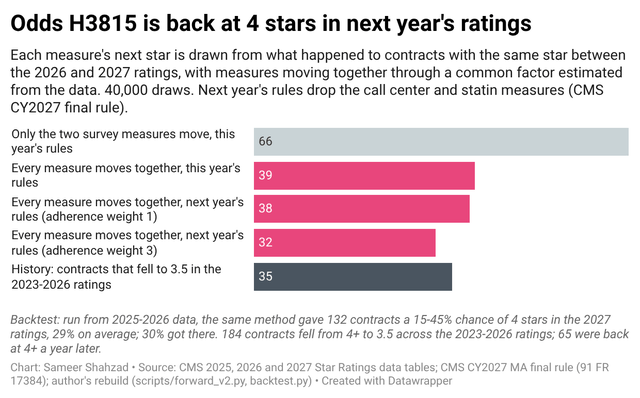
CMS 2025, 2026 and 2027 Star Ratings data tables; CMS CY2027 MA final rule (91 FR 17384); author's rebuild
The gap closes slowly. The downgrade path sits below 4 stars 75 points more often than the 4-star path in 2028, 44 in 2029, and 24 in 2030.
The rebate formula takes $133.6 million a year off H3815, but members carry part of it. In CMS's payment data for 108 contracts that lost 4 stars between 2019 and 2023, members had absorbed a median 26% through thinner benefits. In Alignment's own 2022 episode, it cut benefits by 1.5 times the formula and lost members while 4-star peers really grew. I weight the two patterns equally and value lost members by tenure. Discounted at 8.9%, the downgrade costs about $0.98 a share.
That $0.98 already bakes in 25% odds that Alignment wins its October 9 lawsuit over the 2027 ratings. A win is worth about $0.47. Counting each ruling once, plans have won relief in four of the nine star-rating rulings since 2024 with a reported outcome. SCAN in 2024, Alignment's own Arizona contract in 2025 and Clover this year are among them. I stay below that rate because the remedy may not get Alignment there. Strike all ten measures it challenges, which is Clover's theory, and H3815 goes to 4.07 in my rebuild, so 4 stars. But when CMS reran the 2026 ratings after Clover in June, it leaned on survey and clinical measures. My approximation of that approach still leaves H3815 at 3.34, so that's 3.5 stars. At 44% odds, the target would be $7.32.
Why I count stock pay
Stock pay was $62 million in 2025, 1.57% of revenue. At UnitedHealth, Elevance, CVS, Cigna, Centene, and Molina, it ranges from 0.10% to 0.22%. In my 2027, it's $76.3 million, 37% of adjusted EBITDA. At the peers, last year's stock pay is 2% to 6% of next year's consensus EBITDA. Note that. Shareholders pay for it through dilution: weighted basic shares rose 8.7% in two years, from 190.9 million to 207.4 million, and diluted shares are 215.0 million. I expense it and hold the 215.0 million diluted shares, so it's counted once.
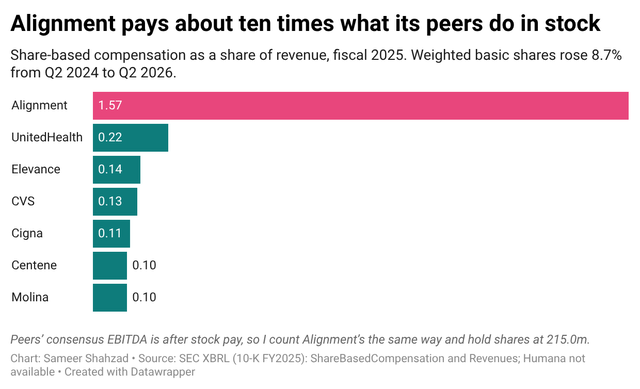
SEC XBRL (10-K FY2025): ShareBasedCompensation and Revenues; Humana not available
Valuation
The primary method I use is the peer-median forward EV/EBITDA on 2027, 10.78 times at the October 22 close, from S&P Global's consensus EBITDA for each peer and their reported net debt. On $129.3 million of EBITDA after stock pay, that is about $1,394 million of enterprise value. Peer enterprise values net all of their cash, regulated OR not, so I net Alignment's $702 million of cash and investments against its $330 million of convertible notes. That gets you $8.21 a share and, less the $0.98 stars cost, $7.23. At the October 8 close, when the peer multiple was 9.7 times, the same math gave $7.56 before any stars cost against a price of $8.71. In other words, the star came out of a premium.
The target moves with the peers, so I ran the same method on every close since September 8. It gives $6.23 to $7.33, below Alignment's price on all 33 days, and the October 22 multiple is the second highest of the stretch. On the median multiple of the last 20 closes, the target would be $6.61. $7.23 is the generous end.
I don't use P/E this year. At under 1% net margin after stock pay, one point of cost ratio moves 2027 EPS by more than 100%.
The DCF runs to 2036 at 8.9%, built from the 10-year Treasury at 5.15% on October 19, Damodaran's 4.20% implied premium on October 1, and Alignment's 5-year beta of 1.14. The notes' 4.25% is a convertible's coupon, cheap because of the option to convert at about $16.04. At an 8% straight-debt cost, the discount rate is 9.34%, and the target is $7.26. With growth fading from 14% to 3% and the margin after stock pay reaching 3.0%, the DCF gives $13.33. It credits only the cash that is free of claims and capital rules: $135 million at the parent and the $73 million the subsidiaries can pay up. Where the DCF actually helps is the margin the price needs. That is about 2.1% after stock pay, for good, close to my 2027.
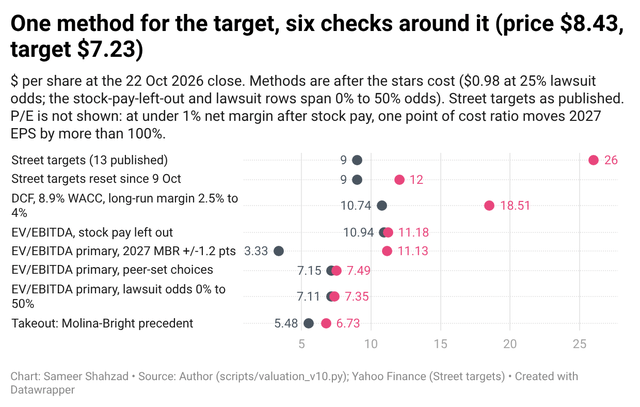
Author (scripts/valuation_v10.py); Yahoo Finance (Street targets)
Dropping CVS and Cigna from the peers gives $7.49. Dropping Humana and Molina gives $7.15. Molina paid $500 million for Bright Health's California plans in January 2024, around 109,000 members, or $4,587 a member. Alignment's enterprise value per member on shares outstanding at each date has fallen from about $15,900 at the end of 2025 to about $4,700, close to that price. A buyer would apply it to the operating plans and credit only the parent's cash, which gives us $5.48 to $6.73. Bright was a forced seller tho.
The 2027 cost ratio, and how far to trust it
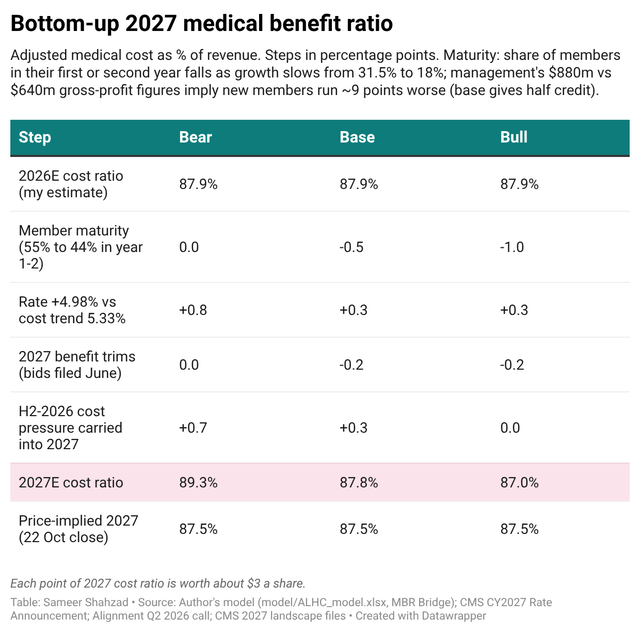
Author's model (model/ALHC_model.xlsx, MBR Bridge); CMS CY2027 Rate Announcement; Alignment Q2 2026 call; CMS 2027 landscape files
My bridge takes the 2026 ratio of 87.9% to 87.8%. Member maturity helps by half a point. CMS's 4.98% rate increase (2.48% before risk-score trend) falls short of its own 5.33% cost growth estimate by enough to add 0.3. The 2027 plans help by 0.2, and I carry half of this year's second-half pressure, 0.3. Each point is worth $3.25 a share, and my primary method equals the price at 87.46%. The bridge got 2025 within 0.2 points and missed 2026 by 2.6, because CMS's 9.04% effective growth rate for 2026 was the benchmark catching up. It definitely was not a jump in Alignment's costs. Treat 87.8% as plus or minus a point. Symmetric cases 1.2 points either side give $3.33 and $11.13, and a 25/50/25 weighting returns the base.
The October 29 print
In 2023, 2024 and 2025, Alignment's second-half cost ratio came in 1.05, 1.84 and 0.07 points below the first half. This year, the guidance midpoint implies about 1.0 point above. My third and fourth quarters, 88.7% and 88.4%, put it 1.35 points above.
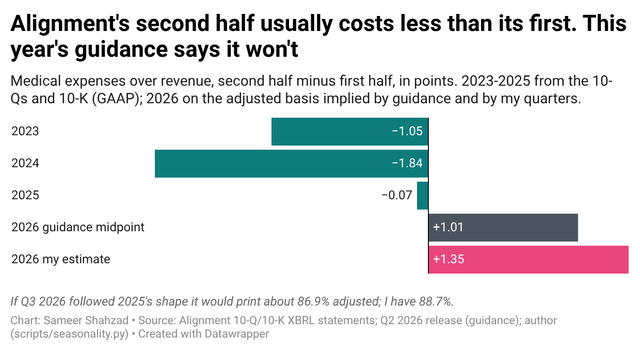
Alignment 10-Q/10-K XBRL statements; Q2 2026 release (guidance); author
Now we are left with two possibilities. Either management's warning about hospital and nursing-home costs is a trend that carries into 2027, or the guidance is cautious after a heavy enrollment year and a backlog that's now cleared. The peer prints so far lean toward the second. UnitedHealth's third-quarter medical care ratio was 88.4% against 89.9% a year earlier, helped by $610 million of favorable reserve development. On October 21, Elevance reported a benefit expense ratio of 90.6%, 70 basis points better, which it credited to Medicare Advantage and individual ACA plans. Molina's Medicare ratio of 93.0% was in line with its expectations, on what it called a stable cost trend. The California hospital data lean the other way for Alignment's home counties. If Alignment's quarter repeats 2025's shape, it prints around 86.9%.
Alignment Q2 2026 release (guidance); Yahoo Finance (consensus); author (track-record pre-registration)
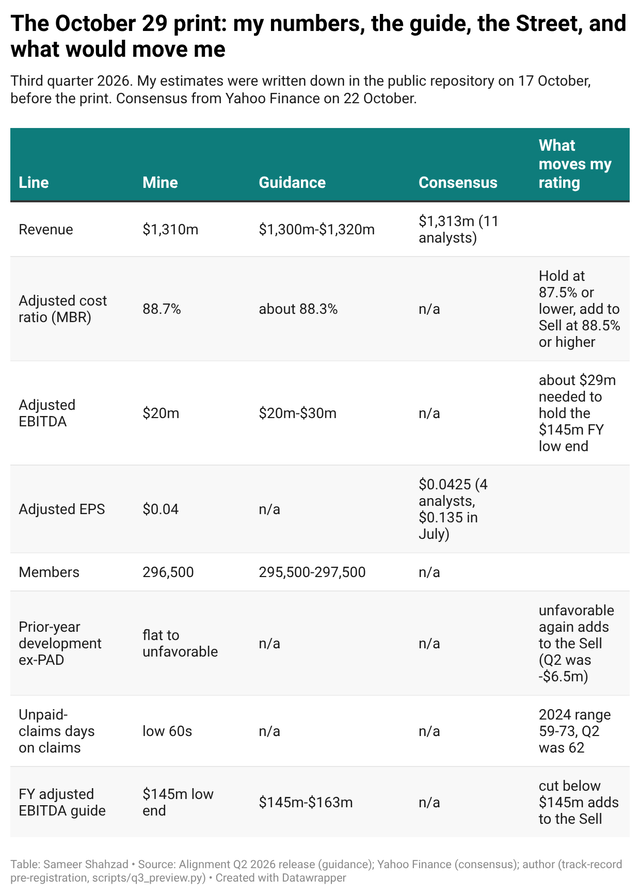
Alignment reports after the close on October 29. My third quarter is $1,310 million of revenue, an adjusted ratio of 88.7%, $20 million of adjusted EBITDA (the bottom of the guide), and $0.04 of EPS. Consensus revenue is $1,313 million from 11 analysts. Consensus EPS of $0.0425, from four analysts, has fallen from $0.135 in July. Holding the $145 million low end of the full-year EBITDA guide needs a third quarter of about $29 million, near the top of the $20-30 million range. The last print, on July 30, moved the stock 20.2% the next day. A move that size could really just go either way.
What would change my mind?
An adjusted ratio of 87.5% or lower in the third quarter, with the favorable prior-year development and full-year guidance intact, and I go back to HOLD. 87.0% or lower with guidance raised, and I move towards BUY. A ratio of 88.5% or higher, a second quarter of unfavorable prior-year development, or a full-year adjusted EBITDA guide cut below $145 million, and I add to the SELL. My estimates were written down in the repository before the print, and I'll score them in the comments the morning after.
Two data releases around and after the print test the cost case. Here's what each has to show.
HCAI's second-quarter hospital file, which is due around the end of October, covers the quarter the reserve charge landed in. If Medicare Advantage days per member in Los Angeles and Orange County again run at least 1.5 points ahead of the rest of the state, the hospital evidence holds. Under half a point and I drop it from the case. Anything in between just weakens it.
CMS's January 2027 enrollment file shows by contract where the sign-ups went. My model has Alignment ending 2027 with about 353,000 members. That is 18% more than this year. A January count already near that means a bigger first-year cohort than I carry, and a harder cost ratio. A fall in H3815's 225,609 members means the star is costing members faster than my $0.98 allows.
After that come 2027 guidance in February, the lawsuit, and the 2028 Star Ratings in October 2027.
Positioning
Short interest was 23.6 million shares on September 30, around 12% of the float and two to three days of average volume. On October 22, Yahoo showed 13 published targets with a mean of $12.31 and a median of $11. Every target reset since the October 8 ratings I can find sits between $9 and $12: JPMorgan at $10, KeyBanc and TD Cowen at $12, and UBS at $9. Of 14 recommendations, 10 are Buys and four are Holds. The ratings haven't followed the targets down.
Where I could be wrong
The convention could technically win. If the markets keep valuing Alignment before stock pay, the same method gives $11.06. I can argue the convention is wrong. I really can't make the market drop it.
Margins could do more than the price needs. At 3% after stock pay, the DCF says $13.33, and at 4% around $18.50. Alignment's own $880 million maturity figure for gross profit implies better than either.
The quarter could follow the calendar and the peers. That takes the carry out of my bridge and adds about $1.07. The reserve charge could prove a one-off from the backlog. The per-member hospital gap could just be patients crossing county lines. The generous 2027 plans could be priced into bids I can't see. And if the court strikes the ten measures, or the survey measures swing back, most of that $0.98 goes away.
On the other side, treating regulated cash as trapped gives $4.60. Risk-adjustment audits are a live cost across the industry: Elevance has accrued $935 million this year for potential exposure on historical Medicare Advantage risk-adjustment data, and H3815 is under a payment-year-2019 audit with no estimate disclosed. A former senior executive, Hakan Kardes, sued in July alleging that $8 million to $10 million of 2024 operating costs were booked as capital spending. Alignment reported $1.3 million of positive adjusted EBITDA for that year. Alignment says an Audit Committee review with outside counsel and an accounting firm found the concerns unfounded. On October 5, a federal judge largely denied its motion to dismiss, which is a procedural ruling and really says nothing on the merits. Several plaintiff firms have announced investigations since July. None has filed a securities complaint.
The data, code, models, and an eight-page note are public, for any of you to run.
Where I come out
The star cost Alignment about $1.25 in a day. Close to what it's worth. That part is done. What's left is cost: plans richer than its rivals', and hospital use per member rising faster at home than in the rest of the state. In a business where a normal reserve release is a fifth of earnings, the estimates stopped proving conservative in the second quarter. And on comparable earnings, the stock still sits above a peer multiple before the star is even counted. Fair value is near $7.23, and no close since September 8 has put it above $7.33. The third quarter could prove me early. The rules above say what would move me.
My rating is SELL, with a 12-month price target of $7.23.



Comments
Log in or sign up to join the conversation.