

While economists shift through Canadian economic data, the politicians debate in Parliament whether Canada is officially in a recession. Is the glass half full or half empty? It all depends on whether one is looking at output growth or job creation. A recession technically occurs when the economy contracts over two-consecutive quarters. But more understanding is needed before jumping to the conclusion that Canada has entered a recession.
In retrospect, GDP in the first quarter of 2026 declined by 0.1%, annualized, on the back of a decline of 1.0% in the last quarter of 2025. So, that supports the view that we are in recession. But those measurements apply up to March of this year. Early indications are that revisions would likely put the growth rate into positive territory. Nonetheless, the Canadian economy is certainly weak and the Bank of Canada continues to expect growth, at best , to be in the annual rate of 1.5% for the year as whole.
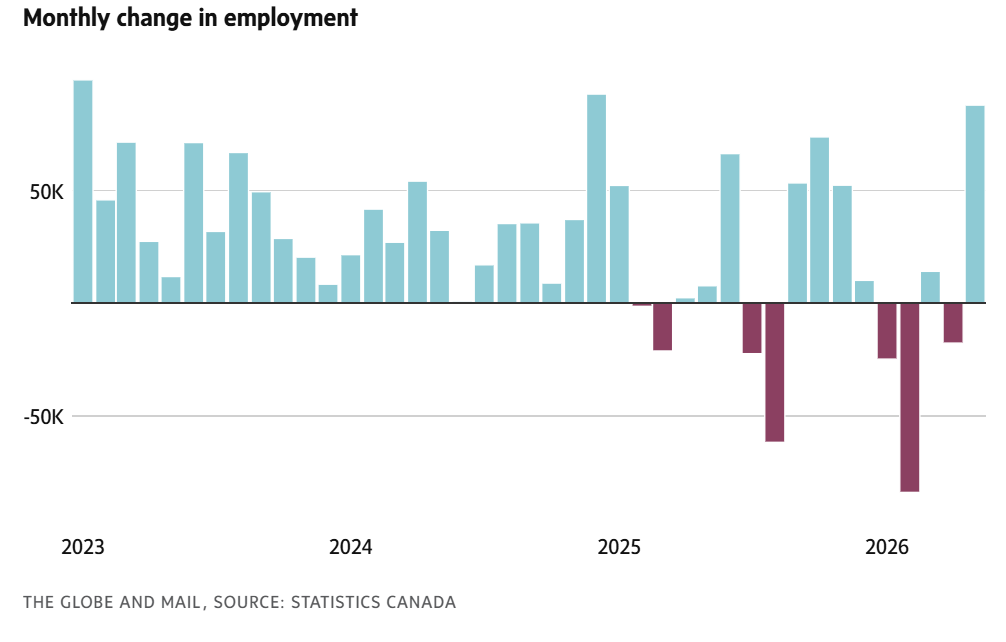
Recessions feature job losses across all sectors. So when the Canadian labour market recorded an increase of 88,000 jobs in May, the debate now took another twist. Job gains were evident in all major sectors such as construction,transportation, information technology, services and manufacturing. More importantly, the job growth was driven entirely by full-time employment of 154,000 additions, while part time positions fell by 66,000. Canada has a tendency to rely on part-time workers and this surge in full time employment is a very important indication that the labour market is recovering rapidly.
Next Wednesday when the Bank of Canada meets, it faces a set of very challenging conditions. Rate hikes may be necessary to counter the inflationary impact of oil prices. . Many central bankers are considering rate hikes and have taken rate cuts off the table. At the same time the Bank is closely watching developments in the three-way free-trade agreement between Canada, US and Mexico (CUSMA) . CUSMA is now entering a crucial stage of negotiations. Should these negotiations not prove successful, Canada will continue to face high tariffs on critical sectors and the Bank will have to consider rate cuts to offset income losses. On top of these issues, is the macro economic concern as to whether the is in recession.


Comments
Log in or sign up to join the conversation.