


As Canadians just celebrated the country’s 159th birthday on July 1st, another milestone was reached regarding the Canada-US- Mexico trade agreement (CUSMA). July 1st triggered a mandatory joint review , rather than an expiration date of the existing arrangement. It essentially kicks off the official opening of the high-stakes annual economic review process required under the existing agreement.
When President Trump launched his world-wide trade war, Canadians believed that they faced an “existential” threat to their economy. The financial media issued all kinds of dire scenarios, citing that Canada’s bilateral trade accounted for more than 75% of all exports. None of these frigthening scenarios even remotely came to pass. The Carney government has played its cards—-a favourite term of Trump—- well . No meaningful concessions were offered by Prime Minister Carney, even on existing bilateral “ irritants “, let alone larger issues facing the energy and automotive sectors. Bilateral exploratory discussions were held at the lower level of government officials over the past year, but to no avail.
July 1st came and went without any US indication that it wished to extend for an additional 16-years. Trump,earlier this year, went on the offensive, claiming that there is no reason to extend the CUSMA, boasting that “ We don't need anything Canada has. We don’t need anything that Mexico has, but they need everything that we have.” Trade officials on both sides know this is a balantely false statement and cannot even be taken with a grain of salt. Canada's bilateral trade surplus is a result of the US heavy reliance on energy and commodities exports to sustain its economy.
So who will blink first? Canada or US ?
So far, Prime Minister Carney has been relatively silent during the period preceding the July 1st deadline, concentrating on Canadian domestic policy issues, particularly on ways to diversify the country’s trade away from the US. US officials, including Secretary of Commerce, Howard Lutnick, have reached a new level of frustration with Canada . Recently, the US ambassador to Canada,Pete Hoekstra, urged Canada to “make us an offer”, a remarkable statement from one party that says it has all the cards.
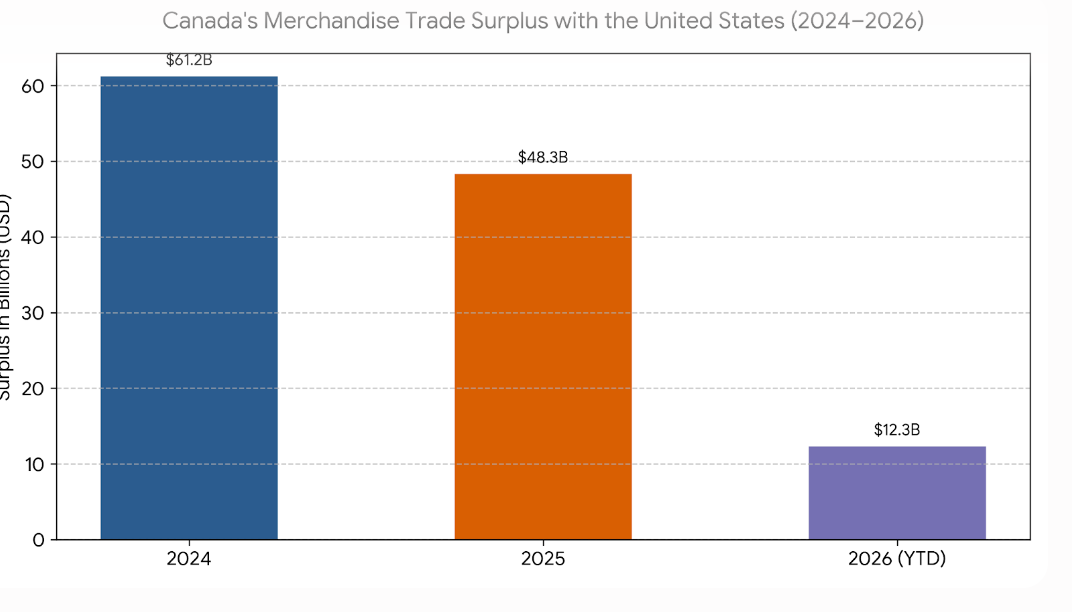
The Canadian government seems to be in no hurry to jump into a deal. Canadians no longer feel President Trump’s trade policy is an existential threat. The Canadian economy is growing, albeit slowly, despite US trade protectionism . Our trade surplus with the US contributes to an improvement in national income. If US trade protectionism is aimed at eliminating Canada’s trade surplus, it continues to fall way short of that goal.
What is a stake in these future negotiations? What is the US concerned with Canadian trade policy?
The US fears that China will use Canada and Mexico as a backdoor to gain entrance to the US market. For example, Canada agreed to let in 49,000 Chinese EVs as part of a Chinese-Canadian trade agreement ; the US fears this is the thin edge of the wedge in getting Chinese EVs imported into the US.;
The US fears the loss of major industrial production to imports and has put heavy tariffs ( as much as 50%), especially in steel,aluminum and copper;
US has long standing issues regarding importation of Canadian lumber products, arguing that Canada subsidizes the industry to the disadvantage of US producers;
US continues to charge tariffs on Canadian exports not covered by CUSMA; numerically this is not so significant since CUSMA covers nearly 85% of all cross border trade; and
The US has long standing complaints regarding Canada’s supply management policies affecting US access to the Canadian food industry, especially poultry and dairy products.
Summing up, Canada is the US largest trading partner, so the broad thrust of US trade policy globally is being played out in the bilateral relationship. Overall, the US goal of removing trade deficits has been a failure, no more so than is evident that Canada continues to be a net exporter to the US. While certain sectors are under pressure,for example, basic metals, Canada continues to run trade surpluses of $3B -6B per month, depending on the swing in international oil prices.


Comments
Log in or sign up to join the conversation.