


Zscaler (ZS) is a major beneficiary of booming AI security demand. The company faces tough and evolving competition, but the market may be underestimating its long-term growth potential and competitive moat.
Importantly, the recent Investor Day highlighted several attractive opportunities for Zscaler to outperform expectations over the long term.
At current prices, we rate Zscaler as a buy, and we are watching it closely because a reacceleration in growth could dramatically increase the upside potential in Zscaler stock.
Solid Fundamentals
Zscaler has faced some hiccups in the past. For example, in 2024 and 2025, the company reorganized its sales team and go-to-market strategy, which created sales friction and lengthened the sales cycle. That incident aside, the long-term picture shows solid execution and consistent financial performance.
Zscaler is growing the top line well above 20% year over year, which is quite impressive for a company of such scale. Annual Recurring Revenue (ARR) reached $3.8 billion last quarter, growing 25% versus the same quarter in the prior year. Excluding the Red Canary acquisition, year-over-year ARR grew 20%.
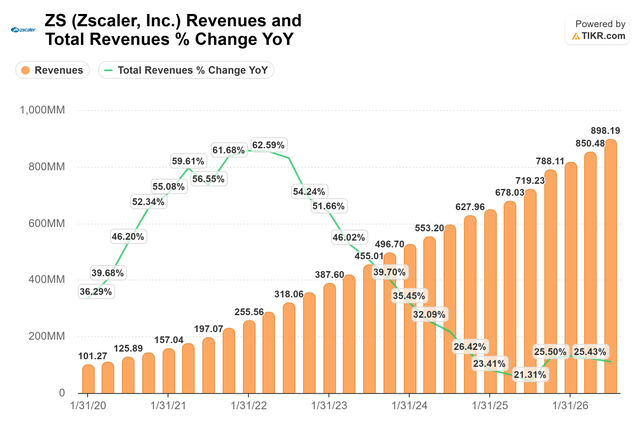
Profitability is also moving in the right direction. Non-GAAP operating margin was 24.3% in the most recent quarter, an increase of 220 basis points versus the same quarter in the prior year. The business model has strong economies of scale, and Zscaler should continue delivering substantial operating leverage in the years ahead.
The company is in the right place at the right time, and it is executing well. Success, however, attracts the competition, and this is perhaps the biggest risk for investors in Zscaler. That said, the company is building its competitive moats through high switching costs and technological capabilities.
Once Zscaler is installed in a Fortune 500 company, it touches everything. It is installed on every employee's laptop via the Zscaler Client Connector. It also integrates with the company's identity provider and manages corporate data routing.
Trying to rip Zscaler out and replace it with a competitor is like trying to replace the plumbing in a skyscraper while all the tenants are still living there. It is highly disruptive, risky, and expensive. As long as Zscaler's product works well, large enterprises have almost zero incentive to switch. If customers are not going to switch, cross-selling opportunities become especially attractive.
Besides, in order to do what Zscaler does without slowing down the internet for users, you need data centers everywhere. Zscaler has spent over a decade building out edge data centers all over the world. This infrastructure is not cheap or easy to replicate.
The Long-Term Growth Path
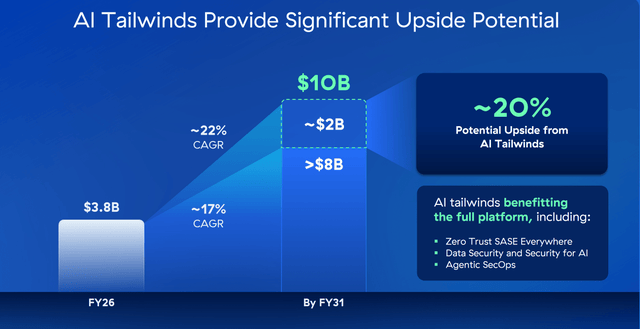
On October 6, 2026, Zscaler held its Investor Day in New York City. The headline number was ambitious: Zscaler reaffirmed its base-case target to surpass $8 billion in Annual Recurring Revenue (ARR) by Fiscal Year 2031. Management also said that they can see a path to $10 billion in ARR in a more bullish scenario powered by Agentic AI.
To get from $3.8 billion to $8 billion, the company doesn't need a miracle. They just need to keep executing their land-and-expand playbook. They are focusing heavily on the enterprise segment, where they already have deep market penetration but plenty of room to up-sell newer products like ZDX and their cloud protection suites.
The most exciting part of the presentation is the upside case. Management said the rapid adoption of agentic AI could add nearly $2 billion in extra ARR, creating a real path to $10 billion in ARR by 2031.
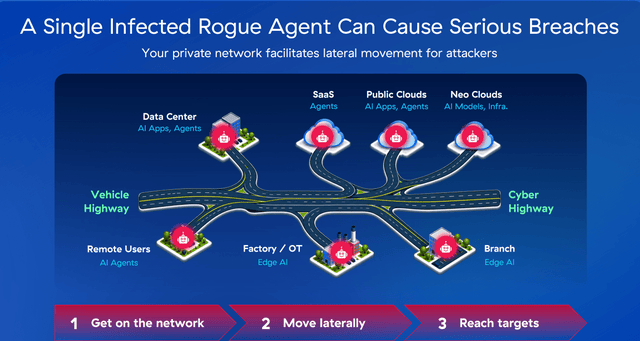
AI has dramatically increased the size of the attack surface, as AI chatbots, servers, and agents are increasingly exposed to the internet; bad actors have far more opportunities to scan and attack a company.
Artificial Intelligence is the biggest wildcard in enterprise security right now. Corporations used to worry about humans, but now they need to worry about agents as bad actors. This risk is exponentially more dangerous because agents move at machine speed, and they never need to rest or take breaks.
Zscaler has built specific AI data protection policies. An IT admin can literally check a box that says something like, "Allow employees to use ChatGPT, but block them from pasting any text that looks like a credit card number, a Social Security number, or proprietary code." As companies rush to adopt AI, they absolutely need a security layer to govern how data flows into these large language models.
Zscaler is well positioned to become a tollbooth for AI traffic. The company processes hundreds of billions of network requests every day, creating one of the largest proprietary datasets of internet traffic on the planet. They are using AI to analyze that traffic and find threats that human analysts would never catch in a timely manner.
If Zscaler detects an anomaly, like an employee logging in from New York and five minutes later logging in from a server in North Korea, for example, an AI agent can automatically isolate that user's machine, revoke their access to internal apps, and generate a plain-English report for the IT team outlining exactly what happened. This reduces the need for massive human security teams and makes Zscaler's platform exponentially more valuable.
Risks and Potential Red Flags to Watch
Zscaler's biggest competitor is Palo Alto Networks (PANW). While Zscaler is the top player among cloud security specialists, Palo Alto has a broader platform that includes on-premises firewalls, cloud security, and endpoint protection.
Palo Alto is aggressively pushing a platformization strategy. They go to a CISO and say, "If you sign a massive contract with us for all your security needs, we will give you our Zscaler-competitor product (Prisma Access) for free for a year." For companies looking to consolidate vendors and save money, this bundling strategy is very attractive. Zscaler argues that their product is vastly superior technologically, but good enough and cheaper can sometimes win.
Microsoft (MSFT) is another competitive threat to watch, with a competing product called Entra Private Access. Because most companies already use Microsoft 365, Microsoft can bundle its security tools at a highly discounted rate. While Microsoft's networking infrastructure is not as purpose-built as Zscaler's, they are a notable threat in the mid-market segment.
The competitive risk is usually seen as the most pressing one for Zscaler, but I think investors are too dualistic in this regard. First of all, Zscaler's competitive strengths and technological advantages are real. Besides, there is enough for multiple players to thrive at the same time given the size of the opportunity.
Imagine if you were given the chance to buy Coca-Cola (KO) or PepsiCo (PEP) in the 1970s or given the choice between JPMorgan (JPM) and Goldman Sachs (GS) decades ago. Which one should you buy? In both cases, the right answer is to buy both high-quality stocks in an industry with abundant growth opportunities.
The same is true for cybersecurity in 2026; we are still very early in this opportunity, and there will be plenty of room for multiple companies with smart management teams and the right technology to thrive in the years to come.
On the macro side, high interest rates and cautious corporate spending can make it harder to close massive multi-million-dollar software deals. CFOs are heavily scrutinizing every software purchase these days. Although cybersecurity spending is arguably more resilient than other software sectors, it is not immune to macro uncertainty if the environment deteriorates.
Valuation Is Reasonable by Industry Standards
Top-quality software and cybersecurity companies typically trade at sharp valuation premiums, especially those companies with AI tailwinds. Zscaler is priced for strong growth expectations, but the stock is not too expensive compared with other names in the sector.
The chart below shows EV-to-Revenue ratios for Zscaler versus CrowdStrike (CRWD), Palo Alto Networks (PANW), Rubrik (RBRK), and Okta (OKTA). Zscaler is currently trading at an EV-to-Revenue ratio of 10, while most industry peers are trading at higher valuation levels.
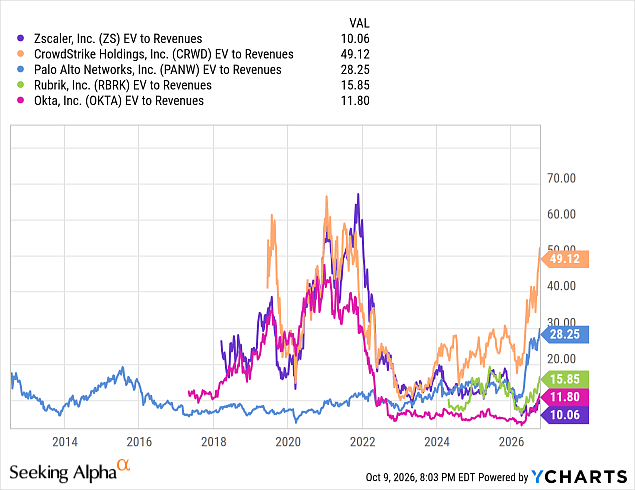
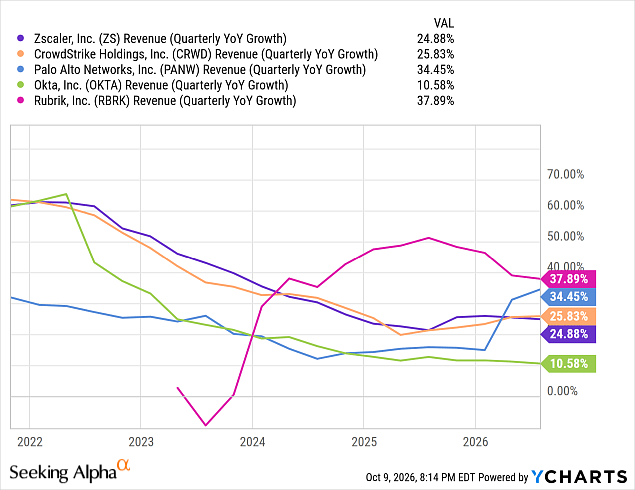
Revenue growth across these companies is similar as of the most recent quarter; however, growth trends differ in some cases. CrowdStrike and Palo Alto Networks have accelerated noticeably, while Zscaler still needs to prove it can deliver this kind of inflection in revenue growth. Still, when you compare EV-to-revenue ratios with revenue growth, Zscaler looks reasonably valued.
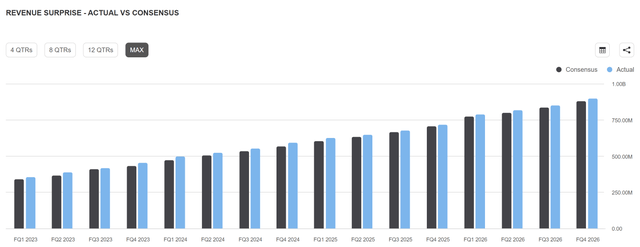
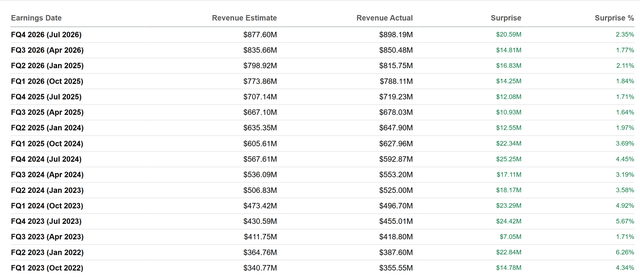
When discussing valuation levels versus revenue, we need to consider that Zscaler has consistently outperformed revenue estimates in each and every quarter. This is because the business continues to perform well, and management is conservative with guidance.
It is always good to have a company consistently beat expectations, but management also needs to be balanced and not hurt expectations too much.
In prior quarters, Zscaler has delivered excellent numbers only to see the stock pull back because guidance was below the most bullish estimates.
When this happens, analysts can get uncomfortable or even concerned because management doesn't have a fundamental explanation for relatively soft guidance after a vigorous quarter. Level-headed guidance is always responsible, but overly conservative guidance numbers can also erode the confidence of both Wall Street analysts and investors.
The valuation model below assumes a 10% discount rate and an exit value of 7 times revenue for Zscaler in ten years. It yields a fair value estimate of $253.18 for the stock, in line with some recent Wall Street valuation targets and implying 16.8% upside versus the current stock price. This model is assuming modest and easily achievable growth expectations for Zscaler.
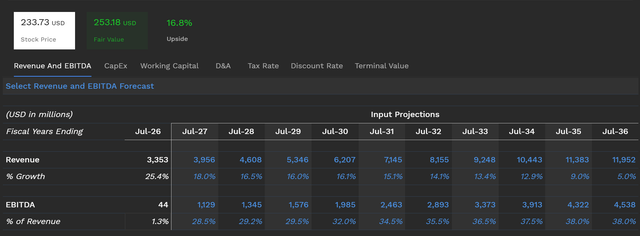
At this point, it makes sense to make more moderate assumptions about future growth. However, it will be interesting to watch the underlying trends over the coming quarters, as some top-quality cybersecurity companies have accelerated growth, and Zscaler is in the right sector with a credible plan to ride AI tailwinds.
If management delivers tangible near-term acceleration, the stock would deserve a material re-rating and an expansion in valuation ratios.
The Big Picture
Zscaler is a well-known leader in a critical industry with vigorous growth. These kinds of companies are never available at bargain-low valuations. However, we could also argue that Zscaler stock is materially less expensive than other companies of similar quality in the industry.
Investing in this sector over the long term is usually about finding category leaders with strong moats that compound cash flow growth over time. Zscaler fits that description quite well.
The transition to Zero Trust security is a fundamental transformation of how the internet works for businesses, and the recent Investor Day shows the company has a clear path to doubling its business by 2031.
If you are a long-term investor willing to hold through the quarterly noise of fluctuating software budgets and competitor pricing wars, Zscaler offers a high-quality business model positioned to continue growing cash flows over the long term.
In a more bullish scenario, accelerating growth driven by Agentic AI could be a powerful catalyst for the stock, so it makes sense to watch Zscaler closely.


Comments
Log in or sign up to join the conversation.