

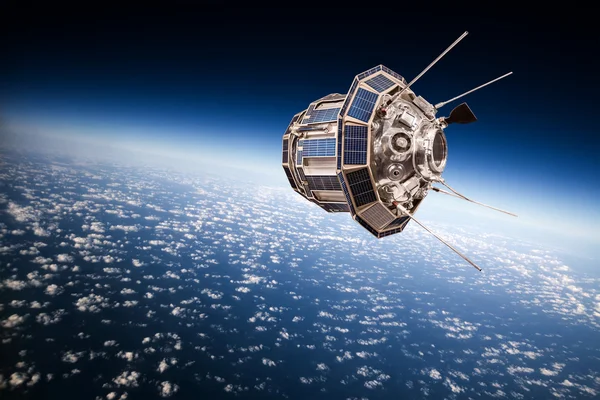
Rocket Lab (RKLB) is building a strong ecosystem of fully integrated technologies in space exploration. At the same time, revenue is booming, and the backlog is stronger than ever. Because of the natural volatility that comes with the space exploration industry, the stock is currently down more than 50% from its highs of the year, and the coming Neutron rocket could be a powerful catalyst for the stock.
Business Model and Financial Performance
Rocket Lab operates mostly under two business segments: Launch Services and Space Systems.
Launch Services is exactly what it sounds like: putting things into orbit. Rocket Lab’s current workhorse is the Electron rocket. It is a small-lift vehicle designed to carry payloads of up to 300 kg into low Earth orbit.
Electron is the second most frequently launched U.S. rocket after SpaceX’s (SPCX) Falcon 9. It provides dedicated, precise access to space for small satellites. While SpaceX’s massive rockets often force smaller satellites to ride-share, meaning that they get dropped off in a general orbit and have to navigate to their final destination, Electron acts like a private taxi. It takes the satellite exactly where it needs to go, when it needs to go.
Rocket Lab also uses a modified version of Electron for its HASTE (Hypersonic Accelerator Suborbital Test Electron) program. HASTE provides suborbital test launch capabilities for hypersonic research, which has become a major priority for the U.S. Department of Defense.
However, Electron has a hard ceiling on its revenue potential due to its size. To unlock the next phase of growth, Rocket Lab is developing Neutron, a medium-lift, reusable rocket capable of carrying 13000-15000 kilograms into orbit.
Neutron is designed to deploy mega-constellations of satellites for both telecommunications companies and governments, and this puts Rocket Lab in direct competition with the Falcon 9 from SpaceX.
Space Systems is the hidden gem of Rocket Lab’s business model, and arguably an underappreciated driver. Space Systems accounted for roughly 29% of the company's $434 million revenue in the first half of 2026.
Rocket Lab manufactures satellite components like reaction wheels, star trackers, solar panels, and separation systems, among others. The company supplies these components to other aerospace players. Rocket Lab has made a series of acquisitions, positioning itself as a premier supplier for the space industry. If a competitor wants to launch a satellite, there is a very high probability that such a satellite uses Rocket Lab parts.
Taking it a step further, Rocket Lab also builds entire spacecraft buses, which are the main body and operating systems of a satellite, called Photon. Customers can simply hand Rocket Lab their sensors or cameras, and Rocket Lab will build the satellite, integrate the payload, launch it on an Electron rocket, and manage the mission from their control centers on Earth.
This segment is crucial because spacecraft manufacturing offers highly predictable, multi-year recurring revenue with significantly better profit margins than the brutal, capital-intensive launch business.
The numbers for Q2 2026 are remarkably strong, with revenue growing 62% to $234 million. The company reported $437 million in new launch contracts across Electron, HASTE, and Neutron. Even better, Rocket Lab ended the quarter with $2.36 billion in backlog, a massive increase of 137% versus the same quarter in the prior year.
Rocket Lab also announced the acquisition of Iridium Communications (IRDM), which was approved by shareholders in September. This deal not only makes a lot of strategic sense by adding Iridium's global network and spectrum to Rocket Lab, but management also expects it to be financially accretive to cash flow generation and profitability.
Management explained in the conference call that demand is truly on fire.
In Q2 and since the end of the quarter closed, we've signed more than $437 million in bookings for Electron, HASTE and Neutron. This includes a record $266 million contract for up to 18 suborbital missions for the Space Force, our largest launch contract ever. Also, we've seen a massive surge in Space Systems contracts with more than $581 million signed in Q2 and post quarter. We ended the quarter with a $2.36 billion in backlog and across launch in Space Systems, we've signed more than $1 billion in new contracts across Q2 and the period since the quarter closed.
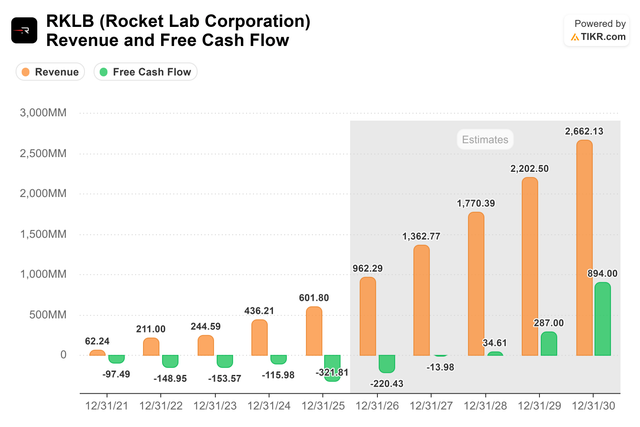
The chart below shows revenue in orange and free cash flow in green. We are showing reported numbers combined with Wall Street expectations to get a dynamic view of past performance and future expectations.
Revenue has always been strong and is expected to get stronger. Free cash flow, on the other hand, is expected to be negative at -$200.4 million in 2026, with substantial improvements next year and positive free cash flow in 2028 and beyond.
TIKR
The main driver behind the free cash flow trends is that Rocket Lab is allocating gargantuan amounts of capital to building Neutron, new launch pads in Virginia, and huge carbon composite manufacturing facilities. These numbers show why delivering Neutron on time and effectively is so important for investors in Rocket Lab in terms of its impact on cash flow generation.
Fortunately, the balance sheet is a fortress: Rocket Lab ended the second quarter with $2.4 billion in cash and securities.
Risk Considerations
For a long-term investor, buying into a space exploration stock requires a high tolerance for volatility. Rockets explode, development timelines slip, and capital can burn rapidly. It would make no sense at all to expect a smooth ride when investing in a true rocketship company.
Rocket Lab's primary operational risk centers on the Neutron rocket. This Rocket was initially scheduled for 2024, and it has experienced several delays since then. The company now expects Neutron to reach the launchpad this year, which could push the inaugural launch to 2027. Because of these delays, the stock is down more than 50% from its year-high, which could create an opportunity for long-term investors.
From a competitive point of view, the sector is highly dynamic, and competition will most certainly increase in the years to come, but SpaceX is the biggest competitor by a far margin right now.
SpaceX has unmatched economies of scale. While Rocket Lab is developing Neutron, SpaceX is already flying Starship, a fully reusable super-heavy launch vehicle that could theoretically drive the price per kilogram to orbit so low that no competitor could survive.
Rocket Lab’s defense against this risk is that the U.S. government and commercial competitors will actively subsidize a second launch provider simply to avoid a SpaceX monopoly. More importantly, there is so much room for growth that the space economy will allow Rocket Lab, SpaceX, and many other players to do well over the long term.
Companies in space exploration are also highly exposed to government contracts and vulnerable to shifts in defense spending. There is no sign of a slowdown in this area, but it remains one of the most relevant risks to watch closely for Rocket Lab.
Valuation and Timing
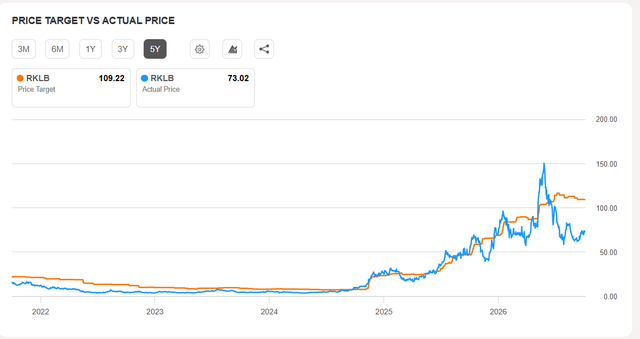
Wall Street analysts have an average price target of $109.15 for Rocket Lab, implying 46.3% upside from the current stock price. It is very hard to do a discounted cash flow analysis for Rocket Lab, and such an exercise necessarily carries a large margin of error. Still, it is good to know the stock offers substantial upside versus the average Wall Street valuation target.
Seeking Alpha
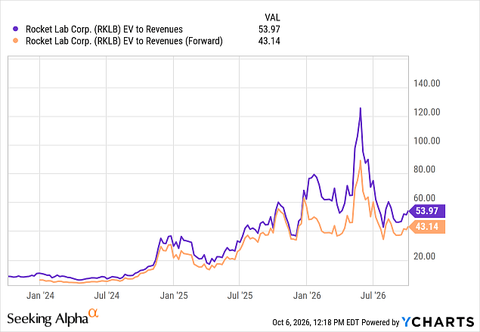
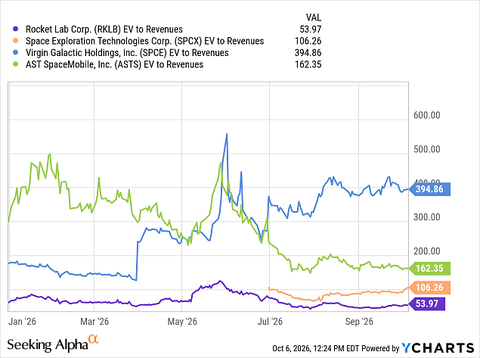
While Rocket Lab is decidedly priced for aggressive growth expectations, the valuation levels have more than halved from their highs of the year.
Data by YCharts
Other companies in related sectors have very different risk profiles and profitability levels, so their valuations cannot be easily compared. But still, Rocket Lab is more reasonably priced than names like SpaceX, Virgin Galactic (SPCE), and AST SpaceMobile (ASTS).
Again, all of these names are still aggressively valued; so SpaceX is still priced for demanding expectations, even if it is not as crazy expensive as other names in similar areas.
Data by YCharts
In terms of key potential catalysts over the next 12 to 24 months, there are some important events to watch. The maiden flight of Neutron will probably take place in late 2026 or early 2027. Given how crucial Neutron is for the whole investment thesis, this can certainly have a material impact on the stock price. It will also be critical to watch the conversion of the $2.4 billion backlog into revenue as well as new satellite deliveries over the months to come.
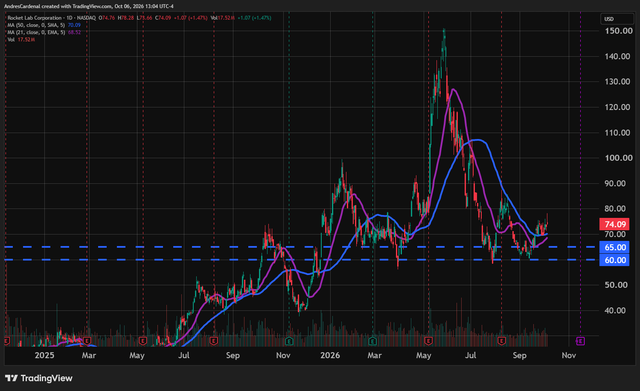
Over the past twelve months, Rocket Lab stock has been building a huge base above $65 per share. A famous Wall Street adage says, "the bigger the base, the higher into space," which seems especially appropriate for a space exploration company.
TradingView
The Big Picture
Stocks should not be judged in isolation; given its risk and reward potential, a stock can be a good investment for one investor and a poor fit for another with a different strategy and risk tolerance level. With this in mind, Rocket Lab is not the right name for those looking for stability and predictable returns.
On the other hand, for a long-term investor willing to endure the volatility of launch delays, high R&D spending, and premium valuations, Rocket Lab represents one of the purest and most established ways to invest in the industrialization of space. It is a high-stakes, high-reward investment.
The most exciting part is that the company is becoming a fully vertically integrated space exploration leader, and it is facing an inflection point in the near term. If Neutron flies as planned, Rocket Lab stock should take off too.


Comments
Log in or sign up to join the conversation.