


Broadcom Inc. (AVGO) is one of the best companies in the semiconductor industry in terms of financial performance, competitive moats, and growth opportunities. The stock is also trading at a conveniently cheap valuation as the semiconductor and other AI infrastructure sectors undergo a natural, well-deserved consolidation phase exacerbated by fears of an AI slowdown.
The timing for a recovery is always uncertain, but the risk-to-reward tradeoff for long-term investors is clearly convenient at these prices.
Outstanding Fundamental Quality
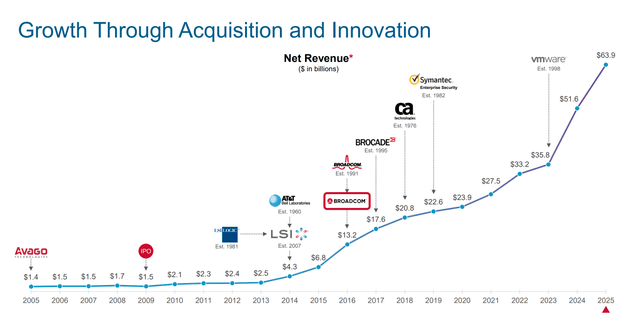
Broadcom management has done a spectacular job acquiring many of the most promising businesses and technologies of the past decade, putting the company in the right position to capitalize on exponential growth opportunities. The strategy has clearly paid off in terms of both revenue growth and free cash flow generation.
Broadcom
AI is, of course, the most exciting growth venue right now, with AI semiconductor revenue growing 221% in Q3 of fiscal 2026 versus the same quarter last year and 54% sequentially. This allowed Broadcom to deliver $29.6 billion in revenue for the quarter, an 86% increase versus the same quarter in the prior year.
Profit margins are huge and expanding; the company retained 68% of revenue as operating profit, with operating income outgrowing revenue due to a 92% year-over-year increase.
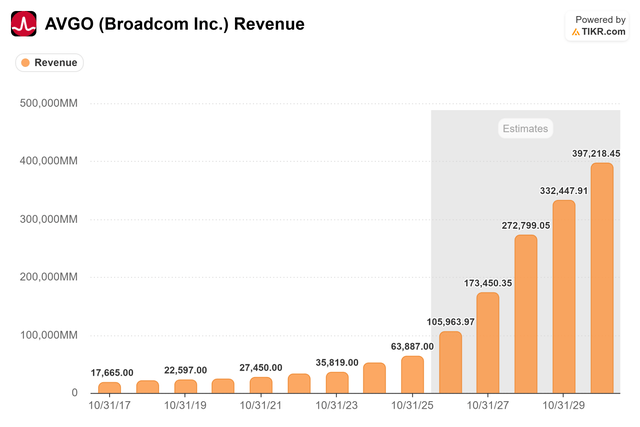
The chart below shows revenue over the past several years combined with the average Wall Street revenue estimate to provide a continuous view of revenue trajectory. Revenue has increased from $17.7 billion in fiscal 2017 to a projected $106 billion in fiscal 2026. For fiscal year 2030, Wall Street is expecting revenue to multiply by 3.7 times, reaching more than $397 billion.
TIKR
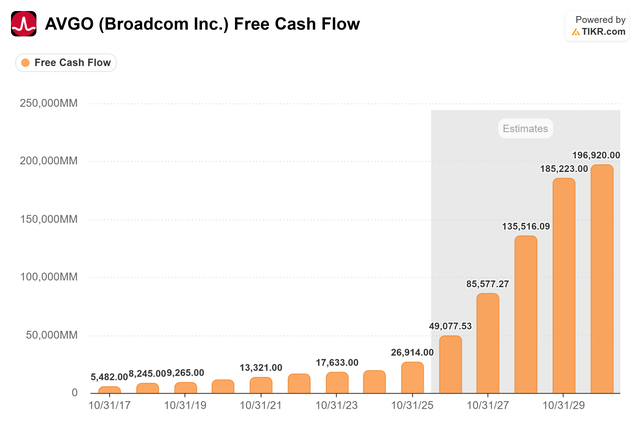
This combination of strong revenue growth and sky-high profitability is exceptional. Free cash flow has increased from $5.5 billion in 2017 to $49 billion expected this year, and analysts project close to $197 billion in 2030.
TIKR
The future looks promising for Broadcom, especially because of two product lines: AI networking and custom AI accelerators.
An AI cluster includes thousands or even tens of thousands of chips that need to communicate with each other at the maximum possible speed and efficiency. AI networking revenue increased by 2.5X year over year in Q3, and management said in the conference call that momentum remains strong into the last quarter of the year.
Custom accelerators are the chips designed for a specific customer's AI work. Broadcom has worked with Alphabet Inc. (GOOG) (GOOG, GOOGL) on TPU generations for more than a decade, and it also has deep relationships with top players like Meta Platforms, Inc. (META), OpenAI (OPENAI), and Anthropic (ANTHRO).
This deep integration with customers provides a key source of moat for Broadcom, because once a Broadcom chip is designed into a phone, a broadband gateway, a switch, or a storage controller, the customer cannot swap it away easily because the software, the board layout, the power design, and the qualification tests are all designed for that chip.
The XPU relationship is even stickier, as Broadcom and the customer co-design the chip. The customer’s software compilers, cluster scheduler, cooling, and network are built around that design. The next generation usually starts before the current generation is fully deployed. Broadcom's long-term relationship with Google is perhaps the clearest example of how this creates a strong moat.
Risk Considerations
Broadcom carries substantial customer concentration risk, with the top five customers accounting for 50-55% of the company's total revenue. The AI ecosystem is heavily concentrated, with a few hyperscalers and big AI labs having a huge impact on overall demand.
If even one of these customers decided to change architecture or slow investments, it would materially impact Broadcom. Needless to say, a broader slowdown in the AI ecosystem could create significant uncertainty around the company's financial performance over the intermediate term.
The custom hardware segment will continue gaining participation in the overall revenue mix, and custom chips require memory components. Surging memory costs over the past several months could negatively impact profit margins in the next few quarters.
Broadcom has nearly $60 billion in balance sheet debt. This is not a problem at all because the company generates massive cash flows to easily cover financial requirements. However, it is a factor to keep in mind going forward, especially if Broadcom decides to leverage its balance sheet more to make additional business acquisitions in the coming years.
The semiconductor industry has always been cyclical. AI demand has dramatically transformed the shape of the demand curve, but we cannot assume that the cyclicality will go away forever. The sole perception that a downturn could be coming can affect stock prices in the sector, even if the fundamental drivers remain intact over the long term.
The recent discussions about slowing down the pace of AI innovation can affect investor perception towards semiconductor stocks in the short term, but the overall fundamental impact will not be too material for a company like Broadcom. At the end of the day, each company needs to be responsible for safety risks, and each company will also be held accountable for the results. The incentives will not change, and all companies will move forward as fast as they can while managing security risks as well as they can.
For Broadcom and other companies in the sector, a more balanced approach to AI infrastructure building could even be a positive, as it would make the cycle longer and reduce the risk of overbuilding in the short term.
Attractive Valuation
Broadcom is currently trading at 18.5 times forward earnings estimates for the fiscal year ending in October 2027 and 11.7 times earnings projections for fiscal 2028. With earnings per share expected to grow 66.3% and 57.7% respectively in those years, the valuation looks more than attractive, especially for a highly profitable business benefiting from proven AI tailwinds.
Fiscal Period Ending | EPS Estimate | YoY Growth | Forward P/E |
Oct 2026 | 11.66 | 70.93% | 30.68 |
Oct 2027 | 19.38 | 66.28% | 18.45 |
Oct 2028 | 30.56 | 57.67% | 11.70 |
Source: Seeking Alpha.
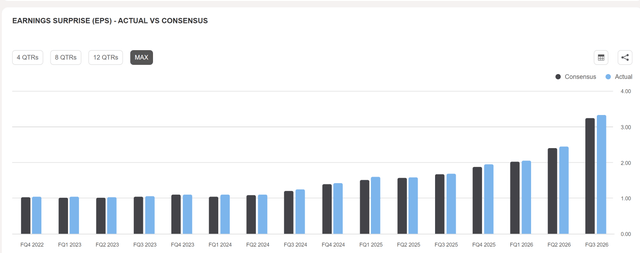
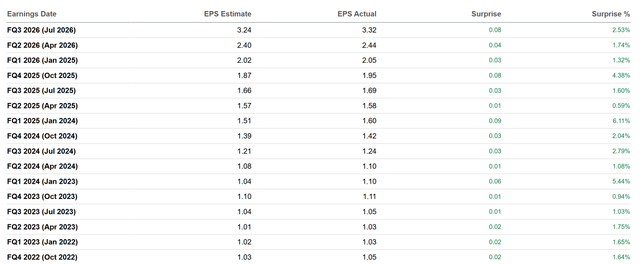
The valuation is very reasonable based on current earnings projections, and we also need to consider that Broadcom has consistently delivered earnings numbers above market expectations. If the company continues on this track over the years ahead, there is a good chance that the earnings reports going forward will also exceed expectations, meaning that the stock is actually cheaper than it seems to be from a static standpoint.
Seeking Alpha
Seeking Alpha
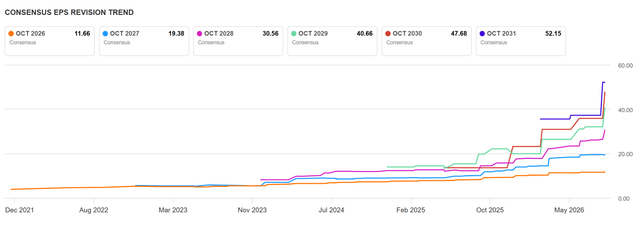
Wall Street analysts' earnings projections for Broadcom are also clearly increasing. The stock price tends to move in the same direction as earnings over the long term, so it is great to have a business that is both growing earnings strongly and also driving increasing expectations for future earnings growth. In the words of Warren Buffett: "If the business does well, the stock eventually follows."
Seeking Alpha
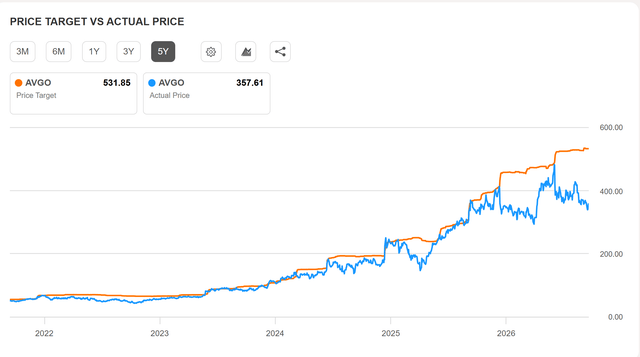
The average price target among the analysts following the stock stands at $531.85, a number that implies an upside potential of 49% versus the current stock price.
At $531.85, Broadcom would be trading at a forward P/E ratio of 17.4 times earnings estimates for fiscal 2028. Given growth expectations of 57.7% in earnings per share that year, the number is not excessive at all.
Besides, this is coming from a company that consistently beats earnings, and given industry demand, I would expect the numbers for the next several years to be above expectations too.
Seeking Alpha
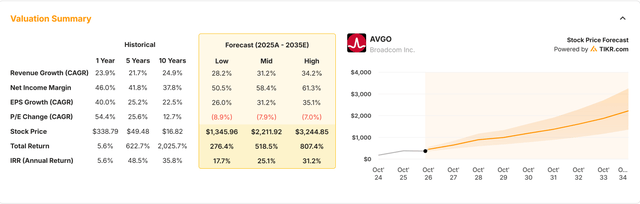
The models below include conservative, balanced, and optimistic scenarios for Broadcom through fiscal 20230.
In the conservative scenario, revenue growth slows more than expected, margins compress from the current level, and the exit P/E ratio in 2030 falls to 19. This estimate provides a valuation target of $1,345.96, for a total return of 276.4% and a compounded annual return of 17.7%.
The moderate valuation estimate has a smooth deceleration in revenue with stable profit margins. The exit P/E ratio in this case is 21 in 2030. This model has a price target of $2,211.92 by fiscal 2030, with a total return estimate of 518.5%, or 25.1% per year over the holding period.
In the optimistic valuation scenario, revenue growth stays elevated for longer than currently expected, and profit margins expand a little bit. The exit P/E in this case is 23, and the price target would be $3,244.85 in 2030. This model implies an annual return of 31.2% and a total return of 807.4% during the holding period.
TIKR
These kinds of models are always to be taken with a big grain of salt because they depend not only on assumptions about the fundamental performance of the business but also on the exit valuation levels that the market could assign to the stock over the long term. That said, it is still relevant to know that Broadcom is positioned for attractive returns under moderate assumptions from current valuation levels.
The Big Picture
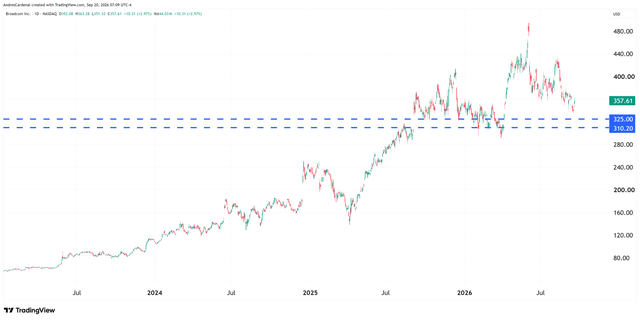
While Broadcom has produced excellent returns for shareholders over the long term, the stock price has been basically flat over the past 12 months, and it is trading at similar levels to September 2025. At the same time, the company continues to deliver excellent financial performance, and it is well positioned to capitalize on AI opportunities in the years to come.
The $310-$325 range has worked as support in the past year, so it makes sense to consider buying Broadcom near those levels
TradingView
It is impossible to know when the current correction or consolidation affecting semiconductor stocks is going to end, but Broadcom is currently offering a convenient entry point in an industry leader with outstanding fundamental quality and abundant potential for long-term growth.


Comments
Log in or sign up to join the conversation.