


This article reviews the bullish and bearish arguments for the market over the next several months. While inflation and interest rates remain key headwinds for the market, we believe strong earnings growth and solid momentum will ultimately let the bull market keep running in the near term. As long as these factors remain favorable, it makes sense to continue riding the trend.
Eventually, an earnings recession or a full-blown market bubble may put a bitter end to this bull market, but that time is not today, and we need to cross that bridge when we get there.
Earnings Are Driving The Bull Market
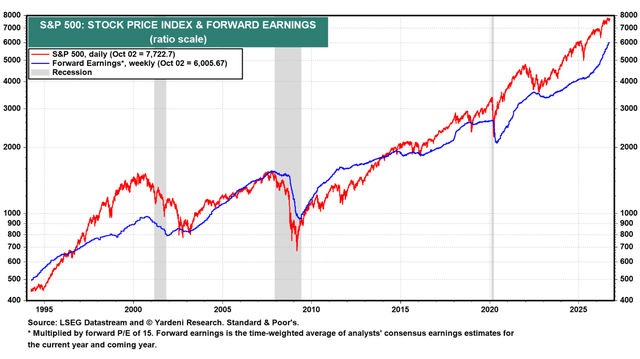
The chart from Yardeni shows S&P 500 earnings in blue and the S&P 500 in red. As we can see, the market tends to do well when earnings are rising.
Historically, the biggest market declines came during recessions and periods when earnings were declining. These periods are shown as shaded areas in the chart. The market can also start declining in anticipation of a decline in earnings, so we need to watch both market momentum and earnings together.
Some very sharp corrections occur when earnings remain strong, but they are short-lived compared with long-term bear markets. When long-term market trends are bullish and earnings are moving in the right direction, it generally pays to buy the dips in any market correction.
Yardeni Research
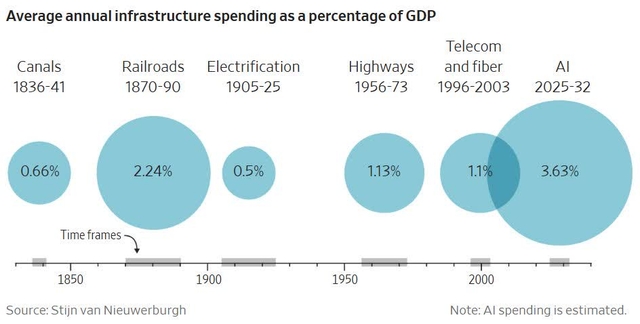
A big factor behind the surge in earnings is the AI infrastructure buildout. The AI buildout is the biggest in history, even bigger than the telecom buildout in 1996-2003 and the railroad buildout 1870-1890. Even more mind-blowing, all of the evidence indicates we are still early in the AI infrastructure buildout.
Stijn van Nieuwerburgh
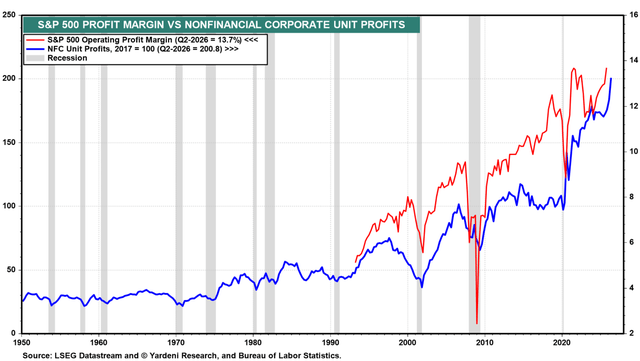
Another key driver of earnings for the market as a whole, also related to AI and technological innovation, is that profit margins are at record highs and still going higher. Operating leverage and productivity gains are strong fuel for profit margins and, in turn, earnings.
Yardeni Research
The Macro Headwinds
The biggest headwinds for this market come from inflationary pressures and rising interest rates. Many investors are reluctant to invest in a tech-driven bull market when the Fed is raising rates, although the evidence is not as negative for the market as media coverage indicates.
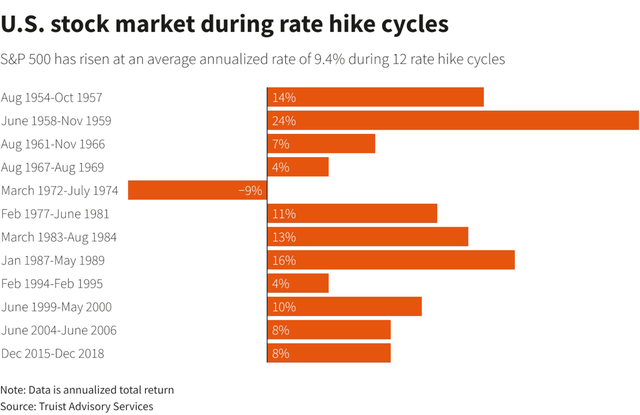
The chart from Truist Advisory shows how the stock market has performed during prior rate-hiking cycles. The hiking cycle from March 1972 to July 1974 is the only one with negative returns, although there are some periods with disappointing returns; rate-hiking cycles are not necessarily a death sentence for a bull market.
Truist Advisory
Providing more granularity, the chart from Ned Davis Research differentiates between slow-hiking cycles and fast-hiking cycles. The speed of rate hikes matters, and the current environment is one of moderate hikes, with some room to maneuver for the Fed. Market expectations change daily, but most investors are currently expecting one more hike this year, followed by a pause and then lower rates in the years to come.
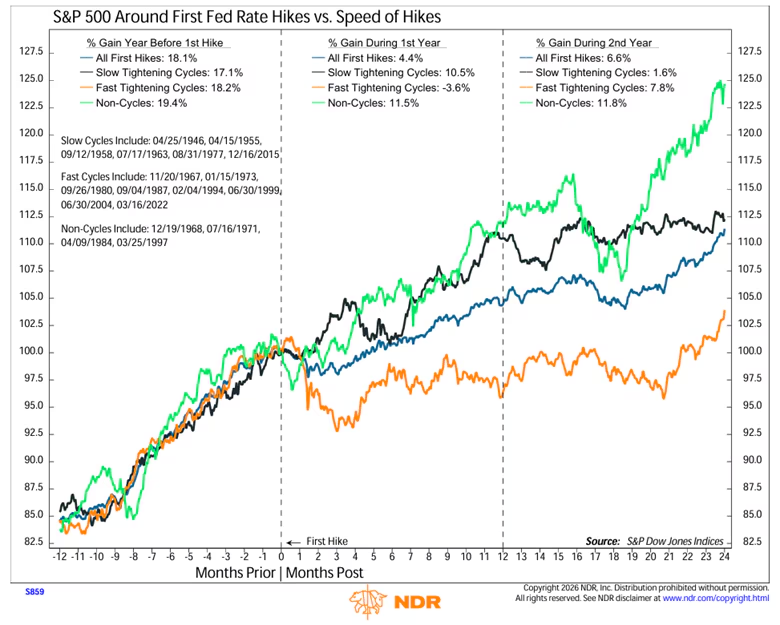
Ned Davis Research
Long-term yields have a huge economic impact, and they started rising well before the Fed began this hiking cycle. Both the private sector and the government are demanding massive amounts of capital, which obviously increases the cost of such capital. The private sector needs money to finance the data center boom, and the public sector needs it due to rampant fiscal deficits.
The war in Iran has a double impact on interest rates: it increases the deficit through military spending and raises oil prices, which directly affects inflation.
Since February of 2026, oil prices, long-term yields, and gas prices have surged abruptly, creating a material headwind for the economy and the stock market.
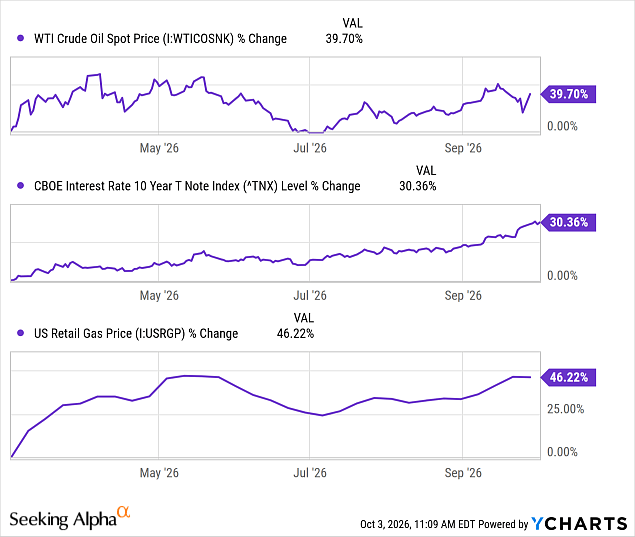
Data by YCharts
Rising interest rates are hurting the fiscal budget considerably, but the corporate sector is in much better financial shape. This suggests we have plenty of room to expand private-sector balance sheets to fund AI investments, but the government needs to get its finances in order.
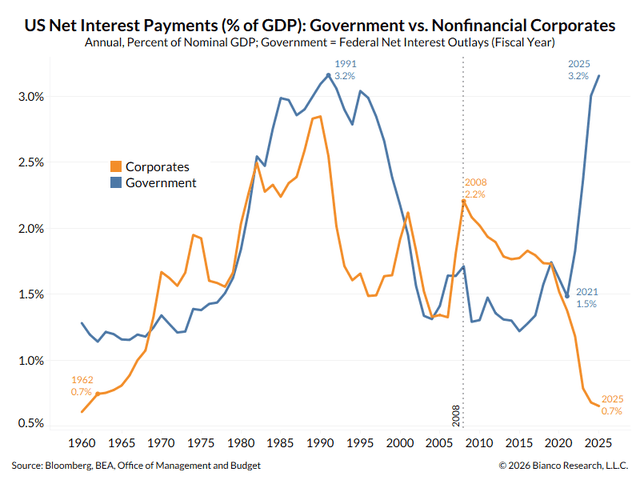
Bianco Research
Another negative factor is increased equity supply to finance the CapEx boom, along with new IPOs in the near future. Big hyperscalers used to repurchase a lot of stock when they had large sums of excess free cash flow available to reward shareholders. Because of the CapEx boom, those cash flows have recently turned negative.
We also need to consider that high-profile new IPOs will probably reach the market in the near term, including names like Anthropic (ANTHRO) and OpenAI (OPENAI). Bull market conditions tend to attract new IPOs, so I wouldn't be surprised to see a wave of new IPOs in the near term.
The laws of supply and demand are inalterable, and we need rising demand to absorb rising equity supply in the market. This is another near-term headwind for the bull market.
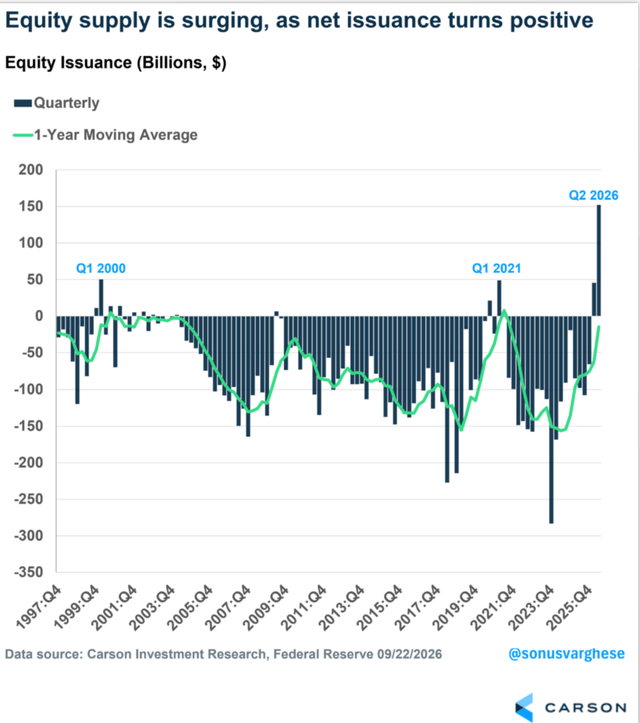
Carson Research
What Could Break The Bull Market?
The bull market is being powered by spectacular earnings growth amid one of the most powerful technological transformations in economic history. These kinds of processes tend to last for much longer than anyone anticipates, but they can also end very badly when the time comes.
Inflation and interest rates are putting downside pressure on the market and generating some volatility, but these factors alone will not derail the bull market's long-term trend.
For this bull market to end, we would need to see either a recession or a full-blown market bubble.
As of this writing, there is no sign of a recession in sight, but we have to acknowledge that we are in an extremely uncertain environment in which the data center buildout is having a disproportionate impact on the economy, especially on corporate earnings.
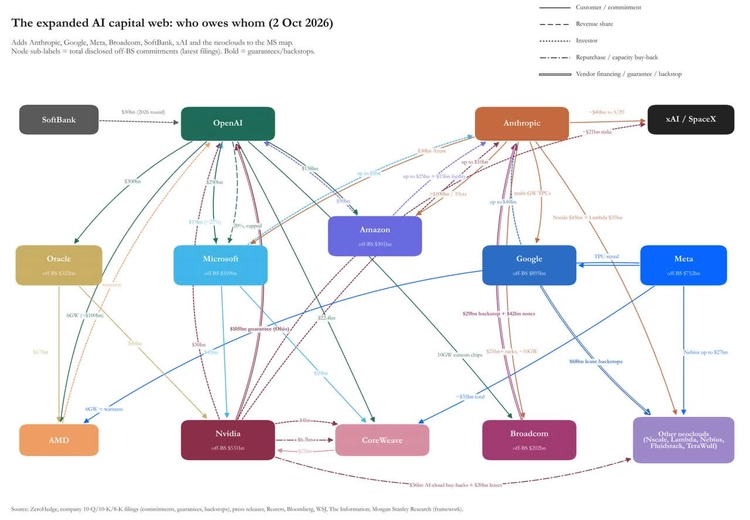
Big tech and AI leaders are intensely entrenched in all kinds of circular financing agreements. If any link in this chain breaks, it can be hard to know how far the repercussions will go. Earnings are spectacularly strong, but the AI ecosystem is the main driver, and things can change quickly when a single sector is holding everything together.
ZeroHedge
A market bubble is different; even if the economy remains strong and earnings keep surging, investor sentiment and valuations can get unhinged, ultimately setting the stage for a devastating bear market when the bubble explodes.
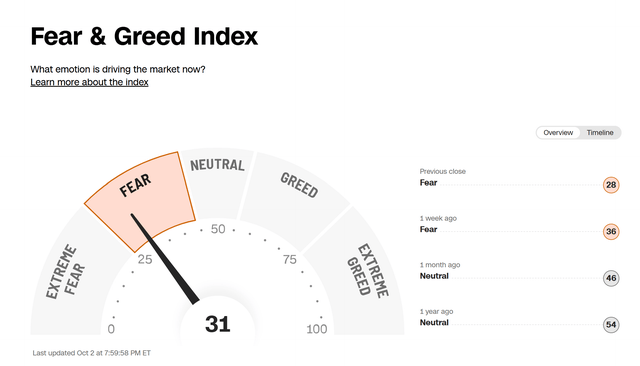
Many investors and market analysts use the term bubble too loosely, and they often confuse genuine bull markets with bubbles. Right now, there are no signs of a bubble in either sentiment or valuations.
The CNN Fear and Greed Index ended last week in Fear territory.
CNN
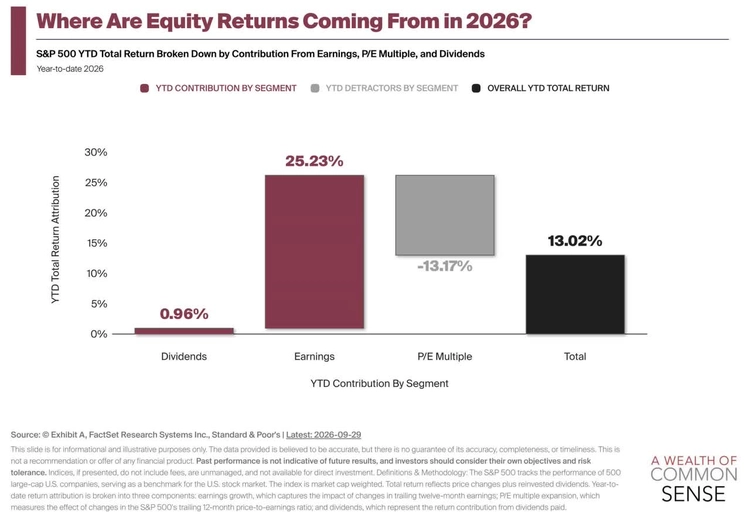
So far this year, stock market performance has been driven mostly by higher earnings, while valuations have contracted. Earnings increased by 25.23% while the price-to-earnings ratio declined 13.17%.
Market bubbles happen when prices rise much faster than earnings, and we are seeing the opposite phenomenon so far.
A Wealth of Common Sense
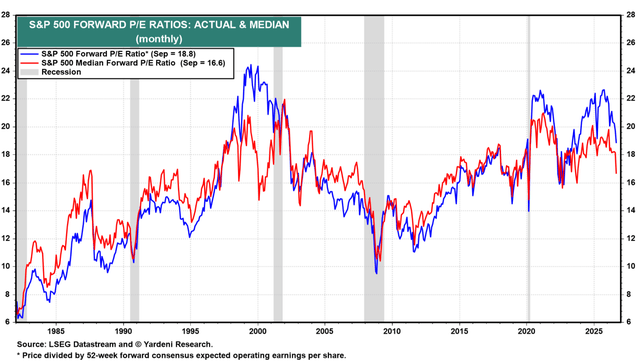
The median forward price-to-earnings for the S&P 500 stands at 16.6, which is not too expensive by historical standards.
Yardeni Research
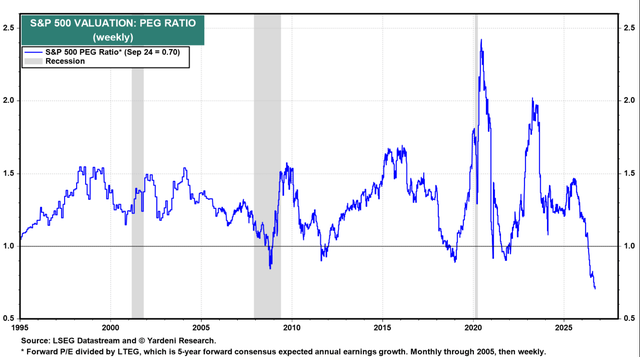
Even more interesting, the price-to-earnings growth ratio suggests the stock market looks quite cheap when we standardize the price-to-earnings ratio by growth expectations.
Yardeni Research
The kind of transformative bull market we are experiencing right now is fertile ground for market bubbles, and I wouldn't be surprised at all if we enter one in the years to come. For now, however, we are nowhere near bubble conditions.
How To Manage Portfolio Risk
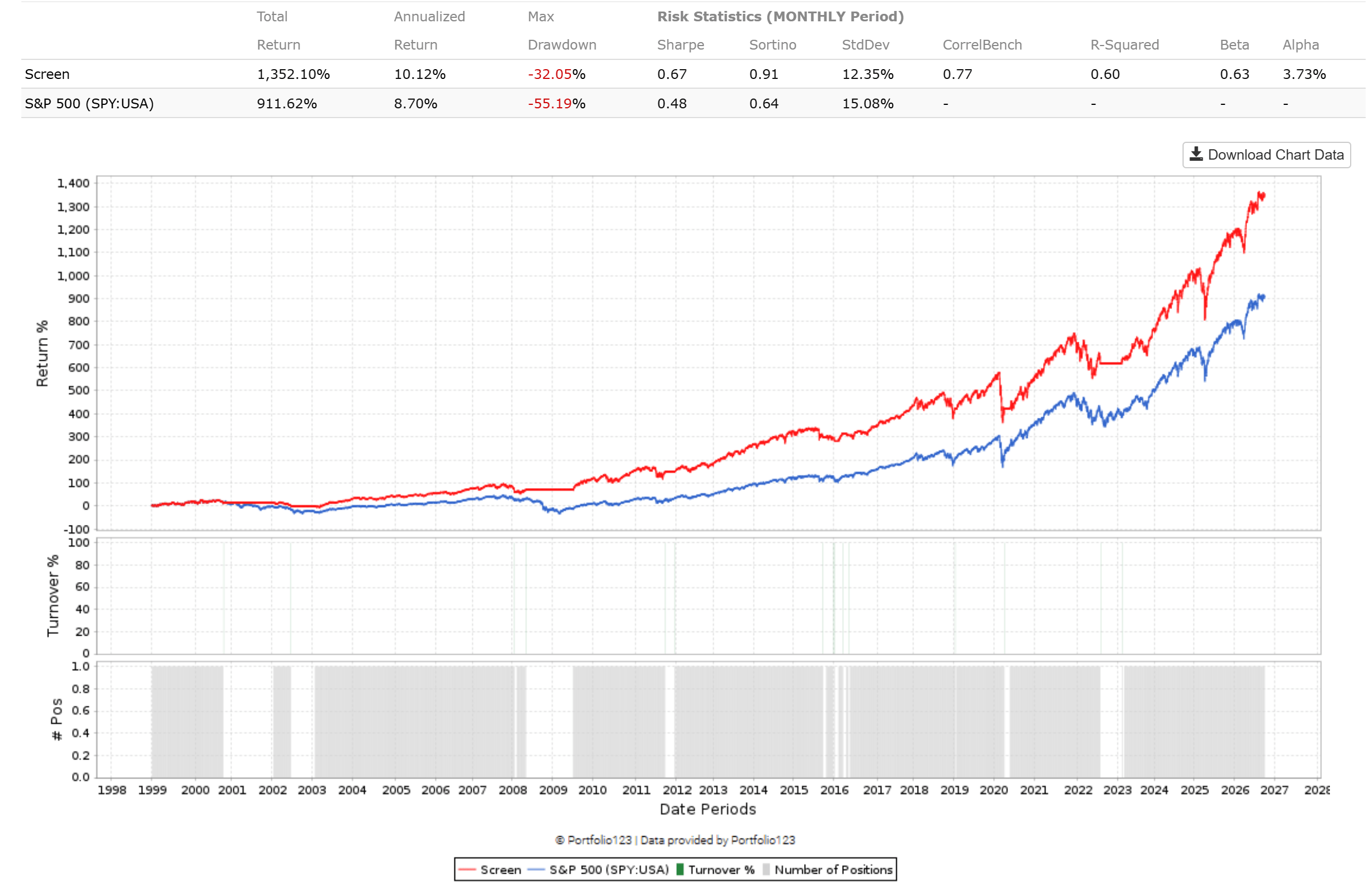
One way to manage risk is to follow earnings and market trends. The following strategy invests in the S&P 500 (SPY) when either earnings are rising or the 200-day moving average in SPY slopes upward, meaning the index itself is in a long-term uptrend.
Please note that we require only one of the two conditions to be met so that the system is going to be in cash only when the market environment is truly horrible, meaning that earnings estimates are declining and the market itself is in a downtrend. We are assuming no return on cash and no trading expenses to simplify the comparisons.
Since 1999, this strategy has gained 10.12% per year versus 8.7% per year for a buy-and-hold investor in SPY. Because the strategy avoided the most severe drawdowns, its maximum drawdown (the maximum decline from the peak) is -32% versus -55.19% for buy-and-hold investors. Both return and risk management are clearly superior.
Author via P123
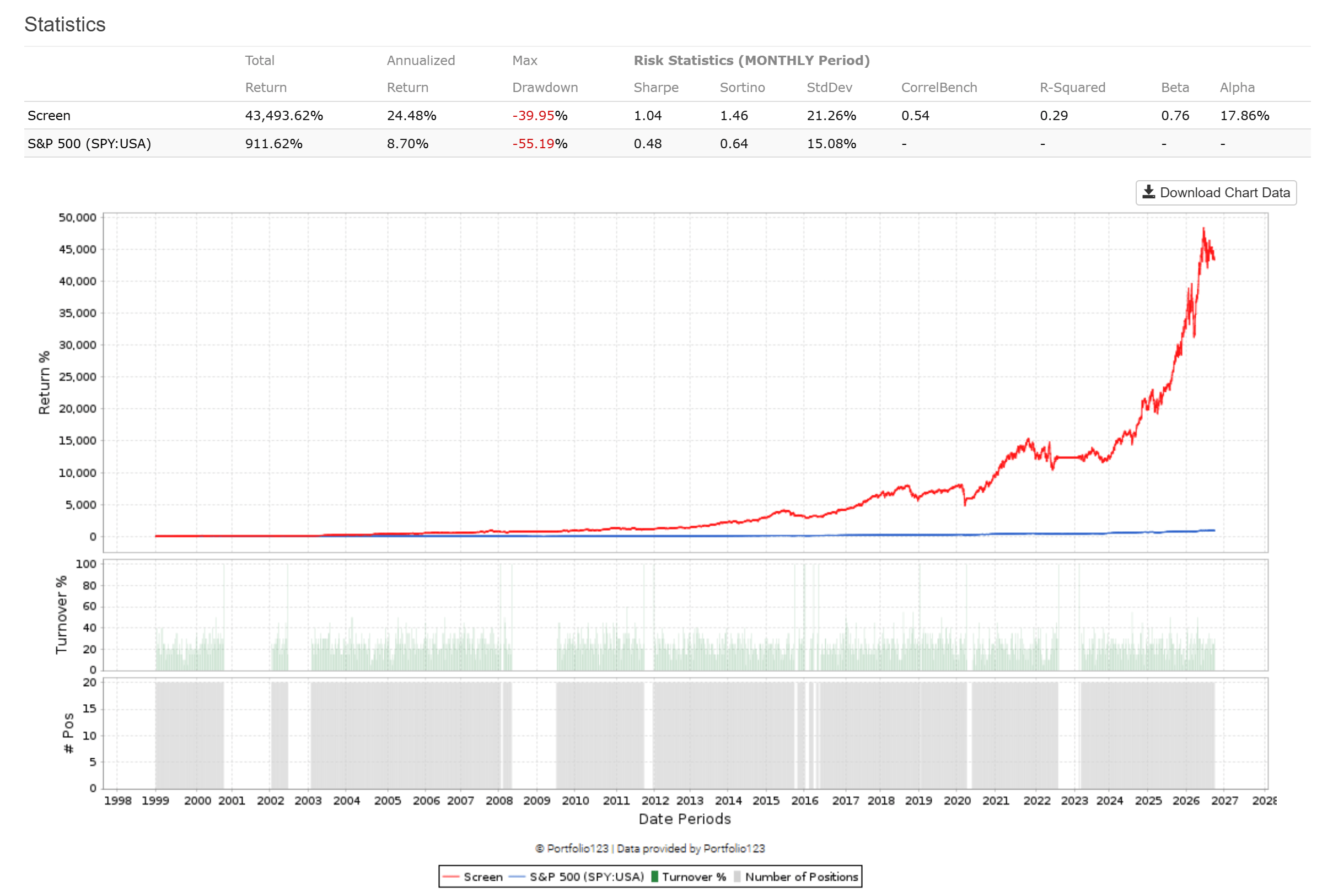
The following version of the strategy uses the same market system as the prior strategy, meaning it goes to cash when earnings are declining and markets are in a downtrend. This strategy, however, does not buy the S&P 500; it buys the 20 stocks with the highest ranking in the PowerFactors algorithm, which is a quantitative system focused on high-octane stocks that we follow in The Data Driven Investor.
In this case, annual returns rise to 24.5% versus 8.7% for the benchmark. The strategy's maximum drawdown is -39.95% versus -55.19% for the benchmark. Volatility increased versus the prior version, but the strategy crushed the market on both return and risk.
Author via P123
The strategies above are not complete trading systems but just proof of concepts. The main point is quite easy to see, though. When earnings and market prices are moving higher, it generally makes sense to have exposure to high-octane growth stocks.
The Bottom Line
All bull markets eventually end, and this one will probably end because something breaks down in the AI ecosystem or a full-blown market bubble inflates and then explodes. Bull markets are generally near the end when everyone is aggressively bullish and oblivious to risks, and that is not the case at present.
Spectacularly strong earnings driven by AI investments are pushing the market higher. While it's always important to watch for risk, we remain bullishly positioned in AI stocks into the fourth quarter of 2026.



Comments
Log in or sign up to join the conversation.