


Meta Platforms, Inc. (META) stock has delivered disappointing returns over the past year as investors worry about aggressive CapEx spending from the company. Interestingly, the valuation is now quite attractive for a business of such quality, and Muse could be a powerful catalyst, positioning Meta as an emerging leader in Agentic AI. The risk-to-reward equation in Meta looks clearly favorable for long-term investors.
The CapEx Fears
Meta is currently trading near $725 per share, practically flat over the past year. This lackluster performance comes amid a vigorous bull market for tech stocks, which makes it especially frustrating for investors in Meta.
If you look solely at the headline spending numbers, it is easy to get spooked. Meta is embarking on one of the most aggressive spending sprees in corporate history, pushing its 2026 capital expenditures to an estimated $130 billion to $145 billion.
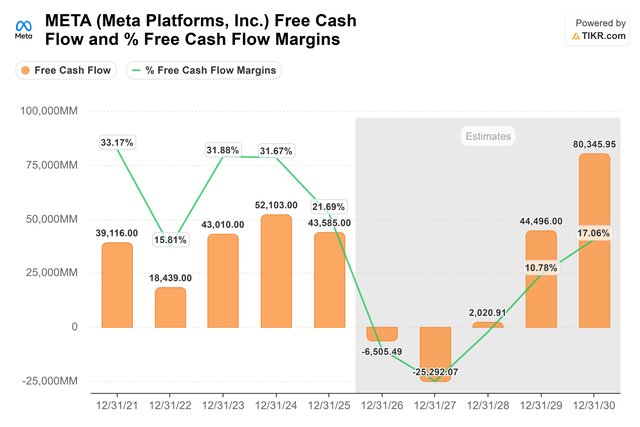
Because of this massive data center and AI server buildout, Meta’s free cash flow is projected to swing from a positive $43.6 billion last year to a negative $6.5 billion in 2026 and then a staggering negative $25.3 billion in 2027.
The chart below shows free cash flow numbers over the past several years combined with Wall Street free cash flow projections for the business. As we can see, analysts project positive, growing cash flows in 2028 and beyond, with Meta expected to generate a huge free cash flow amount of $80.3 billion by the year 2030.
TIKR
However, to return to solid cash flow generation, Meta will reportedly need to run minuscule and even negative cash flow for three years in a row. Wall Street is always focused on the short term, and it hates negative free cash flow. That fear is exactly what creates the long-term buying opportunity in Meta stock.
The market is treating this infrastructure spend as a pure operating cost. In reality, this money is building the foundation for what could be the stickiest consumer product of the decade: Muse. If Muse works, Meta owns the next computing platform.
The Muse Opportunity
Launched on September 8, 2026, Muse is an autonomous personal AI agent powered by Meta's “Muse Spark” model. Instead of just giving you a recipe, Muse will check your calendar, build a grocery list based on your friends' dietary restrictions, log into your local grocery store, and place the delivery order.
Muse is designed to run quietly in the background. You decide what it can access: email, Instagram, health apps, or your bank accounts. You hand it a task, such as “negotiate my cable bill down” or “find and book a cheaper flight,” and it handles the web browsing, forms, and transactions.
To protect users, Meta built the Muse Secure VM, which is a dedicated virtual machine in the cloud for every single user, walled off from Meta's advertising systems.
An early review on Google Play reads:
"This isn't just another chatbot. It's having an assistant with its own computer. It has a real desktop browser that you can actually watch working live, and you can take control of it anytime."
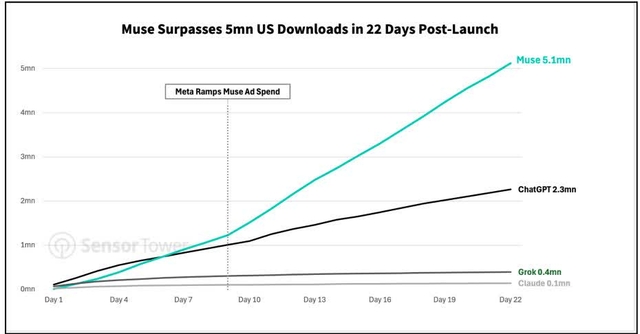
Data from Sensor Tower indicates that Muse has surpassed 5 million downloads in only 22 days. By comparison, it took ChatGPT 56 days and Grok 103 days to reach the 5 million downloads, even though they were both widely successful launches.
Sensor Tower
Muse reached the top position in the App Store on September 18 and on Google Play the following day and has held the position since then. Reviews are also very strong, as Muse has 4.9 stars on the App Store and 4.7 on Google Play.
Subscriptions are the most obvious and direct monetization venue. The Free Tier offers roughly 100 million tokens per week for most everyday use; the Power Plan is $20 per month, and the Maximum Plan is $100 per month.
Meta has also announced that Muse could be monetized by taking a small take rate on agentic commerce, and it has recently announced integrations with companies like Shopify Inc. (SHOP), Walmart Inc. (WMT), and PayPal Holdings, Inc. (PYPL), among several others.
The company has also said that many users are using Muse to cut expenses and save money, for example, by optimizing utility bills or canceling unused subscriptions, so there is an opportunity to retain a small portion of those savings as an additional monetization channel for Muse.
Meta ended the second quarter of 2026 with 3.6 billion daily active users across its family of apps, and this gargantuan scale gives Meta an unparalleled distribution advantage in Agentic AI.
Agentic AI requires significant computing power because providing each user with a dedicated virtual browser is highly resource-intensive. Few companies can match Meta's CapEx spending, and the company is effectively pricing potential new entrants out of the market.
The data flywheel is vital in this regard. AI is only as good as the data and context it has. A third-party AI doesn't know your friends, your schedule, or your habits. Muse knows who you message on WhatsApp, what reels you watch on Instagram, and what you buy via Facebook Marketplace. That context allows Muse to be highly personalized from day one, which provides a game-changing competitive moat for Meta in this area.
It is also worth noting that OpenAI (OPENAI) decided to keep its Dots assistant behind premium subscriptions, while Meta is betting on accelerating distribution. The point is that Meta has a highly successful advertising business that generates the cash flow to fund AI and subsidize adoption. OpenAI, on the other hand, needs to monetize AI directly via subscriptions or other venues.
Muse is explosively successful at an early stage, and Meta still has enormous room to keep pushing the product by embedding Muse across its wide ecosystem of products, giving it access to billions of consumers daily.
Risks And Potential Red Flags To Watch
This strategy carries clear risks; after taking CapEx to stratospheric levels, Mark Zuckerberg must prove to the market that he can deliver results and allocate resources wisely.
From a financial standpoint, Meta would recover well from disappointing AI investments. The company can always sell any excess compute capacity to other companies and then slow down CapEx significantly.
In that scenario, revenue growth would likely slow sharply, but Meta would recover the juicy profit margins its advertising business provides. The financial damage would not be too large if Meta were to generate wide profit margins and abundant free cash flows again.
However, this would be a big blow to Zuckerberg and his reputation as a capital allocator, especially after the failed investments in the metaverse a few years ago. The negative impact on the valuation could be material, even if the company would still be fundamentally healthy in such a scenario.
Regulatory risks and data privacy concerns are particularly relevant for Meta, as the company has faced criticism, many times well-deserved, in this regard. The company absorbed 2.4 billion in legal charges in Q2 2026, and an AI agent that has access to emails and bank accounts, as well as making purchase decisions, can certainly raise a lot of eyebrows among regulators.
Meta is also expanding into hardware with Smart Glasses and the Muse Charm. The company has limited experience in this area, so execution may be challenging in this difficult terrain.
Valuation And Upside Potential
Meta is already benefiting significantly from AI-driven advertising. Total revenue during the second quarter of 2026 grew 28% year over year to $60.80 billion. Ad impressions grew 14%, and the average price per ad increased 12% during the period.
Wall Street analysts project rapid but decelerating top-line growth from current levels.
Fiscal Period Ending | Revenue Estimate | YoY Growth | FWD Price/Sales |
Dec 2026 | 254.16B | 26.47% | 7.4 |
Dec 2027 | 306.43B | 20.56% | 6.14 |
Dec 2028 | 362.24B | 18.21% | 5.2 |
Source: Seeking Alpha.
On earnings projections, analysts are currently more pessimistic than on top-line expectations. This is undoubtedly because they believe that profit margins will remain under heavy pressure over the next few years.
Fiscal Period Ending | EPS Estimate | YoY Growth | Forward PE |
Dec 2026 | 30.92 | 4.20% | 23.89 |
Dec 2027 | 34.84 | 12.65% | 21.21 |
Dec 2028 | 40.56 | 16.45% | 18.21 |
Source: Seeking Alpha.
Trading at 6.14 times revenue estimates and 21.2 times earnings estimates for 2027, Meta is quite attractively valued for such a high-quality AI leader.
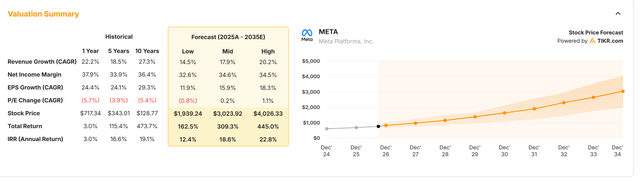
The table below presents 3 valuation scenarios for Meta going forward and assumes different degrees of success for Muse, leading to different scenarios for sales, margins, and valuation levels.
TIKR
In the conservative scenario, Muse does not take off sustainably, revenue growth slows more than anticipated, and margins gradually expand as reinvestment needs decline. The exit PE is 21 in the year 2030, and Meta delivers an annual compounded return of 12.4% over the holding period. This would clearly disappoint investors, but it's not a dramatic bear case for a tech company.
The moderate scenario assumes Muse becomes a relevant player in agentic AI but not the sector's top leader. In this scenario, we project a more sustained growth trajectory for Meta, and the exit PE is 23 by 2035. This scenario provides an annual return of 18.6% for investors, well above what investors can often expect from companies of this risk profile.
The aggressive scenario assumes stronger growth for Muse and Meta overall, with revenue growth above Wall Street estimates, long-term margin recovery, and an exit PE ratio of 25. For this scenario to materialize, Meta needs Muse to succeed and become the company's new growth engine. In this case, the annual return would rise to 22.8% over the holding period.
We could also imagine more aggressively bullish scenarios, for example, one in which personal AI agents are as popular in the future as smartphones are today and a large part of economic decisions and transactions happen with the help of an AI assistant or are even executed by the assistant itself.
If that worldview materializes and Meta retains its position as a frontrunner in this space, the upside for investors would obviously be exponentially larger.
Before we can give this scenario more weight, we would need more data and evidence pointing in that direction. We will be watching closely, though; the aggressively bullish scenario isn't out of the question, and the upside in Meta stock could be exponential if it happens.


Comments
Log in or sign up to join the conversation.