

Key Takeaways
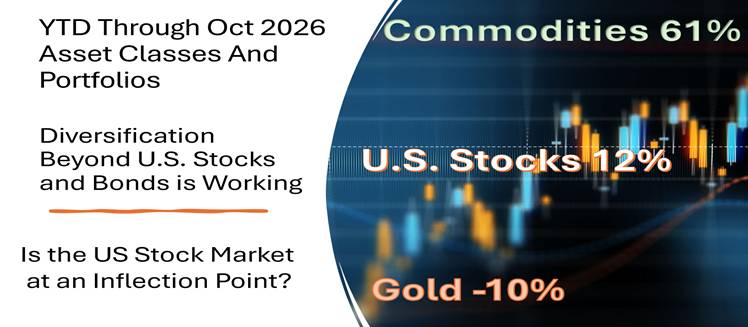
· Commodities have led asset class returns this year with a 60% gain through October, driven by a whopping 144% surge in crude oil prices due to the conflict with Iran
· An important commodity is the worst performing: Gold is down 10%, primarily due to a 7% strengthening of the U.S. Dollar. This follows a 64% return in 2025.
· U.S. stocks, previously dominant, now deliver mid-tier performance at 11.8%, and US bonds have lost 0.4%, highlighting the value of broader diversification.
· Portfolios diversified beyond U.S. stocks and bonds, especially with alternatives like commodities, have outperformed concentrated portfolios. How has your portfolio performed?
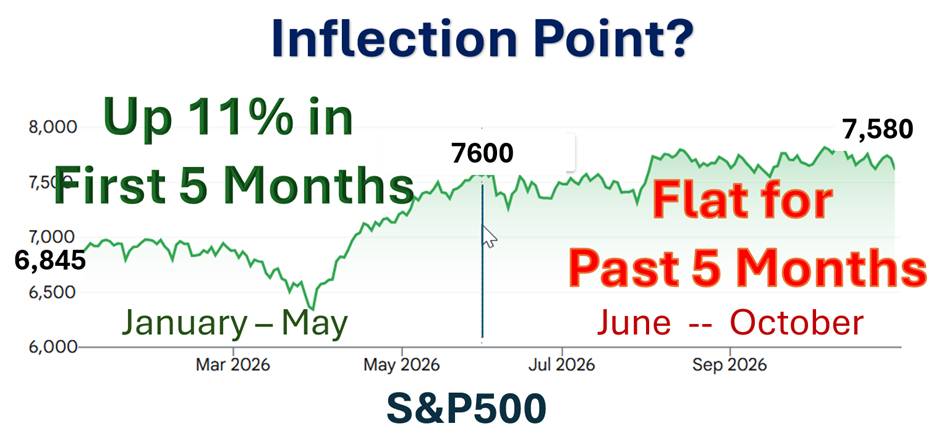
· The US stock market has plateaued at 7600 for the S&P500 over the past 5 months, which is possibly an inflection point leading to the next correction.
Asset Classes
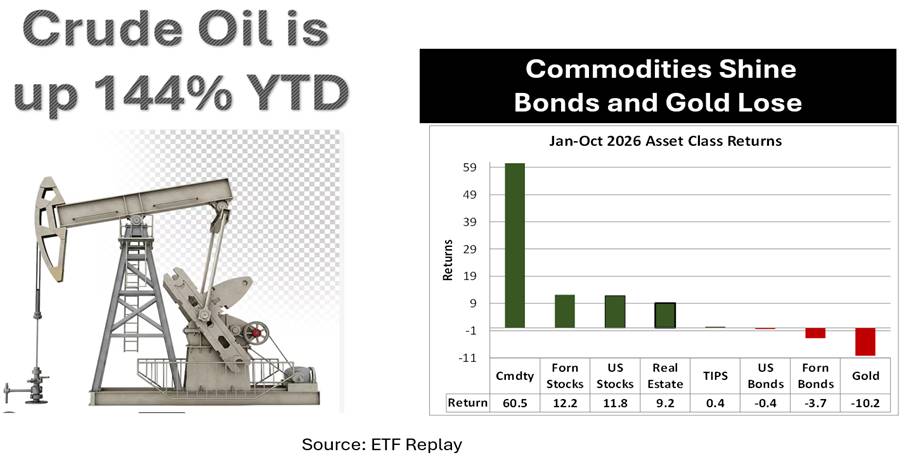
Commodities have dominated this year so far, with a 60.5% return, led by crude oil prices that skyrocketed 144% as a result of the Strait of Hormuz blockade. On the low end of commodity prices and asset class results, gold is down 10.2% due in large part to a strengthening U.S. Dollar that has increased by 7%.
Unlike the previous 17 years, during which U.S. stocks were the best-performing asset class, they are in the middle of the results with an 11.8% return., and US bonds have lost 0.4%. Consequently, diversification beyond U.S. stocks and bonds has added value this year, as evidenced in portfolio performance, as shown in the next section.
Portfolios: Target Date Funds
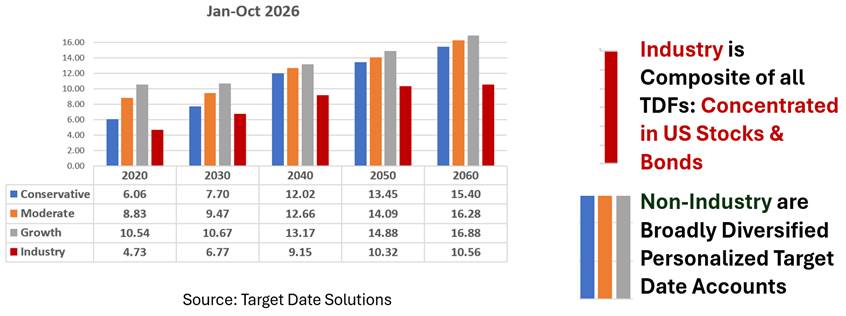
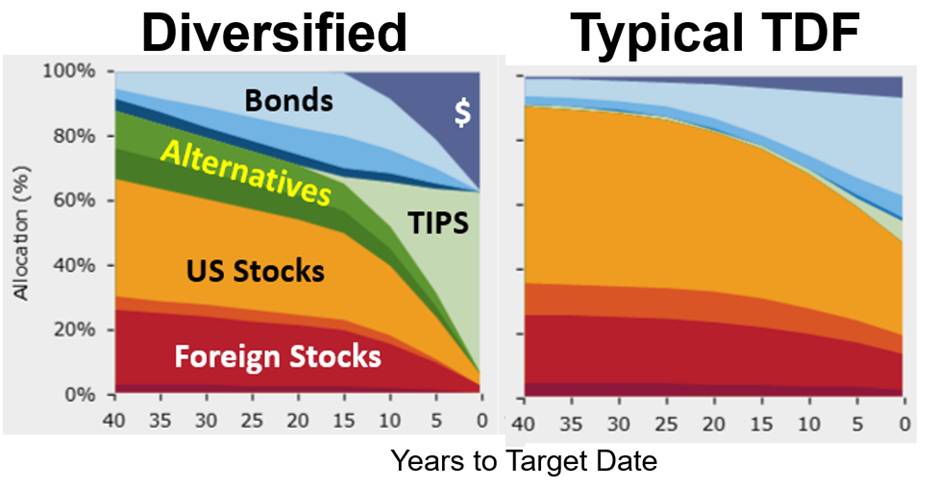
Holding more in your portfolio beyond U.S. securities has benefited performance. Most target date funds (TDFs) are concentrated in U.S. stocks and bonds that comprise more than 90% of underlying assets. By contrast, the non-industry accounts in the exhibit are broadly diversified into alternatives like commodities.
How Did You Do?
How has your portfolio performed? Use the Portfolio results above to answer this question. Choose your horizon (target date), risk preference, and diversification (concentrated in U.S. or diversified) – that’s your benchmark. How did you do?
Infection Point
U.S. stocks are currently very expensive on a variety of bases — like the Buffett barometer — buoyed up by Artificial Intelligence. Corrections have followed previous occurrences of expensiveness. Some investors – like Jeremy Grantham – expect the next correction to be the worst. I think they’ll be right.
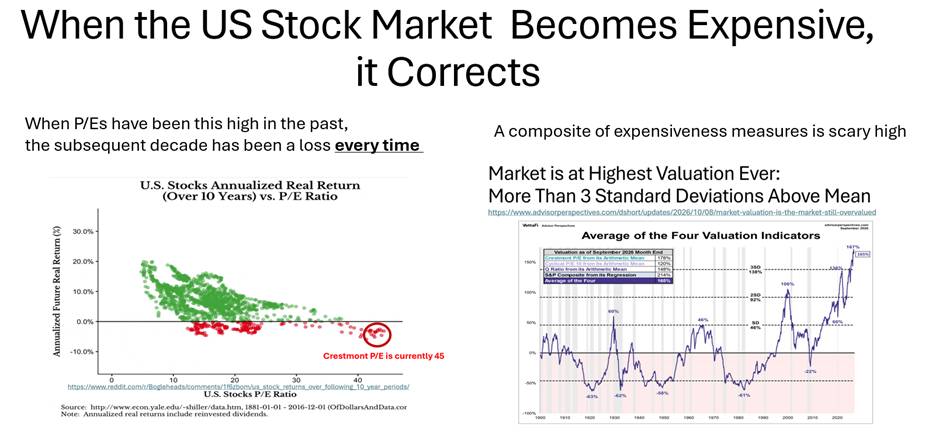
The recent behavior of US stock prices is signaling an inflection point – stocks will break either up or down. The level of the S&P500 has plateaued for the past 5 months. It’s been a directionless market where investors are uncertain. Can Artificial Intelligence stocks continue to drive up stock prices? How high is too high?
So, what will protect portfolios when U.S. stocks tank, especially when inflation is also a concern? I think real assets like commodities and real estate (especially farmland) will hold up, as will Treasury Inflation Protected Securities (TIPS).
Conclusion
The U.S. stock market has gone up every year since 2008, with the exception of 2022. That’s 17 years — the longest bull market ever recorded. Stein’s Law says this will end: “If something cannot go on forever, it will stop.”
Is the correction going to happen soon? No one knows, but being prepared is a good idea.



Comments
Log in or sign up to join the conversation.