


Morningstar reports projected retirement-wealth advantages of 5.9% for managed accounts over target date funds (TDFs) and 9.8% on average under the adverse market scenarios examined.
These findings reflect savings behavior as well as investment allocations; they do not necessarily establish the superiority of default managed accounts with limited participant engagement.
Near-retirement defaulted participants should review their allocations and consider moving to greater safety, potentially with personalized guidance; fiduciaries need not automatically replace TDFs with managed accounts.
Target date funds (TDFs) are a popular choice of qualified default investment alternative (QDIA) in defined contribution savings plans. Managed accounts (MAs) are another QDIA option.
Yet Morningstar has recently published a series of studies projecting better retirement outcomes from MAs than TDFs, challenging fiduciaries’ TDF preference. Have fiduciaries made a mistake?
Analyzing the Value of Managed Accounts analyzes data covering more than 3 million participants and finds a 5.9% improvement in projected retirement wealth-to-salary ratios for TDF investors adopting managed accounts.
Managed Accounts Under Adverse Market Scenarios examines the value of personalization during difficult markets and reports a 9.8% average projected wealth advantage over TDFs.
What Participants Value From Their Managed Accounts Provider explores what participants value in managed-account services. This report raises an important consideration: the role of participant engagement.
The projected wealth advantages are not observed investment returns. They reflect both savings rates and asset allocation, with higher contributions identified as the primary driver in the first study. Both analyses assume an annual managed-account fee of 0.40%.
This article is an update to my 401(k) Specialist article, Have Fiduciaries Failed by Preferring Target Date Funds?
For this discussion, I distinguish between two managed-account experiences that I believe should be evaluated separately:
AMAs, which I call “Actually Managed Accounts,” involve investors who actively engage with the service and may receive human advice. These arrangements extend beyond retirement plans to investors who hire professionals to manage their assets.
QMAs, which I call “QDIA Managed Accounts,” refer here to default managed accounts whose participants do not actively engage. These accounts may rely on automated investment management using information available through the plan’s recordkeeper. I question the depth of their personalization when participants provide no direct input.
These are my descriptive labels, not separate regulatory categories. Managed-account services can serve both engaged and disengaged participants, and automated management is still investment management.
Recordkeeper data available for these accounts can include:
Age, which helps determine the time horizon to expected retirement and supports the use of a glidepath
Current account balance
Salary
Contribution rate
Employer match
These inputs are useful, but they may not reveal a participant’s complete financial circumstances or willingness to accept investment losses.
The following chart compares the assets in these categories, including managed accounts outside retirement savings plans:
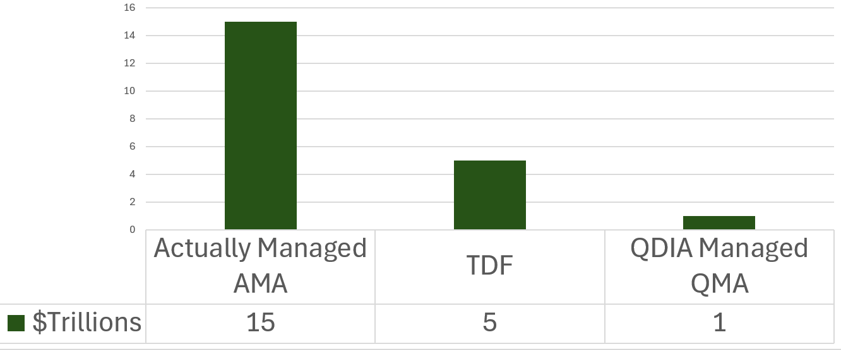
AMAs, as I use the term, extend well beyond retirement savings plans. Wealthy people hire professionals to manage their assets. Within retirement plans, participants can also engage with managed-account providers for personalized guidance.
In other words, I interpret the Morningstar studies as supporting the potential value of advice and savings guidance rather than establishing the superiority of disengaged QMAs over TDFs. To establish that distinction, I would want to see the results separated by participant engagement and default-enrollment status. A finding that participants value human advice does not, by itself, establish that human involvement caused the projected advantages.
Why This Matters
Despite their popularity, TDFs are not sacred. In fact, I believe many are too risky at their target date and therefore need improvement, as I’ve written previously. But they are the better QDIA choice, in my opinion.
To gain the full benefits of personalized guidance and human involvement, a defaulted participant may need to engage actively with the service or select a different investment arrangement. Whether the participant formally leaves the default will depend on the plan and service.
The important question is whether a disengaged participant would receive the same benefits projected in the Morningstar research, particularly when higher savings rates contribute substantially to those benefits.
Conclusion
In my view, fiduciaries are justified in preferring TDFs as their QDIAs, even though TDFs need improvement. I believe the next stock market crash will reinforce my case for greater safety near retirement.
In the meantime, I believe participants approaching retirement should review their default allocations and consider moving to greater safety where appropriate for their circumstances, perhaps with the guidance of an AMA. Morningstar’s research supports considering personalized guidance, although it does not establish that everyone approaching retirement should leave a TDF.
In other words, the Morningstar studies provide a reason to consider engaging with managed-account services if the expected benefits outweigh the costs. They do not, in my view, establish a sufficient case for a fiduciary QDIA move from TDFs to QMAs.
My concern is that QMAs relying primarily on recordkeeper data and age-based glidepaths may offer too little additional personalization to justify their higher fees.



Comments
Log in or sign up to join the conversation.