


· The retirement account conundrum is using the words “managed” and “default” in “Managed Account Qualified Default Investment Alternative. ” Because they will not engage, you cannot manage assets for people who default.
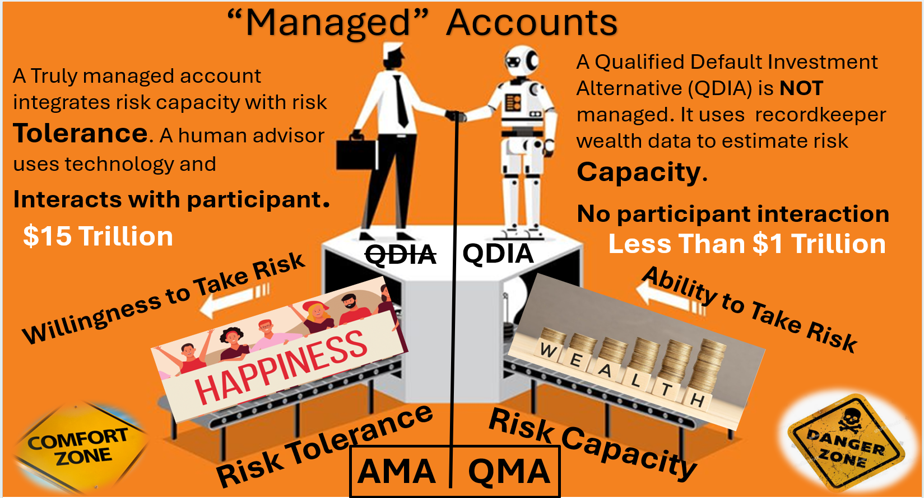
· Truly managed accounts integrate risk tolerance (willingness) with risk capacity (ability/wealth), but QDIAs rely on capacity alone, ignoring tolerance.
· $15 Trillion in truly managed accounts far exceeds less than $1 trillion in “managed” account QDIAs . These two distinct kinds of managed account should not be conflated, but they are.
· A better, less complicated, default solution is to customize a target date fund by blending Conservative/Moderate/Aggressive glide paths to match workforce demographics, setting a single retirement age, and using only plan-approved funds.
The first version of this article was published in 401(k)Specialist earlier this month. This newly updated article goes into greater detail and elaborates on the challenges and solutions.
Roughly 80% of 401(k) participants default their investment election to their employer, so Qualified Default Investment Alternatives (QDIAs) are a very important topic. With more than $5 Trillion, target date funds (TDFs) are the most popular QDIA. With less than $1 Trillion, managed accounts (MAs) are a far distant second QDIA. This article is about MA QDIAs that are gaining popularity as fiduciary appetite for participant personalization grows. Fiduciaries need to be wary of the possibility of all show with no substance.
This article is an expose’ of the shortcomings in MA QDIAs with a recommended solution. Think “Emperor’s New Clothes.” I hope you find this discussion revealing and enlightening.
The Conundrum
MA QDIAs are conundrums. A conundrum is a confusing problem that is hard to solve. By definition, a QDIA is for people who will not engage, so you can’t actually manage their accounts because you do not know them, and if they do engage it’s not a QDIA -- that’s the conundrum. Complicating this conundrum:
· Regulators allow truly unmanaged QDIA accounts to be called “managed.” They should re-think this position. Regulators confuse the very popular real deal MA with the far less popular QDIA version.
· MA providers of QDIAs promote their product by conflating it with the non-QDIA actually managed version. These two are not the same – far from it, as discussed in the next section.
Two Types of Managed Accounts (MAs): AMAs and QMAs
There are 2 distinct types of managed accounts:
· AMAs are Actually Managed Accounts that are not QDIAs because investors actively engage. Most assets in Managed Accounts are AMAs. That’s why it’s easy to confuse these with QMAs. Wealthy people hire professionals to manage their assets.
QMAs are QDIA Managed Accounts that are electronically “managed” by computer with no participant engagement. I consider them unmanaged, despite the name. They are completely different than AMAs because participants do not engage.
PIMCO summarizes the recordkeeper data used in QMAs as follows:
Age determines time horizon to expected retirement, confirming the use of a glidepath
Wealth
Current account balance
Salary
Contribution rate
Employer match
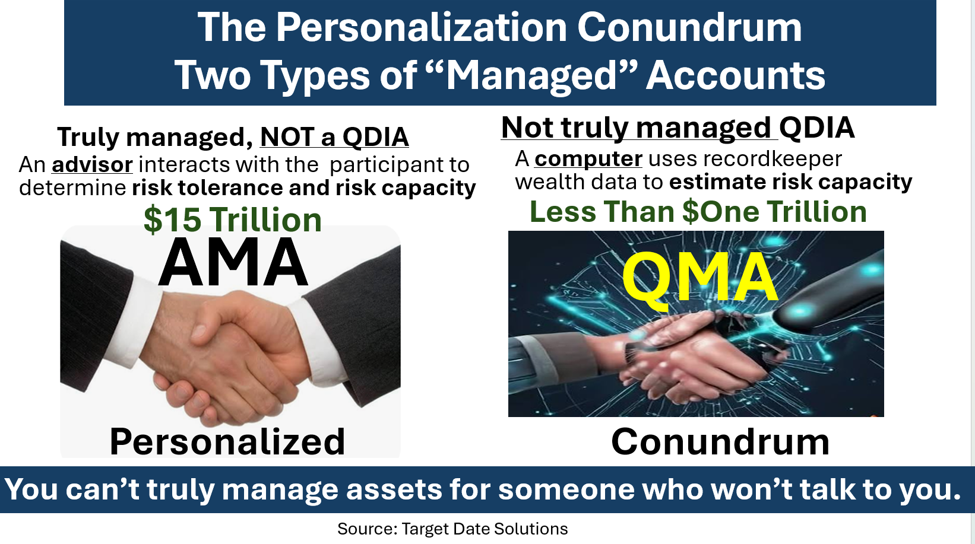
I use these AMA and QMA acronyms throughout the following.
The Investment Company Institute (ICI) reports that total assets in retirement savings plans exceed $50 trillion, with $15 trillion in defined contribution (DC) plans and $20 trillion in Individual Retirement Accounts (IRAs). Cerulli reports that total MA assets in DC and IRA accounts grew 20% in 2025, from $13.7 trillion to $16.3 trillion due in large part to participant attraction to personalization because investing is personal. What these reports, and others like them, fails to acknowledge is the existence of two distinct types of MAs – AMAs and QMAs.
Most assets categorized as MAs are truly managed but are not in a QDIA. Adoption of the QDIA version has grown, but it remains a minority strategy. According to New England Pension Consultants’ 2024 Defined Contribution Survey, 46 percent of plans offer MAs, but only 9 percent use them as the default investment. Similarly, a recent MFS survey reports that participants value truly managed human advice (the real deal) over computerized automation as they near retirement.
I focus on the QDIA in this article, the QMA. Of the $16 trillion in MAs, less than one $trillion is in QMAs because QDIAs are primarily for the not very rich financially naïve. Rich people do not default; their investments are professionally managed. Corporate executives use professional asset managers.
The typical managed account article does not distinguish between QMAs and AMAs. When most think of managed accounts, they are thinking about the very popular AMA version, so it’s easy to conflate QMAs with AMAs. That’s a mistake.
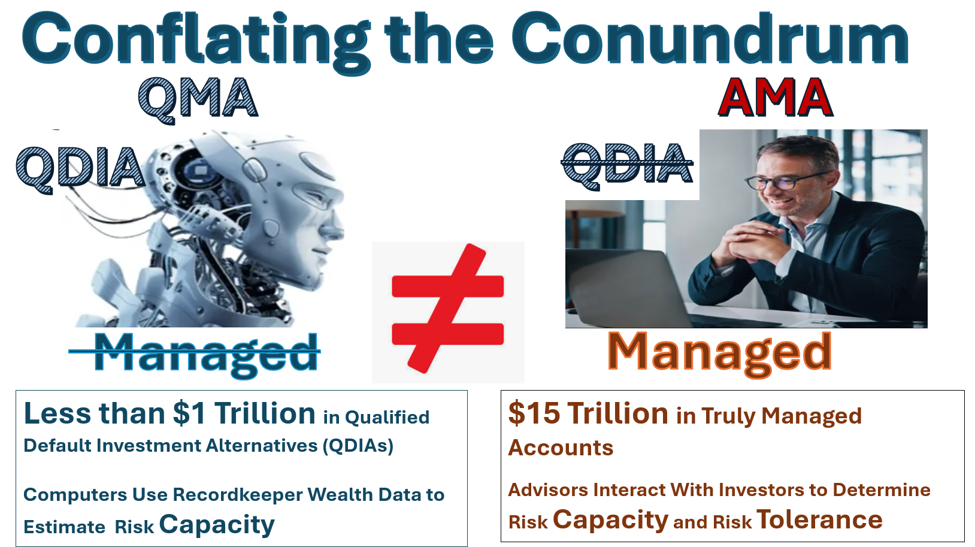
Fiduciaries should not confuse the relatively small amount of “managed” account assets in QMAs with the much larger amount in the real deal AMAs; it’s an easy mistake to make. Here’s an overview of the differences:
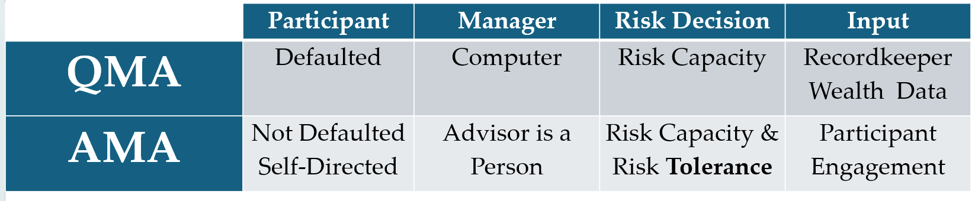
QDIA participants trust their employer to somehow figure out a good solution. They should trust but verify, especially since their risk tolerance is being ignored. Participants should look at the risk they’re taking to verify that it is really what they want and need. Here’s why risk tolerance is so important.
The Importance of Risk Tolerance
Risk tolerance is the willingness to take risk. It is limited by risk capacity, the ability to take risk, namely wealth. QMAs use risk capacity estimated from recordkeeper wealth data and ignore risk tolerance because defaulted participants won’t tell them that, and if they do tell it’s not a QDIA because they have engaged.
Some say that risk tolerance is too illusive to capture and that questionnaires fail to obtain accurate readings, but publications like this FINRA article disagree. Also, behavioral scientist Professor Meir Statman has identified the challenges and how to address them. Where there’s a will, there’s a way. The $15 Trillion in truly massaged AMAs confirms this fact.
As may come as a surprise, defaulted participants, who are generally not rich or financially sophisticated, actually can identify their risk tolerance. Participant surveys say they can: they want to be protected as they approach retirement and mistakenly think they are protected. Surveys report that defaulted participant risk tolerance is very low near retirement, which is consistent with low risk capacity, so reliance on capacity alone for those near retirement might be all right, but it might not be all right for younger participants, especially if they want a shot at not being poor.
Risk capacity should limit risk tolerance as an upper bound rather than dangerously taking all of it, as is the case with QMAs. Taking all the risk you can (capacity) puts you in the danger zone, as shown along the top of the next graph. Toning down capacity with risk tolerance (moving vertically in the next graph) puts you in the comfort zone.
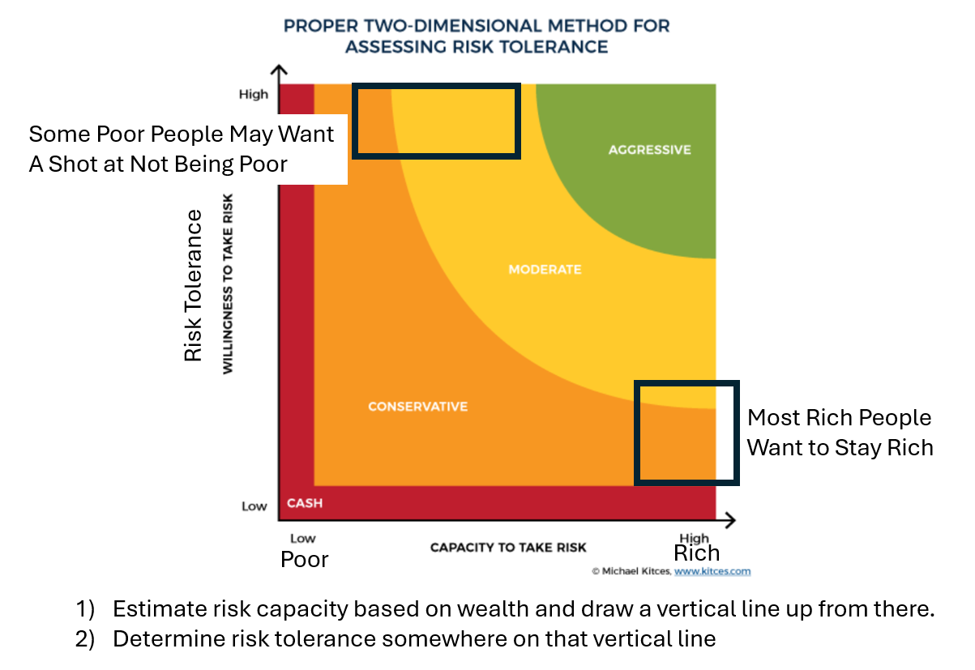
Service providers integrate risk tolerance with risk capacity along the lines shown above..
AMA Services
There are specialized services to help participants engage like Guided Choice, Wealthramp, ProManage, Edelman Financial Engines, Wealthfront and Betterment. With $350 billion under advisement, Edelman Financial Services is the largest AMA service. These service providers’ websites interact with participants as a robo advisor, and they also provide human advice.
Participants should consider using these services if they are available to them, especially while they are in the Retirement Risk Zone spanning the 5 years before and after retirement because this is the critical time in their investment lives
In addition to these services, some plan sponsors have subscribed to a suite of target date fund glidepaths with low, middle, and high risk that self-directed participants can blend as they like through time, essentially managing their own unique individual lifetime investment paths.
As discussed in the next section, participants need to do what is right and prudent for themselves, especially when regulations do not protect them.
Regulations and Prudence
According to Thrivent, a 120+ year old financial services company, a managed account is a portfolio guided by investment professionals who make adjustments based on your specific financial objectives, but QMAs do not meet this definition. We have researched regulations governing QMAs and find that they allow current practices that use recordkeeper wealth data to make the important risk decision, with no participant interaction. Regulators permit QMAs to depart from the standard definition of managed account.
Regulations explicitly allow the exclusion of risk tolerance, presumably because regulators understand that identification of risk tolerance requires communication that isn’t possible in a QDIA since participants will not engage. Reliance on risk capacity (wealth) alone is permitted.
Under Department of Labor regulations, MAs meet the regulatory definition of a QDIA when they allocate assets based on participant characteristics such as age, salary, and projected retirement date. No mention of risk tolerance.
Also, regulatory definition 29 CFR § 2550.404c-5 - Fiduciary relief for investments in qualified default investment alternatives – Section (e)(4)(iii) states that QMA asset allocation decisions are not required to take into account the risk tolerances, other investments, or other preferences of an individual participant.
Even though the regulations permit the current practice of ignoring risk tolerance in QMAs, fiduciaries should be concerned. Just because the laws allow it doesn’t mean it’s prudent. Here’s why.
Fiduciary Responsibilities
“Know your client” goes well beyond wealth alone to include emotional considerations. Even though there are no specific laws that prohibit reliance on risk capacity alone in QMAs, this leads to high risk exposure.. Reliance on capacity alone means taking all the risk you can afford or guesstimating how much capacity you want to use up.
ERISA 404(a) requires fiduciaries to prudently investigate and understand the methodology by which a proposed QMA determines the appropriate level of investment risk, including whether and how the service evaluates participant-specific risk tolerance, risk capacity, investment objectives, and other material financial circumstances.
Advisors to 401(k) plans are further held to FINRA suitability standards. Registered securities professionals are required to follow FINRA Suitability Rule 2111 that says: the following, with emphases added by me:
“A firm or associated person must have a reasonable basis to believe a recommended transaction or investment strategy involving a security or securities is suitable for the customer. This is based on the information obtained through reasonable diligence of the firm or associated person to ascertain the customer’s investment profile.
The rule states that the customer’s investment profile “includes, but is not limited to, the customer’s age, other investments, financial situation and needs, tax status, investment objectives, investment experience, investment time horizon, liquidity needs [and] risk tolerance,” among other information. A broker’s “recommendation,” which is based on the facts and circumstances of a particular case, is the triggering event for application of the rule”.”
The more a MA is marketed as personalized – including the recent emergence of personalized target date accounts -- the stronger the fiduciary obligation to investigate whether it actually possesses and uses the information necessary to individualize the participant's portfolio.
Fiduciaries need to know if and how risk tolerance is determined. Smart, prudent investment fiduciaries will avoid QMAs because they do not integrate risk capacity with risk tolerance.
The following details the importance of integrating risk capacity with risk tolerance.
Risk Tolerance Limited by Risk Capacity

Because they like being rich, most rich people want to stay rich – they have low risk tolerance that uses only a little of their high risk capacity. A risk tolerance adjusted portfolio for the wealthy will likely not perform as well as an unadjusted portfolio, though it may well provide a more satisfying result. Stocks for the long run has been documented by Professor Jeremy Siegel. There can be an opportunity cost for protecting a fortune against losses when risk tolerance is low.
Because they don’t like being poor, poor people could want to take risk in hopes of not staying poor – they might have high risk tolerance that uses most of their risk capacity. Consequently, reliance on risk capacity alone may be just right for these participants, but we simply can’t know without asking.
You can only know risk tolerance by asking because it’s personal. But when you get an answer, it’s not a QDIA anymore.
A Simpler More Sensible QDIA IMHO
Here’s my opinion, and rationale. Fiduciaries should not choose QMAs because they are very complicated and paradoxical. Instead of guessing individual risk based on recordkeeper wealth data, a customized TDF should be created for all defaulted participants, following DoL guidance to conform the TDF to workforce demographics.
Specifically, the sponsor chooses the appropriate risk for the TDF QDIA by blending Conservative-Moderate-Aggressive glidepaths, plus setting a retirement age for all who default. And the custom glidepath invests in the funds approved for the 401(k). Voila! With more than $100 Billion, the popularity of flexPATH attests to the wisdom of this approach.
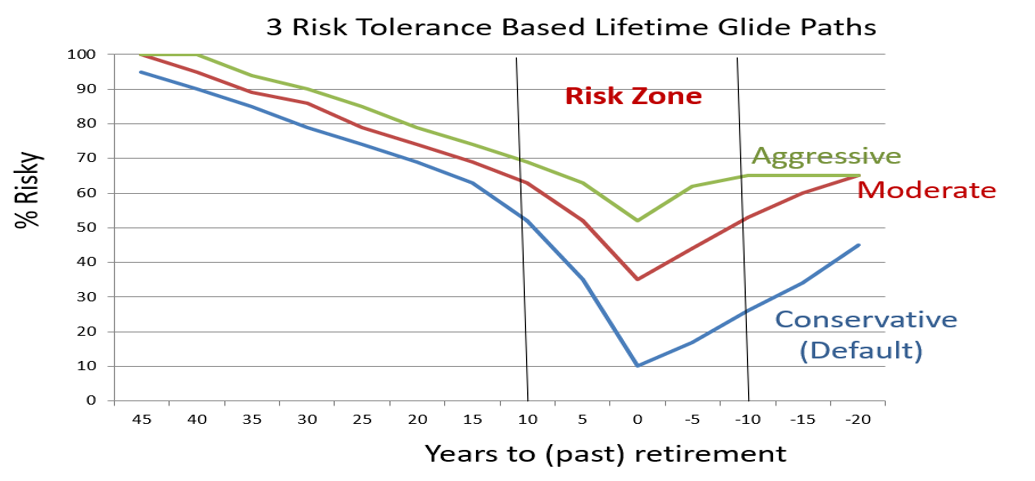
As shown in the graphic above, we advocate re-risking in retirement to extend the life of investments after you pass through the Retirement Risk Zone.
At $5 Trillion and growing, TDFs are the most popular QDIA for good reasons. Note also that TDFs do not claim to manage accounts. Rather, they follow academic lifetime investing theory that integrates human capital with investment capital through time. As human capital depletes, financial capital becomes safer because we become more reliant on it. In other words, TDF glidepaths manage risk through time, moving to protect as retirement nears. QMAs also use glidepaths but downplay this fact in order to distance them away from TDFs.
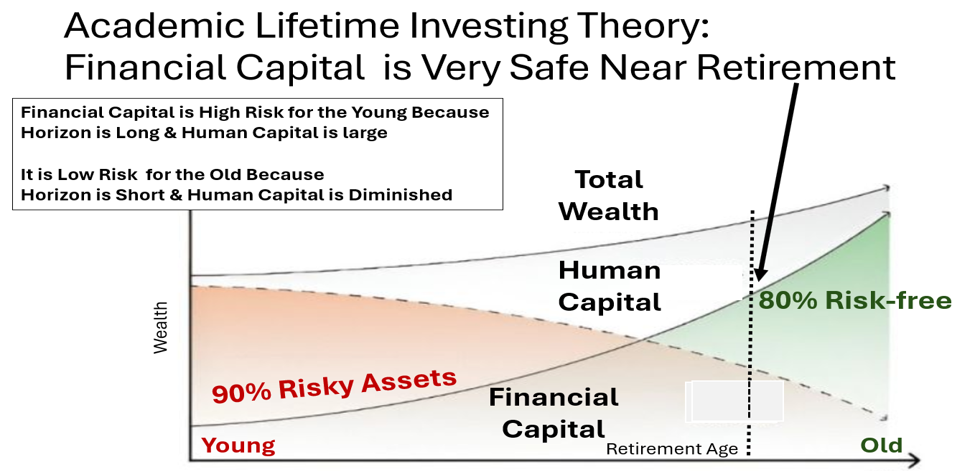
Why TDFs instead of QMAs? It can be argued that TDFs are impersonal while QMAs are personalized because QMAs are individualized to each participant’s wealth, so advantage QMAs. And both TDFs and QMAs ignore risk tolerance, so there is no advantage there.
The benefits of TDFs over QMAs include::
· TDFs are simpler and more direct, so easier to understand and explain. TDFs do not claim to interact with participants while QMAs attempt to substitute recordkeeper wealth data for participant engagement.
· QMAs and TDFs both follow lifetime glidepaths, although QMAs underplay this fact.
· TDF expenses average 40 bps which is generally less expensive than QMAs. A Morningstar analysis of more than 7,000 funds found that managed account investors paid an average of 71 basis points in total fees—31 bps in fund fees, plus an additional 40 bps in service fees. TDFs have a 31 bps advantage on average.
· If you argue that “you get what you pay for,” you need to justify the additional expense. Why exactly are QMAs worth more? Do not confuse QMAs with AMAs when you answer this question.
The struggle for market share has led to ongoing debates between QMA and TDF service providers.
The Great Debate: TDFs versus QMAs
Four years ago, in December 2022, RetireHolics sponsored this Great Debate, I took the target date fund (TDF) side against Todd Lacey from Stadion who took the QMA side. Despite the fact that TDFs are much more popular than Q MAs, I lost the debate (the audience voted) because I made 2 mistakes:
· I confused the real deal AMAs with the QMA version. Credit Todd for masterfully creating this conflation and shame on me for falling for it. The audience fell for it too. I wish I knew then what I know now. I’m glad to write about it now in this article. Lesson learned.
· I talked more about improving TDFs than defending them. TDFs still need improvement, but that’s another article -- I’ve written several.
Recently, QMA providers are making a big push by appealing to participant preference for personalization. This pitch confuses truly managed AMAs with truly unmanaged QMAs. It’s an easy mistake to make. I made it 4 years ago and it cost me a debate and the associated humiliation. Don’t let it confuse you.
Much of the current confusion will end in the next stock market crash when, as Warren Buffet observes, we will all see who has been swimming naked (exposed to risk).
The Next Crash Provokes Baby Boomers in QDIAs
Participants near retirement in QDIAs – namely baby boomers -- should realize that they are taking a lot of risk with 90% in risky assets – 55% in equities plus 35% in risky long-term bonds. This is the risk for most QDIAs, including both TDFs and QMAs. Participants in QDIAs do not realize that they are taking substantial risk near retirement, but they will realize it when the stock market crashes. Most baby boomers are currently in the Retirement Risk Zone when Sequence of Return Risk can strip them of a retirement with dignity. This is a critical time in their investment life.
When -- not if -- we suffer the next stock market crash, defaulted participants will feel their risk because they’ll experience what risk means. And they will react, My “Revenge of the Baby Boomers “ articles have gone viral; they describe how defaulted participants near retirement will react to their losses in the next crash – they’ll get mad, and then they’ll get even. Better risk management will follow, as might another joint hearing of the SEC with the DoL like the one in 2009 following the crash of 2008.
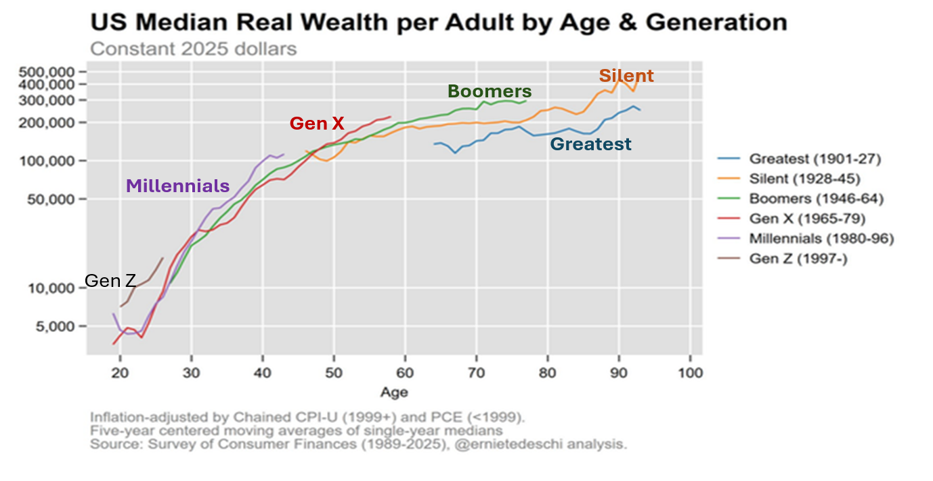
Baby boomers are becoming more and more powerful as their wealth grows in our K-shaped economy. According to this recent WSJ article, Post COVID from 2022 to 2025 wealth increased 37% for Americans 75 and older, while it declined 23% for people under 35. During this period, people 75 and older became the richest age group, with a median net worth of $505,000, more than twice a $216,000 overall median. Wealth is measured as a family’s assets, like stocks and home equity, minus their liabilities, like mortgages and credit-card debt.
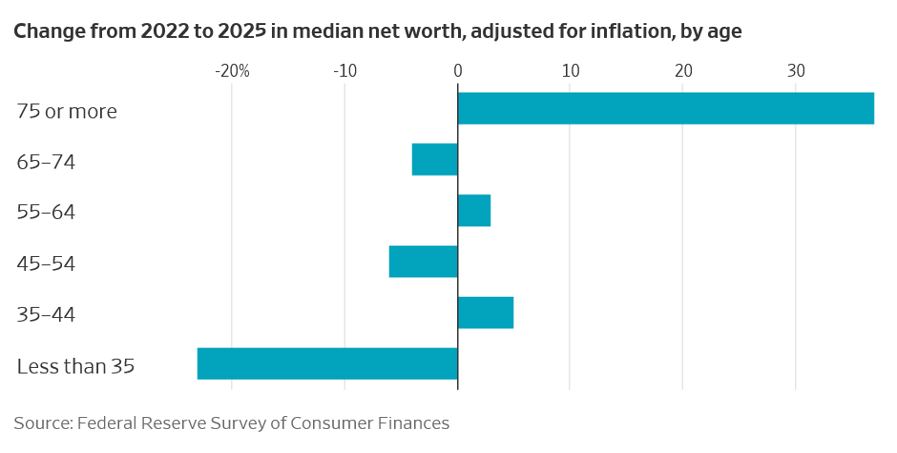
70 million baby boomers are a powerful economic force. They’re currently the richest generation. They will be the catalysts for reform when the next crash makes them realize the risk they currently take in QDIAs.
Conclusion
The less than one $trillion in QMAs is easily confused with the much larger $15 trillion in actually managed AMAs. Wealthy people use professional asset managers to actually manage their accounts., including the formation of family business offices. By contrast, participants in QDIAs are financially naïve and generally not wealthy. Unfortunately, these two distinctly different MAs are being conflated, confusing most, even regulators.
Participants in defined contribution savings plans need to think twice about defaulting their investment choices to their employer. If they do default, they need to look at their asset allocation statements, and to assess their comfort with the risk they’re taking. They might not like the risk that is chosen for them because their risk tolerance is higher or lower.
The problem is that financially naïve people might not know their risk tolerance, but they will come to know it when the stock market crashes. The litmus test for investment risk tolerance is a stock market crash.
If participants are in a QMA, they should be aware that their asset allocation is based exclusively on their wealth. If they are in a TDF, their allocation is based on academic lifetime investing theory. Neither approach asks participants for their risk tolerance because that would require participant engagement – un-defaulting.
Participants who have defaulted into QDIAs should consider not remaining in that default investment, especially if they are not comfortable with their risk. They really need to look and to trust but verify.



Comments
Log in or sign up to join the conversation.