

Trump replaced NAFTA with USMCA. It’s under review on July1. What’s next?
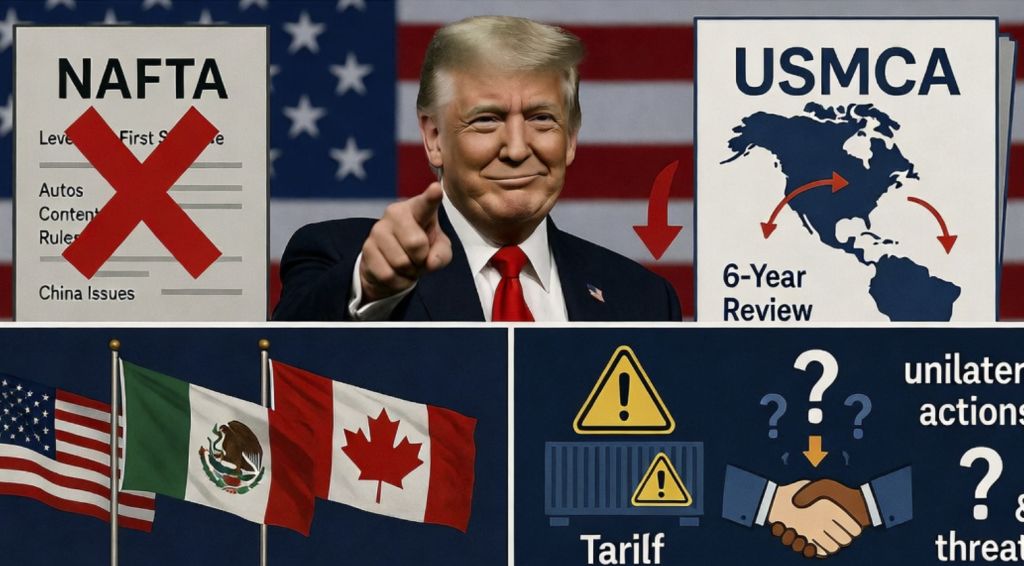
Trump can easily pressure or destabilize USMCA with unilateral actions and threats, and it would hardly be surprising if he did.
By that I mean aggressive unilateral moves (tariffs, threats, or demands) outside the formal 6-year review window. He already applied heavy leverage to his own deal — one that passed the Senate 89-10 (mostly Democrat dissents) and the House 385-41.
Since then, he has mostly backed down or adjusted on some “reciprocal” tariff escalations after market pushback.
Trump’s style is leverage-first and transactional. He’s likely to use it again during the 2026 review process to extract changes (especially on autos, content rules, and China-related issues).
NAFTA vs USMCA Rules of Origin
One of the biggest changes regards automotive rules of origin.
NAFTA required 62.5% North American content for duty-free treatment. USMCA raised this to 75% regional content plus a new labor value content rule: 40–45% of the vehicle’s content must be produced by workers earning at least $16/hour (phased in). This was explicitly designed to shift more production and higher-wage jobs toward the US and Canada.
That sounds good but the 2.5% tariff penalty for non-compliance was low enough for many to opt out rather than fully re-shore. Global supply chains, EV battery minerals (often non-North American), and automation also played roles. Mexico’s cost advantages persisted for labor-intensive work.
Where it did “work” US automakers passed on costs to consumers. Some models were discontinued in North America or shifted sourcing. Mexican vehicle exports to the US remained strong overall, though with adjustments.
The revised deal raised compliance burdens and costs without a full “win” on reshoring. Data through 2024–2025 shows incremental adjustments rather than a major transformation.
NAFTA vs USMCA Courts
Under NAFTA, US investors in Mexico could generally bring claims directly to international arbitration (bypassing Mexican courts) for a wide range of alleged breaches, including “fair and equitable treatment” and indirect expropriation.
Under USMCA, for most claims, US investors must first file in Mexican courts or administrative tribunals. They can only proceed to international arbitration after a final decision from the highest court or after 30 months have passed from initiating the domestic proceeding.
This was on purpose because the Trump administration (led by USTR Robert Lighthizer) viewed expansive ISDS skeptically.
But preferring the Mexican courts on matters Mexico is involved in seems silly.
NAFTA vs USMCA in Practice
Mixed scorecard: Gains for US labor/parts interests in targeted areas; higher costs and complexity for businesses; continued benefits for integrated supply chains. Mexico’s export strength persisted.
Mexico’s export strength persisted and even grew in areas (e.g., autos, advanced manufacturing). Integrated supply chains benefited overall—trade volumes rose, nearshoring trends helped Mexico, and USMCA maintained duty-free access for compliant goods. No collapse in Mexican competitiveness for assembly work
There were few court cases, wages in Mexico did not rise, and compliance costs rose a bit.
The net result was amall aggregate economic effects (negligible GDP impact per modeling). The deal strengthened rules in US-priority areas without breaking the highly integrated North American model. Other forces (COVID, EVs, China tariffs, IRA incentives) drove bigger shifts.
Either Way a Good Deal
NAFTA and USMCA created and sustained one of the world’s most successful regional trade blocs. USMCA modernized it for the 21st century (digital, labor, environment) and fixed some political pain points from NAFTA without blowing up the system.
The deals delivered (and continue to deliver) real value by locking in tariff-free regional trade among three economies that are deeply intertwined. The North American bloc remains one of the most successful and competitive in the world — massive trade volumes, integrated supply chains (especially autos, aerospace, electronics), and resilience against external shocks.
What Happens On/Around July 1, 2026?
The USMCA Free Trade Commission (trade ministers from the U.S., Mexico, and Canada) must meet for the joint review.
They assess how the agreement is working, review any recommendations for changes (submitted at least one month in advance), and decide on actions — including whether to extend the agreement for another 16 years (until 2042). congress.gov
Each country must confirm in writing (via head of government) if it wants to extend.
The continuity was indeed a feature, not a bug. It preserved stability for businesses and consumers while making targeted improvements. Supply chains didn’t fracture; they adapted and, in many cases, strengthened through nearshoring trends.
USMCA Status
Bilateral talks (especially U.S.-Mexico) have already started and are ongoing. A negotiating round is scheduled for the week of July 20, 2026.
A clean, immediate extension on July 1 appears unlikely. Negotiations on issues like rules of origin, non-market (e.g., China) inputs, supply chain security, and other priorities are continuing. csis.org
July 1 is not a hard deadline to finish everything — it’s the date the formal review begins and the extension decision point.
What If No Extension on July 1?
The agreement does not automatically expire.
It shifts to annual joint reviews until all three countries agree to a 16-year extension (or it terminates on July 1, 2036). ielp.worldtradelaw.net
The deal stays in force during this period, but uncertainty increases.
Wrecking the Deal Has Real Costs
USMCA underpins $1.8+ trillion in annual trilateral trade and highly integrated supply chains that benefit U.S. manufacturers, exporters, farmers, and consumers.
July 1 kicks off the formal joint review. It’s the start of negotiations, not the end.
The agreement doesn’t auto-expire if there’s no immediate extension — it shifts to annual reviews until all three countries agree (or it sunsets in 2036).
The continuity of North American trade is a huge benefit.
Blowing it up would trigger retaliation, higher costs, and uncertainty. However, Trump has many times shown willingness to march down that path.
In response, Canadian Prime Minister Mark Carney has forged deeper ties to China. And Trump has countered that the US does not need Canada or Mexico for anything (both lies).
So discussions are not off to a great start.
What Genuine Leadership Looks Like
Related Posts
January 20, 2026: I Salute Mark Carney’s Speech About Trump at Davos. Canadians Should be Proud
Thank you Prime Minister Mark Carney!
January 27, 2026: Carney Disputes US Treasury Secretary Lies, Says ‘I Meant What I Said’ in Davos
Canada’s Prime Minister Mark Carney plays hardball with Trump.
May 8, 2025: Fact Check on Trump’s Claim “We Don’t Do Much Business with Canada”
“We don’t do much business with Canada from our standpoint, they do a lot of business with us,” said Trump.
In terms of US exports, Canada is #1. Canada buys more US goods than the entirety of the EU.
January 17, 2026: Canada Breaks With the US, Cuts Tariffs on Some Chinese EVs
Congrats to Trump for moving Canada and China closer together.
Finally, please consider Cheese Was a “Key Achievement” of Trump’s USMCA Trade Agreement
Trump is complaining about Canada’s cheese tariffs. In 2018, he was bragging about cheese.
Flashback October 1, 2018
Late last night, our deadline, we reached a wonderful new Trade Deal with Canada, to be added into the deal already reached with Mexico. The new name will be The United States Mexico Canada Agreement, or USMCA. It is a great deal for all three countries, solves the many deficiencies and mistakes in NAFTA, greatly opens markets to our Farmers and Manufacturers, reduces Trade Barriers to the U.S. and will bring all three Great Nations together in competition with the rest of the world. The USMCA is a historic transaction!
It was such a great deal that Trump thanked Mexico and Canada. Notably USMCA is “Good for everybody – Farmers, Manufacturers, Energy, Unions – tremendous support. Importantly, we will finally end our Country’s worst Trade Deal, NAFTA!”
It “greatly opened markets to our farmers” and it even paid for the wall! And it will bring three great nations together!
Mercy! Who could possibly see things any differently?

Comments
Log in or sign up to join the conversation.