

Since February, mortgage rates have surged from 6.00 percent to 7.54 percent.
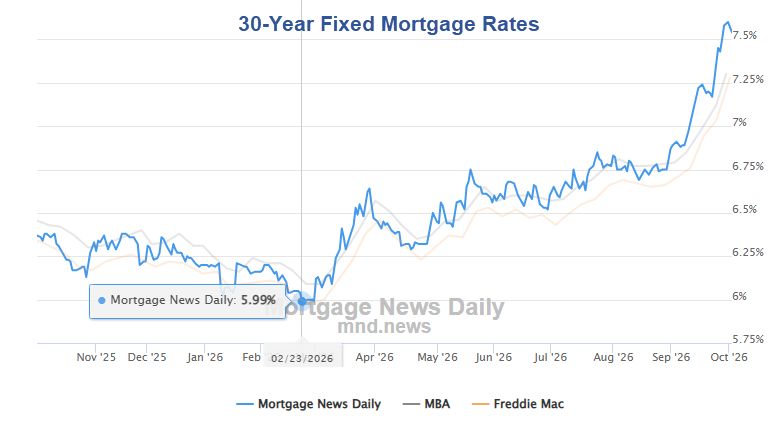
Chart courtesy of Mortgage News Daily.
Mortgage News Daily numbers are higher, but more accurate than other sources including Freddie Mac because MND includes points and fees in its average rates.
Biggest Weekly Surge in Four Years
The Wall Street Journal reports Mortgage Rates Surge, Notching Largest Weekly Gain in Four Years
The rise to 7.28% follows the bond-market rout and deals another blow to a limping housing market.
[Mish Note: Factoring in points and fees, that’s That’s too low by nearly a quarter point.]
Rates for 30-year fixed-rate mortgages leapt to 7.28% from 7.03%, the biggest jump since October of 2022, according to Freddie Mac.
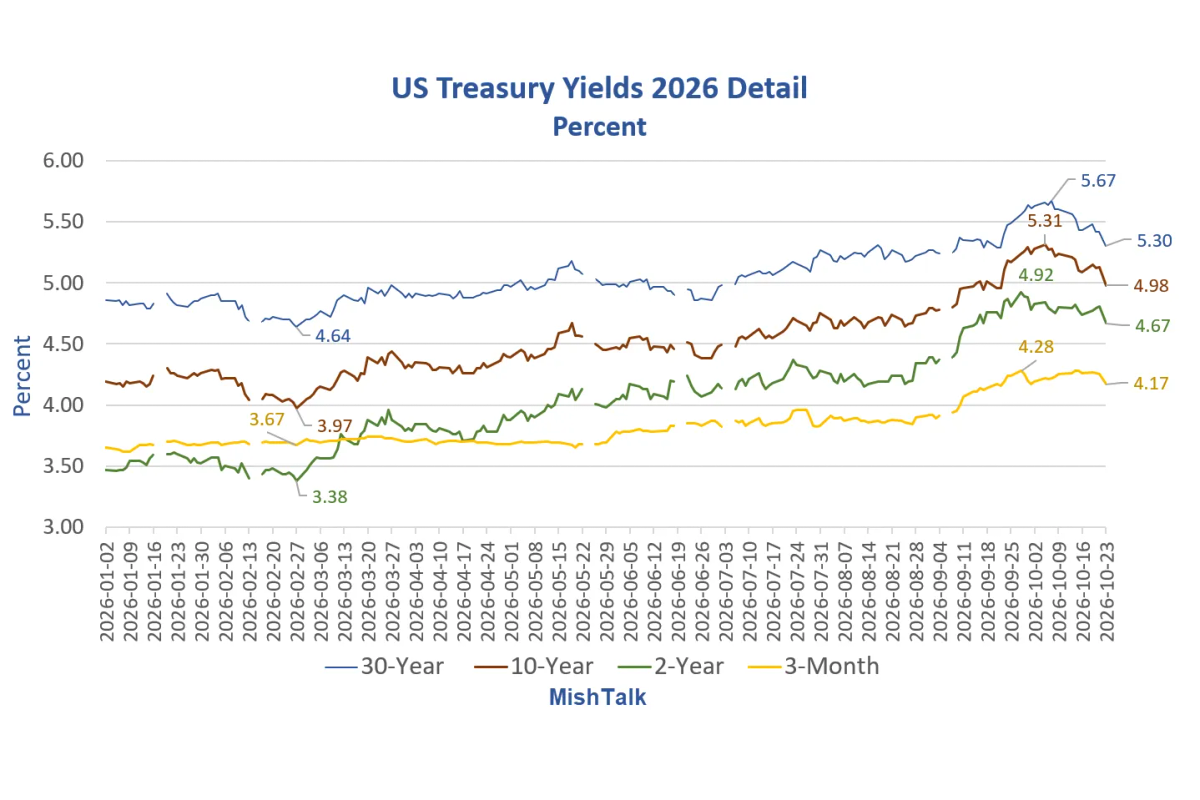
Mortgage rates are rising as inflation, a surge in government debt and heavy corporate borrowing for the build-out of AI push up bond yields, which move in the opposite direction of bond prices. The bond-market selloff is raising borrowing costs for home buyers and dealing blow after blow to a limping housing market.
“Showings have stopped basically,” said Don Wessel, a real-estate agent in Greenville, S.C. “I’ve got good listings in downtown Greenville, which is one of the hottest areas, and nobody’s looking at them.”
For the week ending Sept. 25, mortgage applications fell 6%, the fourth consecutive week of declines, according to the Mortgage Bankers Association.
At the start of the year, mortgage rates touched below 6%, but the beginning of the war in Iran caused them to jump. As the conflict has drawn on, fears of sticky inflation have driven rates higher and higher. Rates began September at 6.71% before a historic bond selloff sent them surging.
Buyers in the upper end of the market, less constrained by affordability, are continuing to show interest, said Anthony Rael, an agent in Denver. “They seem to be flush with cash, bringing 20%, 30% down payments into the mix,” he said. “Whereas the lower market, let’s just say closer to a half a million and below, is really struggling where we’re getting lots of showings and no activity, no offers.”
[Mish Note: This skew artificially increases median and average home prices. Case Shiller repeat sales of the same home is a better metric.]
Pool of Price Insensitive Buyers
It’s not just the ultra-wealthy.
But as discussed many times over the last two years, there is a pool of price insensitive buyers unconcerned about mortgage rates.
They have stock market gains, high end jobs, or cash at hand and want to move so they do.
Existing Home Sales vs Mortgage Rates
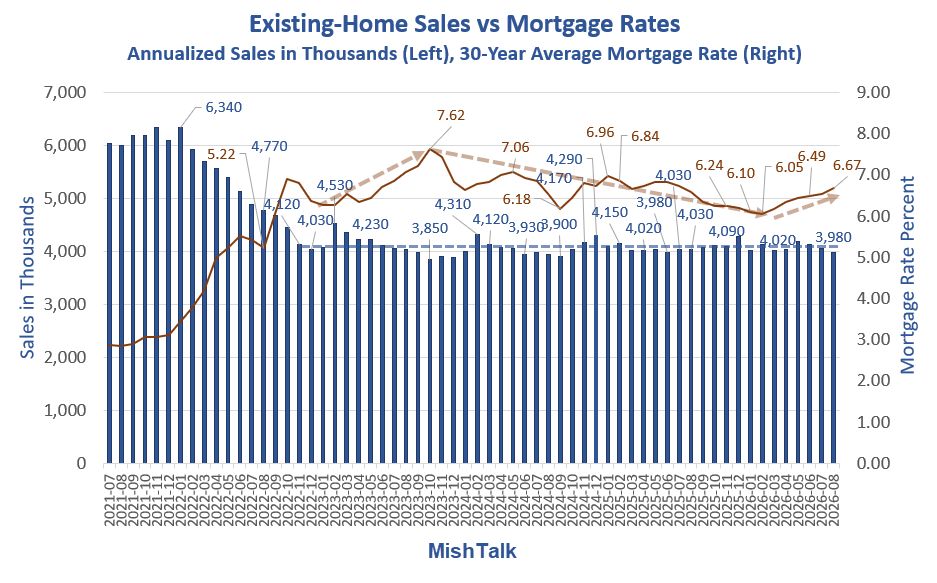
Since November 2022, mortgage rates surged, then declined, and have now risen 1.5 percentage points since February.
Existing-home sales have been relatively flat the entire time.
The stock market and stable jobs support this stalemate. For how long remains to be seen.
Related Posts
September 13, 2026: Existing-Home Sales Drop Two Percent, Gone Nowhere for Four Years
It’s more nowhere for now, but a big caution ahead.
September 17, 2026: Housing Starts Decline 2.6 Percent in August, Overall Weakness Continues
The trends in housing all remain down: starts, permits, completions, and sales.
September 24, 2026: New Home Sales Rebound in August but Housing Remains Stagnant
Housing sales, new and existing, have been comatose for over 3 years.
October 2, 2026: In Big Warning to the Fed, Bond Yields Rise Despite Weak Jobs
The bond market is telling the Fed it wants another interest rate hike.
Comments
Log in or sign up to join the conversation.