


Existing-Home Sales are the lowest since August 2010.
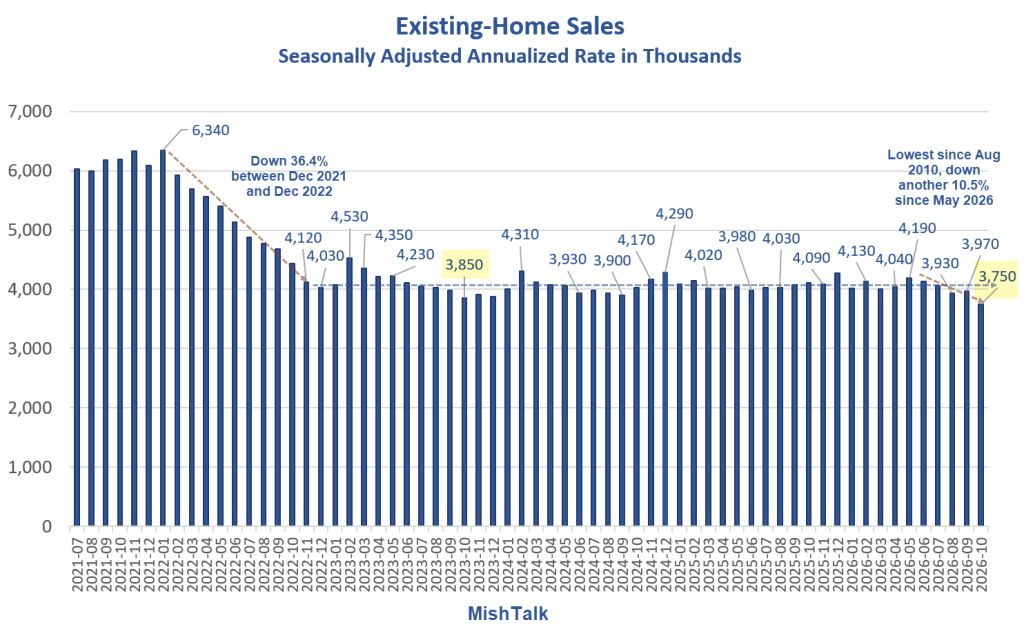
The National Association of Realtors reports Existing-Home Sales Drop 5.5% in October
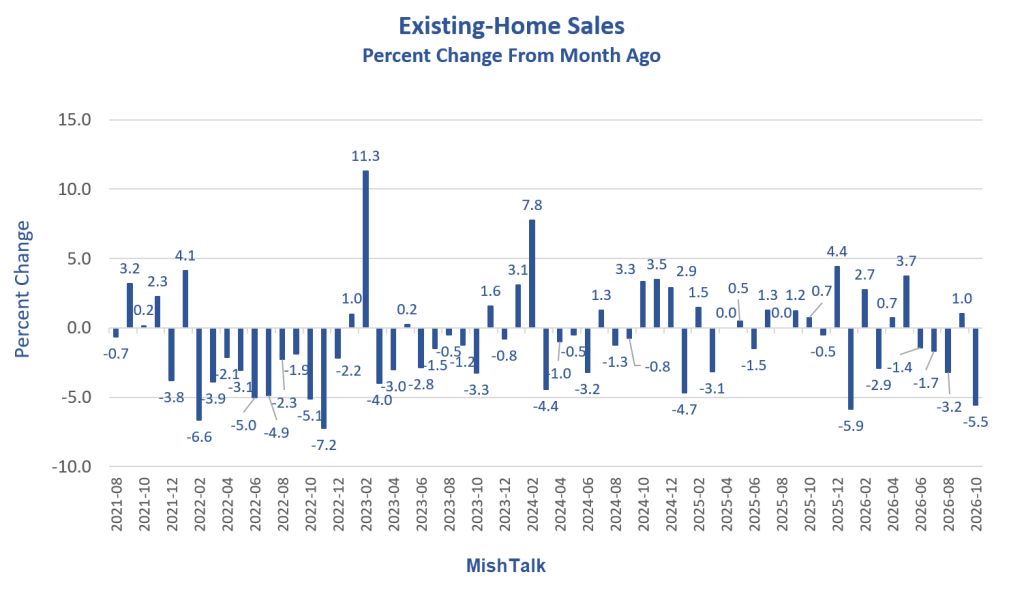
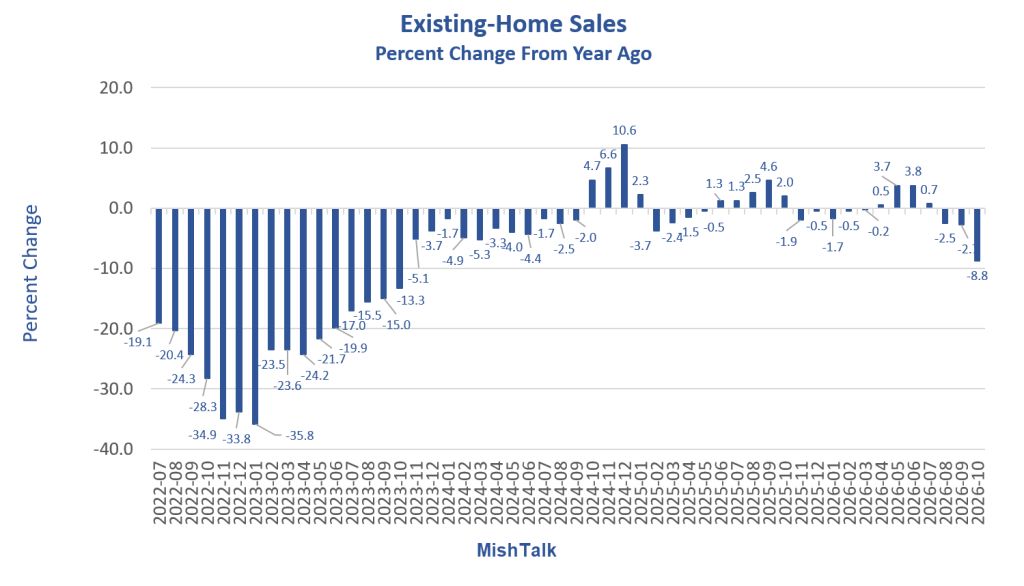
Existing-home sales decreased by 5.5% month-over-month and decreased by 8.8% year-over-year, according to the National Association of REALTORS® Existing-Home Sales report. The report provides the real estate ecosystem, including agents, homebuyers and sellers, with data on the level of home sales, price and inventory.
Month-over-month sales declined in the Midwest, South and West and held steady in the Northeast. Year-over-year sales declined in all four regions.
“Home buying is difficult when mortgage rates have climbed to their highest levels since 2000, aside from a single month in 2023. As a result, home sales fell to their lowest level since August 2010,” said NAR Chief Economist Lawrence Yun.
“Despite fewer transactions in October, the 88 million homeowners across the country are largely in a comfortable financial position due to sizable housing wealth accumulation. The number of distressed property sales remains historically low at only 2% of all transactions,” Yun said. “Based on the current underwhelming home sales pace at a time of consistent job growth, there could be sizable pent-up demand if mortgage rates decline.”
NAR Chief Cheerleader
Yun has been preaching versions of the above nonsense since January 2022. This is not a mortgage rate issue.
This is a price, quality, what you get for your money, interest rate, property tax, insurance, and overall inflation issue.
The NAR should change his title from chief economist to chief cheerleader.
Existing-Home Sales Month-Over-Month
Key October 2026 Statistics
Month-Over-Month: Existing-home sales decreased 5.5% month-over-month million in September to a seasonally adjusted annualized rate of 3.75 million.
Sales Year-Over-Year: Existing-home sales decreased 8.8%.
Inventory Units: Unsold inventory increased 1.3% to 1.59 million units, equal to a 5.1-month supply.
Inventory Supply: 4.8 months’ supply, unchanged from August and up from 4.5 months one year ago.
Median existing-home price: The median existing-home sales price increased 0.4% to $416,700.
Price Change From Year Ago: The median price increased 0.4% from $414,900 one year ago, marking the 40th consecutive month of year-over-year price increases.
Market Time: The median time on market was 35 days, up from 33 days in September and 34 days in October 2025.
Existing-Home Sales Year-Over-Year
Existing Home Sales Supply
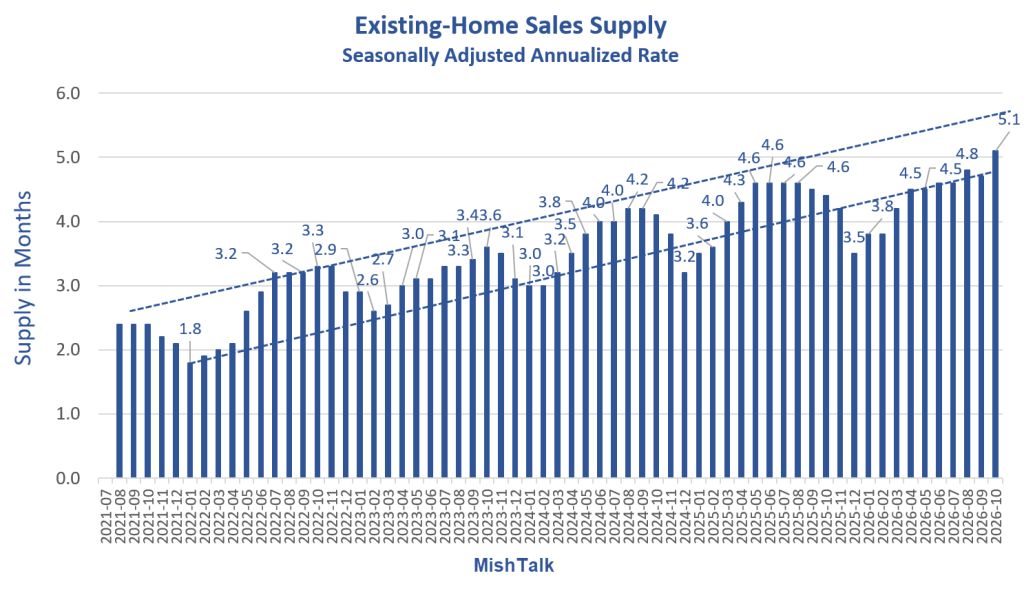
The NAR does not seasonally adjust much of its data as evidenced by the above chart.
Nonetheless, we can see rising supply over time. But rising supply has not helped sales.
Synopsis
Real Income are falling
Home prices are still rising in many areas but data lags
Mortgage rates are back above 7 percent.
Until two months ago, Yun ridiculously claimed affordability was improving.
Mortgage Rates
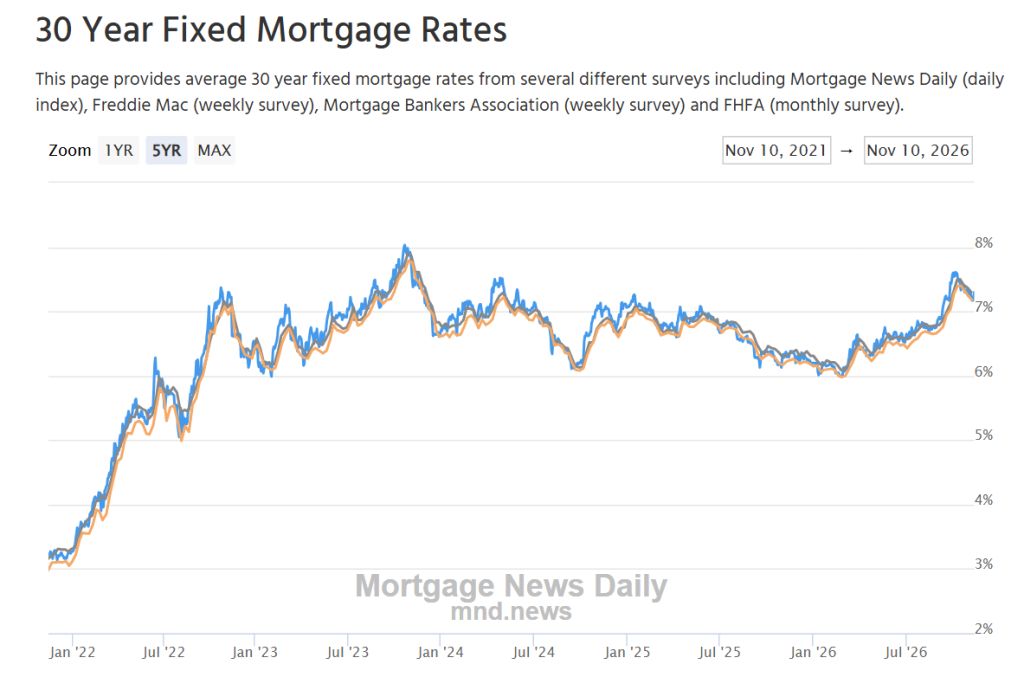
The current Mortgage News Daily rate is 7.30 percent.
MND is more accurate than the Freddie Mac data because it includes points and fees.
I use Freddie Mac data because I have a data download from the St. Louis Fed but not MND.
Existing-Home Sales vs Mortgage Rates
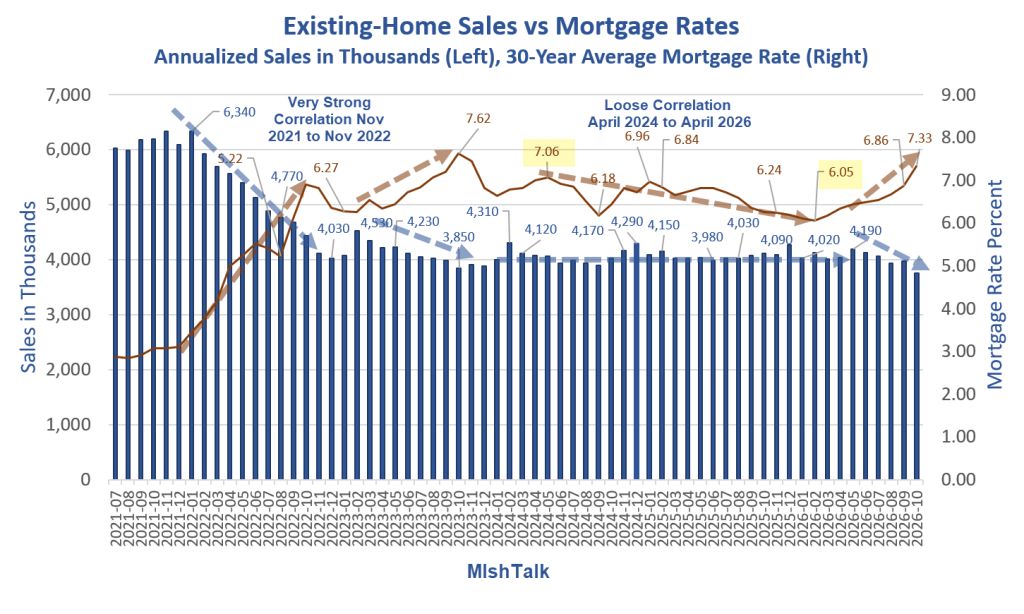
Over time, there have periods of strong and looses correlation between sales and mortgage rates
For example, sales went nowhere even as rates fell from 7.06 percent to 6.05 percent between April 2024 and April 2026, with Yun predicting stronger sales the whole way.
There is more to affordability than just rates.
But rates are over 7 percent again, and this time sales have responded.
Key Conclusions
Home prices are too high, mortgage rates are too high, or both, for most people.
For years, there was a pool of price-insensitive and mortgage rate insensitive buyers, around 4 million annualized, who were able and willing to buy regardless of point one.
Last month I commented “If we see a sustained decline in the stock market, a recession, or other economic shock, point two will not hold.”
Today I note the pool price-insensitive (and mortgage rate insensitive buyers) just gave out.
For whatever reason (perhaps the CPI or Fed rate hike fears, or no reason at all), existing home sales plunged to a 16-year low.
Sentiment can easily change on a dime, for no reason at all. Eventually, the pool of greater fools simply runs out.
Related Posts
October 7, 2026: Long-Term Bond Yields Surge to New 24-Year Highs
What happened to Bessent’s “I am the house” theory?
October 9, 2026: Consumer Sentiment Current Conditions Index Drop to Record Low
By political affiliation, sentiment declines the most for independents.
November 10, 2026: CPI Hotter than Expected Again. Expect a December Fed Rate Hike
This was the third consecutive bad month for CPI inflation.



Comments
Log in or sign up to join the conversation.