

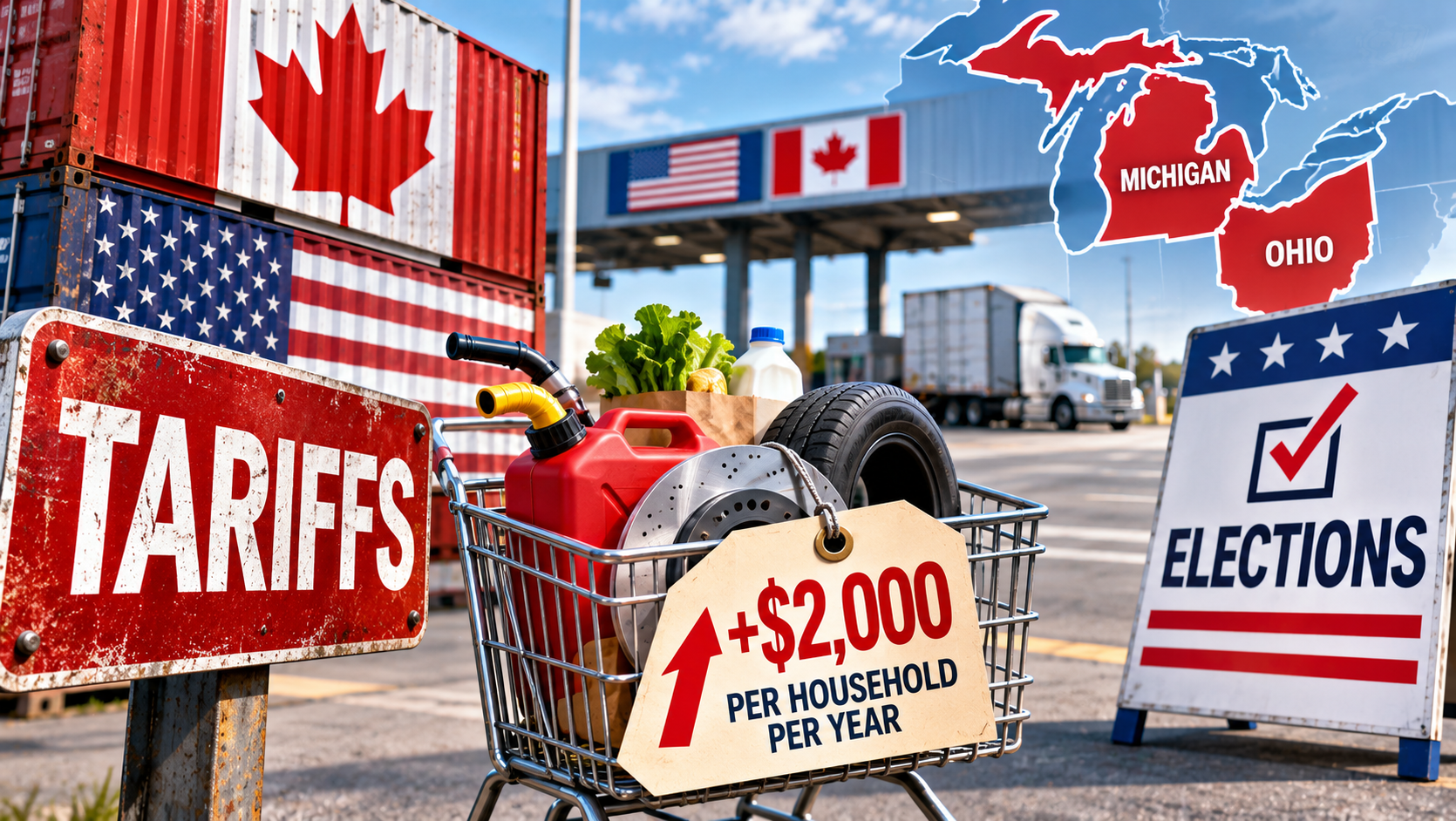
Voting is underway in several important races across border states, including Michigan, Ohio, and Maine, where the cross-border trade war could turn the tide in favor of the Democrats. Undoubtedly, this is an outcome the Trump administration never anticipated when the tariffs were launched in 2024.
U.S. tariffs and Canadian retaliatory countermeasures have hit border states hard, reflecting the deeply integrated nature of cross-border supply chains, energy networks, and regional manufacturing. Initially, the tariffs disrupted intermediate inputs that cross the border multiple times during production, most notably automobiles and auto parts. Before long, however, higher costs rippled throughout the broader U.S. economy.
U.S. tariffs aimed at Canada are tiered, ranging from completely duty-free items to duties as high as 50%. Goods covered by the existing free trade agreement (the United States-Mexico-Canada Agreement, or USMCA) account for over 80% of all bilateral trade. Energy and critical minerals face a lower tariff of 10%. The most contentious measures apply to steel and aluminum due to their scale and vital role in manufacturing, followed by a 50% tariff on a variety of items ranging from dairy to industrial chemicals. With cross-border trade supporting more than 1.4 million American jobs across roughly 34 states, these tariffs have inevitably become a focal point in several pivotal congressional races.
These macroeconomic figures can seem abstract in the voting booth. At the household level, however, the fallout is unmistakable. The Peterson Institute estimates that, nationally, tariffs cost the average household between $1,200 and $1,300 per year. Furthermore, because border states maintain especially deep supply-chain ties with Canada, their local burden climbs well above the national average.
Regionally, New England states rely heavily on Canadian electricity, natural gas, and refined petroleum, where tariffs add an estimated $300 to each family’s annual bills. Households in Michigan and Ohio shoulder an additional $2,000 burden from accumulated tariffs on auto parts, steel, and aluminum used in local manufacturing. In northwestern states, buyers pay an extra $3,000 for Canadian softwood lumber when building single-family homes. Consequently, several congressional candidates have urgently pressed President Trump to roll back the tariffs.
President Trump maintains that the U.S. and Canada have the “concept of a very good deal.” Yet Canadian observers place little faith in such claims, having heard similar posturing in the past. Meanwhile, American voters are lining up at the polls after enduring two years of tariff-driven cost increases—a reality unlikely to be swayed by eleventh-hour rhetoric.



Comments
Log in or sign up to join the conversation.