


Canadians have long participated in strong real estate markets, which have added fuel to the significant growth in its major metropolitan centres. However, now the good times are past for residential developers, as prices fall, rents decline, and inventories rise. No segment of the residential market has gone unscathed.
Starting with detached homes, the market reached an all-time high in 2022 when the average single-family home in the Greater Toronto Area (GTA) was, literally, snapped up at C$1.5 million. Demand jumped in response to the ultra-low mortgage rates—as low as 1.6% p.a. over 5 years. Starting in March 2022, the Bank of Canada pushed its policy rate up, eventually cascading into the mortgage market as lenders posted rates upwards of 5% in 2025. Markets reacted quickly, and average prices fell by 11% last year.
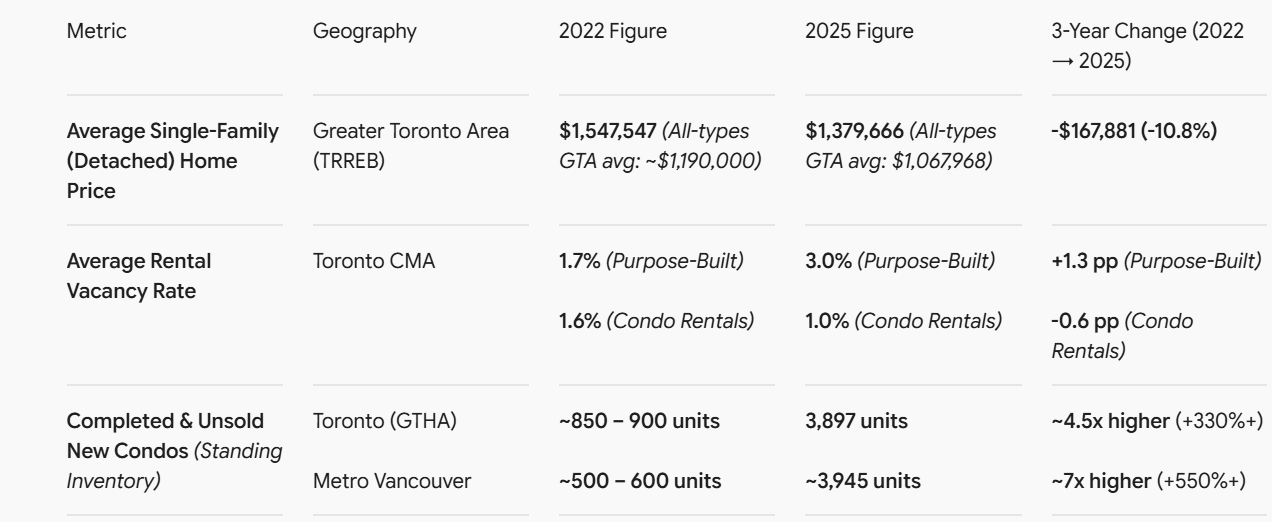
A wave of newly completed purpose-built rentals experienced a huge jump in vacancy rates to 3% in late 2025. This product went head-on with the condo market, which now suffers from a huge glut. Where unsold condos in the past rarely got above a thousand in the major cities, today, both Vancouver and Toronto are choking with 4,000 completed units for sale.
The condo market has its own set of problems. Condo towers completed in 2025 were largely pre-sold during the 2022–2023 boom, attracting domestic and international investors. Pre-sales featured relatively high appraisals, but when it came time to close two years later, investors stepped back and closing appraisals lagged peak contract prices. Consequently, developers were caught with excess inventory, roughly fourfold in Toronto and Vancouver compared to 2022 levels. Condos for rent now compete directly with thousands of units in the conventional rental pool.
Unlike the US, where homeowners can lock into very long-term mortgage terms, Canadian lenders rarely go beyond a 5-year term. Mortgage rates in January 2022 were 4.5%, and by year’s end, lenders were demanding as much as 6.5%. Although rates have moderated slightly in 2026, those financing for the first time or refinancing faced a huge increase in monthly mortgage payments.
Sources: Statistics Canada, CMHC
In 2022, Canada experienced the highest population growth rate in the G7 at 2.7%, generated by the highest-ever level of immigration. Canada welcomed 440,000 new permanent residents, an all-time record in absolute numbers. Politically, these levels of immigration were unsustainable, forcing the federal government to change quotas and work visa requirements to curtail immigration. Statistics Canada estimated that the 1.7 percentage-point drop in population growth in 2025 was directly attributed to new requirements affecting immigration.
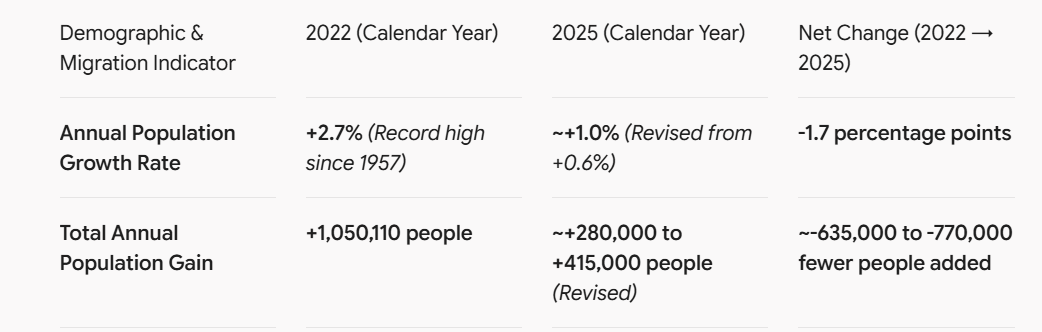
Summing up,we can anticipate that this slump will last at least 5–7 more years. Any return to peak levels of 2022 is not likely to occur, given the overhang of condos. The oversupply situation in the condo market will take a very long time to achieve equilibrium. Meanwhile, that glut is putting considerable pressure on the rental market. Overall, interest rates will continue to remain at these levels, and most likely higher yet, as central banks contend with inflation rates in the 3% to 4% range. Lastly, immigration levels have returned to much lower levels of the past, and Canada’s population will be stagnant.



Comments
Log in or sign up to join the conversation.